Christie’s Exceptional Sale showcases rare masterpieces spanning centuries, from Boulle furniture to Napoleonic relics, offering collectors unparalleled artistry and history.
On 20 November, Christie’s will present the ninth edition of The Exceptional Sale, a highly anticipated event for art enthusiasts seeking masterpieces across various categories.
This prestigious auction brings together an array of extraordinary lots, each distinguished by its exceptional provenance, craftsmanship, or rarity.
From decorative arts and rare books to haute couture and vintage automobiles, the sale promises to captivate collectors and connoisseurs alike.
André Charles Boulle: Honouring the Master Cabinetmaker of the Grand Siècle
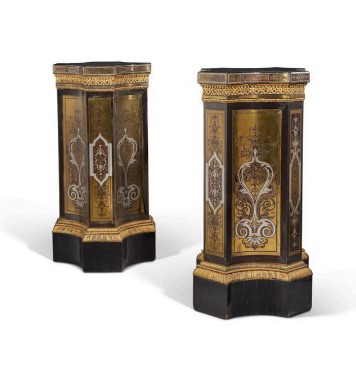
ATTRIBUÉS À ANDRE-CHARLES BOULLE, VERS 1715 Estimation : 200 000-400 000 €
French furniture has long held a place of prominence in The Exceptional Sale, and this year’s edition is no exception. The auction offers a unique opportunity to revisit the creativity and talent of one of the greatest French cabinetmakers of all time, André Charles Boulle. Until 6 October, the Château de Chantilly hosted France’s first exhibition dedicated to Boulle within the Grand Apartments of the Princes of Condé.
The sale features five exquisite pieces of Boulle marquetry, each a perfect example of the artisan’s genius. Boulle elevated marquetry to unprecedented levels of perfection, imbuing his creations with a precious quality that continues to mesmerise collectors today.
Among these outstanding pieces are a pair of pedestals estimated at €200,000-400,000, another pair of pedestals estimated at €100,000-200,000, and a slant-front desk estimated at €100,000-150,000. All of these magnificent pieces date back to the Louis XIV era, representing the pinnacle of French craftsmanship during the reign of the Sun King.
Nearly a century later, René Dubois, known as the “Queen’s cabinetmaker”, gained considerable renown for his luxurious furniture, which often paid homage to the work of his predecessor.
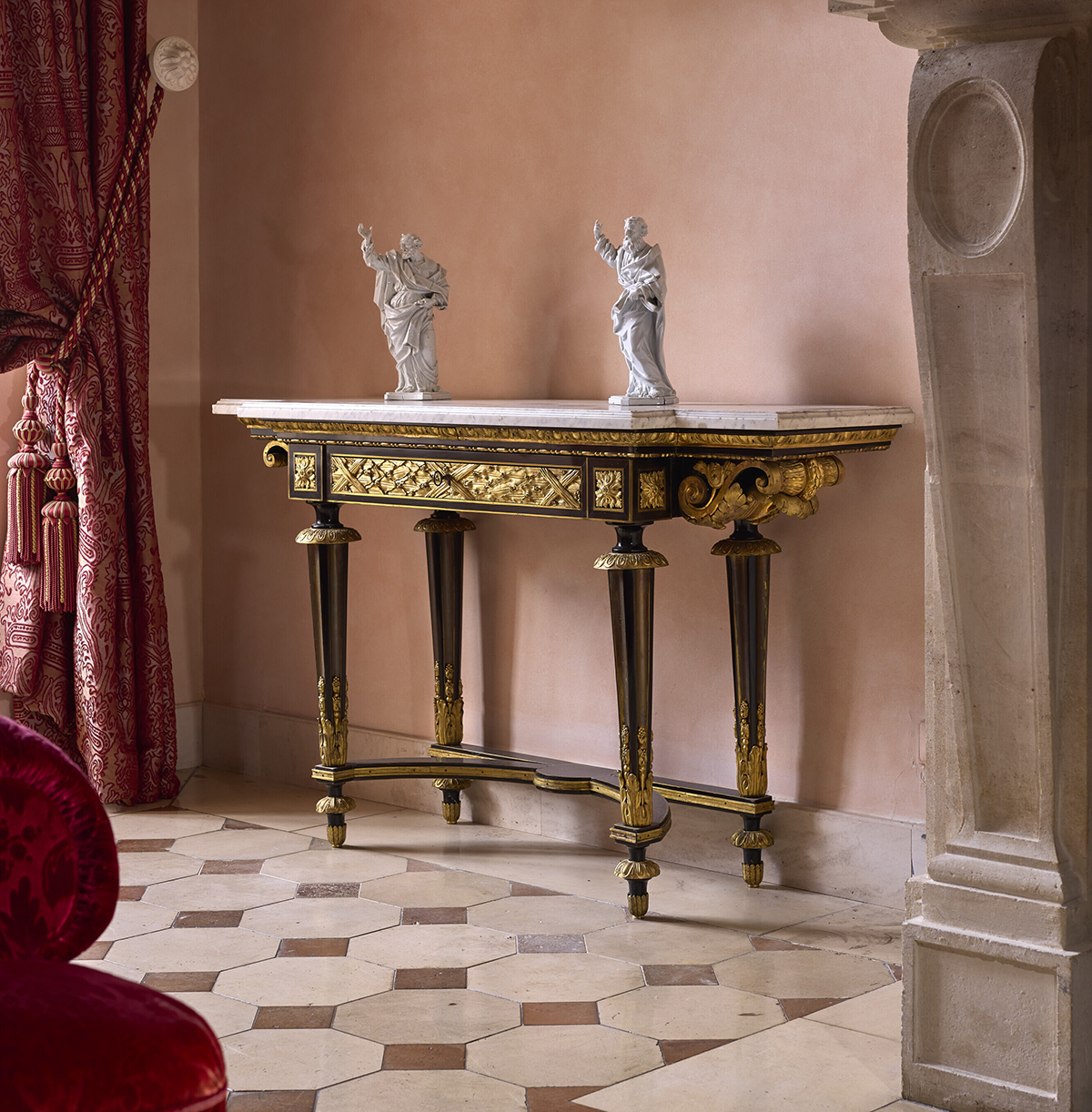
While many of Dubois’ pieces feature intricate marquetry decorations, the elegant pair of consoles offered in this sale stands out for the exceptional quality of its chased and gilt bronzes. These stunning pieces are estimated at €400,000-600,000.
Another highlight of the sale that exemplifies the grandeur of the Grand Siècle in France is a majestic carpet produced by the Savonnerie manufactory in the 1650s. This impressive piece showcases a fascinating blend of Persian influences with Dutch and French ornamental inspirations, epitomising the French production “in the manner of Turkey and the Levant”. The carpet is estimated at €200,000-300,000.
Poignant Memories of Madame Elisabeth and Napoleon

By Jean-Baptiste Claude Sené, sculpture
By Louis-Alexandre Regnier, gilding by Louis-François Chatard
Estimate: 80,000-120,000 €
Jean-Baptiste-Claude Séné, one of the most renowned cabinetmakers of Louis XVI’s reign, is represented in the sale by a royal marquise known as a “tête-à-tête”. Created in 1789 for Madame Elisabeth, this piece is estimated at €80,000-120,000.
As one of the last commissions from the royal furniture repository before the French Revolution, it serves as a poignant reminder of Madame Elisabeth’s tragic fate. The sister of Louis XVI was executed during the Reign of Terror, and the furniture from her château in Montreuil was placed under seal in 1792, barely having been used.
Most pieces from this suite were dispersed during a sale in 1793 and are now preserved in the collections of important museums, including the Musée Nissim de Camondo and the Musée des Arts Décoratifs in Paris.
The sale also presents a rare opportunity to acquire two exceptional plates from the service commissioned by Emperor Napoleon I from the Sèvres manufactory in October 1807. These pieces not only showcase the pinnacle of French porcelain craftsmanship but also serve as extraordinary witnesses to the Napoleonic era.
Originally delivered for the Emperor’s wedding banquet with Marie-Louise on 2 April 1810, the seventy-two plates were returned to the Sèvres manufactory four years later. During the Restoration period, the Emperor’s arms were replaced with the cipher of Louis XVIII. However, Napoleon was permitted to take a portion of his service to Saint Helena.
Through his will, the exiled Emperor bequeathed these plates to an ancestor of the current owner. Today, 55 of the 72 pieces from the original service are housed in museum collections. The two plates offered in this sale are estimated at €200,000-300,000 each.
The first depicts a meeting between Napoleon I and Tsar Alexander I at Tilsit, painted by Jacques-François Joseph Swebach. The second presents a view of the Sèvres manufactory, created by Jean-François Robert in 1811.
Another historical piece in the sale speaks to the Emperor’s nostalgia for his military victories. On 15 August 1816, a defeated and exiled Napoleon, confined to Saint Helena, hand-drew a plan of the Battle of Rivoli, which he had won in 1797 as General Bonaparte.
This major relic of Napoleonic memory is adorned with a crown of leaves from Saint Helena and surmounted by a Legion of Honour medal. It is estimated at €60,000-80,000.
Monumental Masterpieces
An exceptional sale deserves exceptional discoveries, and this auction delivers with a monumental marble vase known as the “Duke of Gramont Vase”, created by Charles Adrien Prosper d’Epinay. Nicknamed the “sculptor of sovereigns”, d’Epinay was a frequent figure in Parisian high society. For his discerning patrons, he deployed an eclectic vocabulary that blended rococo style with neo-Greek inspirations.
The Duke of Gramont Vase, decorated with allegorical figures of Summer and Winter, is a unique piece in its marble version. This extraordinary work is estimated at €80,000-120,000.
Finally, a rare set of four Janiform marble statues showcases four mythical couples: Juno and Jupiter, Bacchus and Ariadne, Hercules and Deianira, and Diana and Apollo. Impressive in size, these statues were once displayed in the extraordinary gardens of Quinta da Fidalga in Seixal, overlooking the Tagus River opposite Lisbon. Their double faces are sure to captivate lovers of gardens adorned with divine figures. The set is estimated at €80,000-120,000.
The Legacy of André Charles Boulle
André Charles Boulle‘s influence on French decorative arts cannot be overstated. His innovative techniques and exquisite designs set a new standard for luxury furniture that would be emulated for generations to come. The pieces featured in The Exceptional Sale offer a rare glimpse into the master’s workshop and the enduring appeal of his creations.
Boulle’s marquetry technique, which involved inlaying brass and tortoiseshell into wooden surfaces, became synonymous with opulence and refinement. The pair of pedestals and the slant-front desk in the sale exemplify this technique, showcasing intricate patterns and designs that demonstrate Boulle’s unparalleled skill and artistic vision.
These pieces not only represent the height of craftsmanship but also serve as tangible links to the grandeur of the French court during the reign of Louis XIV. They offer collectors a chance to own a piece of history, connecting them to the splendour of Versailles and the artistry that defined an era.
René Dubois: Continuing the Tradition of Excellence
The pair of consoles by René Dubois featured in the sale illustrates how the legacy of Boulle continued to influence French furniture design well into the 18th century. Dubois, working nearly a century after Boulle, maintained the high standards of craftsmanship while adapting to the evolving tastes of his time.
The consoles’ chased and gilt bronzes demonstrate the shift in focus from marquetry to metalwork, reflecting the changing preferences of the French aristocracy. These pieces serve as a bridge between the Baroque exuberance of the Louis XIV period and the more restrained elegance that would come to define the Louis XVI style.
The Savonnerie Carpet: A Tapestry of Cultural Exchange

CIRCA 1650-1755
Estimate: 200,000-300,000 €
The majestic Savonnerie carpet included in the sale is a testament to the cultural exchanges that shaped French decorative arts in the 17th century. Created in the 1650s, this carpet reflects the French fascination with Eastern designs, particularly those from Persia and Turkey.
The Savonnerie manufactory, established by Louis XIII in 1627, was tasked with producing carpets that could rival those imported from the East. The result was a unique fusion of Eastern motifs and French sensibilities, creating pieces that were distinctly French while nodding to their exotic inspirations.
This particular carpet, with its blend of Persian influences and Dutch and French ornamental elements, exemplifies the cosmopolitan nature of French art during the Grand Siècle. It stands not only as a masterpiece of weaving but also as a historical document, illustrating the complex cultural interactions that shaped European tastes in the 17th century.
Madame Elisabeth’s Marquise: A Poignant Reminder of Pre-Revolutionary France
The royal marquise by Jean-Baptiste-Claude Séné offers a bittersweet glimpse into the final days of the French monarchy. Created in 1789 for Madame Elisabeth, the sister of Louis XVI, this piece of furniture was one of the last commissions before the tumultuous events of the French Revolution would forever change the course of French history.
The “tête-à-tête” design of the marquise, intended for intimate conversations, speaks to the refinement and sociability of 18th-century French court life. However, its creation on the eve of the Revolution imbues it with a sense of dramatic irony, representing a world on the brink of upheaval.
The fact that most pieces from this suite now reside in museums underscores the historical significance of this particular marquise. It offers collectors a rare opportunity to own a piece of furniture that witnessed one of the most pivotal moments in European history.
Napoleon’s Legacy: From Triumph to Exile
The two Sèvres plates and the hand-drawn battle plan of Rivoli present a narrative arc of Napoleon’s career, from the heights of imperial power to his final exile. The plates, originally created for Napoleon’s wedding banquet with Marie-Louise, represent the Emperor at the zenith of his power. Their subsequent alteration to bear the cipher of Louis XVIII after Napoleon’s first abdication reflects the political turbulence of the era.
The battle plan of Rivoli, drawn by Napoleon during his exile on Saint Helena, offers a poignant contrast. It shows the former Emperor, once the master of Europe, reduced to reminiscing about past glories. This piece is not merely a historical curiosity but a deeply personal artifact, offering insight into Napoleon’s state of mind during his final years.
Together, these items provide a nuanced view of Napoleon’s legacy, from the opulence of the Empire to the introspection of exile. They offer collectors more than just ownership of historical objects; they provide a tangible connection to one of history’s most fascinating figures.
Monumental Art: The Duke of Gramont Vase and Janiform Statues

Vase monumental dit “vase du duc de Gramont” marbre, H. 115 cm Estimation : 80 000-120 000 €
The monumental pieces in the sale, including the Duke of Gramont Vase by Charles Adrien Prosper d’Epinay and the set of Janiform statues, represent the grandeur of 19th-century decorative arts. These pieces were designed to make bold statements, whether in the grand salons of Parisian society or the elaborate gardens of European estates.
The Duke of Gramont Vase, with its blend of rococo and neo-Greek elements, exemplifies the eclectic tastes of the 19th century. It demonstrates how artists of the period drew inspiration from various historical styles to create unique and impressive works.
The Janiform statues, with their double-faced depictions of mythological couples, are not only impressive in size but also in their symbolic complexity. Their previous display in the gardens of Quinta da Fidalga in Portugal speaks to the international appeal of such monumental works and the shared aesthetic language of European elites in the 19th century.
These pieces challenge the boundaries between decorative and fine art, inviting collectors to consider how such monumental works can transform spaces and serve as focal points for impressive interiors or exteriors.
Conclusion: A Sale of Exceptional Breadth and Depth
Christie’s The Exceptional Sale continues to live up to its name, offering a carefully curated selection of masterpieces that span centuries of artistic achievement. From the refined marquetry of André Charles Boulle to the monumental sculptures of the 19th century, this sale presents a comprehensive view of European decorative arts at their finest.
Each piece in the sale tells a story, whether of artistic innovation, historical upheaval, or cultural exchange. For collectors, these items offer more than just aesthetic pleasure or investment potential; they provide a tangible connection to the past, allowing owners to become custodians of history.
As the art market continues to evolve, sales like this remind us of the enduring value of craftsmanship, provenance, and historical significance. They offer a counterpoint to the often ephemeral nature of contemporary culture, presenting objects that have stood the test of time and continue to captivate and inspire.
The Exceptional Sale at Christie’s is more than just an auction; it’s a celebration of human creativity and skill, a showcase of objects that have shaped tastes and reflected the aspirations of generations. As these exceptional pieces find new homes, they will continue to tell their stories, bridging past and present, and enriching the lives of those fortunate enough to acquire them.
Images: Christie’s

Leave a Reply