hacklink hack forum hacklink film izle hacklink marsbahisizmir escortsahabetpornJojobetcasibomgalabetBakırköy Escortcasibom9018betgit casinomarsbahispiabellacasino girişcasibomlunabetlink 5k depositjojobetonwinmatbet

Tag: charge

  • Barcelona subway recycles energy from braking into power to charge electric cars

    Barcelona subway recycles energy from braking into power to charge electric cars

    BARCELONA, Spain — The Barcelona subway grinds to a halt, the doors slide open and commuters pour out to go about their daily business.

    Little do they know that as they do so, a burst of energy is sent up to street level to help charge an electric car.

    Barcelona has put together a package of clean energy technologies to help public transportation go greener, while also doing its part to combat climate change and aid Europe’s difficult shift to the privately owned electric vehicle market.

    Sixteen stations of Barcelona’s subway system are part of its new MetroCharge project, whereby the energy from the underground trains’ brakes is used to power the trains and the stations themselves, while the remainder is sent snaking through cables to the surface to power plug-in stations for privately owned vehicles.

    Bernardo Espinoza, a 49-year-old engineer, commutes daily by subway. He also owns a hybrid car and had just found out that he had a new place to plug in.

    “I am pleasantly surprised, because I have an electric car and am always looking for where to plug it in,” Espinoza said before catching the subway in a working-class area of southern Barcelona. “And if it is from energy from the metro’s brakes, then even better.”

    Regenerative brakes have been in trains for decades and are also used in some cars. They consist of an electric motor which captures energy used in the braking action that would be lost as heat by conventional brakes. That energy can be immediately used to accelerate the vehicle or, in the case of the Barcelona subway system, sent along cables to supply electricity for the station or for electric car chargers.

    Alvaro Luna, professor of electrical engineering at the Polytechnical University of Catalonia, said that the system is innovative in so far as it allows for recycled energy to be redirected to specific local uses — in this case powering electric cars parked nearby. That, he says, boosts efficiency.

    “Since the recharging stations are installed nearby, the energy, instead of being put back into the general electric network, goes directly to the charging stations, and that allows the provider to potentially offer lower prices,” Luna said. “We can say that the innovation is one of urban planning, of being able to bring together energy uses within a city.”

    Making better use of energy has become a key pillar of reducing rising global temperatures. Last year, countries at U.N. climate talks and the members of the Group of 20 industrialized and emerging-market nations agreed to double energy efficiency by 2030.

    Jordi Picas, head of systems for TMB, Barcelona’s subway, said that the public company estimates that it can recover the 7.3 million euros ($7.6 million) spent on MetroCharge, which includes European Union funding, in four years thanks to reduced energy costs.

    The system, which also includes solar panels, provides all the energy needs of 28 of the 163 subway stations, from the lights to the elevators and ventilation systems, and saves 6% of the total energy spent by the metro, according to Picas. An average of 2.3 million people take the Barcelona metro on any given workday.

    This clever program comes while doubts are emerging about the speed and cost of the EU’s green transition as the 27-member bloc seeks to eliminate combustion engines and remain a world leader in standards for environmental protection.

    Spain, like other Mediterranean countries, is feeling the burn of climate change, experts say, with the frequency of prolonged droughts and extreme weather events like the recent devastating floods in Valencia set to increase over the coming years.

    In 2021, Spain’s government rolled out an ambitious electric car plan backed by the EU’s post-pandemic transition funds. The public incentives have succeeded in encouraging private investment like last week’s announcement by Chinese battery maker CATL and carmaker Stellantis to build a lithium battery factory in Zaragoza. The plan also included help for consumers.

    But Spain hasn’t been immune to the stumbles in the industry across Europe as the EU moves toward tariffs on Chinese EVs to try to help continental carmakers catch up.

    Spain, with its wide expanses for a Western European country, faces the extra challenge of deploying recharging stations. Spain has 37,000 charging points, below the goal of 100,000 the government had set for now in 2021, according to ANFAC, the Spanish Association of Automobile and Truck Manufacturers.

    So while the Barcelona subway concept can help chart a course for urban planners, there is still a lot of work to do.

    Ángel García said that he agreed with the spirt of the initiative while plugging his hybrid taxi into a charging point fed by the Barcelona subway.

    But he also said that the government should do more to help shoppers buy electric cars because “people don’t really go for electric cars here.”

    ___

    Hernán Muñoz contributed to this report.

    Source link

  • Manchester United and sporting director Dan Ashworth part ways after five months in charge

    Manchester United and sporting director Dan Ashworth part ways after five months in charge

    dean.jpg
    Getty Images

    Manchester United and sporting director Dan Ashworth have separated after just five months with the Premier League outfit confirming the 53-year-old’s departure on Sunday. Ashworth, who spent five months on gardening leave from Newcastle United before moving to Old Trafford, only joined the Red Devils back in early July.

    United, who recently appointed Ruben Amorim as Erik ten Hag’s replacement as head coach, described the move as being a “mutual agreement.” The decision is believed to have been made following United’s 3-2 home loss to Nottingham Forest on Saturday which mires the team down in 13th position in the Premier League.

    “Dan Ashworth will be leaving his role as sporting director of Manchester United by mutual agreement,” read the club’s official statement this Sunday. “We would like to thank Dan for his work and support during a transitional period for the club and wish him well for the future.”

    Ashworth was present at Old Trafford and was seen walking to a meeting through the press conference room postgame. The former Brighton and Hove Albion technical director cost United millions of dollars in a settlement with former club Newcastle United which prevented him from even taking office before the summer.

    A significant part of Sir Jim Ratcliffe’s initial restructuring of United’s executive team as well as CEO Omar Berrada and technical director Jason Wilcox, he leaves after just one transfer window. The trio worked together on Amorim’s appointment from Sporting CP as Ten Hag’s successor but Ashworth and the Portuguese tactician did not even work together for a full month in Manchester.

    Matthijs de Ligt, Manuel Ugarte, Leny Yoro, Joshua Zirkzee and Noussair Mazraoui all arrived over the summer for a combined total in excess of $229.3 million. Ten Hag was dismissed for failing to build on the confidence shown towards him to turn things around with those new arrivals and new Leicester City boss Ruud van Nistelrooy temporarily replaced his compatriot before Amorim’s arrival last month.

    United are currently 13th in the EPL standings with just 19 points which is their lowest total after 15 games since 1986. Amorim’s side will travel to Czechia to face Viktoria Plzen in the UEFA Europa League this midweek before the Manchester Derby against bitter rivals City next Sunday with Pep Guardiola’s men also in a bad way.


    Source link

  • Inside Pochettino’s first month in charge of USMNT: Mate cups, meetings and a chance encounter

    Inside Pochettino’s first month in charge of USMNT: Mate cups, meetings and a chance encounter

    Over dinner at a Mediterranean restaurant near their Central Park hotel last month, Mauricio Pochettino explained to U.S. Soccer staffers the cultural significance of mate, the herbal tea enjoyed by South American soccer players including Lionel Messi.

    Among the thoughts Pochettino shared with his new colleagues that night in New York was the name of a shop back home in Argentina that makes custom mate cups. A month later in Austin, Texas, when Pochettino and his staff arrived for their first camp in charge of the USMNT, the incumbent staff had a surprise: they had called that store in Argentina and ordered cups emblazoned with a U.S. Soccer logo, which they presented to Pochettino’s coaching group.

    The exchange was a reminder that, in his first month on the job, Pochettino and U.S. Soccer are very much still getting to know each other. They are building relationships, and the hope is that, over time, a bond will push the team to a new level.

    Pochettino was hired to take a U.S. group filled with potential and turn it into something tangible. After a 2-0 win against Panama and a disappointing loss to Mexico by the same score over the past week, Pochettino has seen plenty in this first international window to understand the limitations of this pool and the amount of work he and his assistants have to do. He also started to lay the foundation for how he would take this team forward and toward a 2026 World Cup to be played mostly on United States soil.

    This first camp under their new head coach was at times more intense, but in many ways also more relaxed. Pochettino introduced some tactical tweaks to the way the team would play, though players said he has hinted that much more is to come, but the point of the camp was less about the tactics. Across everything Pochettino did, from his meetings with players, to his approach in front of the microphone at press conferences, to how he set up the team, it has been about fixing expectations for how he expects the team to compete and grow.

    It won’t happen overnight. Anyone hoping that hiring Pochettino was like pushing a “fix it” button will have to reset their thinking. Asked by a Mexican journalist on Tuesday night what he has seen from the U.S. that might convince him that this team can represent the CONCACAF region and ascend to a different level at that World Cup in 20 months’ time, Pochettino smiled.

    “Give me time,” he said in his native Spanish, his voice echoing in a tunnel buzzing with activity at the Estadio Akron in Guadalajara, which will host a game on the first day of that World Cup, co-hosted by Mexico and Canada. “It’s only been 10 days and a few training sessions and circumstances (with players missing) that you yourself can evaluate.

    “Give us time, let us evaluate all the players, get to know them, and from there I can give a better opinion, with much more foundation, on what we can find and create to be able to reach that competition, the World Cup in 2026, with the conditions to be able to compete for great things.”

    go-deeper

    GO DEEPER

    Mauricio Pochettino’s USMNT project will be judged in 2026 – ignore early stutters, for now


    In his first weeks on the job, Pochettino decided against meeting any U.S. players, not wanting anyone to keep tabs on who he sat down with and who he didn’t, or in what order he went to visit them. He didn’t want wrong messages to be sent.

    The only conversation he had with one of his future players came by pure happenstance.

    Pochettino was out to eat at Clap London, a Japanese restaurant in the affluent Knightsbridge neighborhood, near where he lives. It just so happened local Premier League side Fulham were there at the same time for a team meal. Two of Pochettino’s former players on the Fulham squad — Harrison Reed, who played for him at Southampton, and Ryan Sessegnon, who was with him at Tottenham Hotspur — stopped to say hello to their former boss. When they got into the team meal room, they told American left-back Antonee Robinson they had just walked by his new manager. Robinson headed over to introduce himself.

    “I came over, said hello, and we were chatting for a little bit,” Robinson said. “I asked him if he’s excited, what the situation’s been like, whether he’d been over (to the U.S.) yet. It was casual.”

    Joked Pochettino: “I said, ‘Look, you are going to be an exception, because I didn’t speak with (anyone). I think you have the privilege to be the first to talk with me’.”


    Pochettino with Antonee Robinson during the match against Panama (Ronald Cortes/Getty Images)

    Outside of that run-in with Robinson, Pochettino and his staff, including incumbent analysts and staffers at U.S. Soccer’s base in Chicago, stayed away from players and kept in touch with each other over Zooms and phone calls. They scouted players live — a staffer went to see Mark McKenzie and Tanner Tessmann face off with Toulouse and Lyon in France’s Ligue 1, and another saw Robinson play in a Premier League game, as two examples — and watched videos.

    The plan was for Pochettino to return to the U.S. to meet staff in person and maybe do some house shopping in the Atlanta area, but storms and visa delays pushed back his trip. He did not fly to the U.S. until October 5, just two days before camp started.

    Pochettino trusted existing USMNT staff to help him put together the first squad he would work with, and over the first few days of camp he pulled players aside for one-on-one meetings, some of which lasted a few minutes, others a half hour. Players heard some of his ideas, and he wanted to hear how they felt physically and mentally. Among other things, he was gauging confidence levels and trying to find out what psychological buttons he might need to push.

    Everything in those first days, from roster selection to those individual meetings, was about figuring out how people worked.

    “Our first camp is about getting to know each other,” Pochettino said at the Austin FC training facility a few days into the first camp. “Not only the players, the whole staff. We are nearly 40 people working all together, to have the capacity to organize and get to know each other and settle the way that we want to work, is the most important thing from the beginning. Of course, soccer is about competing and wanting to win, because the fans of course want to win, but our first contact with the whole organization and players, we cannot push too much.”

    Usually, the first session of a camp is light. Players are arriving after long flights from Europe and usually hop on a stationary bike or do other recovery work. This time, the U.S. got straight into things with a full session. “We were kind of, ‘Right, we’re here to work’,” left-back Robinson said. “It was definitely intense from the front foot.”

    The actual training sessions, usually a bit shorter in national-team camps than in the club game, lasted around two hours. That’s not unprecedented — sessions under Gregg Berhalter during the 2019 Gold Cup were similarly long. But what stood out was the intensity. Every drill, down to the rondos, called for extreme competition. “We demand a lot,” Pochettino said. “Because we really believe that if you want to compete in your best, you need to train to try to replicate the intensity that the competition is going to demand.”

    Away from the field, Pochettino’s style was different. Most USMNT camps were more regimented under previous coach Berhalter. The days then were organized, with meetings and work throughout the day. The support staff would have a sort of uniformity in what they wore on the training pitch, which included no ankle socks and no sunglasses. That changed in this first camp under Pochettino. The atmosphere outside of the on-field work was a bit more relaxed, and players were given more time to themselves.
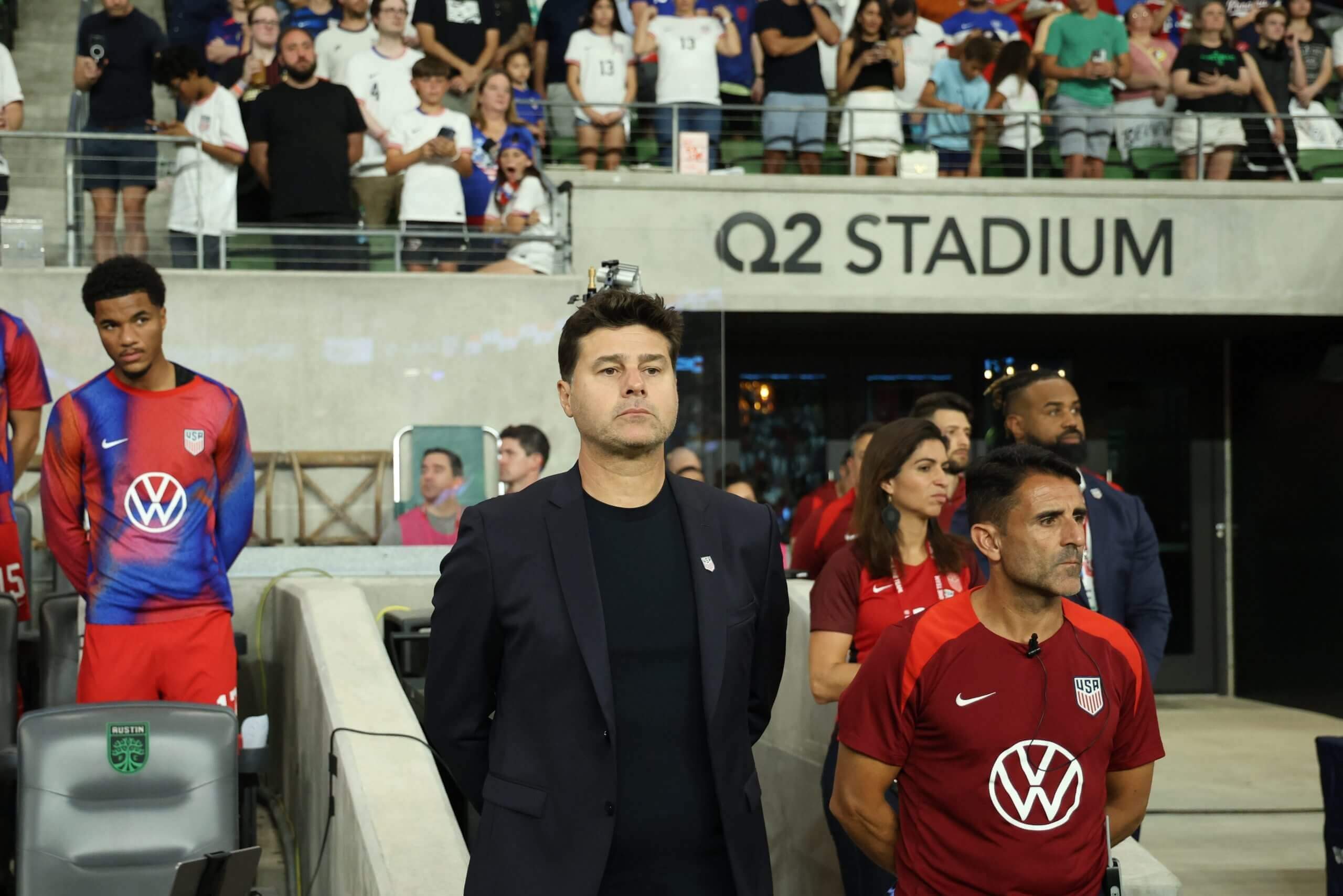

    Pochettino stands for the national anthem before the Panama game (Ronald Cortes/Getty Images)

    That approach might have been intentional, especially in this first camp. Pochettino noted that the mental strain on players would be bigger this time because they would want to make a good impression on the new coach, which meant they would likely over-analyze every touch and every action. Even in drills designed to be loose and have fun, Pochettino said, players might be worried a bad touch would leave a negative impression on him.

    “You spend more energy here,” Pochettino said, touching his finger to his temple, “(and) that affects your body.”

    It wasn’t the only time one of Pochettino’s answers in a press conference revealed how important that part of the game is to him, and how much of this camp was about evaluating the character and confidence of this team — and every player in the pool.

    Pochettino comes across as honest, charming and down-to-earth in front of the press. He is at times philosophical, but it rarely feels like he’s lecturing or touting his expertise. One answer stood out this month because of what it revealed about his approach to his first days on the job.

    Pochettino was asked about midfielder Malik Tillman, and in the question the journalist said that Tillman compared “physically and positionally” to one of his former Tottenham players, Dele Alli. Pochettino raised his eyebrows and joked that the question “put pressure on Malik, eh?”

    But then Pochettino went deeper, and his response showed that in just a few days he had diagnosed some of the things that have held Tillman back with the national team compared to his success with his Dutch club PSV Eindhoven, and he used that moment to also talk about the team.

    “I agree with you, because we were talking in the same way that the (physical attributes) of him is similar to Dele Alli,” Pochettino said. “Malik is an unbelievable talent. Of course, Deli Alli was an animal. Very competitive. He was unbelievable. When he arrived as a 17-year-old from (third-tier club) Milton Keynes Dons — impossible to stop him. We are not talking about playing football. We are talking about competing, killing everyone. Teammates, opponents. Sometimes we needed to stop him and say, ‘Calm (down), we need to arrive in a good condition to play’.

    “And I think if we talk about talent, I think maybe they have similar talent. We need to use our experience to try to translate and to challenge him to try to compete in this way. Because if Malik competes in the way that Dele Alli used to compete, Malik for sure has the capacity, the talent, the body, the power, everything. Don’t take it in a bad way. I think he’s an amazing talent. It’s only to help (him) to be better and better.

    “Because for us it’s not enough. (Whether it is USMNT star Christian) Pulisic or different players, we need to help them to be better and better. Yes, they are good players. Is it enough? No, it’s not enough. It’s not enough to play for your national team. And that is what we are going to do, is to try to push in a very good way, or in the way that we believe. Not all the players have the same character, but we are going to try to push them and to help them to find their best.”
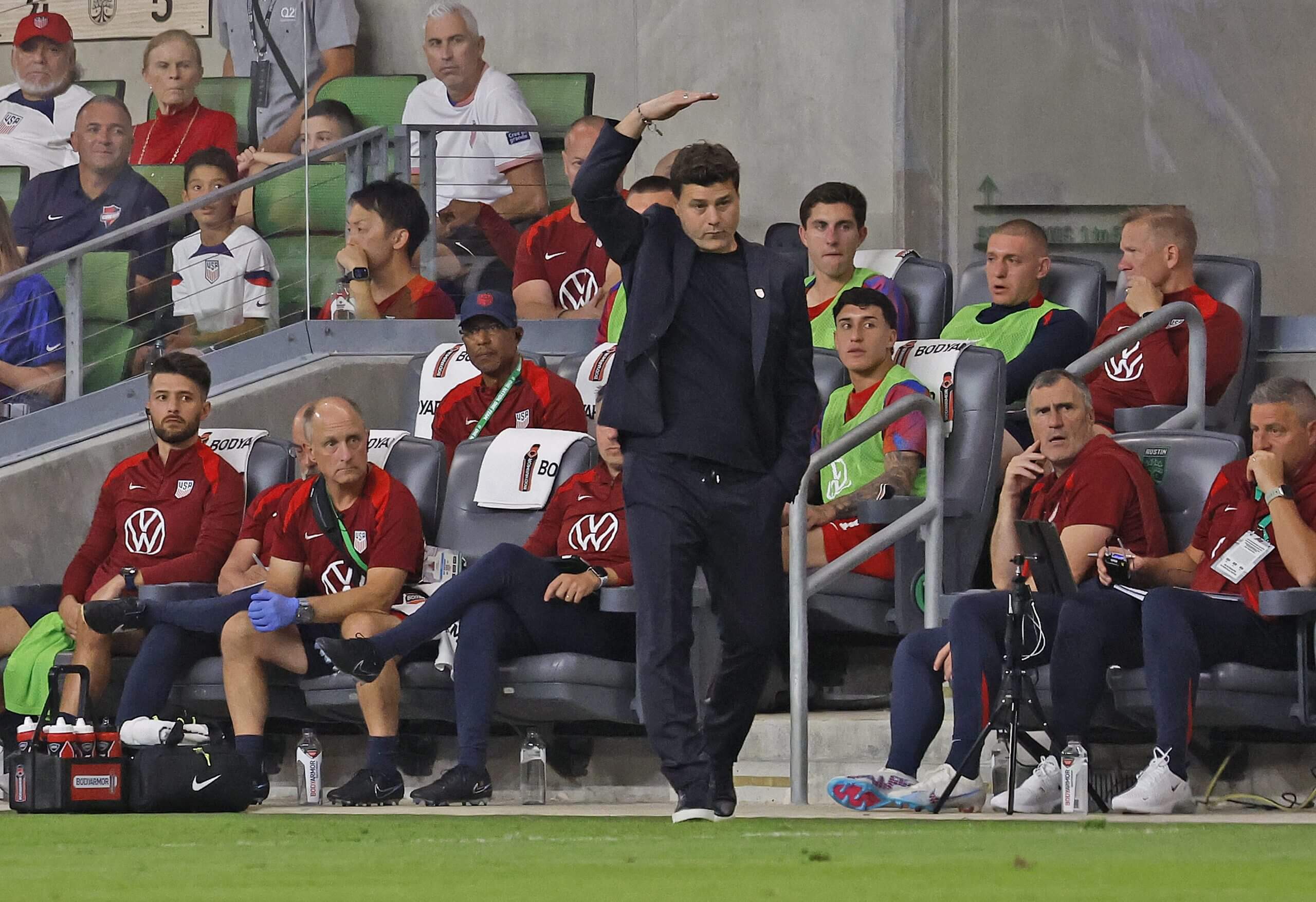


    Pochettino during USMNT’s match against Panama (Ronald Cortes/Getty Images)

    It had been mostly smiles for Pochettino since his first day stepping off a plane at John F Kennedy International Airport last month in New York, but in the tunnel under the Estadio Akron, the frustration of a 2-0 loss to Mexico sullied the mood.

    The Americans had looked overwhelmed that night. They lost duels in midfield, were mostly overrun by a better team and never truly looked threatening. It was the USMNT’s first loss to Mexico in five years. Even without a CVS-receipt-length list of players absent, including Pulisic, Weston McKennie, Tyler Adams, Folarin Balogun, Gio Reyna and Tim Weah, the defeat highlighted some of the pool’s shortcomings.

    If the win over Panama a few days earlier had given a dose of optimism that a coaching change would help flip the fortunes, Tuesday was a reminder that this team would need more than just a new voice on the sidelines.

    Pochettino, though not smiling, said the overall experience of the camp, and even the defeat, had plenty of positives on which the team could build. He insisted that he was pleased with this October window overall.

    “With all the circumstances we are happy, we are positive, and of course we are focused on all the areas we need to improve with time,” he said. “But it’s only a matter of time.”

    Just more than one month after that first dinner in Manhattan with staffers, things were still very much in that getting-to-know-you phase. That in itself provided some optimism around the team, even if the result against Mexico didn’t.

    “It was a good introduction,” said center back Tim Ream, who wore the captain’s armband in the camp. “They gave just enough information to make sure that guys were all on the same page and guys understood, while hinting at, ‘There’s more to come in the camps ahead’. Guys will have a better idea coming into each and every camp now that we’re going to continue to progress and work on things and (take the) next steps.

    “A lot of unknowns coming into this one. And now there’s not unknowns. We know where we’re going.”

    (Top photo: Pochettino at the Mexico game; Agustin Cuevas Cornejo/USSF/Getty Images for USSF)

    Source link

  • Sean Diddy Combs in custody on racketeering sex trafficking charge

    Sean Diddy Combs in custody on racketeering sex trafficking charge

    Superstar producer and businessman Sean ‘Diddy’ Combs will remain in jail after a judge denied his release on bail on Tuesday, facing charges of sex trafficking and racketeering conspiracy – accusations that follow numerous others grounded in events from 2009 onwards.

    To Read Lifestyle Stories in Urdu- Click Here

    Combs pleaded not guilty Tuesday to racketeering and sex trafficking charges and was ordered to remain in custody pending a trial.

    Combs, 54, was arrested by federal agents in New York on Monday evening and accused in a just-unsealed three-count criminal indictment alleging he sexually abused women and coerced them into drug-fueled sex parties using threats and violence.

    Appearing in a Manhattan courtroom where many family members came to support him, the one-time music dignitary pleaded not guilty. His lawyer asked Magistrate Judge Robyn Tarnofsky to allow his release on bail.

    After a lengthy bail hearing in which the prosecution voiced concerns including the potential for witness tampering and flight risk, Judge Tarnofsky denied bail, saying she was concerned about a ‘power imbalance’ in the case that includes people she said are ‘subject to coercion’.

    She also cited concerns over his alleged propensity for anger, violence and substance abuse.

    Combs, who was wearing a black t-shirt, grey sweatpants and sneakers, did not noticeably react to the pre-trial detention ruling, which his attorney, Marc Agnifilo, said would be appealed.

    Along with racketeering conspiracy and sex trafficking, Combs is charged with one count of transporting victims across state lines to engage in prostitution.

    Damian Williams, the US Attorney for the Southern District of New York, said that although Combs is the only person indicted for now the investigation is ongoing.

    The indictment alleges that for decades Combs ‘abused, threatened, and coerced women and others around him to fulfill his sexual desires, protect his reputation, and conceal his conduct’.

    It accused him of running a criminal enterprise that carried out ‘sex trafficking, forced labour, kidnapping, arson, bribery, and obstruction of justice’.

    Combs allegedly engaged in a ‘persistent and pervasive pattern’ of verbal, emotional, physical, and sexual abuse of women, the indictment said.

    “On numerous occasions from at least in or about 2009 and continuing for years, Combs assaulted women by, among other things, striking, punching, dragging, throwing objects at, and kicking them,” it said.

    Williams said female victims were forced to engage in extended sexual performances with male commercial sex workers in sessions called ‘Freak Offs’, which were planned and controlled by Combs and often videotaped.

    “The Freak Offs sometimes lasted days at a time… and often involved a variety of narcotics such as ketamine, ecstasy and GHB,” he said. “The indictment alleges that Combs threatened and coerced victims to get them to participate in the Freak Offs.”

    Bombshell suit

    The powerful music industry figure, who has gone by various monikers including Puff Daddy and P Diddy, was credited as key to hip hop’s journey from the streets to luxury clubs.

    Despite his efforts to cultivate the image of a smooth party kingpin and business magnate, a spate of lawsuits describe Combs as a violent man who used his celebrity to prey on women.

    The floodgates opened last year after singer Cassie, whose real name is Casandra Ventura, alleged Combs subjected her to more than a decade of coercion by physical force and drugs as well as a 2018 rape.

    Also Read: Sean ‘Diddy’ Combs’ ex Casandra Ventura reacts after assault video

    The pair met when Ventura was 19 and Combs was 37, after which he signed her to his label and they began a relationship.

    The bombshell suit was settled out of court, but a string of similarly lurid sexual assault claims followed – including one in December by a woman who alleged Combs and others gang-raped her when she was 17.

    The rapper’s luxury homes in Miami and Los Angeles were raided by agents in March.

    Disturbing surveillance video emerged in May showing Combs physically assaulting his then-girlfriend Ventura, corroborating allegations she made in the now-settled case.

    The prosecution referenced the footage’s content during the bail hearing, suggesting it is a key element of their case.

    Global fame with dark shadow

    Born Sean John Combs on November 4, 1969, in Harlem, the artist entered the industry as an intern in 1990 at Uptown Records, where he eventually became a talent director.

    In 1991, he promoted a celebrity basketball game and concert at the City College of New York that left nine people dead after a stampede and resulted in a string of lawsuits.

    He was fired from Uptown and founded his own label, Bad Boy Records.

    Also Read: Sean ‘Diddy’ Combs sued for sexual assault by former Bad Boy Records singer

    That began a quick ascent to the top of East Coast hip hop, along with his late disciple, The Notorious B.I.G.

    Combs boasted a number of major signed acts and production collaborations with the likes of Mary J Blige, Usher, Lil’ Kim, TLC, Mariah Carey and Boyz II Men.

    He was also a Grammy-winning rapper in his own right, debuting with the chart-topping single ‘Can’t Nobody Hold Me Down’ and his album ‘No Way Out’.


    Source link