hacklink hack forum hacklink film izle hacklink marsbahisizmir escortsahabetpornJojobetcasibompadişahbetBakırköy Escortcasibom9018betgit casinojojobetmarsbahis

Tag: countries

  • Guess which four countries led APAC’s top lifestyle and investment hotspot rankings

    Guess which four countries led APAC’s top lifestyle and investment hotspot rankings

    Find out which countries prove to be prime residential hotspots.

    Knight Frank’s recent report has identified Asia-Pacific as a premier lifestyle and investment destination, with Singapore standing out for individuals considering relocation.

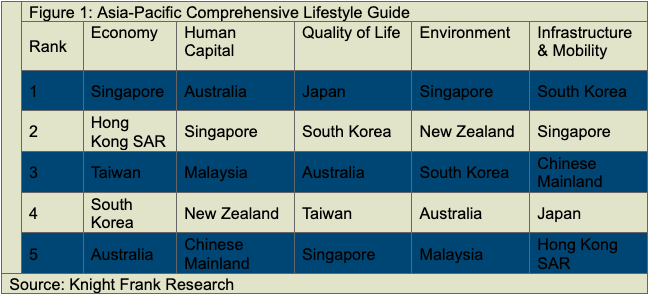
    In its latest report, “Quality Life-ing: Mapping Prime Residential Hotspots”, Knight Frank evaluates 15 prominent markets based on five leading indicators: Economy, Human Capital, Quality of Life, Environment, and Infrastructure and mobility.

    Singapore, Australia, Japan and Malaysia lead the rankings as Asia-Pacific’s leading lifestyle and investment hotspots.
    Here’s more from Knight Frank:

    Singapore: Recognised for its stability and development, Singapore emerged the top destination as it ranks among the top five in all indicators. Its robust economy, marked by political stability and a skilled workforce, makes it an attractive destination for businesses and individuals. 

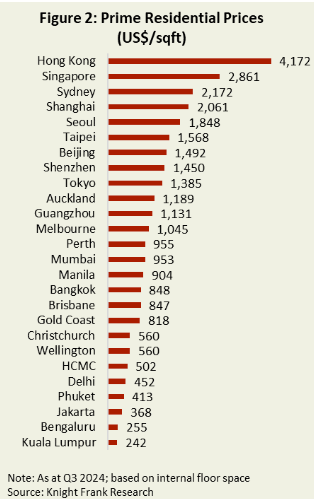
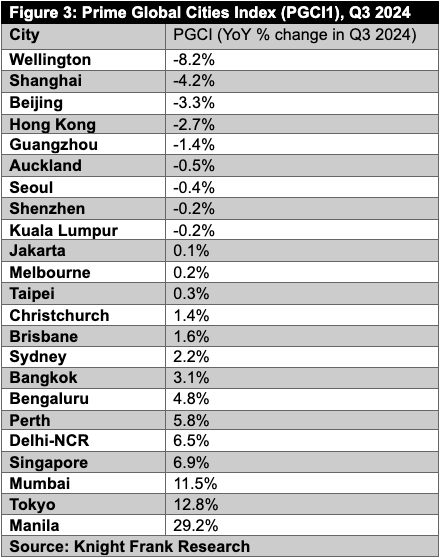
    In Q3 2024, prime residential prices rose 6.9% year-on-year, making it the second most expensive market in APAC (Figure 2, at 2,861 US$ per square feet (psf)), 31% cheaper than Hong Kong (US$4,172 psf), but still ahead of Sydney (US$2,172 psf), Shanghai (US$2,061 psf) and Seoul (US$1,848 psf). The city-state’s economic fundamentals remain strong, with low unemployment and projected GDP growth of 1-3% for 2024. Additionally, the Family Office sector has surged from 400 in 2020 to 1,650 by August 2024, reinforcing its status as a global wealth management hub.
    Australia: Australia is the second most desirable location for investments and relocations, as it came in top 5 for four out of the five indicators in our study.  In Q3 2024, major cities like Sydney experienced a 2.2% year-on-year price increase, supported by cash buyers and limited property supply. Despite rising interest rates, Australian cities continue to show positive price trends. 

    The country’s diverse landscapes cater to various lifestyles, with cities like Perth seeing significant population growth of 3.6% in FY2023. Sydney continues to be the financial capital, home to over a third of Australia’s ultra-high-net-worth individuals, and Melbourne ranks highly for quality of life, excelling in healthcare and education retaining the top spot in Australia as the EIU’s most liveable city in 2024. Overall, Australia’s attractive residential market and enviable lifestyle continue to draw investors, expatriates, and international students from around the globe.

    Japan: Japan excels in Quality of Life and Infrastructure & Mobility aspects, boasting a high life expectancy and sophisticated transportation network. With modest economic growth projected at 0.9% for 2024, rising wages are expected to enhance consumer spending. The Tokyo residential market has shown resilience, with prices increasing over 20% since Q1 2022 and an annual rise of 12.8% noted in Q3 2024 (for the full breakdown, please click here), making it the second best-performing market in Asia-Pacific. 

    This growth is fuelled by high demand for luxury condominiums amid limited supply. Additionally, Japan’s stock market reached an all-time high this year, attracting substantial foreign investment as Tokyo’s population continues to grow with an influx of foreign residents and investors.
    Malaysia: Malaysia, emerging as a hub for technological innovation, is attracting major tech companies like Oracle and Microsoft due to its favourable business climate.  The country’s prime residential market is poised for stability and gradual growth, reflecting the broader resilience of the Asia-Pacific region’s real estate sector. Kuala Lumpur also remains the most affordable market in APAC, with prime residential prices at US$242 psf, making it a top choice for expatriate relocations. 

    Despite facing challenges from rising interest rates, the Malaysian property market has shown signs of recovery, with significant transactions recorded in early 2024. The government’s initiatives, such as maintaining interest rates at 3% and offering stamp duty exemptions for first-time homebuyers, are expected to stimulate demand. 

    Kuala Lumpur is a focal point for this growth, where new residential projects are catering to evolving buyer preferences, particularly among single-family households seeking lifestyle-oriented developments. Additionally, the appeal of Malaysia’s real estate is enhanced by its strategic location and cultural richness, making it an attractive option for both local and foreign investors looking for quality residential opportunities.

    Other emerging markets in Asia-Pacific, such as the Philippines, India, Vietnam, Thailand, and Cambodia, are experiencing significant growth. In the Philippines, Manila’s prime residential prices continue to thrive, with remarkable growth of 4.6% over the past three months and an annual increase of 29.2%, driven by strong economic growth and rising consumer confidence according to Knight Frank’s Prime Global Cities Index Q3 2024. 

    India is projected to lead with a 7.0% GDP growth rate in 2024, driven by a booming tech sector expected to contribute US$350 billion to the GDP by 2026. Momentum in the residential market in India has significantly increased in 2024, with Q3 recording the highest quarterly sales of 87,108 units, representing a 5% year-over-year (YoY) increase and a 9% rise compared to year-to-date figures, particularly in the luxury segment.

    Vietnam follows closely with a GDP growth forecast of 6.1%, bolstered by its favourable manufacturing landscape and the ‘China+1’ strategy, attracting expatriates and investors alike. The average selling price for high-end apartments in Ho Chi Minh City and Hanoi ranges from US$5,400 to US$15,000 psm, aligning with prices in developed global markets, appealing to wealthy individuals due to competitive pricing and strong potential for capital appreciation. 

    In Thailand, Bangkok’s prime real estate segment has demonstrated remarkable resilience, achieving a sales rate of over 80% of total supply despite challenges like limited land availability and rising costs in the central business district and along the Chao Phraya riverside. The demand for high-quality developments in these sought-after locations remains strong. 

    Finally, Cambodia’s urbanisation is set to accelerate, with the population living in urban areas projected to rise from 24.2% currently to 30.6% by 2030 and further to 41.1% by 2050. This increasing urbanization, combined with one of the youngest demographics in the region, is driving a growing demand for affordable housing, particularly in Phnom Penh.

    The Asia-Pacific residential market is poised to remain attractive to HNWIs, expatriates, and investors due to its strong price resilience amid global economic uncertainties, with safe-haven markets like Singapore, Australia, and Japan leading the way. The region’s sustained economic growth and rising affluence are expected to drive stable price growth and returns, particularly as 19 megacities are projected to emerge by 2030, intensifying housing demand. 

    Additionally, the middle-class population in Asia-Pacific is anticipated to reach 1.7 billion by 2030, prompting a significant rise in demand for affordable housing, especially in emerging markets like Vietnam and Indonesia. Furthermore, there is a noticeable shift toward branded residences in the prime market especially in markets such as Australia, India, and Thailand, appealing to both local and international investors who value luxury living combined with high-end services on top of secure investments.


    Source link

  • 2 cities, 1 fare: We tried this latest travel trend of doing a ‘free stopover’, which allowed us to visit more countries for less, Lifestyle News

    2 cities, 1 fare: We tried this latest travel trend of doing a ‘free stopover’, which allowed us to visit more countries for less, Lifestyle News

    A new travel trend has taken flight – literally.

    More and more travellers are embracing the concept of ‘free stopovers,’ allowing them to explore additional destinations at one fare. Yet, despite the growing popularity of this travel ‘hack’, many still don’t quite understand how it can work for them.

    Intrigued by the idea, we decided to put this trend to the test by booking a flight with EVA Air that would take us on a whirlwind adventure through Taipei, Taiwan and Fukuoka, Japan.

    EVA Air, a Skytrax-certified five-star airline, serves 10 cities in Japan (such as Tokyo, Osaka and Fukuoka) and Seoul, Korea with over 130 weekly flights from Taipei – perfect for those looking for a vacation within a vacation.

    Best part of EVA Air’s free stopover

    Free food

    If you’re flying with EVA Air, don’t toss away your boarding pass when you land – instead, use it to exchange for a complimentary bowl of Danzai Noodles at Du Hsiao Yueh, a popular chain specialising in classic Taiwanese food.

    We weren’t particularly hungry because EVA Air fed us so well on board, but when the Danzai Noodles were served, its umami broth and meat sauce paired with chewy wheat noodles just made us slurp till the very last strand.

    This offer is only available till Jan 31, 2025, at:

    Tainan Original Store

    No. 16, Zhongzheng Rd, West Central District, Tainan City

    Taipei Dihua Store

    No. 112, Section 1, Dihua Street, Datong District, Taipei City

    Free guided tour

    Maximise and enjoy your time in Taiwan with a free half-day tour. Be sure to book early, as each tour is limited to just 18 people.

    A mini vacation in Taiwan

    We chose to stay in different hotels in Taoyuan and Taipei respectively when we were flying to and fro Fukuoka, Japan from Singapore so we could explore a different side of Taiwan each time.

    If you’re into laidback vibes and affordable eats, Taoyuan is a great option for your stopover – plus, it’s less than 30 minutes from the airport!

    For the Taoyuan leg of our trip, we chose to stay at Century Hotel Taoyuan. It was all we needed to rest, relax, pig out at a nearby night market, get a foot reflexology just five minutes away and get a good night’s sleep before our week-long adventure in Japan.

    Head to Rong Ji Dou Jiang for some traditional Taiwanese breakfast like green onion pancakes and soybean milk before exploring Taoyuan 77 Art Zone – a former police station turned arts and cultural district. Good coffee and cute trinkets are aplenty there.

    However, if you’re more interested in what the capital of Taiwan, Taipei, has got to offer – like, Pop Mart’s Taiwan flagship store which is right smack in the middle of the vibrant Ximending district – then just take a 45-minute taxi ride or hop on the Taoyuan Metro to Taipei Main Station.

    Aside from getting free noodles at Du Hsiao Yueh along Dihua Street, you should also take a stroll to Dadaocheng Wharf Container Market for some drinks, snacks and vibes along the Insta-worthy pier. The nearby Ningxia Night Market and Ximending are also great for picking up some salt and pepper popcorn chicken and bubble tea – both must-haves when visiting Taiwan!

    Double the adventure

    Our experience with EVA Air’s multi-destination adventure was nothing short of fantastic. The opportunity to explore both Taipei and Fukuoka enriched our trip and showcased how a short stopover can transform a standard flight into an unforgettable vacation.

    If you’re looking to maximise your travel experience without stretching your budget, consider taking advantage of free stopovers. With EVA Air’s extensive flight network, your next trip could turn into a two-in-one holiday that you won’t soon forget.

    Whether you’re captivated by the neon lights of Taipei or the serene temples and castles of Fukuoka, this travel trend is well worth exploring.

    This article is brought to you in partnership with EVA Air.

    lynette@asiaone.com

    Source link

  • Sweden joins countries seeking to end screen time for children under 2

    Sweden joins countries seeking to end screen time for children under 2

    Sweden says children under the age of 2 should not be exposed to any digital screens. The recommendations, issued by the Scandinavian country’s public health agency earlier this month as a new school year begins, are the latest in a worldwide effort to limit screen time for young children. The coronavirus lockdowns exacerbated the problem as schools turned to Zoom for distance-learning and parents relied on TV shows and movies to keep their children occupied while they worked from home.

    Sweden suggests that toddlers should not have any exposure to digital screens, including television. The recommendations ease slightly as the children age: From 2 to 5 years old, they should have a maximum of one hour a day in front of a screen, while for youngsters aged 6 to 12 it’s two hours. Teenagers should have no more than three hours of screen time a day.

    Sweden’s suggestions came after research found that children reported negative effects like poorer sleep, depression and limited physical activity with high use of digital devices.

    Similar recommendations have come out of other countries as well, including the United States, Ireland, Canada, Australia and France.

    France has the strictest suggestions so far, saying children under 3 should not have any time in front of screens. The recommendation comes from a report published in April that was commissioned by President Emmanuel Macron.

    Ireland and the U.S. say babies and toddlers can engage in video calls with family and friends — though Canada, Australia and Sweden do not make such distinctions.

    Cellphone bans are already in place at many schools across the United States. Cellphone pouches, lockers and bins have grown in popularity to help carry out the prohibitions.

    But the bans aren’t always enforced, and students often find ways to bend the rules, like hiding phones on their laps. Some parents have expressed concerns that bans could cut them off from their kids if there is an emergency, such as a school shooting.

    But while the bans are gaining traction, many experts say they’re not enough. They argue for alternative stimulation: steering students outdoors or toward extracurricular activities to fill time they might otherwise spend alone online. And students need outlets, they say, to speak about taboo topics without fear of being “ canceled ” on social media.

    A 2023 UNESCO report says while digital technology can augment education — through new learning environments and expanded connections and collaboration — it comes at a cost to socialization and real-life learning. Negative effects on physical and mental health also play a role.

    The report additionally noted insufficient regulations around unauthorized use of personal data for commercial purposes, as well as the spread of misinformation and hate speech online.

    “Such challenges may cancel out any benefits,” the UNESCO authors wrote.

    And a study published last year in JAMA Pediatrics researched a potential link between screen time for young children and developmental delays.

    “In this study, greater screen time for children aged 1 year was associated with developmental delays in communication and problem-solving at ages 2 and 4 years,” the study said.

    Policymakers and children’s advocates are growing increasingly concerned with teens’ relationships with their phones and social media.

    Last fall, dozens of U.S. states, including California and New York, sued Instagram and Facebook owner Meta Platforms Inc. for harming young people and contributing to the youth mental health crisis by knowingly and deliberately designing features that addict children.

    In January, the CEOs of Meta, TikTok, X and other social media companies went before the Senate Judiciary Committee to testify about their platforms’ harms to young people.

    Now Sweden’s public health agency has called for tech companies to change their algorithms so children do not get stuck doom-scrolling for hours or watching harmful content.

    Source link