hacklink hack forum hacklink film izle hacklink marsbahisizmir escortsahabetpornJojobetcasibompadişahbetjojobet

Tag: Credits

  • Stalin credits athletes for making TN a sports powerhouse as Chennai crowned overall Champions

    Stalin credits athletes for making TN a sports powerhouse as Chennai crowned overall Champions

    Chennai: Tamil Nadu Chief Minister MK Stalin has credited the athletes and the sportspersons for their incredible achievement that ensure that the state draw the global attention.

    Presenting the winners, runners-up and second runners-up trophies to Chennai, which had won a record more than 100 medals, Chengalpattu and Coimbatore, respectively in the closing ceremony of the CM’s Trophy held over two weeks across the State in the presence of Deputy CM Udhayanidhi Stalin, he said the mega state games came to an end with a memorable high.

    A total of Rs 37 crore was distributed as prize money to the medal winners of the CM Trophy 2024, at a grand event held at the Jawaharlal Nehru Stadium on Thursday evening.

    Addressing the athletes, Mr Stalin said, “TN has become one of the frontrunners among states in promoting sports in India and I congratulate all the winners. The CM Trophy tournament spread over various disciplines is to unearth hidden talent and the TN government will do everything to support athletes to shine on the national and world stage.”

    The Chief Minister also spoke about the importance of participation in sports and said he was looking forward to a much bigger turnout next year and promised all help for the sportspersons, while highlighting the efforts taken by the state government with the Deputy CM at the helm holding the sports development portfolio, by organising various international tournaments, including Chess Olympiad, International surfing, ATP Tennis events, Asian Hockey, that put TN on the global map.

    Mr Udhayanidhi also congratulated the toppers and advised better luck next time for those
    who could not finish in the podium.

    Earlier, table toppers Chennai and second placed Chengalpattu signed off their campaign with a gold medal each on the final day as the Games will be remembered for the spirited performance by Cerebral Palsy athletes, Olympians and Paralympians facing off with upcoming stars and a festival feeling of sports that hooked one and all over the last 21 days.

    Chennai expectedly topped the standing, winning 105 gold, 80 silver and 69 gold with only third placed Coimbatore joining them in crossing the 100 medals mark.

    Chengalpattu took the second spot in the medals tally due to their superior gold medal count at 31 along with 26 silver and 36 bronze medals. Coimbatore ended with 23 gold, 40 silver and 39 bronze medals.

    Salem was the biggest mover on the medals tally from the last edition as they jumped to fourth spot from 19th in 2023, winning 21 gold, 12 silver and 23 bronze. Dindigul was the other big moved as they jumped from 17th spot to 6th with 16 gold, 7 silver and 11 bronze.

    The 2024 CM Trophy is one of the largest grassroot initiatives and this edition has attracted over 33,000 participants from 38 districts and competed across five categories–school, college students, public, government employees and differently-abled persons–in 36 sports disciplines.

    Prior to the state meet, district level competitions were held across the state in which over
    11 lakh players participated.

    This was the first time that all the 38 participating districts found a spot on the medals tally
    with Nilgiris taking the last spot thanks to a bronze medal winning performance by A Nafila
    in school girls’ chess competition.

    More importantly, all 38 districts managed to win at least one gold medal in the Games.

    But more than the medals, it was the passion and spirit of cerebral palsy athletes that
    mesmerised the spectators as they competed in football and athletics competitions.
    This year also saw the addition of track cycling, para shot put, handball, chess, fencing,
    judo, gymnastics and squash to the Games program along with Esports as a demo sport,
    that attracted over 5000 competitors in 8 categories.

    The district and regional level competitions saw a 42% increase in participation while the
    CM Trophy overall saw an increase of 72% in total registrations.

    However, the most important take away from the Games was the abundance of talent that
    was on display from across the state and the government would now chalk out a forward
    path for the school and college athletes through SDAT scholarships and CM Champions
    Foundation.

    Source link

  • Stalin credits athletes for making TN a sports powerhouse as Chennai crowned overall Champions

    Stalin credits athletes for making TN a sports powerhouse as Chennai crowned overall Champions

    Chennai: Tamil Nadu Chief Minister MK Stalin has credited the athletes and the sportspersons for their incredible achievement that ensure that the state draw the global attention.

    Presenting the winners, runners-up and second runners-up trophies to Chennai, which had won a record more than 100 medals, Chengalpattu and Coimbatore, respectively in the closing ceremony of the CM’s Trophy held over two weeks across the State in the presence of Deputy CM Udhayanidhi Stalin, he said the mega state games came to an end with a memorable high.

    A total of Rs 37 crore was distributed as prize money to the medal winners of the CM Trophy 2024, at a grand event held at the Jawaharlal Nehru Stadium on Thursday evening.

    Addressing the athletes, Mr Stalin said, “TN has become one of the frontrunners among states in promoting sports in India and I congratulate all the winners. The CM Trophy tournament spread over various disciplines is to unearth hidden talent and the TN government will do everything to support athletes to shine on the national and world stage.”

    The Chief Minister also spoke about the importance of participation in sports and said he was looking forward to a much bigger turnout next year and promised all help for the sportspersons, while highlighting the efforts taken by the state government with the Deputy CM at the helm holding the sports development portfolio, by organising various international tournaments, including Chess Olympiad, International surfing, ATP Tennis events, Asian Hockey, that put TN on the global map.

    Mr Udhayanidhi also congratulated the toppers and advised better luck next time for those
    who could not finish in the podium.

    Earlier, table toppers Chennai and second placed Chengalpattu signed off their campaign with a gold medal each on the final day as the Games will be remembered for the spirited performance by Cerebral Palsy athletes, Olympians and Paralympians facing off with upcoming stars and a festival feeling of sports that hooked one and all over the last 21 days.

    Chennai expectedly topped the standing, winning 105 gold, 80 silver and 69 gold with only third placed Coimbatore joining them in crossing the 100 medals mark.

    Chengalpattu took the second spot in the medals tally due to their superior gold medal count at 31 along with 26 silver and 36 bronze medals. Coimbatore ended with 23 gold, 40 silver and 39 bronze medals.

    Salem was the biggest mover on the medals tally from the last edition as they jumped to fourth spot from 19th in 2023, winning 21 gold, 12 silver and 23 bronze. Dindigul was the other big moved as they jumped from 17th spot to 6th with 16 gold, 7 silver and 11 bronze.

    The 2024 CM Trophy is one of the largest grassroot initiatives and this edition has attracted over 33,000 participants from 38 districts and competed across five categories–school, college students, public, government employees and differently-abled persons–in 36 sports disciplines.

    Prior to the state meet, district level competitions were held across the state in which over
    11 lakh players participated.

    This was the first time that all the 38 participating districts found a spot on the medals tally
    with Nilgiris taking the last spot thanks to a bronze medal winning performance by A Nafila
    in school girls’ chess competition.

    More importantly, all 38 districts managed to win at least one gold medal in the Games.

    But more than the medals, it was the passion and spirit of cerebral palsy athletes that
    mesmerised the spectators as they competed in football and athletics competitions.
    This year also saw the addition of track cycling, para shot put, handball, chess, fencing,
    judo, gymnastics and squash to the Games program along with Esports as a demo sport,
    that attracted over 5000 competitors in 8 categories.

    The district and regional level competitions saw a 42% increase in participation while the
    CM Trophy overall saw an increase of 72% in total registrations.

    However, the most important take away from the Games was the abundance of talent that
    was on display from across the state and the government would now chalk out a forward
    path for the school and college athletes through SDAT scholarships and CM Champions
    Foundation.

    Source link

  • How to Shop Smart for an EV: Battery Health, Range, Charging, Tax Credits

    How to Shop Smart for an EV: Battery Health, Range, Charging, Tax Credits

    • Used electric vehicles became more affordable after a new tax credit kicked in in January 2023.
    • Driving range and driving habits can affect the type of used EV you should shop for.
    • This article is part of “Getting Ready for Electric,” a series of guides and practical advice for buying your next EV.

    Electric-vehicle prices are falling across the board. And as more models flood the market, you can get a particularly good deal on a used EV.

    But shelling out thousands of dollars on an unfamiliar piece of technology (especially one that’s been around the block a few times) is daunting for some shoppers.

    Aside from wondering which car to buy, used-EV shoppers might be wondering whether the battery could die. Shoppers on a budget might also be looking for more ways to save money, as EV tax credits broadened to include used electric cars in January 2023.

    The research can be a lot to take on at once. We talked to car-buying experts to demystify the process.

    Consider where and how much you drive

    Scott Case, the cofounder and CEO of Recurrent, a startup that tracks EV battery health, recommended starting by considering how far you typically drive and the climate you live in — those factors will affect how much range you’ll want, as EVs perform best in temperate weather and can’t drive quite as far in cold temperatures.

    “Let’s say you live in Florida and you drive 30 to 50 miles every day — you can pretty much buy anything,” Case said. On the other hand, people who travel 150 miles daily and live in the occasionally frigid Midwest would need to shop around for a long-range vehicle.


    A gray Tesla Cybertruck plugged in at a public charging station.

    Knowing your average mileage going in is key when researching a used EV. Even fast chargers can take more than an hour to refill your battery.

    Graham Rapier/Business Insider


    Most older electric cars don’t have the range of the latest offerings — you might find models with estimates from the Environmental Protection Agency of only 80 to 120 miles.

    Battery range will degrade over time

    Anyone who’s owned a smartphone knows that lithium-ion batteries wear out over time. Pretty much the same goes for EVs.

    As the years go by, cycles of charging and driving wear out an EV’s battery pack, reducing driving range. The vehicle-data firm Geotab has estimated that EV batteries tend to lose about 2% of their capacity each year.

    The good news is that an EV’s battery is unlikely to fail completely or render the car useless.

    But understanding how much life a vehicle has left isn’t all that simple. Case said that exposure to extreme temperatures, frequent trips to powerful DC fast chargers, and variations in battery chemistry mean some used cars perform better than others with identical mileage.


    A charging cable extending from a Tesla Supercharger to a Chevrolet Equinox EV.

    Ask lots of questions about battery care before purchasing a used EV. A battery left below 20% or over 80% too often won’t last as long.

    Nora Naughton, Business Insider


    Jim Fish, a vice president of Opus IVS, a tech-focused collision-repair company, said the best question to ask about a battery’s care is how often it was left below 20% and above 80% of its charge.

    Leaving a battery too close to empty or on a full charge for too long affects its ability to hold a charge, Fish said.

    “Of course, you might struggle to find out the truth to that question,” Fish said.

    Recurrent provides reports on EV battery health aimed at helping shoppers choose between cars.

    You can get up to $4,000 off thanks to federal tax credits

    At the start of last year, a used-EV tax credit went into effect as part of a larger incentive program in the Inflation Reduction Act. Automotive retail analysts described it as a welcome change for EV shoppers on a budget.

    To qualify for the credit, the vehicle must be purchased at a dealership so that the dealer can report the required information to the IRS.

    The buyer must be purchasing the vehicle for personal use and not for resale, must not be the original owner of the vehicle, must not be able to be claimed as a dependent, and must not have used any other clean-vehicle credit in the previous three years. Income caps for buyers range from $75,000 to $150,000, depending on their tax-filing status.

    The vehicle must have a sale price of $25,000 or less and must be at least two model years old.

    Many states also have tax incentives for purchasing EVs. More detailed information and required forms can be found on the IRS’s website.


    Source link

  • How to Shop Smart for an EV: Battery Health, Range, Charging, Tax Credits

    How to Shop Smart for an EV: Battery Health, Range, Charging, Tax Credits

    • Used electric vehicles became more affordable after a new tax credit kicked in in January 2023.
    • Driving range and driving habits can affect the type of used EV you should shop for.
    • This article is part of “Getting Ready for Electric,” a series of guides and practical advice for buying your next EV.

    Electric-vehicle prices are falling across the board. And as more models flood the market, you can get a particularly good deal on a used EV.

    But shelling out thousands of dollars on an unfamiliar piece of technology (especially one that’s been around the block a few times) is daunting for some shoppers.

    Aside from wondering which car to buy, used-EV shoppers might be wondering whether the battery could die. Shoppers on a budget might also be looking for more ways to save money, as EV tax credits broadened to include used electric cars in January 2023.

    The research can be a lot to take on at once. We talked to car-buying experts to demystify the process.

    Consider where and how much you drive

    Scott Case, the cofounder and CEO of Recurrent, a startup that tracks EV battery health, recommended starting by considering how far you typically drive and the climate you live in — those factors will affect how much range you’ll want, as EVs perform best in temperate weather and can’t drive quite as far in cold temperatures.

    “Let’s say you live in Florida and you drive 30 to 50 miles every day — you can pretty much buy anything,” Case said. On the other hand, people who travel 150 miles daily and live in the occasionally frigid Midwest would need to shop around for a long-range vehicle.


    A gray Tesla Cybertruck plugged in at a public charging station.

    Knowing your average mileage going in is key when researching a used EV. Even fast chargers can take more than an hour to refill your battery.

    Graham Rapier/Business Insider


    Most older electric cars don’t have the range of the latest offerings — you might find models with estimates from the Environmental Protection Agency of only 80 to 120 miles.

    Battery range will degrade over time

    Anyone who’s owned a smartphone knows that lithium-ion batteries wear out over time. Pretty much the same goes for EVs.

    As the years go by, cycles of charging and driving wear out an EV’s battery pack, reducing driving range. The vehicle-data firm Geotab has estimated that EV batteries tend to lose about 2% of their capacity each year.

    The good news is that an EV’s battery is unlikely to fail completely or render the car useless.

    But understanding how much life a vehicle has left isn’t all that simple. Case said that exposure to extreme temperatures, frequent trips to powerful DC fast chargers, and variations in battery chemistry mean some used cars perform better than others with identical mileage.


    A charging cable extending from a Tesla Supercharger to a Chevrolet Equinox EV.

    Ask lots of questions about battery care before purchasing a used EV. A battery left below 20% or over 80% too often won’t last as long.

    Nora Naughton, Business Insider


    Jim Fish, a vice president of Opus IVS, a tech-focused collision-repair company, said the best question to ask about a battery’s care is how often it was left below 20% and above 80% of its charge.

    Leaving a battery too close to empty or on a full charge for too long affects its ability to hold a charge, Fish said.

    “Of course, you might struggle to find out the truth to that question,” Fish said.

    Recurrent provides reports on EV battery health aimed at helping shoppers choose between cars.

    You can get up to $4,000 off thanks to federal tax credits

    At the start of last year, a used-EV tax credit went into effect as part of a larger incentive program in the Inflation Reduction Act. Automotive retail analysts described it as a welcome change for EV shoppers on a budget.

    To qualify for the credit, the vehicle must be purchased at a dealership so that the dealer can report the required information to the IRS.

    The buyer must be purchasing the vehicle for personal use and not for resale, must not be the original owner of the vehicle, must not be able to be claimed as a dependent, and must not have used any other clean-vehicle credit in the previous three years. Income caps for buyers range from $75,000 to $150,000, depending on their tax-filing status.

    The vehicle must have a sale price of $25,000 or less and must be at least two model years old.

    Many states also have tax incentives for purchasing EVs. More detailed information and required forms can be found on the IRS’s website.


    Source link

  • How to Shop Smart for an EV: Battery Health, Range, Charging, Tax Credits

    How to Shop Smart for an EV: Battery Health, Range, Charging, Tax Credits

    • Used electric vehicles became more affordable after a new tax credit kicked in in January 2023.
    • Driving range and driving habits can affect the type of used EV you should shop for.
    • This article is part of “Getting Ready for Electric,” a series of guides and practical advice for buying your next EV.

    Electric-vehicle prices are falling across the board. And as more models flood the market, you can get a particularly good deal on a used EV.

    But shelling out thousands of dollars on an unfamiliar piece of technology (especially one that’s been around the block a few times) is daunting for some shoppers.

    Aside from wondering which car to buy, used-EV shoppers might be wondering whether the battery could die. Shoppers on a budget might also be looking for more ways to save money, as EV tax credits broadened to include used electric cars in January 2023.

    The research can be a lot to take on at once. We talked to car-buying experts to demystify the process.

    Consider where and how much you drive

    Scott Case, the cofounder and CEO of Recurrent, a startup that tracks EV battery health, recommended starting by considering how far you typically drive and the climate you live in — those factors will affect how much range you’ll want, as EVs perform best in temperate weather and can’t drive quite as far in cold temperatures.

    “Let’s say you live in Florida and you drive 30 to 50 miles every day — you can pretty much buy anything,” Case said. On the other hand, people who travel 150 miles daily and live in the occasionally frigid Midwest would need to shop around for a long-range vehicle.


    A gray Tesla Cybertruck plugged in at a public charging station.

    Knowing your average mileage going in is key when researching a used EV. Even fast chargers can take more than an hour to refill your battery.

    Graham Rapier/Business Insider


    Most older electric cars don’t have the range of the latest offerings — you might find models with estimates from the Environmental Protection Agency of only 80 to 120 miles.

    Battery range will degrade over time

    Anyone who’s owned a smartphone knows that lithium-ion batteries wear out over time. Pretty much the same goes for EVs.

    As the years go by, cycles of charging and driving wear out an EV’s battery pack, reducing driving range. The vehicle-data firm Geotab has estimated that EV batteries tend to lose about 2% of their capacity each year.

    The good news is that an EV’s battery is unlikely to fail completely or render the car useless.

    But understanding how much life a vehicle has left isn’t all that simple. Case said that exposure to extreme temperatures, frequent trips to powerful DC fast chargers, and variations in battery chemistry mean some used cars perform better than others with identical mileage.


    A charging cable extending from a Tesla Supercharger to a Chevrolet Equinox EV.

    Ask lots of questions about battery care before purchasing a used EV. A battery left below 20% or over 80% too often won’t last as long.

    Nora Naughton, Business Insider


    Jim Fish, a vice president of Opus IVS, a tech-focused collision-repair company, said the best question to ask about a battery’s care is how often it was left below 20% and above 80% of its charge.

    Leaving a battery too close to empty or on a full charge for too long affects its ability to hold a charge, Fish said.

    “Of course, you might struggle to find out the truth to that question,” Fish said.

    Recurrent provides reports on EV battery health aimed at helping shoppers choose between cars.

    You can get up to $4,000 off thanks to federal tax credits

    At the start of last year, a used-EV tax credit went into effect as part of a larger incentive program in the Inflation Reduction Act. Automotive retail analysts described it as a welcome change for EV shoppers on a budget.

    To qualify for the credit, the vehicle must be purchased at a dealership so that the dealer can report the required information to the IRS.

    The buyer must be purchasing the vehicle for personal use and not for resale, must not be the original owner of the vehicle, must not be able to be claimed as a dependent, and must not have used any other clean-vehicle credit in the previous three years. Income caps for buyers range from $75,000 to $150,000, depending on their tax-filing status.

    The vehicle must have a sale price of $25,000 or less and must be at least two model years old.

    Many states also have tax incentives for purchasing EVs. More detailed information and required forms can be found on the IRS’s website.


    Source link

  • How to Shop Smart for an EV: Battery Health, Range, Charging, Tax Credits

    How to Shop Smart for an EV: Battery Health, Range, Charging, Tax Credits

    • Used electric vehicles became more affordable after a new tax credit kicked in in January 2023.
    • Driving range and driving habits can affect the type of used EV you should shop for.
    • This article is part of “Getting Ready for Electric,” a series of guides and practical advice for buying your next EV.

    Electric-vehicle prices are falling across the board. And as more models flood the market, you can get a particularly good deal on a used EV.

    But shelling out thousands of dollars on an unfamiliar piece of technology (especially one that’s been around the block a few times) is daunting for some shoppers.

    Aside from wondering which car to buy, used-EV shoppers might be wondering whether the battery could die. Shoppers on a budget might also be looking for more ways to save money, as EV tax credits broadened to include used electric cars in January 2023.

    The research can be a lot to take on at once. We talked to car-buying experts to demystify the process.

    Consider where and how much you drive

    Scott Case, the cofounder and CEO of Recurrent, a startup that tracks EV battery health, recommended starting by considering how far you typically drive and the climate you live in — those factors will affect how much range you’ll want, as EVs perform best in temperate weather and can’t drive quite as far in cold temperatures.

    “Let’s say you live in Florida and you drive 30 to 50 miles every day — you can pretty much buy anything,” Case said. On the other hand, people who travel 150 miles daily and live in the occasionally frigid Midwest would need to shop around for a long-range vehicle.


    A gray Tesla Cybertruck plugged in at a public charging station.

    Knowing your average mileage going in is key when researching a used EV. Even fast chargers can take more than an hour to refill your battery.

    Graham Rapier/Business Insider


    Most older electric cars don’t have the range of the latest offerings — you might find models with estimates from the Environmental Protection Agency of only 80 to 120 miles.

    Battery range will degrade over time

    Anyone who’s owned a smartphone knows that lithium-ion batteries wear out over time. Pretty much the same goes for EVs.

    As the years go by, cycles of charging and driving wear out an EV’s battery pack, reducing driving range. The vehicle-data firm Geotab has estimated that EV batteries tend to lose about 2% of their capacity each year.

    The good news is that an EV’s battery is unlikely to fail completely or render the car useless.

    But understanding how much life a vehicle has left isn’t all that simple. Case said that exposure to extreme temperatures, frequent trips to powerful DC fast chargers, and variations in battery chemistry mean some used cars perform better than others with identical mileage.


    A charging cable extending from a Tesla Supercharger to a Chevrolet Equinox EV.

    Ask lots of questions about battery care before purchasing a used EV. A battery left below 20% or over 80% too often won’t last as long.

    Nora Naughton, Business Insider


    Jim Fish, a vice president of Opus IVS, a tech-focused collision-repair company, said the best question to ask about a battery’s care is how often it was left below 20% and above 80% of its charge.

    Leaving a battery too close to empty or on a full charge for too long affects its ability to hold a charge, Fish said.

    “Of course, you might struggle to find out the truth to that question,” Fish said.

    Recurrent provides reports on EV battery health aimed at helping shoppers choose between cars.

    You can get up to $4,000 off thanks to federal tax credits

    At the start of last year, a used-EV tax credit went into effect as part of a larger incentive program in the Inflation Reduction Act. Automotive retail analysts described it as a welcome change for EV shoppers on a budget.

    To qualify for the credit, the vehicle must be purchased at a dealership so that the dealer can report the required information to the IRS.

    The buyer must be purchasing the vehicle for personal use and not for resale, must not be the original owner of the vehicle, must not be able to be claimed as a dependent, and must not have used any other clean-vehicle credit in the previous three years. Income caps for buyers range from $75,000 to $150,000, depending on their tax-filing status.

    The vehicle must have a sale price of $25,000 or less and must be at least two model years old.

    Many states also have tax incentives for purchasing EVs. More detailed information and required forms can be found on the IRS’s website.


    Source link

  • Fewer Electric Vehicles Will Qualify for U.S. Tax Credits in 2024

    Fewer Electric Vehicles Will Qualify for U.S. Tax Credits in 2024

    Efforts to fight global warming could suffer a setback next year when new rules reduce the number of electric cars that qualify for a federal tax credit.

    The credits, up to $7,500 a vehicle, have helped make electric cars more affordable, bringing the cost of some models below $30,000. Next year, for the first time, dealers will be able to give buyers the credit when they purchase a car, rather than telling them to claim it on their tax returns.

    But qualifying for the subsidy will become more difficult on Jan. 1 because of Biden administration rules intended to encourage automakers to manufacture vehicles and parts in North America, while bypassing China. Most automakers are still years away from breaking their dependence on China for batteries and essential materials like refined lithium.

    The stricter rules, which stem from the Inflation Reduction Act, throw up another impediment to electric vehicles. Sales of such cars and trucks are already growing less briskly than a year ago because of high interest rates and drivers’ anxiety about finding charging stations.

    Electric vehicles are still the fastest-growing segment of the auto industry, and Americans have already bought more than one million this year. Sales will rise another 32 percent in 2024, according to BloombergNEF, compared to 47 percent in 2023. But Ford Motor, General Motors and Tesla have slowed investment as the pace of growth has cooled.

    The list of fully electric vehicles that qualify for tax credits was already limited. Under rules that took effect this year, the credit was available only to cars manufactured in North America.

    To collect the full credit, carmakers also must meet quotas on how much of their battery components and certain raw materials come from the United States or trade allies. Tesla, General Motors, Ford, Volkswagen, Rivian and Nissan are the only companies offering electric cars that qualify for the at least a partial credit. Some plug-in hybrid cars from Audi, BMW, Chrysler, Jeep and Lincoln also qualify for tax breaks.

    New rules kicking in on Jan. 1 add another set of restrictions, disqualifying vehicles containing components made in China or made elsewhere by a firm under the control of the Chinese government.

    “If it was already confusing for consumers, it gets even more confusing,” said Kevin Roberts, director of industry insights and analytics at CarGurus, an online marketplace.

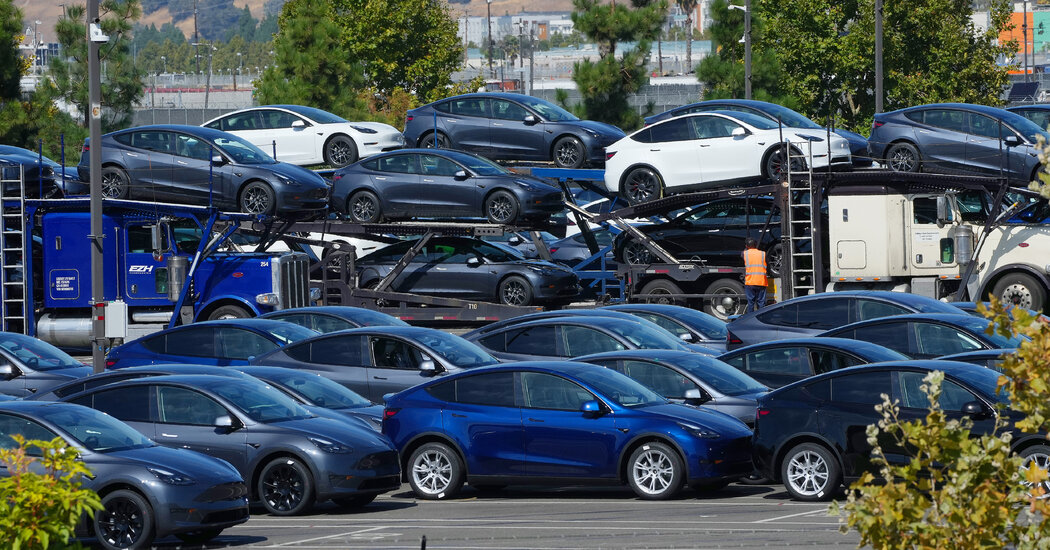
    Tesla, which accounts for half of all the electric vehicles sold in the United States, has warned on its website that the least expensive Model 3 sedan and a long-range version will no longer qualify after Dec. 31. The cars have a battery made in China. The existing credits lowered the price of the base Model 3 to around $30,000, on a par with similarly equipped gasoline cars like the Toyota Camry or Honda Accord.

    The stricter rules will also disqualify Ford’s Mustang Mach-E, which has been eligible for half the credit and was the fourth-most-popular U.S. electric vehicle this year. Ford is still figuring out whether the F-150 Lighting, an electric pickup, will be eligible, a spokesman said.

    The rules are complex and could still be modified by administration officials, leading to confusion among industry executives. In the worst case, only a handful of vehicles will qualify.

    Volkswagen said it is “cautiously optimistic” that its ID.4 electric sport utility vehicle, made in Chattanooga, Tenn., will continue to get the credit.

    General Motors said it is assessing whether its electric lineup, which includes the Chevrolet Bolt and an electric version of the Silverado pickup, will qualify. Nissan, whose electric Leaf is eligible for half of the $7,500 credit, did not respond to a request for comment. Rivian, whose electric pickups and S.U.V.s have qualified, also did not respond.

    There is another way drivers can benefit from the credit. Under an exception intended for businesses with vehicle fleets, the Inflation Reduction Act allows dealers to apply the subsidy to leased vehicles and pass it on to customers. That wrinkle has helped Hyundai and other foreign automakers remain competitive even though they do not produce electric vehicles and batteries in the United States.

    More than 40 percent of Hyundai’s electric vehicle sales are leases, a spokesman said, up from just 5 percent before new restrictions took effect this year. The same provision in the law has allowed people who lease cars made abroad by Mercedes-Benz, BMW, Volvo and Polestar to receive the credit indirectly.

    But leasing is not a panacea. Many people prefer to own their cars, and foreign automakers are sore that they have been excluded from the subsidy available to buyers. The electric vehicle credit “is overly complex and unfortunately creating customer and dealer confusion,” Volvo Cars said in a statement.

    But the lawmakers who drafted and passed the Inflation Reduction Act have said they wrote it to force carmakers to realign their supply chains. That is happening, but the changes will take some time to bear fruit.

    The list of eligible vehicles could grow over the course of 2024 as carmakers ramp up U.S. production to qualify for the credits and other subsidies.

    The Korean automaker Kia expects to begin producing the EV9, a seven-passenger electric sport utility vehicle, at a factory in Georgia next year. Those domestically assembled vehicles should be eligible for half the credit, or $3,750, a Kia spokesman said.

    Stellantis, which owns Chrysler, Dodge, Ram and Jeep, plans to introduce six mass-market electric vehicles in 2024, including versions of the Dodge Charger, Jeep Wagoneer and Ram pickup. The company has not said whether the vehicles will qualify for credits.

    Some hybrids, which have internal combustion engines and electric motors, will also qualify if they meet the sourcing requirements and have a battery with a capacity of at least seven kilowatt-hours.

    The Chrysler Pacifica Hybrid will most likely still be eligible for a $7,500 credit, a company spokesman said, while buyers of the Jeep Grand Cherokee 4xe and Jeep Wrangler 4xe hybrids are expected to be eligible for up to $3,750.

    Market forces are pushing down the prices of electric vehicles, a trend that is expected to continue as carmakers increase production. The average list price of an electric vehicle fell to $63,000 in November from $68,000 a year earlier, according to CarGurus. The average list price of a vehicle with an internal combustion engine was $48,000, the same as in the previous year.

    Federal subsidies and loans for battery factories and electric car plants are also helping to lower prices. At some point during the next several years, analysts expect electric vehicles to become less expensive than internal combustion models even without tax credits.

    “The long-term trend is going to be one of reducing prices,” Mr. Roberts of CarGurus said. “You are going to see more mainstream vehicles.”

    Source link