Week 14 will be the toughest one of the fantasy football season yet. Most fantasy leagues will be playing their final week of the regular season, but a whopping six NFL teams will be on bye after zero were off for Thanksgiving week.
That will create plenty of roster dilemmas for fantasy managers hoping to play their way into the playoffs. It won’t just be about key start ’em, sit ’em decisions; it will also be about add/drop choices for their roster.
Late-season injuries have put fantasy stars such as J.K. Dobbins, in precarious positions. Will Dobbins return before the end of the regular season, or will he remain out through the fantasy playoffs? Owners will have to weigh that possibility as they investigate whether to keep Dobbins, and other banged-up stars, on their roster.
Here’s a look at five players to cut after Week 13 of the fantasy football season, including some big names who may no longer have fantasy value in redraft leagues.
Cousins has a high ceiling – as evidenced by his 509-yard, four-touchdown game earlier in the season against the Tampa Bay Buccaneers – but his floor is low, as fantasy managers have learned the hard way in recent weeks. During his past three games, Cousins has failed to throw a touchdown while throwing six interceptions, four of which came against the Los Angeles Chargers in Week 13.
Could Cousins bounce back in short order? Sure, but he is facing a tough Minnesota Vikings defense in Week 14. It’s probably best not to start him in that contest, so you can drop him this week to pick up other pieces. And if he bounces back against the Vikings, then you can add him back for a more favorable three-game stretch against the Las Vegas Raiders, New York Giants and Washington Commanders.
But if not? Consider him a boom-or-bust QB2 the rest of the way.
KIRK COUSINS:Falcons QB endures forgettable afternoon with four interceptions vs Chargers
Dobbins was one of the best sleeper picks from fantasy football drafts in 2024, but his owners are facing a brutal reality. The veteran running back suffered an MCL sprain in Week 12 and was put on IR just a day before the Chargers’ Week 13 game against the Atlanta Falcons.
That will put Dobbins out for at least four games. As a result, the earliest he can return to action is in Week 17, which will be the fantasy championship game in most fantasy leagues.
There is no guarantee that Dobbins will be in action in Week 17, especially if the Chargers are out of the AFC West divisional race and have a strong hold on a wild-card spot. If he doesn’t return for that contest, then he will simply spend the last month of the fantasy season eating up a roster spot that could be used on other waiver-wire pickups.
As such, fantasy owners needing roster flexibility might be best served dropping Dobbins. It will be a painful decision, but it is probably the right move at this point.
White is starting to look more and more like the No. 2 back for the Buccaneers. Bucky Irving out-touched him 27-9 against the Carolina Panthers in Week 13 and the rookie outgained White 181-34 in the quality matchup. Irving also scored a touchdown while White did not.
Keeping White certainly won’t hurt fantasy owners, as he looks like a high-end handcuff for a team that runs the ball well. At the same time, it will probably take an injury to Irving to make White a legitimate lead back again. Parting with him for a player at a position of need could be worthwhile for fantasy owners in need of depth at quarterback, tight end or defense.
MIKE TOMLIN:George Pickens needs to ‘grow up in a hurry’
There is little doubt that Lockett has dropped to third in the pecking order among Seattle’s receivers. He has posted three or less catches in five consecutive games and has only topped 20 receiving yards once in that span.
The Seahawks still have a higher-volume passing offense, but it’s clear that Geno Smith prefers throwing to DK Metcalf and Jaxon Smith-Njigba over Lockett. The veteran and longtime Seattle weapon might still occasionally pop off in favorable matchups, but you can’t really trust him as anything more than a shaky flex given his lack of volume.
Johnston is in a similar boat to Lockett. He will pop off on occasion, as evidenced by his three-game touchdown streak from Weeks 9 through 11, but he also has recorded 24 or less yards in five of his past seven games.
Johnston’s value doesn’t appear to be on the upswing, either. In Week 13, Justin Herbert threw the ball 23 teams. A whopping 12 of those targets went to Ladd McConkey while Johnston ranked second on the team with four targets.
Perhaps Johnston will be able to earn a more consistent share of Herbert’s looks as teams increasingly pay attention to McConkey. But barring a big-time change in the Chargers’ philosophy, Johnston figures only to be a streaky DFS play the rest of the season.
The University of Kansas doesn’t have plans to eliminate any of its money-losing Olympic sports despite great uncertainty about whether the athletic department can afford to pay student-athletes in the future, KU’s chancellor said.
The future of those programs — which range from big ones like track and field to smaller ones like golf and tennis — has been the focus of speculation across the country as a federal court in April is expected to finalize a lawsuit settlement that will allow universities to start paying student-athletes. Initially, programs like KU could spend slightly more than $20 million a year to pay student-athletes, over and above the scholarships they often receive. That amount would grow through the years as athletic department revenues grow.
But KU is like many other athletic department programs across the country: It doesn’t know where it would find $20 million a year in its current budget to pay student-athletes. But it also knows that if it doesn’t find the money — the lawsuit settlement will allow but not require schools to pay student-athletes — that remaining competitive in the top tier of college athletics will be very difficult.
Chancellor Douglas Girod has been blunt in saying he doesn’t know how KU is going to solve that problem. He knows it is not a satisfying answer — but it does have the benefit of being an honest one.
“If anyone tells you they have it figured out, they are lying,” Girod said during a brief interview recently. “I have talked to dozens of chancellors and presidents, and they are all scratching their heads.”
At this point, Girod is more comfortable in saying what KU isn’t considering: Cutting sports.
“To be honest, you don’t save a whole bunch of money doing that. It is not really a priority for us,” Girod said of using sports cuts to solve the pending budget crunch.
There may be another reason KU isn’t considering such cuts: The university would face a big loss in status if it cut any sport. Currently, NCAA rules require any university that wants to compete in the highest level of Division I athletics to field 16 sports programs. That is exactly how many KU has currently.
Student-athletes and coaches of KU Olympic sports may still have reason to be wary, though. While cutting entire programs may not be the question floating through the halls of athletic departments, the numbers suggest another question will soon emerge:
Are we in it to win it?
Roster changes
An analysis of the pending legal settlement shows KU will have some decisions to make on whether to invest new money in the Olympic sports. If it doesn’t, those sports may have a hard time competing in the future.
The reason is because major roster changes will come to college athletics as part of the legal settlement. No longer will individual sports have limits on the number of scholarships they can offer. Instead, they will have limits on how large their overall rosters can be.
The change is expected to create two impacts. The most certain one is that some students will see their college athletic careers end because there will no longer be a roster spot for them. Walk-on student-athletes — the term for student-athletes who don’t receive a scholarship — are the most likely to lose spots.
An analysis by the Journal-World found that, compared to 2023 totals, there will be 49 fewer scholarship spots for student-athletes across KU’s 16 sports when the new rules are expected to take effect in 2025-2026. That would be an almost 10% reduction in student-athletes at KU.
But the other impact might be the one that creates havoc in the competitive landscape. Schools now will be allowed to give every student-athlete who is on a roster a scholarship. That is not how the system works today.
Take, for instance, baseball. In 2023, there were 40 players on the roster. However, NCAA rules limit the number of scholarships that can be offered to 11.7, meaning most players are receiving partial scholarships, and all those partial scholarships add up to the equivalent of just less than 12 full-ride scholarships.
In the 2025-2026 school year, the size of the baseball team will shrink to 34 players. Six students will no longer have the chance to be a Jayhawk baseball player. However, all 34 remaining players can receive a full scholarship — if the university invests the money to make it happen.
How much money would that take? I haven’t seen any official numbers from KU, and to be clear, Girod and I did not dive into any of these scholarship issues during our interview. Instead, I looked at the 2023 NCAA financial filings for KU and found that the athletic department provided $15.2 million in student aid to 432 athletes. That’s an average of $35,185 per student-athlete.
If you simply use that average, it would cost about $785,000 per year to fund the approximately 22 new scholarship positions that would be available on the baseball team. That would be about a 20% increase in the total operating expenses of the baseball program. The baseball program in 2023 operated at an approximately $4 million loss.
The story is much the same for every sport other than football and men’s basketball. In total, KU, using the average above, is looking at $6.7 million in additional scholarship money that is needed to bring all its teams — minus football and men’s basketball — to the full scholarship levels. Those programs posted a $28.4 million operating loss in 2023. Only football and men’s basketball in 2023 posted an operating profit. The two sports combined had operating revenues that were $20 million over operating expenses, according to the NCAA filings.
If this were only a money question, the answers would be pretty easy. But college athletics still have elements of education, opportunity and equity. At the end of the day, though, the concept of competition is paramount.
That comes back to the growing question in college athletics: Are you in it to win it?
Take baseball as the example again. KU may decide not to invest the more than $700,000 a year in additional scholarship money to field a team that is fully stocked with scholarship players. But certainly some schools will. That discrepancy is likely to have competitive implications.
That’s the polite way to say it.
Donors to the rescue?
If you have been doing the math as we go, you realize we have a problem. The group of sports that are money-losers lost $28 million, while the two sports that are money-makers made $20 million. We are $8 million short.
Donors, along with other revenue sources, make up the difference. The $8 million gap is deceiving, though. KU had about $52 million in other expenses in 2023 that weren’t tied to any one team. That’s everything from administrative salaries to debt payments to a host of other expenses required to run a $100 million-plus enterprise.
Fortunately for KU, it had about $64 million in revenues that weren’t tied to any one team, with a little less than half that amount coming from donors. Add it all up, and Kansas Athletics ended 2023 with revenues being about $4 million greater than expenses. In the world of college athletics, that is not a given. There are many schools that end the year with a deficit and have to seek money from general university coffers to cover the shortfall. Girod has said multiple times that KU must avoid that situation at nearly all costs.
But that brings us to the 2025-2026 school year. If the lawsuit settlement is approved, KU will need to find about $20 million to pay student-athletes and another $5 million to $7 million, perhaps, to fully stock teams with scholarship players.
Maybe donors could be the answer. Maybe, but a little perspective might be helpful. Donors provided about $29 million to Kansas Athletics in 2023. That would mean donors would need to nearly double their contributions to also cover the $25 million to $27 million gap created by the lawsuit settlement. And, they might need to be prepared to do that year after year. Plus, the cost of the settlement will grow over the years. The settlement is structured such that the amount schools can pay athletes rises as the total revenue of athletic departments increases.
Additionally, there’s a question of how much more donors at KU can give. This lawsuit settlement is hitting KU at a time when it already is tapping donors in a big way for facility improvements. Donors have pledged about $250 million for renovations to the west side of David Booth Kansas Memorial Stadium. It is very likely the university will ask for additional donor dollars to complete the east side of the stadium renovations in the near future. KU is betting the new stadium will create new revenues. It will need to because KU also plans to take out at least $115 million in new debt to help pay for the west side renovations. It is unclear whether it will have to take out additional debt for the east side improvements.
Maybe donors can’t ride to the rescue. Cost-cutting might have to be part of the equation, and KU has hired one of the most renowned accounting firms in the country — Deloitte — to study athletic department finance.
The common fan on the street may be screaming that they can save the firm the trouble — reduce coaches’ salaries. KU did pay $23.5 million in coaching salaries in 2023. That’s a lot, but it also is worth noting that every KU coach could agree to work for free, and you still wouldn’t quite cover the pending $25 million to $27 million shortfall.
The payroll category that actually is larger at KU is the money paid to athletic administrators and support staff. That figure was $28.3 million in 2023. Of course, it is not realistic to simply eliminate that category, which includes everything from the athletic director to administrative assistants.
If you cut 50% from both the coaching category and the administrative category, you would basically cover your projected shortfall. That’s not a recommendation, by the way, but rather an example of how deep the cuts would have to be if you chose to operate with blunt instruments.
That’s an operation that would require a lot of anesthesia.
Of course, you could do nothing. The pending settlement doesn’t require any university to pay student-athletes. It simply allows them to pay student-athletes, and places a cap on how much.
“You don’t have to pay anything,” Jeff DeWitt, the university’s chief financial officer, noted in a recent interview. “It is a cap, not a requirement. But how do you remain the No. 1 ranked in basketball? How do you move up the Big 12 in football?”
Another option is that maybe the Big 12 Conference comes together and creates its own, lower caps on payments and/or scholarships. That may maintain some competitive balance in the conference, but what would happen in postseason play when those Big 12 schools are competing against other schools that are operating with higher caps?
That’s an operation that may require a bunker for university presidents to hide from angry fans and donors who become frustrated at early exits from NCAA tournaments or bowl blowouts.
That seemingly brings us right back to where we began.
“Nobody knows,” DeWitt said of how KU or other athletic departments are going to deal with the pending settlement. “If you want me to give you any certainty, I can’t.”
2023 Profit and Loss by Sport
— Baseball: $4.0 million loss
— Women’s basketball: $4.7 million loss
— Men’s golf: $1.2 million loss
— Women’s golf: $1.0 million loss
— Rowing: $2.2 million loss
— Soccer: $2.4 million loss
— Softball: $2.2 million loss
— Swimming & diving: $1.7 million loss
— Tennis: $1.6 million loss
— Women’s track & field/cross-country: $2.8 million loss
— Men’s track & field/cross-country: $2.8 million loss
— Volleyball: $1.9 million loss
— Men’s basketball: $3 million profit
— Football: $17 million profit
Changing Rosters
Here’s a look at changing roster sizes for the 2025-2026 season compared to 2023 numbers:
— Baseball: down 6
— Men’s cross country: no change
— Women’s cross country: down 2
— Football: down 18
— Men’s basketball: down 2
— Women’s basketball: no change
— Men’s golf: down 2
— Women’s golf: down 3
— Rowing: down 4
— Soccer: down 3
— Softball: up 2
— Swimming: down 2
— Tennis: down 1
— Men’s track: down 5
— Women’s track: down 2
— Volleyball: down 1
Scholarship changes
While roster sizes generally are going down, the number of scholarships the university can offer on each team is generally going up.
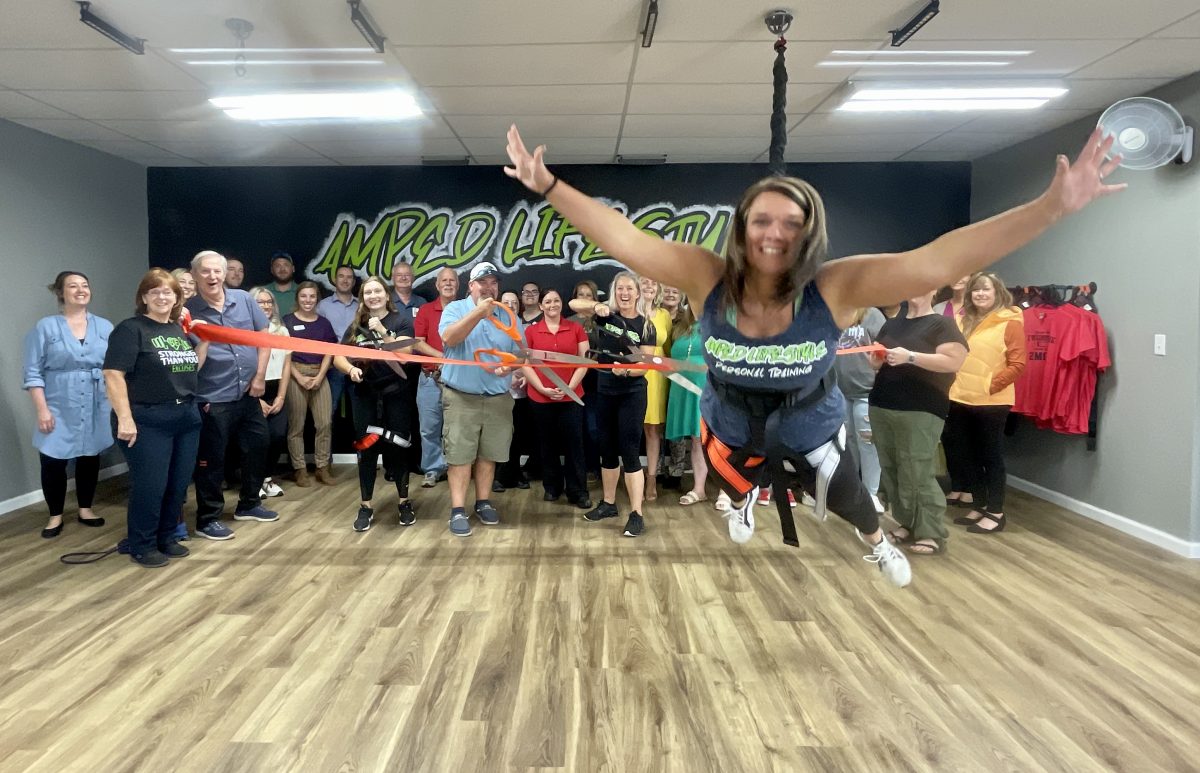
Amped Lifestyle ribbon cutting for their Park Hills location on St. Joe Drive featured instructor Emily McRaven seeming to take flight in a bungee fitness harness. Lisa Brotherton-Barnes
Personal fitness trainer Michelle Smith expressed her excitement at the ribbon cutting for her second Amped Lifestyle fitness studio at 600 St. Joe Dr. in Park Hills; the other is located at 305 Forster St. in Farmington. The Park Hills-Leadington Chamber, the Desloge Chamber, and the Farmington Regional Chamber partnered for the ceremony and celebration activities.
Surveying the large gathering that included fellow area business owners, city officials, community leaders, family, and friends, Smith said, “God has done amazing things. It has been an amazing year.”
Smith expressed her appreciation to the training and fitness team who work with her to provide personal attention and instruction to those who are pursuing their health goals at Amped Lifestyle.
“Emily McRaven is our athletic trainer; she’s a bungee instructor, does the fit and flex cardio classes, and is a jack of all trades.Starting November 12th, she’s going to be doing a 60-plus senior class here, two days a week at 9 a.m. I’m super excited. I don’t know any senior that doesn’t want to swing the golf club better, want to walk, want to do all those great things. Stacy Tongay has been with me from the beginning as well,” she said.
Bungee fitness programs are a recent fitness trend that is new to the Parkland area. Special elasticized bungee cables are connected to structural supports in the ceiling and the client wears a safety harness that attaches to the cables. Workouts are high-excitement, and high-intensity while being low-impact so the activity is gentle on the body. The workouts provide a unique combination of strength training, cardio, and dynamic movements. A high percentage fun quotient comes into play with enthusiastic leaps that mimic flight for the person in the harness.
The three instructors gave a demonstration of a typical beginner bungee fitness workout. Attendees commented amongst themselves that it looked like something they would be interested in trying.
Bungee fitness classes are available for beginners, and those interested in cardio-focused workouts. Private one-on-one sessions or small group classes are available in addition to special event packages for things like private parties or groups who would like to have a fun experience together.
Traditional fitness programs are also available through a wide range of classes structured to achieve health goals regardless of beginning fitness level or age.The 60+ fitness sessions will focus on mobility maintenance, strength building, and overall wellness enhancements for better health.
Smith said her goal is to provide health and wellness opportunities to women regardless of their beginning fitness level, budget, or scheduled availability.
For more information about classes or membership options, contact Smith at (573) 760-9931 or michellesmith@ampedlifestyle.com. The website address is ampedlifestyle.com.
Lisa Brotherton-Barnes is a staff writer for the Daily Journal and can be reached at lbarnes@dailyjournalonline.com.
Amped Lifestyle ribbon cutting for their Park Hills location on St. Joe Drive featured instructor Emily McRaven seeming to take flight in a bungee fitness harness. Lisa Brotherton-Barnes
Personal fitness trainer Michelle Smith expressed her excitement at the ribbon cutting for her second Amped Lifestyle fitness studio at 600 St. Joe Dr. in Park Hills; the other is located at 305 Forster St. in Farmington. The Park Hills-Leadington Chamber, the Desloge Chamber, and the Farmington Regional Chamber partnered for the ceremony and celebration activities.
Surveying the large gathering that included fellow area business owners, city officials, community leaders, family, and friends, Smith said, “God has done amazing things. It has been an amazing year.”
Smith expressed her appreciation to the training and fitness team who work with her to provide personal attention and instruction to those who are pursuing their health goals at Amped Lifestyle.
“Emily McRaven is our athletic trainer; she’s a bungee instructor, does the fit and flex cardio classes, and is a jack of all trades.Starting November 12th, she’s going to be doing a 60-plus senior class here, two days a week at 9 a.m. I’m super excited. I don’t know any senior that doesn’t want to swing the golf club better, want to walk, want to do all those great things. Stacy Tongay has been with me from the beginning as well,” she said.
Bungee fitness programs are a recent fitness trend that is new to the Parkland area. Special elasticized bungee cables are connected to structural supports in the ceiling and the client wears a safety harness that attaches to the cables. Workouts are high-excitement, and high-intensity while being low-impact so the activity is gentle on the body. The workouts provide a unique combination of strength training, cardio, and dynamic movements. A high percentage fun quotient comes into play with enthusiastic leaps that mimic flight for the person in the harness.
The three instructors gave a demonstration of a typical beginner bungee fitness workout. Attendees commented amongst themselves that it looked like something they would be interested in trying.
Bungee fitness classes are available for beginners, and those interested in cardio-focused workouts. Private one-on-one sessions or small group classes are available in addition to special event packages for things like private parties or groups who would like to have a fun experience together.
Traditional fitness programs are also available through a wide range of classes structured to achieve health goals regardless of beginning fitness level or age.The 60+ fitness sessions will focus on mobility maintenance, strength building, and overall wellness enhancements for better health.
Smith said her goal is to provide health and wellness opportunities to women regardless of their beginning fitness level, budget, or scheduled availability.
For more information about classes or membership options, contact Smith at (573) 760-9931 or michellesmith@ampedlifestyle.com. The website address is ampedlifestyle.com.
Lisa Brotherton-Barnes is a staff writer for the Daily Journal and can be reached at lbarnes@dailyjournalonline.com.
Irritable bowel syndrome (IBS) is a chronic condition that affects the digestive system. It causes abdominal pain, discomfort, and changes in bowel habits. Other common symptoms include bloating, diarrhoea, constipation, mucus in stool, and a feeling of incomplete evacuation. The current dietary recommendation for IBS is called a low-FODMAP diet. It is a strict, regulated diet where lists of foods that are allowed/not allowed must be consistently followed. This diet also excludes gluten and lactose. Bodil Ohlsson, a professor at Lund University and consultant at Skane University Hospital, decided to investigate the role of sugars and starches in IBS.
A previous study conducted by Professor Ohlsson showed that the starch and sucrose-reduced (SSRD) diet greatly reduced IBS symptoms such as recurring pain, tightness in the abdomen, diarrhoea, and/or constipation. Sweet treats, highly processed foods, and ready-to-eat meals were to be avoided.
“We launched this study in 2022 to compare SSRD and Low FODMAP. One hundred and fifty-five patients diagnosed with IBS were included and randomly allocated to follow either SSRD or Low FODMAP for four weeks. They were not allowed to have been on a diet at the start of the trial, but rather ate ‘everything,’” says Bodil Ohlsson. Participants in both groups had to follow the basic principles of each diet. However, they chose how often or regularly they ate.
Reducing sugary foods from diet can help with IBS symptoms.Photo Credit: iStock
How Starch And Sugar Reduction Helped Patients With IBS:
1. Improvement In Symptoms
In both groups, regardless of diet, IBS symptoms improved in 75-80 percent of the patients, which according to Bodil Ohlsson “was even better than we expected.”
2. Weight Loss
Weight loss after four weeks was greater in the SSRD group.
3. Reduced Sugar Cravings
Sugar cravings also decreased the most in this group, which is positive, as IBS patients weigh more on average than healthy people, says Bodil Ohlsson. Also Read:Pear For Gut Health: 5 Reasons Why You Should Include Nashpati In Your Daily Diet
“We wouldn’t even call SSRD a diet. It’s how everyone should eat, not just those with IBS. And unlike Low FODMAP, SSRD is easy to understand and easier to follow. You can eat everything when you are invited to dinner, just less of certain things. If you rest your stomach for the rest of the week, you can indulge a little one day!” says Bodil Ohlsson.
Disclaimer: This content, including advice, provides generic information only. It is in no way a substitute for qualified medical opinion. Always consult a specialist or your doctor for more information. NDTV does not claim responsibility for this information.