NEW YORK — The New York architect facing murder charges in a string of deaths known as the Gilgo Beach killings is challenging the DNA evidence against him and seeking separate trials in the sprawling case.
Rex Heuermann’s lawyers argue DNA analysis relied on by prosecutors is not widely accepted in the scientific community and should be excluded from the trial. The Long Island resident’s defense team also wants to break out the case against him into multiple trials.
Since late 2010, police have been investigating the deaths of at least 10 people — mostly female sex workers — whose remains were discovered along an isolated highway not far from Gilgo Beach on Long Island’s south shore.
Heuermann was arrested in 2023 and charged in the deaths of three of the victims between 2009 and 2010: Melissa Barthelemy, Amber Lynn Costello and Megan Waterman.
Huermann has maintained his innocence and pleaded not guilty to all counts.
Michael Brown, Heuermann’s attorney, said following a Wednesday court hearing that his client risks being improperly convicted because of the “cumulative effect” of the evidence put forward by prosecutors.
He also argued there’s a “substantial disparity” in the evidence in the some of the deaths, which he maintained involves different time frames, killing methods and locations for disposing the bodies.
“The danger of having count after count, victim after victim in the same trial is that ‘If there’s smoke, there’s fire’ mentality,” Brown said. “They shouldn’t be tried together. One issue has nothing to do with the other.”
Prosecutors on Wednesday filed a written response to the DNA challenge and said they will respond to the motion for separate trials later. Heuermann’s next court date is Feb. 18.
DNA results from hair strands found at some of the crime scenes are among the key pieces of evidence prosecutors have put forward in the case.
Suffolk County District Attorney Ray Tierney has maintained the DNA science is sound and that his office will oppose separate trials.
In their Wednesday filing, prosecutors argued that the “whole genome sequencing” technique utilized in the case has been accepted in peer-reviewed scientific journals and by federal regulators, paleontologists, virologists, and medical communities.
The findings by Astrea Forensics, a California lab, were also independently corroborated by mitochondrial DNA testing, a methodology long accepted by New York courts, prosecutors said.
Whole genome sequencing “enables more comprehensive collection and evaluation of DNA,” prosecutors wrote. It is “so widely used for scientific, medical, and forensic purposes, it would seem there is little question as to whether it has been accepted in the relevant scientific community.”
Prosecutors also say Heuermann kept a “blueprint” of his alleged crimes on his computer that included a series of checklists with tasks to complete before, during and after the killings, as well as practical lessons for “next time.”
MIAMI — Two humpback whales were found dead and another seriously injured this year in huge nets used to collect krill for fishmeal and omega-3 pills near Antarctica, The Associated Press has learned.
The whale deaths, which have not been previously reported, were discussed during recent negotiations between the U.S., China, Russia and two dozen other countries in which officials failed to make progress on long-debated conservation goals and lifted some fishing limits in the Southern Ocean that have been in place since 2009.
Taken together, the whale deaths and rollback of the catch limits represent a setback for the remote krill fishery, which has boomed in recent years and is set to expand even further following the acquisition of its biggest harvester, Norway’s Aker BioMarine, by a deep-pocketed American private equity firm.
AP journalists last year spent more than two weeks in the frigid waters around Antarctica aboard a conservation vessel operated by Sea Shepherd Global to take a rare, up-close look at the world’s southernmost fishery. As part of that investigation, the AP followed the tiny crustacean on its journey from the fragile ecosystem, where it is the main nourishment for whales, to salmon farms in Europe, Canada and Australia, pet food manufacturers in China and a former ice cream factory in Houston that produces 80% of the world’s nutrient-rich krill oil.
Delegates to the annual meeting in Australia of the Commission for the Conservation of Antarctic Marine Living Resources, or CCAMLR, shared with the AP unpublished reports of the whale deaths on the condition of anonymity because the talks, which ended last week, are not open to the public. Officials at CCAMLR, which was established in 1982 to protect the international waters near Antarctica, didn’t comment.
Under a conservation agreement developed almost two decades ago, the krill catch has soared: from 104,728 metric tons in 2007 to 424,203 metric tons in 2023 as larger, more sophisticated vessels have joined the chase. So far this year, the catch has jumped to 498,000 metric tons — the highest on record, according to the unpublished reports.
Although fishing is still below a previously agreed limit and barely 1% of the estimated biomass of 63 million metric tons of krill found in the main Antarctic fishing grounds, direct competition between marine mammals has resulted in whale deaths before.
But following the first ever recorded entanglements of four humpback whales in 2021 and 2022, Aker BioMarine redesigned its fishing nets, which regularly vacuum up to 500 metric tons of krill per day – the equivalent daily diet for about 150 humpback whales. First, it added a rope barrier to repel large mammals and then, last fall, it developed a second barrier to close a still sizable gap that can threaten whales swimming vertically.
The new net had not yet been installed when a juvenile humpback was observed dead Jan. 27 on the Antarctic Endurance, the company’s most advanced supertrawler, according to a report presented by Norwegian negotiators at the CCAMLR meeting.
The reasons behind the second death in May involving another Aker BioMarine ship remain unclear. But two days earlier the ship reported difficulty maneuvering its net and blubber was recovered on the ship’s conveyor belt, suggesting the dead whale had been trapped by the net for some time, the report said.
A third humpback was hauled alive in late January on a Chilean-flagged vessel, the Antarctic Endeavor, using traditional trawling gear. After the ship’s crew struggled for 40 minutes to cut the net tightly wrapped around the 15-meter-long (15-yard-long) male, the whale, with blood on its tail, was dumped back into the ocean.
“Upon release it was lethargic and had some injuries from rubbing with the net,” according to a report by Chile’s delegation to the CCAMLR talks that included graphic images of the capture. Although the whale was observed swimming, the capture was considered a mortality event by CCAMLR scientists because the released whale’s injuries were likely to prove fatal.
Attempts to contact the trawler’s owner, Pesca Chile SA, were unsuccessful.
A minke whale was also found dead after entangling itself in a buoy line belonging to a South Korean vessel targeting Patagonian toothfish, which is also managed by CCAMLR. It was the first ever whale death recorded in the fishery.
Pressure on krill stocks is building as a result of surging demand for omega-3 pills taken as dietary supplements, advances in fishing and rising ocean temperatures due to climate change.
This summer, New York-based American Industrial Partners acquired a majority stake in Aker BioMarine’s feed business with the goal of positioning krill as a premium ingredient for the aquaculture industry, now the source for about half the world’s seafood.
Webjørn Barstad, CEO of the new company, Aker BioMarine Antarctic, said developing new technologies to mitigate risks of whale mortalities is a top priority. Starting next season, he said, its entire fleet will be equipped with special stretch sensors that will alert the crew when a whale has interacted with the mesh front of a trawler’s net. Underwater cameras may also be used, he said.
“Our goal is always zero incidents,” Barstad said in an interview. “Hopefully the net will do the job but we will try something else as well.”
CCAMLR, whose mission is conservation, is tasked with refereeing the fishing industry. But in recent years, progress has stalled due to geopolitical wrangling, especially opposition from China and Russia.
Coming into the latest meeting, hopes were high that delegates would approve a new management plan to further spread the krill catch and finally adopt a California-sized reserve along the Antarctic Peninsula, a highly sensitive ecosystem. Currently, less than 5% of the Southern Ocean is protected — well behind CCAMLR’s target and not nearly enough to meet a United Nations goal to preserve 30% of the world’s oceans by 2030.
But a tentative deal fell apart over a last minute proposal by the UK and Australia for an even lower catch limit than the one agreed to during talks over the summer, according to one delegate who spoke to AP. China, objecting to the persistent Western demands, then withdrew its support for the marine reserve and refused to renew the existing management system.
The result: a 620,000 metric ton catch limit that for 15 years has divvied fishing into four quota areas can now be concentrated into even smaller krill hotspots, some of them teeming with wildlife, including seals and penguins, some already showing signs of stress from competition with fishing, tourism and climate change.
“The meeting was a huge disappointment, even by the low standards that we’ve come to expect,” said Evan Bloom, who for 15 years, until his retirement from the State Department in 2020, led the U.S. delegation to the annual CCAMLR meeting.
“Krill is the base of the food chain in Antarctica and fishing for krill must be handled sustainably if the entire ecosystem is to thrive,” said Bloom, adding that in the absence of further action by CCAMLR and given the advances in fishing the “prospects for harming the ecosystem have now increased.”
Barstad said the krill industry will consider putting its own voluntary limits in place in the absence of an updated CCAMLR framework.
“Whether it’s a big setback, I’m not so sure,” he said. ”Once you go beyond the emotion and come to terms with the fact that a regulation that had been standing for quite some years now suddenly disappeared, a little bit out of the blue, I think it could create a better atmosphere for discussing how to progress sustainably based on science.”
___
This story was supported by funding from the Walton Family Foundation. The AP is solely responsible for all content.
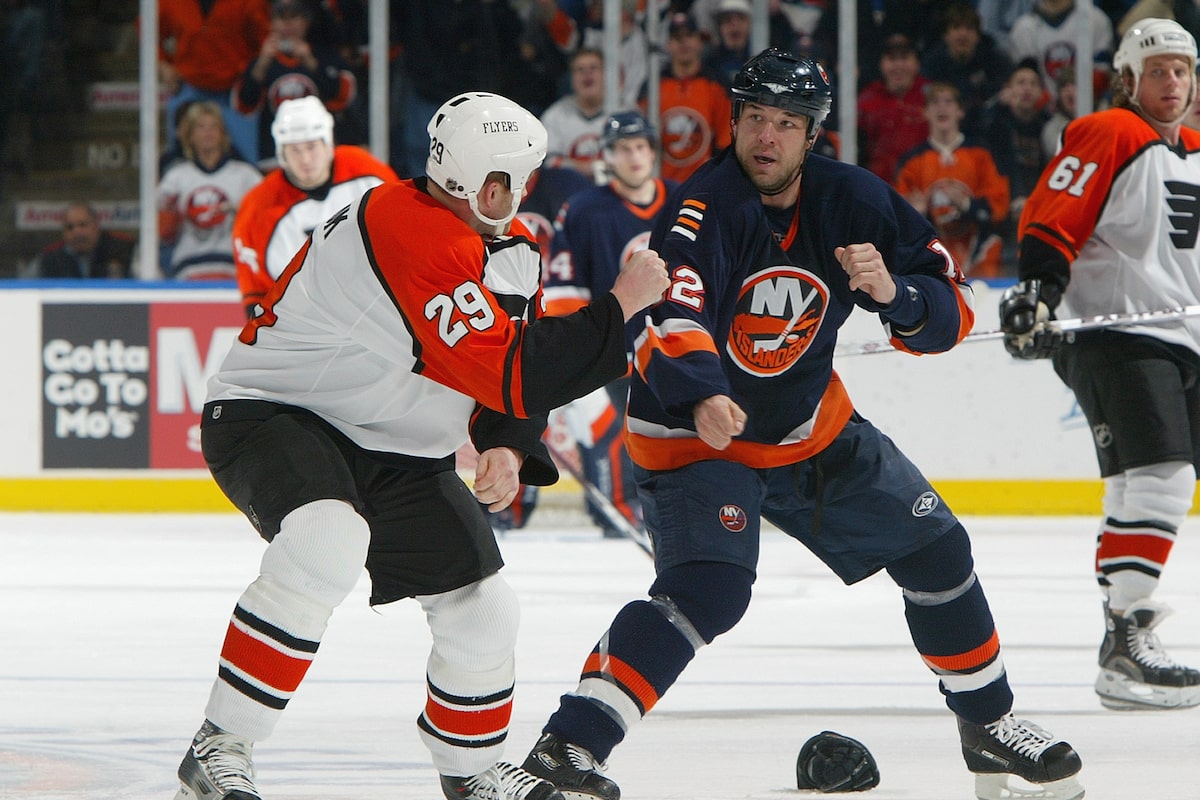
Chris Simon of the New York Islanders fights Todd Fedoruk of the Philadelphia Flyers in a 2007 game at Nassau Coliseum in Uniondale, N.Y.. Simon died in March.Jim McIsaac/Getty Images
Lauri Smith was visiting Orlando this past March when a journalist called about her ex-husband.
She had learned long ago to say “No comment” when reporters asked about Chris Simon, one of the toughest fighters in NHL history. She opted for the same approach this time around, especially considering the guy’s question: Do you have any comment on the death of your ex-husband?
She was stunned. Dead? He was 52, just a decade from his career on the ice, where he seemed virtually indestructible as an enforcer responsible for brutalizing any opposing player who endangered his team’s stars.
Simon’s family believes the brain disorder chronic traumatic encephalopathy (CTE) contributed to his death. Simon leaves the ice in a 2002 game against the Tampa Bay Lightning.CHRIS O’MEARA/The Canadian Press
“I thought it was a joke, to be honest, but then it was followed with my co-worker calling,” says Smith, an Ottawa-area law clerk who spent five years with Simon, who died by suicide on March 18.
For years, she’d been convinced that Simon had suffered a brain injury during a playing career that included stops in Quebec, Colorado and Washington. As far back as his 1993 rookie year with the Nordiques, she had researched his changing behaviour. Why had he begun blinking incessantly? Could blows to the head have triggered his anger-management issues? Can his employer help?
Those questions grew more urgent after their relationship dissolved and their son, Mitch, picked up the game. Would she have to worry about his head, too?
Sitting in Orlando last March, those unresolved questions intruded on her grief. At least with Simon’s death, she thought, the hockey world would be forced to recognize the devastating symptoms of the fighting she witnessed.
She thought wrong.
Instead, a new season has dawned with nary a mention of his name or chronic traumatic encephalopathy (CTE), the brain disorder Simon’s family believes led to his death. Smith, along with some of Simon’s old on-ice foes, want more accountability from the league and more assistance to prevent future deaths.
“I noticed after Chris’s passing that the story just went away,” she says. “No one’s talking about CTE and we should be talking about it more than ever. Did Chris have something hereditary? Was it a mental-health issue? Or was it actually CTE because of his job? I need to know for my son and the rest of the Simon family as well. And I think the NHL owes something to his family in terms of resolution.”
In death, Simon joined a tragic roll call of NHL fighters who died young – Derek Boogaard, Rick Rypien, Wade Belak, Jeff Parker and Todd Ewen, to name a few. All five men were posthumously diagnosed with CTE, which researchers say is caused by repeated brain injuries and can lead to depression, aggression, memory loss and physical impairment – sometimes long after triggering incidents.
Simon looks to shoot on Montreal Canadiens goalie Jose Theodore at Madison Square Garden in New York in December, 2003.KATHY WILLENS/The Canadian Press
In public statements, and in courtrooms, the NHL has denied any link between the game and the disease, and argued that it has gradually made the game safer by increasing penalties for fighting, introducing a concussion protocol and restricting contact to the head.
Two days after Simon’s death, reporter Frank Seravalli asked the NHL’s deputy commissioner, Bill Daly, if the league’s position had changed.
“No,” Daly said. “I think the science is still lacking.”
That’s consistent with the position the NHL took defending a lawsuit brought by hundreds of players who claimed the league ignored the effects of long-term head trauma. A judge declined to certify the class action in 2018 and the NHL eventually agreed to a US$18.9-million settlement with around 300 players – chump change compared with the reported US$1.2-billion the NFL has paid out so far related to a settlement in a similar case.
The Washington Capitals take a moment of silence for Chris Simon after he passed away, on March 20.John McCreary/Getty Images
There are many vocal critics of the league’s attitude toward CTE, but few as authoritative as a former World Wrestling Entertainment heel who went by the stage name Chris Harvard, so named for his Ivy League background. A mistimed drop kick in 2003 caused months of postconcussion syndrome, convincing him to retire and go back to school for a PhD in behavioural neuroscience under his real name, Chris Nowinski. As someone who approaches the issue as both a patient and a researcher, he can’t stomach the NHL’s position on CTE.
“People who care about hockey players need to recognize that what they are saying is not true, and we have to both push for them to tell the truth and also ignore what they’re saying as we try to help these hockey players,” said Nowinski, a doctor who co-founded Concussion Legacy Foundation, a charity that supports athletes and veterans affected by CTE.
Evidence continues to mount in his favour. A 2023 Boston University study found that a person’s risk of developing CTE increased by 23 per cent with each additional year of playing hockey.
Though they didn’t focus on CTE, Columbia University researchers found last year that NHL enforcers died 10 years earlier than non-enforcers. And the enforcer deaths were more strongly linked to drug overdose, suicide and neurodegenerative disease.
Matthew Barnaby of the Colorado Avalanche, right, fights Darren McCarty Detroit Red Wings during a 2004 match. Barnaby estimates he racked up at least 400 fights between his junior and pro career.Brian Bahr/Getty Images
Considering the number of punches that enforcers endure, Nowinski said it’s plausible to assume they have a higher risk of CTE, and potentially other neurodegenerative diseases, than other players.
Scrappers from Simon’s era tend to agree. Matthew Barnaby, a forward on a tough Buffalo Sabres team that terrorized opponents in the mid-90s, estimates he racked up at least 400 fights between his junior and pro career, enduring an average of five punches per bout, or 2,000 blows in total.
“It has to have some cumulative effects,” said Barnaby, 51, though he has not yet personally noticed any symptoms.
Dennis Vial, who led the league with 30 fights in the 1995-96 season, said his head gives him little trouble aside from a bit of anxiety when he hears of fallen foes. He can’t help but wonder what the future will bring. “One day am I going to wake up losing my mind and turning into some violent person?” says Vial, who runs a small business in Nova Scotia. “Will my brain deactivate because of all these injuries? I don’t know.”
One of Barnaby’s former teammates takes a starkly different view. As president of the local Sabres alumni association, Rob Ray said he hears about all manner of health problems among retired players. “The issues I deal with for players who never dropped their gloves are just as bad or worse than those that did,” he says.
“People have a burr up their ass about that physical style of game,” he adds. “They say any player who got in a fight suddenly has something wrong with them. And that bugs the piss out of me.”
Today, those old fights remain like ghosts in his bones. He’s got a plate with five screws in his thumb from the time he tried to give the Islanders’ Steve Webb an uppercut. His jaw occasionally locks up from the time it was broken in a fight. He’s got arthritis in both elbows and his hands are always stiff. But his head? “I’m doing fine, I got a few businesses, wife, family, kids. I don’t have a problem,” he says.
Not everyone’s fine. When NHL players first launched their class-action lawsuit against the league for the effects of head trauma, Mike Peluso was one of the star plaintiffs. A veteran of nine seasons who won a Stanley Cup with the New Jersey Devils, Peluso struggled with grand mal seizures following a 1993 knockout by St. Louis Blues tough-guy Tony Twist. In the years since his 1998 retirement he says he’s battled depression, dementia and suicidal thoughts.
Mike Peluso, left, fights with Tie Domi of the Winnipeg Jets in 1993. Peluso struggled with grand mal seizures following a 1993 fight and since his 1998 retirement he says he’s battled depression, dementia and suicidal thoughts.
A few years back, he loaded some of his prescription medication into a bowl of popcorn, with plans to end his life, but couldn’t stand the thought of his Labrador Retriever, Coors, being alone.
Coors has since died. He keeps the dog’s ashes in a room off his basement for the day they can be buried together.
“Had I known the side effects, I never would have played this game,” he said in an interview at his townhouse in Hudson, Wis., where he said he receives little assistance aside from a US$830-a-month pension.
But that lack of help is starting to change.
Seven years ago, former goalie Glenn Healy took over as president and executive director of the NHL Alumni Association, then known primarily as the organizer of old-timers’ games. From the start, he was inundated with calls about suicide, depression and other problems among players, for whom he had nothing to offer.
So the association hired a medical director, three social workers, a dental consultant and created a mental-health network based in Ottawa, Pittsburgh and Sweden that can see players on a moment’s notice.
Healy says his staff is helping around 200 players right now with anything from brain scans to rent money. “Most of our calls come from the wives saying they want their husband back, or from a kid saying they want their dad back. It’s rarely the player.”
They can’t reach everyone. Peluso dismissed the idea of asking for the association’s help. But nobody’s about to do it on his behalf.
“I don’t have anybody,” says Peluso, surrounded by hockey memorabilia, including a photo of Healy, in his basement. “Hopefully I’ll get a will done some time, and when that time comes, it comes.”