hacklink hack forum hacklink film izle hacklink marsbahisizmir escortsahabetpornJojobetcasibompadişahbetGorabetcasibom9018betgit casinojojobetmarsbahismatbetmatbet

Tag: Deep

  • NRAI Cautions Restaurants Against In-Dining Deep Discounts

    NRAI Cautions Restaurants Against In-Dining Deep Discounts

    The National Restaurant Association of India (NRAI) on Monday cautioned restaurants regarding the potential long-term adverse effects of in-dining deep discount programmes and aggregator payment platforms. According to the apex hotel industry body which represents more than 5 lakh restaurants, these programmes – while appearing beneficial in the short term – could threaten the economic stability and autonomy of restaurants and disrupt the restaurant ecosystem.
    “Our industry is at a crossroads, and the decisions we make now will shape the future of dine-in operations. Deep discounting may appear appealing in the short term, but they also pose long-term risks to restaurants’ independence and viability, especially when mandatorily bundled with the aggregator’s payment gateway,” said Sagar Daryani, NRAI President.
    Deep discounting has caused significant challenges in the food delivery market, and NRAI warned that similar tactics are being employed to capture the dine-in market through aggressive aggregator payment gateway adoption. Aggregator payment gateways provide various issues for eateries. These networks reward clients with aggressive discounts and cashback, which are sometimes sponsored at the expense of the restaurants themselves. However, restaurants must pay substantial commissions on transactions, ranging from 4-8 per cent, significantly higher than the 1-1.5 per cent charged by standard payment gateways.
    The NRAI emphasised that deep discounting presents substantial economic hurdles to the restaurant business. Unlimited and unsustainable discounts alter price structures, setting unreasonable expectations for customers and undervaluing the dining experience. These practices disproportionately affect small, independent enterprises, who lack the financial resources of larger, better-funded competitors, making it harder for them to compete and survive in the long run, said the industry body.
    As customers become more reliant on these gateways, restaurants face a significant risk of losing direct ties with their customers, thereby transferring them into the aggregator’s ecosystem and compromising the restaurant’s autonomy. The NRAI asked restaurants to be cautious and thoroughly consider the terms and conditions of aggregator payment systems before making decisions, taking into account the financial implications of deep discounting campaigns.

    (Disclaimer: Except for the headline, this story has not been edited by NDTV staff and is published from a syndicated feed.)

    Source link

  • Athlete of the week: Mackenzie Toney is looking to put a bow on her junior season with a deep playoff run – LaGrange Daily News

    Athlete of the week: Mackenzie Toney is looking to put a bow on her junior season with a deep playoff run – LaGrange Daily News

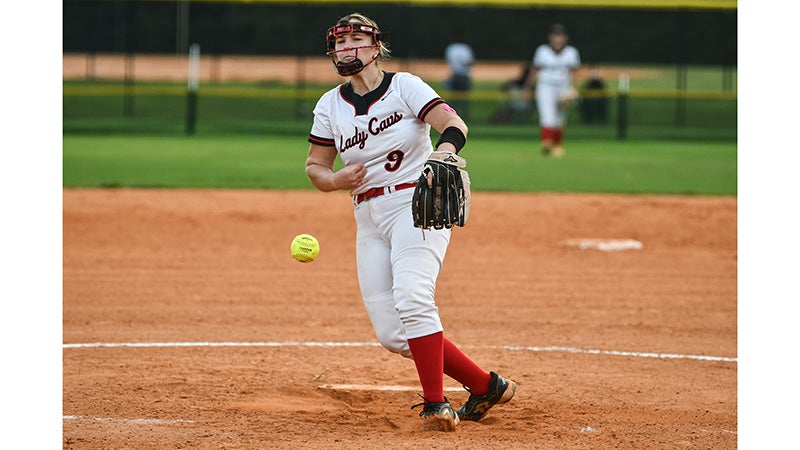
    Athlete of the week: Mackenzie Toney is looking to put a bow on her junior season with a deep playoff run

    Published 8:15 am Saturday, October 12, 2024

    Mackenzie Toney does it all for the Callaway softball pitching staff. The junior will find her way into the circle under any circumstances, whether it is a starter or in relief. Toney has pitched 89 innings in the regular season, 37 more than the next-highest Cavalier.

    “It means a lot that the coaching staff trusts me to pitch in big games whether I’m starting or coming off the bench,” Toney said. “I just stay ready for my number to be called.”

    Toney took no time adjusting to the high school ranks, immediately earning a role as a starting pitcher as a freshman. It has been a steady rise to the point where she is now the bonafide no. 1 pitcher on the staff.

    “On the mound, I can control my emotions more than my freshman year, because I would get frustrated, and I got a lot better with that,” Toney said. “I have a lot more spin. I even build up more speed with my pitches. I have a lot more now than what I even had last year.”

    Before finding pitching at 11 years old, Toney was a shortstop and an occasional outfielder. Now, she is practically a pitching specialist, though she has occasionally played first base during the travel ball season.

    The regular season is a wrap as the Cavaliers head into the playoffs that start early next week. As Callaway awaits its playoff opponent, Toney can’t help but look back on how quickly three seasons on the diamond have flown by.

    “It is crazy how fast it went, I might have cried a little on senior night,” Toney said with a chuckle.

    Toney will have to play her senior season without her partner in crime, Karlie Walker. The senior catcher/third baseman helped Toney get acclimated to the varsity team and the two have formed quite a bond over the years.

    “I cried with her on senior night. I’m gonna miss her,” Toney said. “It’s gonna be different for me my senior year.”

    Now, Toney is building a new comradery with freshman catcher Ella Kelly that will continue into next season.

    “I’ve been knowing Ella for years,” Toney said. “Working with her has been great and she is really learning how to catch my pitches.”

    When Toney first put on the jersey for the varsity team she was almost exclusively a pitcher that relied on a pinch hitter. Not anymore. Toney has worked tirelessly to improve her swing and it has paid dividends in the diamond this season as Toney hit .312 with six RBIs in the regular season.

    “I have been working at that, especially during the travel ball season. We’ve been doing a lot of hitting during the summer, and it also helped with coming into high school, but also my mentality changed, stepping into the batter’s box I have more confidence now than what I did have my freshman year because I would just go up there thinking ‘I’m about to strike out.’” Toney said. “Now, I’m more relaxed when I go up there.”

    The junior also hit her first two home runs on varsity this year, the only two home runs any Cavalier hit in 2024 in fact.

    “Those were amazing, they felt great,” Toney said. “The first one it thought ‘How in the world am I doing this.’”


    Source link

  • Friday Night Highlight: Tiger Pride runs deep in Commerce football program | Local Sports

    Friday Night Highlight: Tiger Pride runs deep in Commerce football program | Local Sports

    COMMERCE, Okla. — Logan Cawyer took over the head coaching role of the Commerce High School football team four years ago after spending three years as an assistant under Steve Moss.

    Cawyer was a 2006 graduate of Commerce High School and spent some time coaching at Miami High School, coached a little college football and then made his way back to being a Tiger again in 2018.

    “It’s always good to come back home. I was blessed to learn under coach Steve Moss. He was one of the coaches when I was in high school,” Cawyer said. “He was the head coach here when I came back seven years ago.”

    The four-year head coach has now gotten to see his first group of freshmen become seniors, and he has two of them as leaders on the field this year.

    “These guys that were freshmen when I started, I’ve seen some of the grow up, I’ve seen some of them quit, some of them stay with it,” Cawyer said. “We have six seniors, we have one new one, but the five that have been here the whole time, it’s a bond we can create in small towns and hopefully it’s a bond we share for our whole lives.”

    Seniors Gracen Shelton and Camden Poteet are two of the player-named captains on the Commerce team this fall. Shelton plays quarterback while Poteet plays on the defensive and offensive lines.

    Another captain on the team is junior linebacker and running back Landon Brunner. Brunner was actually selected by the coaching staff because of his excellent offseason.

    “He was 100% (attendance) this offseason. He put in the work. Not necessarily led out loud, kind of led by example,” Cawyer said. “He carried a full-time job pretty much the whole summer — just seeing him put in the work and commit himself to the team.”

    Each one talked about the opportunity to lead and what it means to them.

    “It means a lot. There’s a lot of school pride here, and its fun to lead,” Shelton said.

    “It’s pretty special. I don’t think you get it at any other school. It’s kind of a brotherhood. We’ve all played together for quite awhile,” Poteet added.

    “It’s important to me because I really enjoy the sport, and I take a lot of my emotions to the field and I like to keep everyone pumped up and stuff,” Brenner said.

    Poteet extends his responsibility as a captain to things beyond the football field. He tries to set an example throughout the school day as well. He said he tries to teach the younger group “not to be doing dumb stuff.” The senior lineman noted grades as being important to setting an example as well.

    Part of that is to show leadership in the classroom by “not being a jerk” to teachers. That also includes not reacting to smack talk after a play but just letting his aggression during the play do the talking.

    When it comes to his seniors, coach Cawyer sees different styles of leaders on the field.

    “Gracen is kind of that intellectual leader. People have questions, they go to Gracen,” Cawyer said. “Camden sets the tone with physicality. He’s a three-year starter on the offensive line. If we can count on anyone to run behind, it’s Camden.”

    Each one of these athletes exemplify Tiger Pride in their own way. That’s something Cawyer has tried to continue since rejoining the Tigers’ football program.

    He believes his dad, Chris, and coach Rick Trimble started that Tiger Pride slogan and the traditions behind the football program back in 1990, Cawyer believes. He added that the community and athletes buy into the thought of “playing with Tiger Pride.”

    The community is a part of that Tiger Pride to some of the players as well.

    “Everyone comes out on Friday nights. It feels like the whole town’s out there watching you,” Poteet said.

    “I think we have one of the best communities,” Brunner added.

    Speaking of coach Cawyer’s dad and his time at Commerce as a coach, he was the defensive coordinator at CHS when Cawyer was in school. His return in 2018 was mostly because of his dad still being around the area.

    When the former Division I football player from Tulsa University came back to be be a Tiger, his dad was coaching at Quapaw High School just up the road. One thing he wanted was to be able to coach alongside his dad one day.

    “We were fortunate enough to get that chance when I took over in ’21. … He was coaching with us the last three years,” Cawyer said. “That was really one of the main reasons I came back, to have that bond and that relationship with him and see what it was all about.”

    He spoke about many things he learned from mentors and coaches before him and even from his dad about the defensive part of the game. But one thing that really stuck with him about his dad was how to build relationships with athletes.

    “Seeing him being personable with the kids and building those relationships, that’s one thing I took from him is trying to get those relationships,” Cawyer said.

    ABOUT THE TEAM

    Commerce is off to a 2-0 start with wins over Fairland (37-9) and Oklahoma Union (28-24). The Tigers have been led by the running game and the production from Keylen White. White has 289 rushing yards in two games and four touchdowns.

    Shelton has thrown for 189 yards, two touchdowns and one interception on 10-of-21 passing.

    Braxton Wright adds 124 rushing yards and two touchdowns. He also has two catches for 70 yards and another touchdown. Brice Busby has four catches for 66 yards and a score.

    The Tigers are facing nearby rival Quapaw (0-2) on Friday night. Poteet talked about the importance of taking down the Warriors.

    “I want to whoop them one more time. They’ve gotten us the past couple years, but I want to end my career whoopin’ them one more time,” Poteet said.

    Source link

  • The Lebanon explosions raise a question: Deep into the smartphone era, who is still using pagers?

    The Lebanon explosions raise a question: Deep into the smartphone era, who is still using pagers?

    The small plastic box that beeped and flashed numbers was a lifeline to Laurie Dove in 1993. Pregnant with her first baby in a house beyond any town in rural Kansas, Dove used the little black device to keep in touch with her husband as he delivered medical supplies. He carried one too. They had a code.

    “If I really needed something I would text ‘9-1-1.’ That meant anything from, ‘I’m going to labor right now’ to ‘I really need to get ahold of you,’” she recalls. “It was our version of texting. I was as nervous as a long-tailed cat in a room full of rockers. It was important.”

    Beepers and all they symbolized — connection to each other or, in the 1980s, to drugs — went the way of answering machines decades ago when smartphones wiped them from popular culture. They resurfaced in tragic form Tuesday when thousands of sabotaged pagers exploded simultaneously in Lebanon, killing at least a dozen people and injuring thousands in a mysterious, multi-day attack as Israel declared a new phase of its war on Hezbollah.

    In many photos, blood marks the spot where pagers tend to be clipped — to a belt, in a pocket, near a hand — in graphic reminders of just how intimately people still hold those devices and the links — or vulnerability — they enable.

    Then as now — albeit in far smaller numbers — pagers are used precisely because they are old school. They run on batteries and radio waves, making them impervious to dead zones without WiFi, basements without cell service, hackings and catastrophic network collapses such as those during the Sept. 11, 2001, attacks.

    Some medical professionals and emergency workers prefer pagers to cell phones or use the devices in combination. They’re handy for workers in remote locations, such as oil rigs and mines. Crowded restaurants use them, too, handing patrons blinking, hockey puck-like contraptions that vibrate when your table is ready.

    To those who distrust data collection, pagers are appealing because they have no way to track users.

    “A mobile phone at the end of the day is like a computer that you’re carrying around, and a pager has got a fraction of that complexity,” said Bharat Mistry, the UK’s technical director for Trend Micro, a cybersecurity software company. “Nowadays it’s used by people who want to maintain their privacy … You don’t want to be tracked but you do want to be contactable.”

    From the start, people have been ambivalent about pagers and the irksome feeling of being summoned when it’s convenient for someone else.

    Inventor Al Gross, regarded by some as the “founding father” of wireless communication, patented the pager in 1949 intending to make it available to doctors. But they balked, he said, at the prospect of being on-call 24/7.

    “The doctors wanted to have nothing to do with it because it would disturb their golf game or it would disturb the patient,” Gross said in a video made when he received the Lemelson-MIT Lifetime Achievement Award in 2000. “So it wasn’t a success, as I thought it would be when it was first introduced. But that changed later.”

    By the 1980s, millions of Americans used pagers, according to reports at the time. The devices were status symbols — belt-clipped signals that a wearer was important enough to be, in effect, on call at a moment’s notice. Doctors, lawyers, movie stars and journalists wore them through the 1990s. In 1989, Sir Mix-a-Lot wrote a song about them, rapping: “Beep diddy beep, will I call you maybe.”

    By then, pagers also had become associated with drug dealers and schools were cracking down. More than 50 school districts, from San Diego to Syracuse, New York, banned their use in schools, saying they hampered the fight to control drug abuse among teenagers, The New York Times reported in 1988. Michigan prohibited the devices’ use in schools statewide.

    “How can we expect students to ‘just say no to drugs’ when we allow them to wear the most dominant symbol of the drug trade on their belts,″ James Fleming, associate superintendent for the Dade County Public Schools in Florida, was quoted as saying.

    By the mid-90s, there were more than 60 million beepers in use, according to Spok, a communications company.

    Dove, who went on to serve as the mayor of Valley Center, Kansas, and become an author, says she and her family use cell phones now. But that means accepting the risk of identity theft. In some ways, she fondly recalls the simplicity of pagers.

    “I do worry about that,” she says. “But that risk just feels like a part of life now.”

    The number of pagers globally is hard to come by. But more than 80% of Spok’s paging business deals with healthcare, with about 750,000 subscribers across large hospital systems, according to Vincent Kelly, CEO of the company.

    “When there’s an emergency, their phones don’t always work,” Kelly said, adding that pager signals are often stronger than cell phone signals in hospitals with thick walls or concrete basements. Cell networks are “not engineered to handle every single subscriber trying to call at the same time or send a message at the same time.”

    Members of Iran-backed Hezbollah on Israel’s northern border have used pagers to communicate for years. In February, the group’s leader, Hassan Nasrallah, directed Hezbollah members to ditch their cell phones in an effort to dodge what’s believed to be Israel’s sophisticated surveillance on Lebanon’s mobile phone networks.

    Tuesday’s attack appeared to be a complex Israeli operation targeting Hezbollah. But the widespread use of pagers in Lebanon meant the detonations cost an enormous number of civilian casualties. They exploded in a moment across the landscape of everyday life — including homes, cars, grocery stores and cafes.

    Kelly says first responders and large manufacturers also use pagers. The manufacturers have employees use the devices on factory floors to prevent them from taking photos.

    Most medical personnel use combinations of pagers, chat rooms, messaging and other services to communicate with patients without revealing home numbers — an effort to be truly off-duty when they’re not working.

    Dr. Christopher Peabody, an emergency physician at San Francisco General Hospital, uses pagers every day — albeit grudgingly. “We’re on a crusade to get rid of pagers, but we’re failing miserably,” said Peabody, who is also director of the UCSF Acute Care Innovation Center.

    Peabody said he and others at the hospital tested a new system and “the pager won”: The doctors stopped answering the two-way text messages and would only respond to pagers.

    In some ways, Peabody understands the resistance. Pagers provide a certain autonomy. In contrast, two-way communication carries the expectation to immediately answer and could provide an avenue for follow-up questions.

    The problem, Peabody said, is that paging is one-way communication and providers can’t communicate back and forth through the paging system. The technology, he said, is inefficient. And paging systems are not necessarily secure, a critical issue in an industry that must keep patient information private.

    “This has been a culture of medicine for many, many years,” he said, “and the pager is here to stay, most likely.”

    ____

    Parvini reported from Los Angeles.

    Source link

  • Pan Frying Vs. Deep Frying – Whats The Difference? Which Method Makes Your Food Extra Crispy?

    Pan Frying Vs. Deep Frying – Whats The Difference? Which Method Makes Your Food Extra Crispy?

    Fried food is a total treat in so many cuisines. Seriously, that golden crunch? Unbeatable! But when it comes to getting that perfect crispiness, you might be wondering about the difference between pan-frying and deep-frying. They seem pretty similar, right? If you’re new to cooking, this can be super confusing. The main thing to know is that the amount of oil you use changes how your food turns out. Ever been puzzled by a recipe or menu that mentions “pan-fried momos” and wondered how that’s different from deep-fried? You’re in the right place! Let’s break down the basics and clear up the difference between pan-frying and deep-frying.

    Also Read: Make Crisp And Longer French Fries Easily At Your Home With This Simple Trick

    Pan frying requires lesser oil usage than deep frying.

    Pan frying requires lesser oil usage than deep frying.
    Photo Credit: iStock

    What Is Pan Frying?

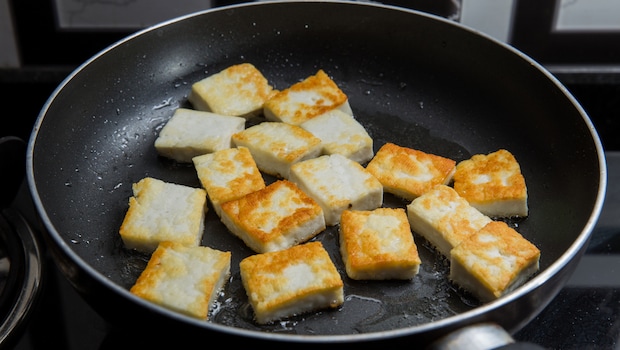
    In pan-frying, we use a very small amount of oil in a shallow pan. Think of it as a mid-point between sauteing and deep-frying food. The idea behind pan frying food is to use just enough oil to cover the bottom of the pan. This method is quick and will give you that golden and crispy crust on foods like paneer, cutlets, or even aloo tikki without drowning them entirely in oil. The food will cook in its own juices while the little oil used will add a delightful taste to your dish. This will result in a dish that is packed with flavours, not too greasy, and holds some original texture. Plus, it is a healthier option as compared to deep frying since you are using less oil.

    What Is Deep Frying?

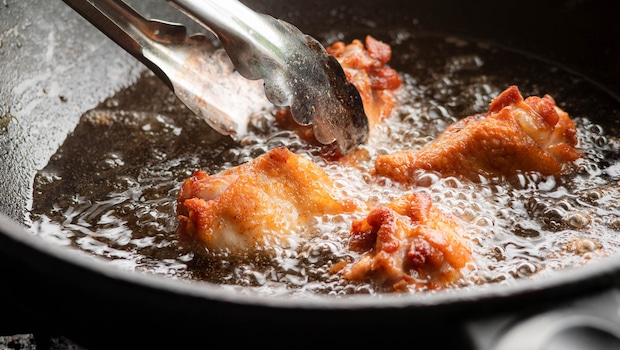
    As the name suggests, deep frying requires the food to be submerged completely in the hot oil to cook. This method will give your foods a perfect, all-around crispiness. When you deep fry, the heat of the oil seals the exterior layer of the food quickly. This results in locked-in moisture and gives you a crispy and crunchy exterior. Deep frying is what gives those lip-smacking samosas, pakoras and jalebis that irresistible crunch. Although it is not the healthiest cooking method, once in a while you can indulge in that ultimate crunch that deep frying provides.

    Deep frying requires a large amount of oil to cook the food.

    Deep frying requires a large amount of oil to cook the food.
    Photo Credit: iStock

    Which One Do You Choose – Pan Fry or Deep Fry?

    So, when do you pan-fry or when do you deep fry? It all depends on the dish and the texture you are hoping for. Pan frying is generally better suited for smaller quantities of quickly cooking foods like eggs and vegetables. The end result would be a lighter, less oily dish with a deliciously subtle crunch. Moreover, other dishes – particularly involving fish – may also fall into this category as they can break into pieces.

    On the other hand, if you are looking for a full-on crispy indulgent treat, then you should deep fry. This method would allow quick and even cooking and works best for large quantities of food. Since it is deeply fried and requires more amount of oil, deep-fried food lends a heavier, richer taste, as compared to pan-fried foods.

    Also Read: Author Krish Ashok Explains “Indian Food Terms” In An Oh-So-Relatable Manner

    Source link

  • 8 Best and Worst Oils For Deep Frying – As Told By A Doctor

    8 Best and Worst Oils For Deep Frying – As Told By A Doctor

    Deep frying is a popular cooking method, but it requires a careful selection of oils to ensure both flavour and health benefits. The choice of oil is crucial because different oils have varying smoke points, which is the temperature at which an oil begins to break down, producing smoke and potentially harmful compounds. When an oil reaches its smoke point, it loses its nutritional value and can impart a burnt flavour to food. Therefore, understanding which oils are best suited for high-heat cooking like deep frying is essential for both health and culinary success. In this article, we’ll explore the best and worst oils for deep frying, helping you make informed decisions in the kitchen.

    Also Read: 5 Best Cooking Oils For Heart Health, According To Dr Shriram Nene

    Here Are 6 Best Oils for Deep Frying:

    1. Refined Coconut Oil: 

    Refined coconut oil is an excellent choice for deep frying due to its high saturated fat content and stability at high temperatures. With a smoke point of about 400 degrees F (204 degrees C), refined coconut oil is less likely to break down during frying, preserving the flavour and health benefits of your food. Its mild taste also makes it a versatile option for various dishes.

    2. Refined Olive Oil: 

    Although extra virgin olive oil is often praised for its health benefits, it’s not suitable for deep frying due to its low smoke point. However, refined olive oil is a different story. It has a smoke point of 465 degrees F (240 degrees C) and contains healthy monounsaturated fats. Refined olive oil undergoes a process that removes impurities, making it stable for deep frying without altering its fundamental glyceridic structure. Its neutral flavour allows it to be used in a wide range of recipes.

    3. Ghee (Clarified Butter): 

    Ghee, or clarified butter, is another excellent option for deep frying. With a smoke point of approximately 450 degrees F (232 degrees C), ghee can withstand high temperatures without breaking down. It is rich in butyric acid, which supports gut health by promoting the growth of beneficial bacteria. Additionally, ghee’s anti-inflammatory properties make it a healthy choice for frying, sauteing, and other high-heat cooking methods.

    4. Avocado Oil: 

    Avocado oil is one of the healthiest oils you can use for deep frying. It has an exceptionally high smoke point of around 520 degrees F (271 degrees C), making it ideal for high-heat cooking. Avocado oil is rich in heart-healthy monounsaturated fats, similar to olive oil, and contains essential fatty acids, antioxidants, and vitamins A, D, and E. These nutrients contribute to various health benefits, making avocado oil a premium choice for frying.

    5. Rice Bran Oil and Peanut Oil: 

    Both rice bran oil and peanut oil are good choices for deep frying, with high smoke points and a healthy balance of monounsaturated fats. These oils are stable at high temperatures and offer a neutral flavour, making them suitable for a variety of fried dishes. Rice bran oil, in particular, is known for its antioxidant content, while peanut oil is valued for its nutty flavour.

    6. Mustard Oil: 

    While mustard oil is commonly used in some regions for cooking, it contains erucic acid, which has been linked to heart issues in animal studies, though evidence in humans remains inconclusive. Mustard oil has a high smoke point and contains beneficial fats, but it should be used in moderation, especially if other healthier options like olive or avocado oil are available.

    Also Read: How To Safely Dispose Of Cooking Oil After Frying? Viral Video Explains

    Here Are 2 Worst Oils for Deep Frying, As Per The Doctor

    1. Extra Virgin Olive Oil: 

    Extra virgin olive oil is highly valued for its health benefits, including its rich content of antioxidants like polyphenols and vitamin E. However, it has a low smoke point and is not suitable for deep frying. When exposed to high heat, extra virgin olive oil can degrade, leading to the production of harmful compounds. It’s best reserved for low-heat cooking or raw dishes, such as a salad dressing.

    2. Seed Oils (Sunflower, Soybean, and Canola Oils): 

    Oils like sunflower, soybean, and canola are high in polyunsaturated fats, which are prone to oxidation at high temperatures. When these oils oxidize, they produce harmful free radicals, which can contribute to chronic health conditions. For this reason, it’s advisable to avoid using these oils for deep frying.

    Opting for oils with high smoke points and stable fat content can make your fried dishes healthier and more enjoyable. 


    Source link

  • Young girls are using anti-aging products they see on social media. The harm is more than skin deep

    Young girls are using anti-aging products they see on social media. The harm is more than skin deep

    SACRAMENTO, Calif. — When she was in fifth grade, Scarlett Goddard Strahan started to worry about getting wrinkles.

    By the time she turned 10, Scarlett and her friends were spending hours on TikTok and YouTube watching influencers tout products for achieving today’s beauty aesthetic: a dewy, “glowy,” flawless complexion. Scarlett developed an elaborate skin care routine with facial cleansers, mists, hydrating masks and moisturizers.

    One night, Scarlett’s skin began to burn intensely and erupted in blisters. Heavy use of adult-strength products had wreaked havoc on her skin. Months later, patches of tiny bumps remain on Scarlett’s face, and her cheeks turn red in the sun.

    “I didn’t want to get wrinkles and look old,” says Scarlett, who recently turned 11. “If I had known my life would be so affected by this, I never would have put these things on my face.”

    Scarlett’s experience has become common, experts say, as preteen girls around the country throng beauty stores to buy high-end skin care products, a trend captured in viral videos with the hashtag #SephoraKids. Girls as young as 8 are turning up at dermatologists’ offices with rashes, chemical burns and other allergic reactions to products not intended for children’s sensitive skin.

    “When kids use anti-aging skin care, they can actually cause premature aging, destroy the skin barrier and lead to permanent scarring,” says Dr. Brooke Jeffy, a Scottsdale, Arizona, dermatologist who has posted her own social media videos rebutting influencers’ advice.

    More than the physical harm, parents and child psychologists worry about the trend’s effects on girls’ mental health — for years to come. Extensive data suggests a fixation on appearance can affect self-esteem and body image and fuel anxiety, depression and eating disorders.

    The skin care obsession offers a window into the role social media plays in the lives of today’s youth and how it shapes the ideals and insecurities of girls in particular. Girls are experiencing high levels of sadness and hopelessness. Whether social media exposure causes or simply correlates with mental health problems is up for debate. But to older teens and young adults, it’s clear: Extended time on social media has been bad for them, period.

    Young girls’ fascination with makeup and cosmetics is not new. Neither are kids who hold themselves to idealized beauty standards. What’s different now is the magnitude, says Kris Perry, executive director of Children and Screens, a nonprofit that studies how digital media impacts child development. In an era of filtered images and artificial intelligence, some of the beautiful faces they encounter aren’t even real.

    “Girls are being bombarded with idealized images of beauty that establish a beauty standard that could be very hard — if not impossible — to attain,” Perry says.

    The obsession with skin care is about more than the pursuit of perfect skin, explains 14-year-old Mia Hall.

    It’s about feeling accepted and belonging to a community that has the lifestyle and look you want, says Mia, a New Yorker from the Bronx.

    Skin care was not on Mia’s radar until she started eighth grade last fall. It was a topic of conversation among girls her age — at school and on social media. Girls bonded over their skin care routines.

    “Everyone was doing it. I felt like it was the only way I could fit in,” says Mia. She started following beauty influencers like Katie Fang and Gianna Christine, who have millions of young followers on TikTok. Some influencers are paid by brands to promote their products, but they don’t always mention that.

    Mia got hooked on “Get Ready With Me” videos, where influencers film themselves getting ready — for school, for a night out with friends, packing for a trip. The hashtag #GRWM has over 150 billion views on TikTok.

    “It’s like a trance. You can’t stop watching it,” Mia says. “So when they tell me, ‘Go buy this product’ or, ‘I use this and it’s amazing,’ it feels very personal. Getting what they have makes me feel connected to them.”

    Mia started saving her $20 weekly allowance for trips with friends to Sephora. Her daily routine included a face wash, a facial mist, a hydrating serum, a pore-tightening toner, a moisturizer and sunscreen. Most were luxury brands like Glow Recipe, Drunk Elephant or Caudalie, whose moisturizers can run $70.

    “I get really jealous and insecure a lot when I see other girls my age who look very pretty or have an amazing life,” she says.

    The level of detail and information girls are getting from beauty tutorials sends a troubling message at a vulnerable age, as girls are going through puberty and searching for their identities, says Charlotte Markey, a body image expert and Rutgers University psychologist.

    “The message to young girls is that, ‘You are a never-ending project to get started on now.’ And essentially: ‘You are not OK the way you are’,”’ says Markey, author of “The Body Image Book for Girls.”

    The beauty industry has been cashing in on the trend. Last year, consumers under age 14 drove 49% of drug store skin sales, according to a NielsonIQ report that found households with teens and tweens were outspending the average American household on skin care. And in the first half of 2024, a third of “prestige” beauty sales, at stores like Sephora, were driven by households with tweens and teens, according to market research firm Circana.

    The cosmetics industry has acknowledged certain products aren’t suitable for children but has done little to stop kids from buying them. Drunk Elephant’s website, for example, recommends kids 12 and under should not use their anti-aging serums, lotions and scrubs “due to their very active nature.” That guidance is on the site’s FAQ page; there are no such warnings on the products themselves.

    Sephora declined to comment for this story.

    Ingredients like retinol and chemical exfoliants like hydroxy acids are inherently harsh. For aging skin, they are used to stimulate collagen and cell production. Young or sensitive skin can react with redness, peeling and burning that can lead to infections, acne and hypersensitivity if used incorrectly, dermatologists say.

    Dermatologists agree a child’s face typically needs only three items, all found on drugstore shelves: a gentle cleanser, a moisturizer and sunscreen.

    A California bill aimed at banning the sale of anti-aging skin care products to children under age 13 failed this spring, but Democratic Assemblymember Alex Lee says he plans to continue pursuing industry accountability. Lee and other critics say popular brands use colorful packaging and product names like “Baby facial” to attract younger buyers in the same way that e-cigarette companies and alcohol brands created fruity flavors that appeal to underage users.

    Lee points to Europe as setting the right example. The European Union enacted legislation last year that limits the concentration of retinol in all over-the-counter products. And one of Sweden’s leading pharmacy chains, Apotek Hjartat, said in March it would stop selling anti-aging skin care products to customers under 15 without parental consent. “This is a way to protect children’s skin health, finances and mental well-being,” the company said.

    Around the country, concerned mothers are visiting dermatologists with their young daughters, carrying bags filled with their child’s skin care products to ask: Are these OK?

    “Often the mothers are saying exactly what I am but need their child to hear it from an expert,” says Dr. Dendy Engelman, a Manhattan dermatologist. “They’re like, ‘Maybe she’ll listen to you because she certainly doesn’t listen to me.’”

    Mia’s mother, Sandra Gordon, took a different approach. Last spring, she noticed dark patches on Mia’s face and became alarmed. Gordon, a nurse, threw all her daughter’s products into the trash.

    “There were Sephora bags on top of bags. Some things were opened, some not opened, some were full. I got rid of them all,” she says.

    Mia wasn’t happy. But as she starts high school, she now feels her mother was right. She has switched to a simple routine, using just a face wash and moisturizer, and says her complexion has improved.

    In Sacramento, California, Scarlett missed early signs the products were hurting her skin: She developed a rash and felt a stinging sensation, within days of trying out viral skin care products. Scarlett figured she wasn’t using enough, so she layered on more. That’s when her cheeks erupted in blistering pain.

    “It was late at night. She came running into my room crying. All of her cheeks had been burned,” recalls Anna Goddard, Scarlett’s mother, who hadn’t realized the extent of Scarlett’s skin care obsession.

    When Goddard read the ingredients in each product, she was shocked to find retinol in products that appeared to be marketed to children — including a facial sheet mask with a cat’s face on the packaging.

    What worries her mother most is the psychological consequences. Kids’ comments at school have caused lingering anxiety and self-consciousness.

    Goddard hopes to see more protections. “I didn’t know there were harmful ingredients being put in skin care that is marketed to kids,” she says. “There has to be some type of warning.”

    ___

    The Associated Press’ education coverage receives financial support from multiple private foundations. AP is solely responsible for all content. Find AP’s standards for working with philanthropies, a list of supporters and funded coverage areas at AP.org.


    Source link