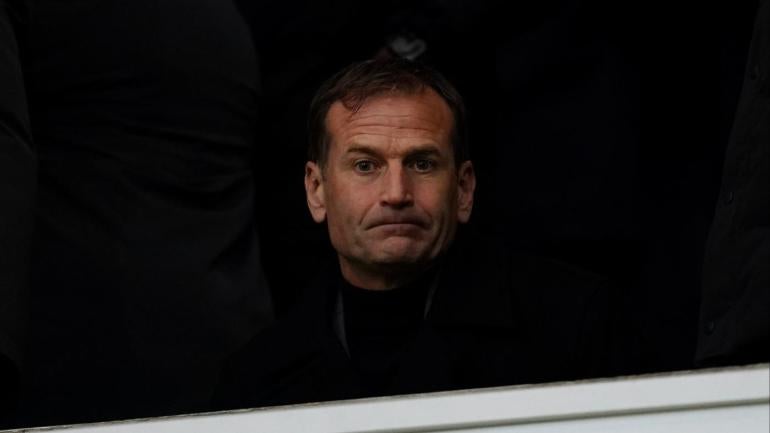
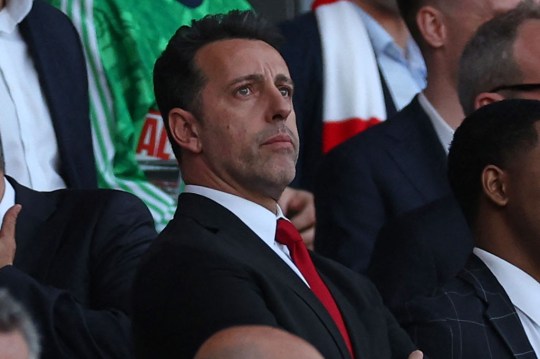
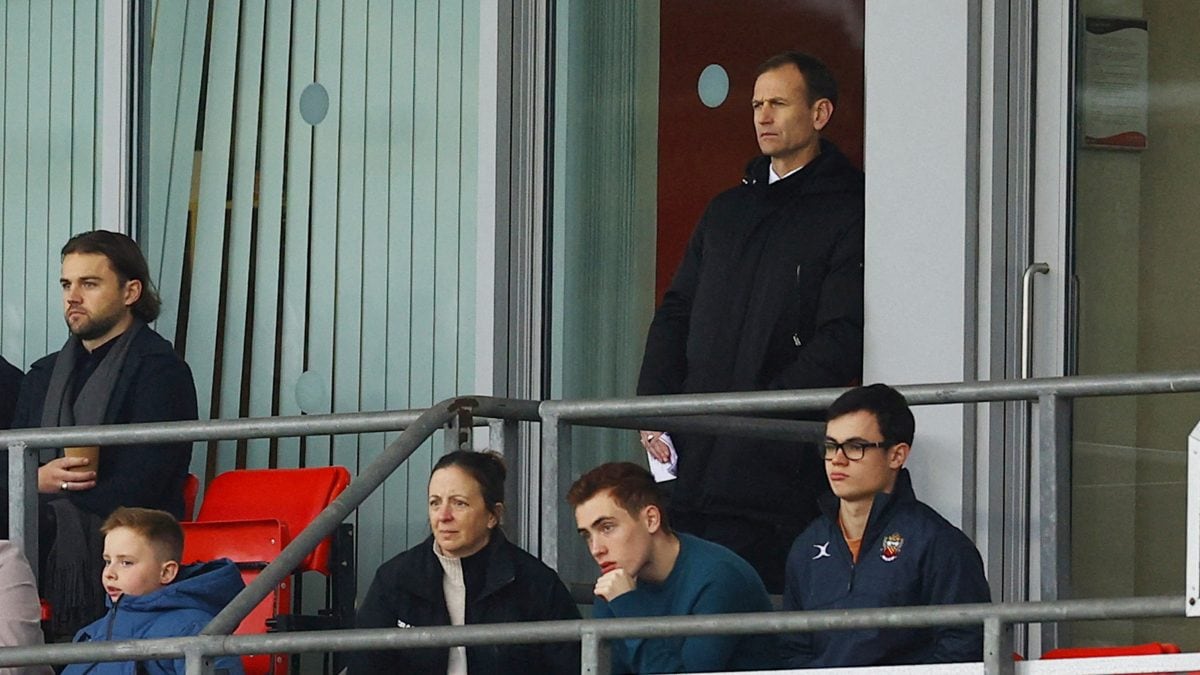
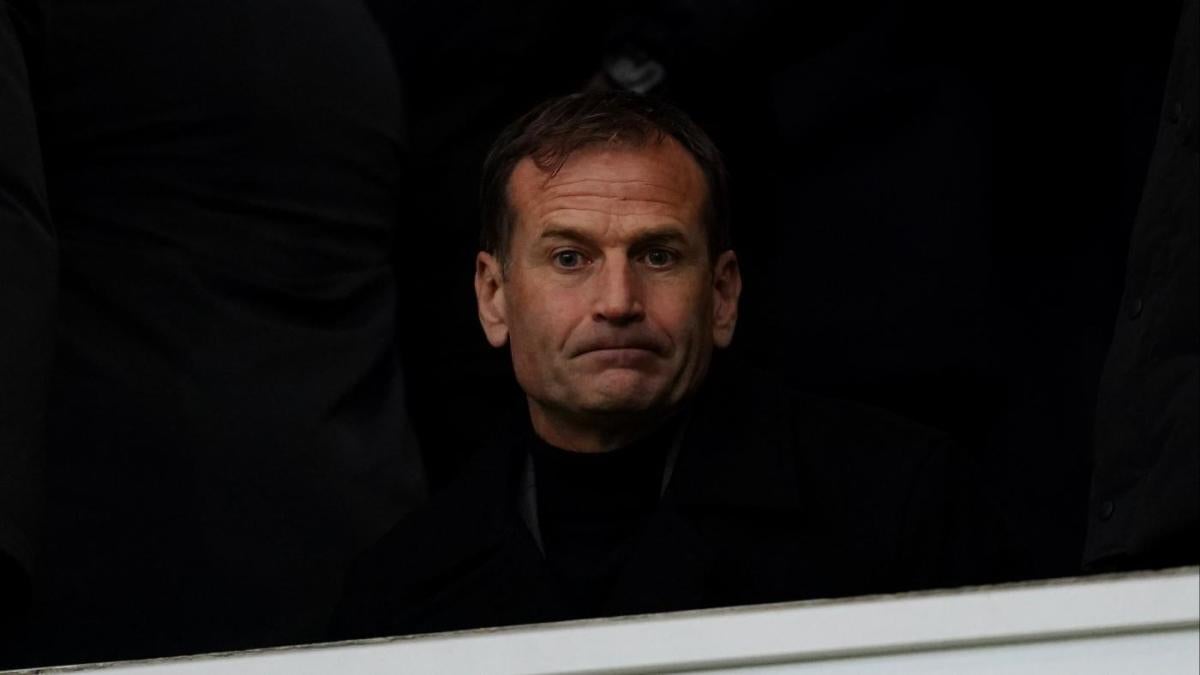
Everything that can go wrong is going wrong at Manchester United. They have lost the last two matches in Premier League under new manager Ruben Amorim and their sporting director, Dan Ashworth, has been sacked after just five months in the job.
read more
The troubles don’t seem to get over at Manchester United. They recently sacked Erik Ten hag in October after the club was reeling at 14th place in the Premier League and the Red Devils are in 13th now after two back-to-back defeats under new manager Ruben Amorim, who joined the club with a big reputation, only in November.
To make matters worse, they have now sacked sporting director Dan Ashworth after just five months. Ashworth was the force behind giving Ten Hag a year’s contract extension, which was initially greeted positively by fans after United upset Manchester City to win the FA Cup final at the end of last season.
Man Utd admit mistake by sacking Ashworth
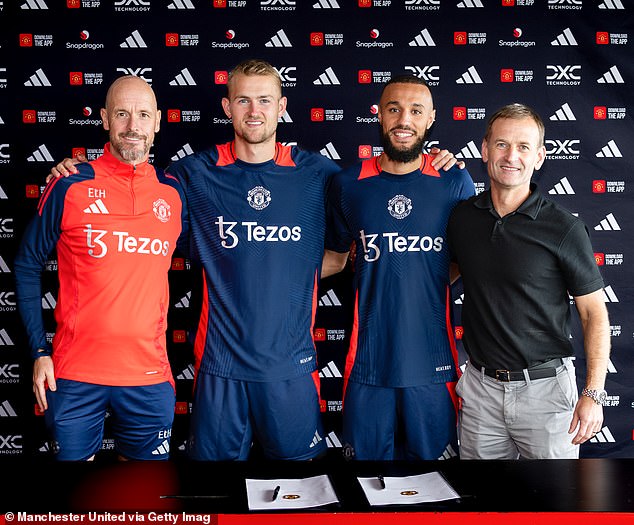
Ashworth also oversaw United’s major summer player signings including Matthijs de Ligt, Noussair Mazraoui, Manuel Ugarte, Leny Yoro, and Joshua Zirkzee.
None of them have consistently impressed, although French defender Yoro only made his debut last week following a lengthy injury.
The Premier League club said Ashworth’s contract was terminated by mutual agreement.
“We would like to thank Dan for his work and support during a transitional period for the club and wish him well in the future,” United said in a statement.
It has to be noted that the 53-year-old was recruited from Newcastle United and the Red Devils paid around 10 million pounds to secure his services, as per reports. He was described as “one of the top sporting directors in the world” by minority owner Jim Ratcliffe. However, the reports now say that it was also the INEOS boss, Ratcliffe, who engineered Ashworth’s departure.
Ashworth, who oversaw spending of close to 200 million pounds ($255 million) on new players since joining United, was sacked after a meeting with Chief Executive Omar Berrada after Saturday’s 3-2 home loss to Nottingham Forest, the Athletic reported.
In many ways an admittance of their failures, by United.
Man Utd continue to struggle on pitch
There’s no quick solution in sight as the club continues to struggle on the field as well.
United’s first loss to Forest at Old Trafford in more than 30 years on Saturday left them 13th in the table on 19 points, their lowest after 15 games since 1986.
Portuguese Amorim, recruited from Sporting Lisbon, has led United one win in his four league games in charge.
“We already knew (it would be tough),” Amorim said after the Forest defeat. “It will be a long journey but we want to win because this is a massive club.”
United travel to face Czech team Viktoria Plzen in the Europa League on Thursday and before travelling to champions Manchester City on Sunday.
Manchester United and sporting director Dan Ashworth have separated after just five months with the Premier League outfit confirming the 53-year-old’s departure on Sunday. Ashworth, who spent five months on gardening leave from Newcastle United before moving to Old Trafford, only joined the Red Devils back in early July.
United, who recently appointed Ruben Amorim as Erik ten Hag’s replacement as head coach, described the move as being a “mutual agreement.” The decision is believed to have been made following United’s 3-2 home loss to Nottingham Forest on Saturday which mires the team down in 13th position in the Premier League.
“Dan Ashworth will be leaving his role as sporting director of Manchester United by mutual agreement,” read the club’s official statement this Sunday. “We would like to thank Dan for his work and support during a transitional period for the club and wish him well for the future.”
Ashworth was present at Old Trafford and was seen walking to a meeting through the press conference room postgame. The former Brighton and Hove Albion technical director cost United millions of dollars in a settlement with former club Newcastle United which prevented him from even taking office before the summer.
A significant part of Sir Jim Ratcliffe’s initial restructuring of United’s executive team as well as CEO Omar Berrada and technical director Jason Wilcox, he leaves after just one transfer window. The trio worked together on Amorim’s appointment from Sporting CP as Ten Hag’s successor but Ashworth and the Portuguese tactician did not even work together for a full month in Manchester.
Matthijs de Ligt, Manuel Ugarte, Leny Yoro, Joshua Zirkzee and Noussair Mazraoui all arrived over the summer for a combined total in excess of $229.3 million. Ten Hag was dismissed for failing to build on the confidence shown towards him to turn things around with those new arrivals and new Leicester City boss Ruud van Nistelrooy temporarily replaced his compatriot before Amorim’s arrival last month.
United are currently 13th in the EPL standings with just 19 points which is their lowest total after 15 games since 1986. Amorim’s side will travel to Czechia to face Viktoria Plzen in the UEFA Europa League this midweek before the Manchester Derby against bitter rivals City next Sunday with Pep Guardiola’s men also in a bad way.
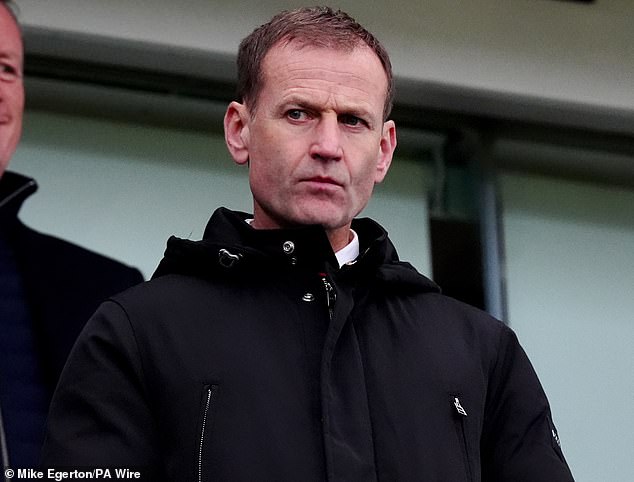
Dan Ashworth left his job as the sporting director of Manchester United after just five months as both parties agreed he was not a good ‘fit’ for the club.
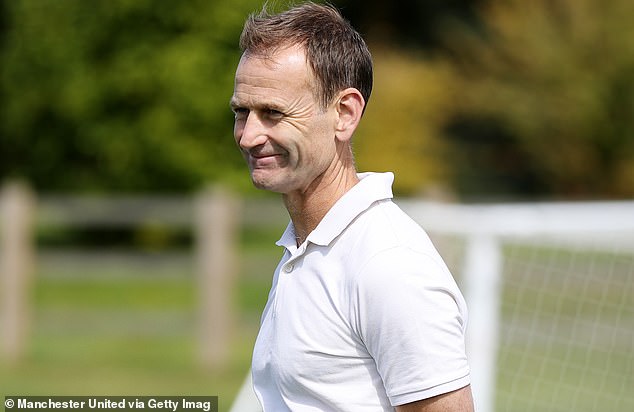
Ashworth officially began work at Old Trafford on July 1 after a lengthy period of gardening leave at his former club Newcastle United.
However, his shock departure today is said to have been finalised in a meeting with United CEO Omar Berrada after last night’s defeat by Nottingham Forest.
There is not believed to have been a row but it was clear to all parties that the relationship was not working and Ashworth was not the fit club chiefs had hoped it would be.
Sir Jim Ratcliffe, United’s part-owner, was reportedly pivotal in the decision.
United are not thought to be searching for a replacement at this stage.
Dan Ashworth left his job as the sporting director of Manchester United after just five months as both parties agreed he was not a good ‘fit’ for the club
There is not believed to have been a row but it was clear to all parties that the relationship was not working
United say the agreement to rip up Ashworth’s contract was mutual – sharing the following statement: ‘Dan Ashworth will be leaving his role as Sporting Director of Manchester United by mutual agreement.
‘We would like to thank Dan for his work and support during a transitional period for the club and wish him well for the future.’
Ashworth, 53, was appointed to oversee football performance and recruitment at the club and reported to Berrada, a recent arrival from Manchester City.
In turn, Jason Wilcox, United’s technical director, worked under Ashworth as part of the new-look hierarchy implemented by Ratcliffe.
Ashworth was involved in the Red Devils’ £200million spending spree during the summer with Leny Yoro, Manuel Ugarte, Matthijs de Ligt, Noussair Mazraoui and Joshua Zirkzee also recruited as part of the substantial outlay.
He was subsequently quoted in the statements confirming each signing.
Ashworth was also part of the executive team that made the decision to hand Erik ten Hag a new contract and then sack him just a matter of months later.
His appointment at United came at the end of painstaking negotiations with Newcastle. Ashworth informed the Tyneside club that he wanted to move to Old Trafford in February and was reportedly open to taking them to arbitration.
United CEO Omar Berrada reportedly agreed the departure in a meeting with Ashworth
Ashworth was involved in a summer spending spree which saw the likes of Matthijs de Ligt and Noussair Mazraoui arrive
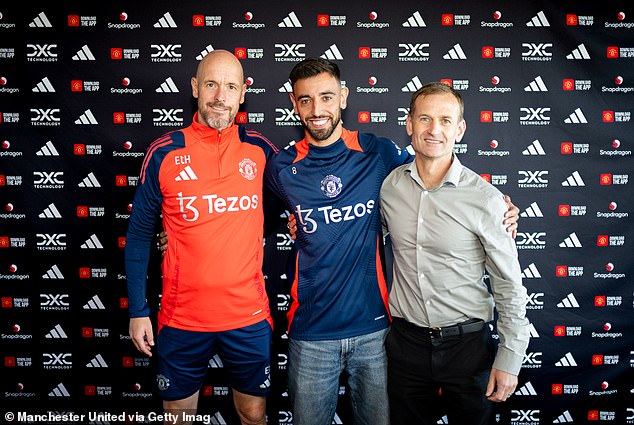
He was also snapped with Bruno Fernandes after his contract extension was announced
Initially, Newcastle had demanded around £20m in compensation, although a compromise worth between £2m to £3m was eventually thrashed out.
‘Dan Ashworth is clearly one of the top sporting directors in the world,’ Ratcliffe said in February. ‘I have no doubt he is a very capable person.
‘He is interested in Manchester United because it’s the biggest challenge at the biggest club in the world. It would be different at City because you’re maintaining a level. Here it’s a significant rebuilding job. He would be a very good addition.’
Ashworth joined Newcastle after resigning from his technical director role at Brighton in February 2022. He previously held the same post with the Football Association.
Ratcliffe brutally described United as a ‘mediocre’ club paying the price for ‘very poor’ recruitment in a bombshell interview with fanzine United We Stand.
‘The club has drifted for a long period of time, a decade or so. Manchester United has become mediocre,’ Ratcliffe said.
‘It’s not elite and it is supposed to be one of the best football clubs in the world.
‘That’s what it used to be under Alex [Ferguson]. There is major change to come to achieve elite status.
Ashworth joined United from Newcastle after protracted negotiations spanning several weeks
United couldn’t find the much-needed equaliser in a 3-2 defeat at home to Nottingham Forest
‘But already there has been huge change at this club.’
Ratcliffe has also been left astounded by how out of touch United have been become with data analysis in comparison to their rivals.
‘Until we’re are as good as anyone in the world, then it’s not good enough for Manchester United. We must have the best recruitment in the world,’ he added.
‘Data analysis comes alongside recruitment. It doesn’t really exist here. We’re still in the last century on data analysis here.’
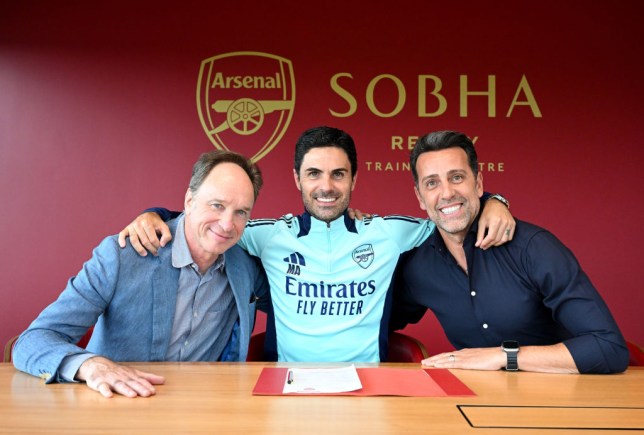
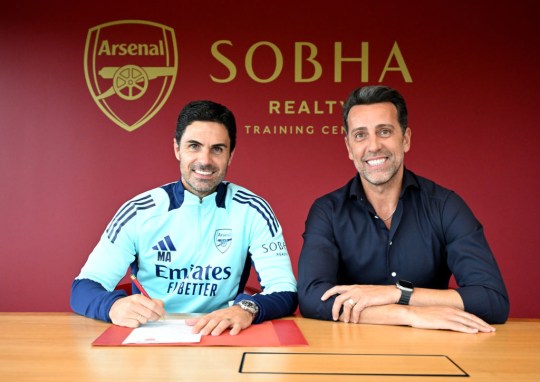
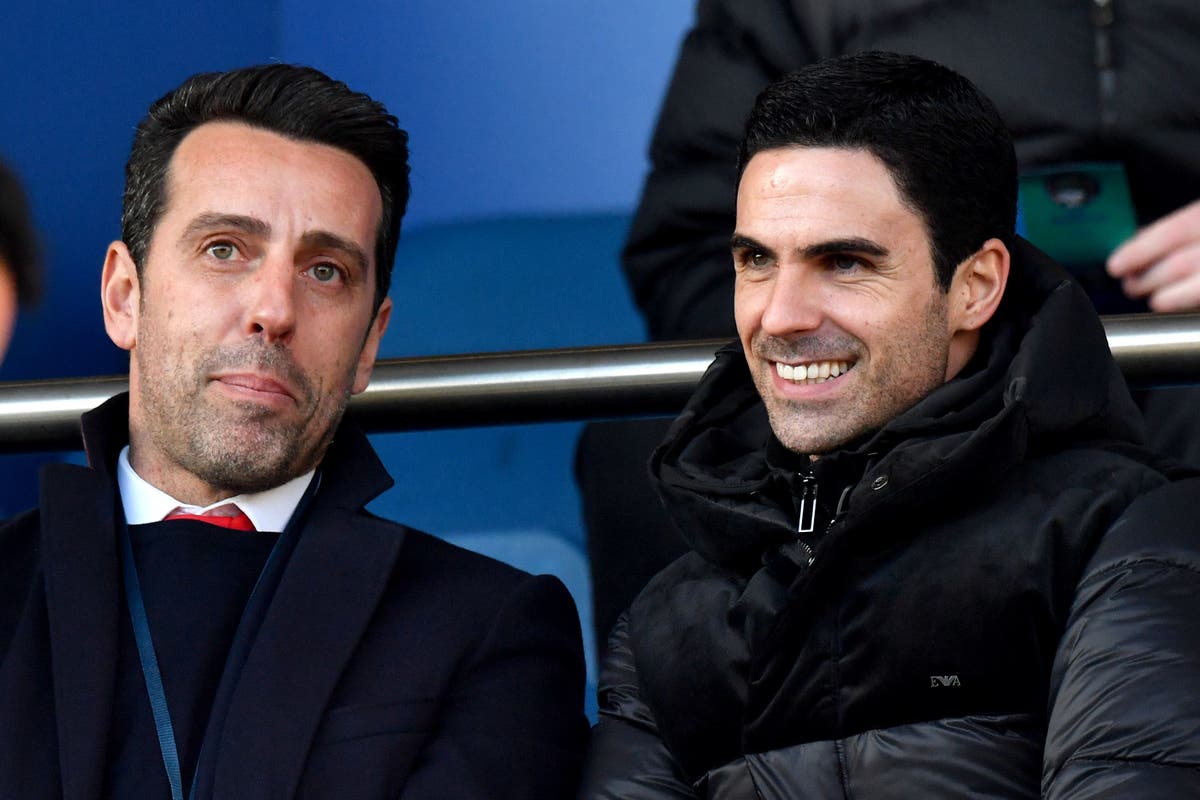
Edu Gaspar (right) alongside Mikel Arteta and Executive Vice-Chair Tim Lewis (Picture: Getty Images)
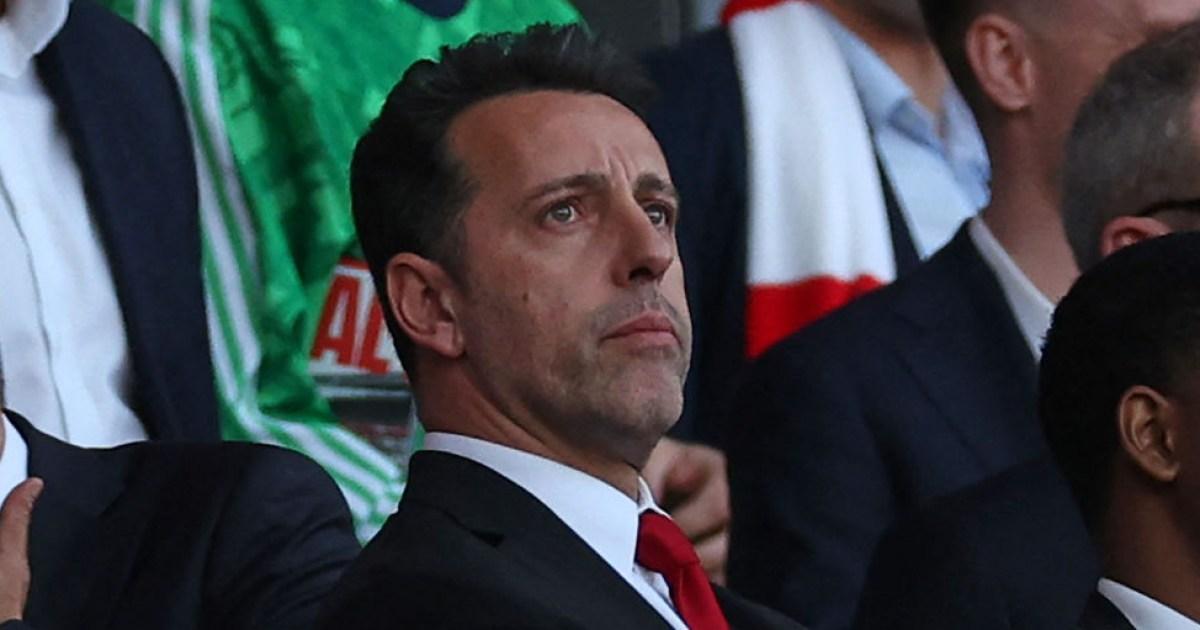
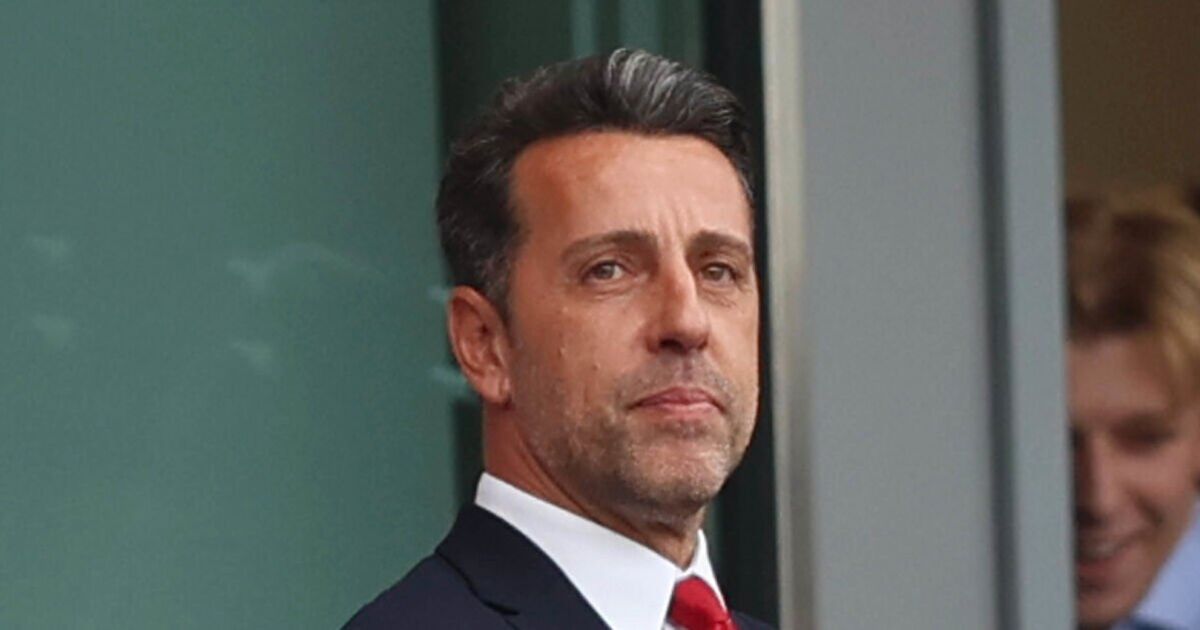
Arsenal sporting director Edu is to leave in a huge blow for the Gunners, set to join Evangelos Marinakis’ group of clubs which includes Nottingham Forest.
The Brazilian rejoined the club he used to play for from 2001-05 in 2019 as technical director and stepped up to sporting director in November 2022.
The Daily Mail report that talks have been held between Edu and the Arsenal hierarchy but the Brazilian has decided to move on.
The Independent have since reported that he is making a surprise move to link up with the Marinakis network of Forest, Oympiacos and Rio Ave.
The unexpected move is reportedly driven by Edu wanting to become CEO at Arsenal and being offered that position at the Marinakis-owned group.
Edu was alongside Mikel Arteta in September as the Spaniard signed a new contract with the club and spoke about the long-term future under the manager.
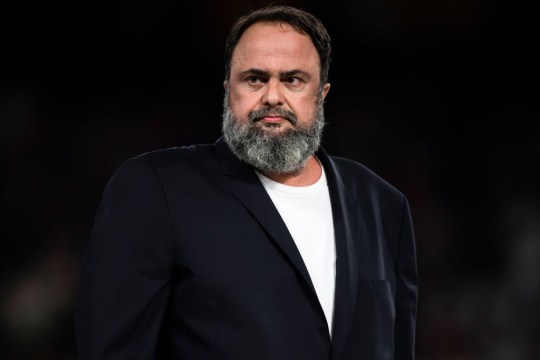
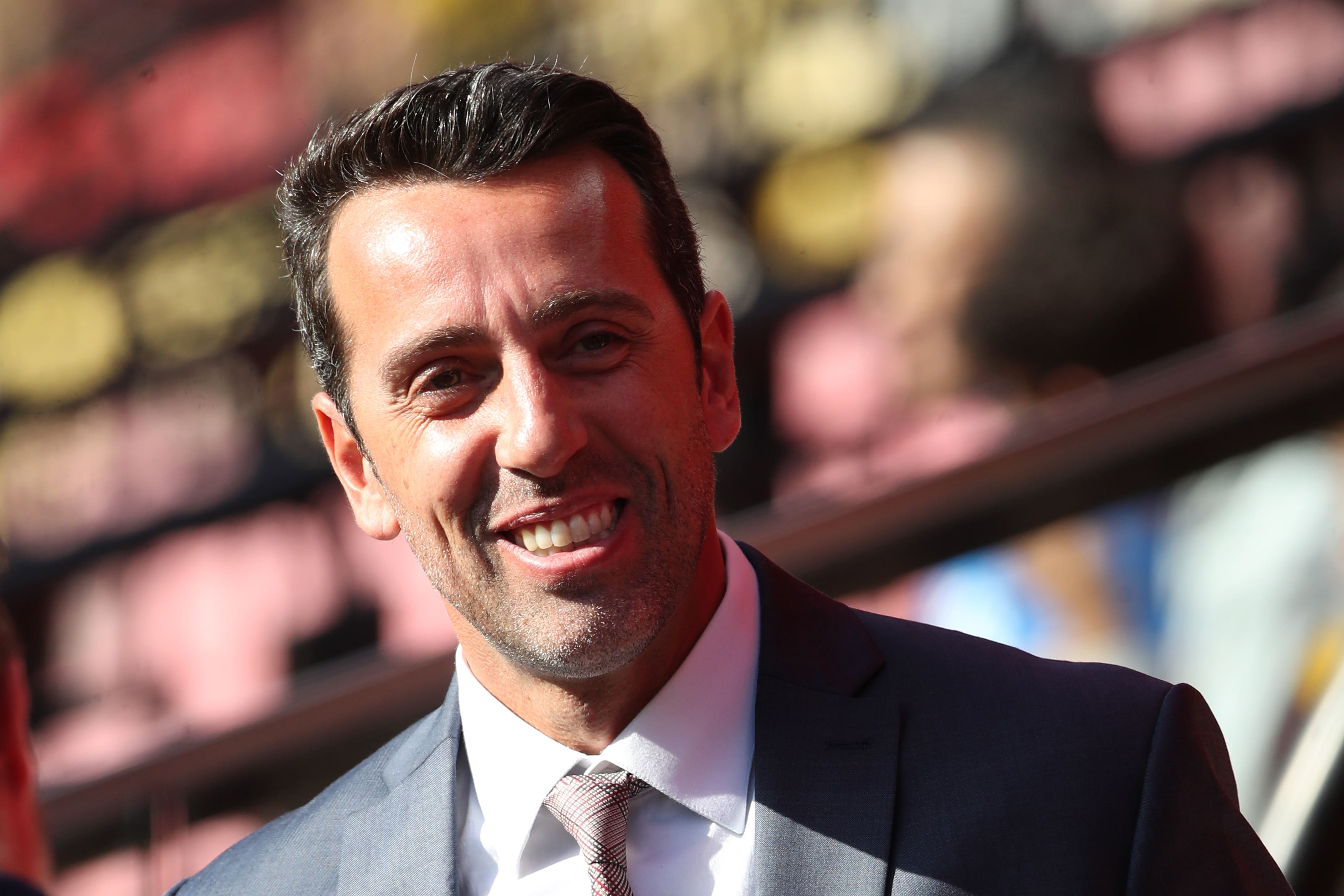
Greek businessman Evangelos Marinakis has pulled off a huge coup by attracting Edu (Picture: Getty Images)
‘We are really happy that Mikel has signed a new long-term contract,’ said the Brazilian.
‘It’s a very positive and proud moment for everyone at the club and an important part of what we’re all working towards.
‘Mikel has shown his qualities since the very first day he joined us, not only as a football manager, but as a person with wonderful values.
Edu has been a key figure at Arsenal over the last five years (Picture: Getty Images)
‘It’s a very positive and proud moment for everyone at the club and an important part of what we’re all working towards.
‘Mikel has shown his qualities since the very first day he joined us, not only as a football manager, but as a person with wonderful values.’
Edu spoke over the summer with Men In Blazers about his strategy and how he has had to make ‘unpopular decisions’ to achieve success.
‘When you live in the football world, sometimes you have to make decisions simple and sometimes you have to make decisions even if it is not popular,’ he said.
Mikel Arteta and Edu appear to have enjoyed a close working relationship (Picture: Getty Images)
‘You have to be very strong on your ideas, what you believe, what is good for the club, what is good for the future of the club.
‘For me, there are some elements in football which I will always give a lot of attention. When I joined, I looked at the squad balance, the positions, the age of the group. There are three elements that you have to be really aware of.
‘First of all, we have to see the age of the player. Then you have to see the salary of the player. And third you have to see the performance of the player.
‘If you have a player over 26 or 27 years, you need attention. If his salary is high, you need attention. And if he is not performing, you are dead.
‘Let’s come back… If you have a player, 27 years old or 28, on a big salary, but he is performing, you can accept it. What you cannot accept is if you have those three elements and the player is over 28.
‘You start to become uncomfortable and it is better for you to move them on – because maybe this player is blocking someone younger, an asset who could help you.
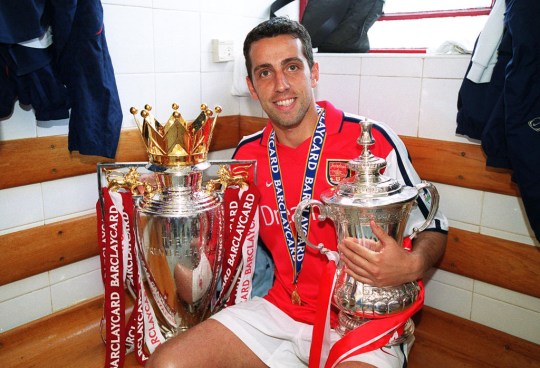
Edu won two Premier League titles with Arsenal as a player (Picture: Getty Images)
‘When I came to Arsenal, I saw all the squad, with respect, almost everyone was over 26, 27, on big salaries and not performing. If you have those three elements, which club in the world wants to come here and buy one of our players? No-one.
‘So how do you deal with that situation? You have to be strong and sometimes you have to make decisions. You can go strong and try to let those players go or your project is going to take, instead of three or four years, maybe seven, eight or nine.
‘Then unpopular decisions started to come. Because most of the players that have those elements, they have a fanbase and a media that love them. But for the club it is not healthy sometimes to keep the player in that situation.
‘When I started I saw every single player in the squad with those three characteristics. Then I said: “Guys, we have to clean this squad, with all my respect, to build a new foundation here. From that foundation, we need to sign younger players, on lower salaries, with better futures, who are hungry to take us where we want to go.’
The Arsenal sporting director, Edu, is to leave the club and looks likely to join the network of clubs spearheaded by Evangelos Marinakis, the owner of Nottingham Forest.
Edu’s shock departure will bring to an end five years in Arsenal’s senior management and means Mikel Arteta will lose one of his major allies. The pair enjoy a strong relationship and Arsenal will need too recalibrate when the Brazilian moves on. The timescale of his departure remains unclear.
Arsenal have become title challengers since their former midfielder rejoined the club, initially as technical director, in July 2019. He was heavily involved in Arteta’s arrival five months later and grew in influence after Raul Sanllehi, their head of football, departed in August 2020. Despite hits and misses early in his tenure, Edu has become regarded as integral to an aggressive, effective transfer policy that saw the likes of Martin Ødegaard, Ben White, Gabriel Magalhães, Gabriel Jesus and Declan Rice arrive to transform the profile of Arsenal’s squad.
There have been frustrations in more recent windows – the lack of genuine backups to Ødegaard or Bukayo Saka and an ongoing uncertainty over their centre-forward position the primary issues – although there is no indication that this is responsible for Edu’s imminent departure. His bonds with key members of Arsenal’s hierarchy are understood to extend beyond the friendship with Arteta. Arsenal are fifth in the Premier League after a patchy, injury-struck start to the season in which they have rarely recaptured their free-flowing best form of the Arteta era.
Now Edu is being lined up to take a senior role in Marinakis’ group, potentially in a position involving recruitment oversight. Forest, Olympiacos and the Portuguese side Rio Ave are the three clubs currently under the 57-year-old’s control.
Edu was director of football at Corinthians after ending his playing career and, before returning to Arsenal, had been team coordinator for Brazil’s national team. The 46-year-old’s lack of experience at the sharp end of European football administration had appeared a concern at the outset but he is now poised for a new challenge working for the ambitious and controversial Marinakis, whose Forest team have been the season’s surprise package and currently sit third in the top flight.
Arsenal sporting director Edu is reportedly set to leave the north London club.
The Brazilian has been Mikel Arteta‘s right-hand man since the manager’s appointment in 2019. He became Arsenal‘s technical director months before Arteta arrived and transitioned to the sporting director role three years later.
Edu has played a key part in Arsenal‘s successful recruitment strategy under Arteta. David Raya, Martin Odegaard and Leandro Trossard have all been smash hits since signing for the Gunners, who also pipped Manchester City to Declan Rice’s signature last year.
According to The Daily Mail, Edu has taken the decision himself to leave the Emirates Stadium. Changes to responsibility areas among senior figures at the club may have played their part in his departure, though the specifics are currently unclear and more light is expected to be shed on the situation over the next 24 hours.
Arteta is certain to be asked about Edu’s predicament during his press conference on Tuesday, the day before Arsenal play AC Milan at the San Siro in a mouth-watering Champions League showdown.
Edu has been a towering figure during Arteta’s time at the club, and he is widely considered to be one of the best sporting directors in world football.
The 46-year-old spent five seasons at Arsenal as a midfield player, starring alongside the likes of Thierry Henry and Patrick Vieira during the ‘Invincibles’ season and becoming a full Brazilian international.
Arsenal legend Martin Keown, who shared a dressing room with Edu, talked up his technical director appointment in 2019. “He understands this role and he understands the expectancy at Arsenal,” explained the former centre-back.
“He cannot really affect it on the training ground, but he will be able to address things with the processes at the club. He is a great guy who was also greatly underestimated, to be honest. It was a big loss when he left the football club because there was an element of class to him. I am pleased that the club has recognised that.”
Edu played 127 games for Arsenal before spending four years at Valencia and returning to Brazilian club Corinthians, who gave him his senior breakthrough in 1998.
Before joining up with the Gunners in retirement, Edu served as Corinthians’ director of football, assisted Iran boss Carlos Quieroz during the 2014 World Cup, and spent three years as Brazil’s general coordinator.
From reproductive rights to climate change to Big Tech, The Independent is on the ground when the story is developing. Whether it’s investigating the financials of Elon Musk’s pro-Trump PAC or producing our latest documentary, ‘The A Word’, which shines a light on the American women fighting for reproductive rights, we know how important it is to parse out the facts from the messaging.
At such a critical moment in US history, we need reporters on the ground. Your donation allows us to keep sending journalists to speak to both sides of the story.
The Independent is trusted by Americans across the entire political spectrum. And unlike many other quality news outlets, we choose not to lock Americans out of our reporting and analysis with paywalls. We believe quality journalism should be available to everyone, paid for by those who can afford it.
Your support makes all the difference.
Arsenal are set to lose sporting director Edu Gaspar with the Brazilian poised to join up with Nottingham Forest owner Evangelos Marinakis and his network of clubs.
The departure will remove one of Mikel Arteta’s key allies at the Emirates after a successful period establishing the Gunners as one of the most efficient clubs in Europe in the transfer market.
The Brazilian has played a vital role in Arteta’s side emerging as Premier League title contenders with some of the best business in recent years including the signings of Martin Odegaard and Declan Rice.
The former Arsenal midfielder has established himself as one of the game’s leading sporting directors after impressing with both signings and trimming down the Gunners’ squad after selling Pierre Emerick Aubameyang.
Edu has been in talks with the Marinakis group and could now lead their recruitment to assist with the likes of Nottingham Forest and Greek club Olympiacos, as well as Portuguese side Rio Ave.
The move will force a reshuffle at the top of the Arsenal hierarchy at a pivotal time for the club and their push to wrestle the title away from Manchester City.
The 46-year-old has been on record about his pride in shifting the culture at the Emirates and “changing how people see our club and the vision people have of Arsenal compared to the past.”
Edu maintained winning was not enough for Arsenal and their style was also paramount to their success.
Edu has played a leading role in Arsenal’s resurgence (PA Archive)
“I want to win the best way possible,” he said. “When we win the trophy, it is because we did it the right way. Ask every single Arsenal fan how they feel about that.”
The Brazilian midfielder was signed by Arsene Wenger and became an integral part of ‘The Invincibles’ alongside teammates Dennis Bergkamp, Patrick Vieira and Martin Keown.
In December 1990 The Wall Street Journal published a long front-page story about Jacques de Groote, a “suave and erudite” 63-year-old Belgian economist who was one of the most senior of the 22 executive directors of both the World Bank and the International Monetary Fund in Washington DC.
It reported that he “lives in a style that suggests substantial wealth … he has long been something of a bon vivant, with a taste for the finest in clothes, restaurants and residences. He has a $1 million townhouse in the Georgetown section of Washington, a $2 million working farm in Italy and a $1 million apartment in Brussels.”
It quoted a friend saying: “De Groote is an eccentric … He will go to a shop and buy 20 shirts, six pairs of shoes, flashy ties. He loves the finer things in life.” All this while facing what a Belgian court described as “serious financial problems” — namely debts totalling $1 million.
De Groote with his wife arriving at court in 2013
ALAMY
Where did his money come from? The suspicion, the Journal said, was that he was on the payroll of Mobutu Sese Seko, the deeply corrupt dictator of Zaire, the former Belgian colony now called the Democratic Republic of Congo. De Groote denied the charge.
The report noted that over two decades he had informed Zaire of the World Bank and IMF’s confidential negotiating strategies for granting that country’s regime aid packages worth hundreds of millions of dollars, and that Zaire had generally secured those packages despite its manifest corruption and huge debts.
At one point de Groote had visited Mobutu at his villa in the south of France to advise him on IMF business, the Journal said. At another, he had flown to Zaire to discuss its tattered relations with the IMF. In 1989 he had actively promoted a $211 million IMF loan plan for Zaire “despite worsening Zairian corruption, government misspending and economic decay”. Within months, the reform plan on which the loan was predicated had proved “a shambles”.
De Groote performed those services for Zaire even though it was not one of the countries that fell within his remit. But as an IMF and World Bank director, he was governed by no rules, no code of conduct. “He involves himself in the affairs that he chooses, rendering advice as he sees fit while helping to channel the $25 billion or so in international aid the organisations annually dispense,” the Journal wrote. “It is a position of much autonomy, with wide freedom from interference or scrutiny.”
The Journal cited other ways de Groote had benefited from his ties to both Zaire and neighbouring Rwanda, another former Belgian colony. He had run up sizeable personal debts, but was bailed out by assorted Belgian friends including Baron Jean-Louis van den Branden, who owned a mining and real estate company that operated in Zaire and Rwanda.
De Groote sought unsuccessfully to get the baron’s cash-strapped company $30 million in financing from a World Bank affiliate. Rather more successfully, he urged Rwanda to devalue its currency at van den Branden’s behest. De Groote survived the Journal’s investigation, but continued to live dangerously.
After leaving the World Bank in 1991, and the IMF in 1994, he became president of a Swiss-registered company called Appian Group, which invested in central and eastern European companies that were being privatised after communism’s collapse. One of those companies was Mostecka Uhelna Spolecnost (MUS), a big mining business in the Czech Republic.
He fell out with Alain Abdourahman, a Swiss financier who had lent him and his five secret Czech partners $533,000, which they used illegally to purchase MUS shares. Abdourahman sued de Groote to get the money back. The Swiss authorities investigated, and found that de Groote had used Appian to conceal the true identities of MUS’s purchasers.
In the ensuing trial in 2013 the five Czechs were imprisoned for money laundering and fraud, while de Groote was fined. The president of the court said he had “taken advantage of his excellent reputation”. His appeal against his conviction was upheld six years later, but he had paid a heavy price. His lawyer said his client, by then 86, hoped the ruling would “put an end to what has destroyed him psychologically and financially for so many years”.
De Groote said he’d had “stormy liaisons with well-known ladies”
ALAMY
Jacques de Groote was born in the village of Klerken in the Belgian province of West Flanders in 1927, one of nine siblings and half-siblings. Two of his half-brothers fought in the resistance in the Second World War and died in Nazi concentration camps. He was educated by Benedictine monks in Zevenkerken, near Bruges, then read law, economics and political science at Leuven University, earned an MA from Cambridge and taught at universities in Leuven, Lille and Namur.
In 1959, at the behest of the Congolese leader Patrice Lumumba, he was appointed secretary of a commission preparing for the Belgian Congo’s independence the following June, then moved to Washington as an assistant to Belgium’s representative at the IMF and World Bank.
In 1963 he joined the National Bank of Belgium. Three years later he became an economic adviser to Mobutu’s government and its national bank. It was de Groote who advised Mobutu to adopt “zaire” —meaning “river” or “big water” — as the name of its new currency, and Mobutu later adopted it as his country’s name.
In 1973 de Groote returned to Washington as Belgium’s executive director of the IMF and World Bank. Within those organisations he was responsible for the interests of six nations — Belgium, Austria, Luxembourg, Turkey, Hungary and what was then Czechoslovakia — but not of Zaire, which had its own executive directors.
That did not stop him from taking an active interest in Zaire’s affairs, an interest that he attributed to his personal commitment to that country and Belgium’s colonial ties to it. “I am not a Mobutu agent,” he told the Journal in that notorious 1990 article, though there is some evidence that his murky finances caused him to be overlooked for the governorship of the Belgian national bank.
As for his lavish lifestyle, de Groote admitted that he enjoyed the company of women. By then, the Journal reported, he was living apart from his wife, Jacqueline, the daughter of a former Belgian foreign minister with whom he is believed to have had a daughter. He acknowledged that he had “certainly had a number of women in my life … I had stormy liaisons with well-known ladies”.
Jacques de Groote, IMF and World Bank director, was born on May 25, 1927. He died on September 21, 2024, aged 97
In December 1990 The Wall Street Journal published a long front-page story about Jacques de Groote, a “suave and erudite” 63-year-old Belgian economist who was one of the most senior of the 22 executive directors of both the World Bank and the International Monetary Fund in Washington DC.
It reported that he “lives in a style that suggests substantial wealth … he has long been something of a bon vivant, with a taste for the finest in clothes, restaurants and residences. He has a $1 million townhouse in the Georgetown section of Washington, a $2 million working farm in Italy and a $1 million apartment in Brussels.”
It quoted a friend saying: “De Groote is an eccentric … He will go to a shop and buy 20 shirts, six pairs of shoes, flashy ties. He loves the finer things in life.” All this while facing what a Belgian court described as “serious financial problems” — namely debts totalling $1 million.
De Groote with his wife arriving at court in 2013
ALAMY
Where did his money come from? The suspicion, the Journal said, was that he was on the payroll of Mobutu Sese Seko, the deeply corrupt dictator of Zaire, the former Belgian colony now called the Democratic Republic of Congo. De Groote denied the charge.
The report noted that over two decades he had informed Zaire of the World Bank and IMF’s confidential negotiating strategies for granting that country’s regime aid packages worth hundreds of millions of dollars, and that Zaire had generally secured those packages despite its manifest corruption and huge debts.
At one point de Groote had visited Mobutu at his villa in the south of France to advise him on IMF business, the Journal said. At another, he had flown to Zaire to discuss its tattered relations with the IMF. In 1989 he had actively promoted a $211 million IMF loan plan for Zaire “despite worsening Zairian corruption, government misspending and economic decay”. Within months, the reform plan on which the loan was predicated had proved “a shambles”.
De Groote performed those services for Zaire even though it was not one of the countries that fell within his remit. But as an IMF and World Bank director, he was governed by no rules, no code of conduct. “He involves himself in the affairs that he chooses, rendering advice as he sees fit while helping to channel the $25 billion or so in international aid the organisations annually dispense,” the Journal wrote. “It is a position of much autonomy, with wide freedom from interference or scrutiny.”
The Journal cited other ways de Groote had benefited from his ties to both Zaire and neighbouring Rwanda, another former Belgian colony. He had run up sizeable personal debts, but was bailed out by assorted Belgian friends including Baron Jean-Louis van den Branden, who owned a mining and real estate company that operated in Zaire and Rwanda.
De Groote sought unsuccessfully to get the baron’s cash-strapped company $30 million in financing from a World Bank affiliate. Rather more successfully, he urged Rwanda to devalue its currency at van den Branden’s behest. De Groote survived the Journal’s investigation, but continued to live dangerously.
After leaving the World Bank in 1991, and the IMF in 1994, he became president of a Swiss-registered company called Appian Group, which invested in central and eastern European companies that were being privatised after communism’s collapse. One of those companies was Mostecka Uhelna Spolecnost (MUS), a big mining business in the Czech Republic.
He fell out with Alain Abdourahman, a Swiss financier who had lent him and his five secret Czech partners $533,000, which they used illegally to purchase MUS shares. Abdourahman sued de Groote to get the money back. The Swiss authorities investigated, and found that de Groote had used Appian to conceal the true identities of MUS’s purchasers.
In the ensuing trial in 2013 the five Czechs were imprisoned for money laundering and fraud, while de Groote was fined. The president of the court said he had “taken advantage of his excellent reputation”. His appeal against his conviction was upheld six years later, but he had paid a heavy price. His lawyer said his client, by then 86, hoped the ruling would “put an end to what has destroyed him psychologically and financially for so many years”.
De Groote said he’d had “stormy liaisons with well-known ladies”
ALAMY
Jacques de Groote was born in the village of Klerken in the Belgian province of West Flanders in 1927, one of nine siblings and half-siblings. Two of his half-brothers fought in the resistance in the Second World War and died in Nazi concentration camps. He was educated by Benedictine monks in Zevenkerken, near Bruges, then read law, economics and political science at Leuven University, earned an MA from Cambridge and taught at universities in Leuven, Lille and Namur.
In 1959, at the behest of the Congolese leader Patrice Lumumba, he was appointed secretary of a commission preparing for the Belgian Congo’s independence the following June, then moved to Washington as an assistant to Belgium’s representative at the IMF and World Bank.
In 1963 he joined the National Bank of Belgium. Three years later he became an economic adviser to Mobutu’s government and its national bank. It was de Groote who advised Mobutu to adopt “zaire” —meaning “river” or “big water” — as the name of its new currency, and Mobutu later adopted it as his country’s name.
In 1973 de Groote returned to Washington as Belgium’s executive director of the IMF and World Bank. Within those organisations he was responsible for the interests of six nations — Belgium, Austria, Luxembourg, Turkey, Hungary and what was then Czechoslovakia — but not of Zaire, which had its own executive directors.
That did not stop him from taking an active interest in Zaire’s affairs, an interest that he attributed to his personal commitment to that country and Belgium’s colonial ties to it. “I am not a Mobutu agent,” he told the Journal in that notorious 1990 article, though there is some evidence that his murky finances caused him to be overlooked for the governorship of the Belgian national bank.
As for his lavish lifestyle, de Groote admitted that he enjoyed the company of women. By then, the Journal reported, he was living apart from his wife, Jacqueline, the daughter of a former Belgian foreign minister with whom he is believed to have had a daughter. He acknowledged that he had “certainly had a number of women in my life … I had stormy liaisons with well-known ladies”.
Jacques de Groote, IMF and World Bank director, was born on May 25, 1927. He died on September 21, 2024, aged 97
In December 1990 The Wall Street Journal published a long front-page story about Jacques de Groote, a “suave and erudite” 63-year-old Belgian economist who was one of the most senior of the 22 executive directors of both the World Bank and the International Monetary Fund in Washington DC.
It reported that he “lives in a style that suggests substantial wealth … he has long been something of a bon vivant, with a taste for the finest in clothes, restaurants and residences. He has a $1 million townhouse in the Georgetown section of Washington, a $2 million working farm in Italy and a $1 million apartment in Brussels.”
It quoted a friend saying: “De Groote is an eccentric … He will go to a shop and buy 20 shirts, six pairs of shoes, flashy ties. He loves the finer things in life.” All this while facing what a Belgian court described as “serious financial problems” — namely debts totalling $1 million.
De Groote with his wife arriving at court in 2013
ALAMY
Where did his money come from? The suspicion, the Journal said, was that he was on the payroll of Mobutu Sese Seko, the deeply corrupt dictator of Zaire, the former Belgian colony now called the Democratic Republic of Congo. De Groote denied the charge.
The report noted that over two decades he had informed Zaire of the World Bank and IMF’s confidential negotiating strategies for granting that country’s regime aid packages worth hundreds of millions of dollars, and that Zaire had generally secured those packages despite its manifest corruption and huge debts.
At one point de Groote had visited Mobutu at his villa in the south of France to advise him on IMF business, the Journal said. At another, he had flown to Zaire to discuss its tattered relations with the IMF. In 1989 he had actively promoted a $211 million IMF loan plan for Zaire “despite worsening Zairian corruption, government misspending and economic decay”. Within months, the reform plan on which the loan was predicated had proved “a shambles”.
De Groote performed those services for Zaire even though it was not one of the countries that fell within his remit. But as an IMF and World Bank director, he was governed by no rules, no code of conduct. “He involves himself in the affairs that he chooses, rendering advice as he sees fit while helping to channel the $25 billion or so in international aid the organisations annually dispense,” the Journal wrote. “It is a position of much autonomy, with wide freedom from interference or scrutiny.”
The Journal cited other ways de Groote had benefited from his ties to both Zaire and neighbouring Rwanda, another former Belgian colony. He had run up sizeable personal debts, but was bailed out by assorted Belgian friends including Baron Jean-Louis van den Branden, who owned a mining and real estate company that operated in Zaire and Rwanda.
De Groote sought unsuccessfully to get the baron’s cash-strapped company $30 million in financing from a World Bank affiliate. Rather more successfully, he urged Rwanda to devalue its currency at van den Branden’s behest. De Groote survived the Journal’s investigation, but continued to live dangerously.
After leaving the World Bank in 1991, and the IMF in 1994, he became president of a Swiss-registered company called Appian Group, which invested in central and eastern European companies that were being privatised after communism’s collapse. One of those companies was Mostecka Uhelna Spolecnost (MUS), a big mining business in the Czech Republic.
He fell out with Alain Abdourahman, a Swiss financier who had lent him and his five secret Czech partners $533,000, which they used illegally to purchase MUS shares. Abdourahman sued de Groote to get the money back. The Swiss authorities investigated, and found that de Groote had used Appian to conceal the true identities of MUS’s purchasers.
In the ensuing trial in 2013 the five Czechs were imprisoned for money laundering and fraud, while de Groote was fined. The president of the court said he had “taken advantage of his excellent reputation”. His appeal against his conviction was upheld six years later, but he had paid a heavy price. His lawyer said his client, by then 86, hoped the ruling would “put an end to what has destroyed him psychologically and financially for so many years”.
De Groote said he’d had “stormy liaisons with well-known ladies”
ALAMY
Jacques de Groote was born in the village of Klerken in the Belgian province of West Flanders in 1927, one of nine siblings and half-siblings. Two of his half-brothers fought in the resistance in the Second World War and died in Nazi concentration camps. He was educated by Benedictine monks in Zevenkerken, near Bruges, then read law, economics and political science at Leuven University, earned an MA from Cambridge and taught at universities in Leuven, Lille and Namur.
In 1959, at the behest of the Congolese leader Patrice Lumumba, he was appointed secretary of a commission preparing for the Belgian Congo’s independence the following June, then moved to Washington as an assistant to Belgium’s representative at the IMF and World Bank.
In 1963 he joined the National Bank of Belgium. Three years later he became an economic adviser to Mobutu’s government and its national bank. It was de Groote who advised Mobutu to adopt “zaire” —meaning “river” or “big water” — as the name of its new currency, and Mobutu later adopted it as his country’s name.
In 1973 de Groote returned to Washington as Belgium’s executive director of the IMF and World Bank. Within those organisations he was responsible for the interests of six nations — Belgium, Austria, Luxembourg, Turkey, Hungary and what was then Czechoslovakia — but not of Zaire, which had its own executive directors.
That did not stop him from taking an active interest in Zaire’s affairs, an interest that he attributed to his personal commitment to that country and Belgium’s colonial ties to it. “I am not a Mobutu agent,” he told the Journal in that notorious 1990 article, though there is some evidence that his murky finances caused him to be overlooked for the governorship of the Belgian national bank.
As for his lavish lifestyle, de Groote admitted that he enjoyed the company of women. By then, the Journal reported, he was living apart from his wife, Jacqueline, the daughter of a former Belgian foreign minister with whom he is believed to have had a daughter. He acknowledged that he had “certainly had a number of women in my life … I had stormy liaisons with well-known ladies”.
Jacques de Groote, IMF and World Bank director, was born on May 25, 1927. He died on September 21, 2024, aged 97