HENNIKER, N.H. — When Hector Xu was learning to fly a helicopter in college, he recalled having a few “nasty experiences” while trying to navigate at night.
The heart-stopping flights led to his research of unmanned aircraft systems while getting his doctorate degree in aerospace engineering at Massachusetts Institute of Technology. Then, he formed Rotor Technologies in 2021 to develop unmanned helicopters.
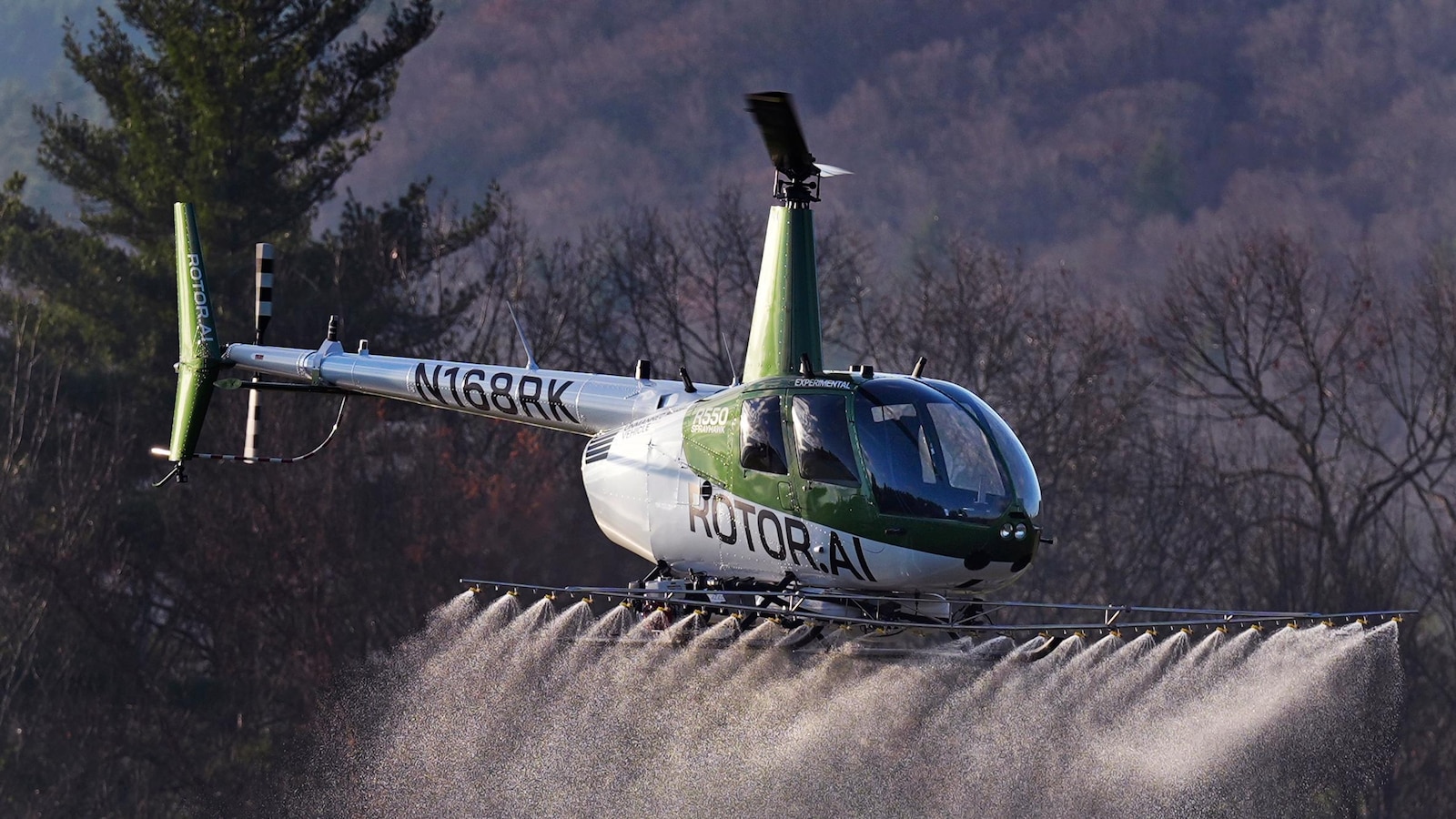
Rotor has built two autonomous Sprayhawks and aims to have as many as 20 ready for market next year. The company also is developing helicopters that would carry cargo in disaster zones and to offshore oil rigs. The helicopter could also be used to fight wildfires.
For now, Rotor is focused on the agriculture sector, which has embraced automation with drones but sees unmanned helicopters as a better way to spray larger areas with pesticides and fertilizers.
On Wednesday, Rotor plans to conduct a public flight test with its Sprayhawk at an agriculture aviation trade show in Texas.
“People would call us up and say, ‘hey, I want to use this for crop dusting, can I?’ We’d say, OK maybe,” Xu said, adding that they got enough calls to realize it was a huge untapped market. The Associated Press reporters were the first people outside the company to witness a test flight of the Sprayhawk. It hovered, flew forward and sprayed the tarmac before landing.
Rotor’s nearly $1 million Sprayhawk helicopter is a Robinson R44, but the four seats have been replaced with flight computers and communications systems allowing it be operated remotely. It has five cameras as well as laser-sensing technology and a radar altimeter that make terrain reading more accurate along with GPS and motion sensers.
At the company’s hangar in Nashua, New Hampshire, Xu said this technology means there is better visibility of terrain at night.
One of the big draws of automation in agriculture aviation is safety.
Because crop dusters fly at around 150 miles an hour and only about 10 feet off the ground, there are dozens of accidents each year when planes collide with powerlines, cell towers and other planes. Older, poorly maintained planes and pilot fatigue contribute to accidents.
A 2014 report from the National Transportation Safety Board found there were more than 800 agriculture operation accidents between 2001 and 2010 including 81 that were fatal. A separate report from the National Agriculture Aviation Association found nearly 640 accidents from 2014 until this month with 109 fatalities.
“It is a very, very dangerous, profession and there are multiple fatalities every year,” said Dan Martin, a research engineer with the U.S. Department of Agriculture’s Agriculture Research Service. “They make all their money in those short few months so sometimes it may mean that they fly 10 to 12 hours a day or more.”
Job hazards also include exposure to chemicals.
In recent years, safety concerns and the cheaper cost has led to a proliferation of drones flying above farmers’ fields, Martin said, adding that some 10,000 will likely be sold this year alone.
But the size of the drones and their limited battery power means they only can cover a fraction of the area of a plane and helicopters. That is providing an opening for companies building bigger unmanned aircraft like Rotor and another company Pyka.
The California-based Pyka announced in August that it had sold its first autonomous electric aircraft for crop protection to a customer in the United States. Pyka’s Pelican Spray, a fixed-wing aircraft, received FAA approval last year to fly commercially for crop protection. The company also sold its Pelican Spray to Dole for use in Honduras and to the Brazilian company, SLC Agrícola.
Lukas Koch, chief technology officer at Heinen Brothers Agra Services, the company which bought the Pelican Spray in August, has called unmanned aircraft part of a coming “revolution,” that will save farmers money and improve safety.
The Kansas-based company operates out of airports from Texas to Illinois. Koch doesn’t envision the unmanned aircraft replacing all the the company’s dozens of pilots but rather taking over the riskiest jobs.
“The biggest draw is taking the pilot out of the aircraft inside of those most dangerous situations,” Koch said. “There’s still fields that are surrounded by trees on all borders, or you’ve got big, large power lines or other just dangers, wind turbines, things like that. It can be tough to fly around.”
But Koch acknowledges autonomous aviation systems could introduce new dangers to an already chaotic airspace — though that is less of a concern in rural areas with plenty of open space and fewer people.
“Putting more systems into the air that don’t have a pilot inside could introduce new dangers to our current existing pilots and make their life even more dangerous,” he said. “If you’ve got this full size helicopter flying beyond the line of sight, how is it going to react when it sees you? What is it going to do? … That’s a giant question mark, one that we take very seriously.”
Companies like Rotor have incorporated built-in in contingencies should something go wrong — its helicopter features a half-dozen communications systems and, for now, a remote pilot in control.
If the ground team loses contact with the helicopter, Rotor has a system which Xu referred to as a big, red button that ensures the engine can be shut off and the helicopter perform a controlled landing. “That means that we’ll never have an aircraft fly away event,” he said.
The safety measures will go a long way to helping the company receive what it expects will be FAA regulatory approval to fly its helicopters commercially. Once they have that, the challenge, as Xu sees it, will be scaling up to meet the demand in the United States but also Brazil which has a huge agriculture market but more relaxed regulatory environment.
“I think 2025 will be production hell as Elon Musk calls it,” Xu said. “It’s kind of the difference between building a couple to building tens and hundreds at scale … These are no longer just like bespoke Rolls-Royces. You want to be stamping these out like you would production automobiles.”