LONDON — European Union regulators said Tuesday they’re investigating whether TikTok breached the bloc’s digital rulebook by failing to deal with risks to Romania’s presidential election, which has been thrown into turmoil over allegations of electoral violations and Russian meddling.
The European Commission is escalating its scrutiny of the popular video-sharing platform after Romania’s top court canceled results of the first round of voting that resulted in an unknown far-right candidate becoming the front-runner.
The court made its unprecedented decision after authorities in the European Union and NATO member country declassified documents alleging Moscow organized a sprawling social media campaign to promote a long shot candidate, Calin Georgescu.
“Following serious indications that foreign actors interfered in the Romanian presidential elections by using TikTok, we are now thoroughly investigating whether TikTok has violated the Digital Services Act by failing to tackle such risks,” European Commission president Ursula on der Leyen said in a press release. “It should be crystal clear that in the EU, all online platforms, including TikTok, must be held accountable.”
The European Commission is the 27-nation EU’s executive arm and enforces the bloc’s Digital Services Act, a sweeping set of regulations intended to clean up social media platforms and protect users from illegal content. It ordered TikTok earlier this month to retain all information related to the election.
In the preliminary round of voting on Nov. 24 Georgescu was an outsider among the 13 candidates but ended up topping the polls. He was due to face a pro-EU reformist rival in a runoff before the court canceled the results.
The declassified files alleged that there was an “aggressive promotion campaign” to boost Georgescu’s popularity, including payments worth a total of $381,000 to TikTok influencers to promote him on the platform.
TikTok said it has “protected the integrity” of its platform over 150 elections around the world and is continuing to address these “industry-wide challenges.”
“TikTok has provided the European Commission with extensive information regarding these efforts, and we have transparently and publicly detailed our robust actions,” it said in a statement.
The commission said its investigation will focus on TikTok’s content recommendation systems, especially on risks related to “coordinated inauthentic manipulation or automated exploitation.” It’s also looking at TikTok’s policies on political advertisements and “paid-for political content.”
TikTok said it doesn’t accept paid political ads and “proactively” removes content for violating policies on misinformation.
The investigation could result in TikTok making changes to fix any problems, or in fines worth up to 6% of the company’s total global revenue.
BUCHAREST, Romania — TikTok took down several networks that tried to meddle in Romania’s elections, executives said Tuesday as they defended the company’s election integrity measures to European Union lawmakers.
The video-sharing platform is a focus of controversy in the Eastern European country after far-right outsider Calin Georgescu emerged as the frontrunner in the vote, plunging the country into turmoil amid allegations of electoral violations and Russian meddling.
Among the networks that TikTok uncovered were two small groups that it disrupted on Friday, days after the first round of voting, Brie Pegum, the platform’s global head of product, authenticity and transparency, told a committee.
Both networks targeted Romanian users. One had only 1,781 followers and supported Georgescu, who was a little-known independent candidate until he set off shockwaves by convincingly winning the first round of voting, beating out the incumbent prime minister. The other networks supported different candidates, Pegum said.
Many observers chalked up Georgescu’s success to his TikTok account, which now has 5.8 million likes and 527,000 followers.
He gained huge traction and popularity in the weeks leading up to the first vote. But experts suspect Georgescu’s online following was artificially inflated while officials hinted that he was given preferential treatment by TikTok.
The controversy highlights how TikTok has become a key election tool in Romania, an EU and NATO member state that shares a long border with war-torn Ukraine.
TikTok applied its “global playbook” for the Romanian election and took a local approach with staff on the ground, said Caroline Greer, the company’s top lobbyist in the EU.
Greer and Pegum were being grilled by EU lawmakers about Tiktok’s role in the Romanian vote as well as its compliance with the 27-nation bloc’s Digital Services Act, a sweeping set of regulations designed to protect users online from illegal or harmful content.
Greer said TikTok deployed 95 Romanian language content moderators, worked with a fact-checking group and met with political parties and a number of different authorities including the country’s electoral authority.
But many lawmakers were not satisfied with their responses.
“The feeling here is that we are losing patience … and that we need more specific answers,” said Dirk Gotink, a Dutch member of the European Parliament. He also questioned what the scores of Romanian content moderators were doing during the election, and compared Pegum and Greer to firefighters TikTok sent to put out a fire.
“They come, they let the fire rage online for weeks, months, during an election. And then they send very nice people here into this committee to answer questions in a very polite way,” Gotink said. “But it is simply not convincing — and it also doesn’t reflect what is happening online.”
According to a report by the Bucharest-based Expert Forum think tank, Georgescu’s TikTok account garnered 92.8 million views primarily within the last few months, a figure that grew by 52 million views a week later, just days ahead of the first-round vote.
Another TikTok account solely featuring Georgescu content, which had 1.7 million likes on the night first-round polls closed, was removed the day after voting. It had posts with Georgescu attending church, doing judo, running around an oval track, and speaking on podcasts.
In an emailed statement to The Associated Press on Monday, TikTok said the account was one of “more than 150 accounts impersonating Georgescu” to date that has been removed, but added: “We also removed more than 650 additional impersonation accounts belonging to other candidates.”
Georgescu will face reformist Elena Lasconi, of the progressive Save Romania Union party, in a presidential runoff on Sunday.
—-
AP Business Writer Kelvin Chan reported from London.
__
This story corrects the spelling of lawmaker Dirk Gotink’s name.
LOS ANGELES — Social media site Bluesky has gained 1 million new users in the week since the U.S. election, as some X users look for an alternative platform to post their thoughts and engage with others online.
Bluesky said Wednesday that its total users surged to 15 million, up from roughly 13 million at the end of October.
Championed by former Twitter CEO Jack Dorsey, Bluesky was an invitation-only space until it opened to the public in February. That invite-only period gave the site time to build out moderation tools and other features. The platform resembles Elon Musk’s X, with a “discover” feed as well a chronological feed for accounts that users follow. Users can send direct messages and pin posts, as well as find “starter packs” that provide a curated list of people and custom feeds to follow.
The post-election uptick in users isn’t the first time that Bluesky has benefitted from people leaving X. Bluesky gained 2.6 million users in the week after X was banned in Brazil in August — 85% of them from Brazil, the company said. About 500,000 new users signed up in the span of one day last month, when X signaled that blocked accounts would be able to see a user’s public posts.
Despite Bluesky’s growth, X posted last week that it had “dominated the global conversation on the U.S. election” and had set new records. The platform saw a 15.5% jump in new-user signups on Election Day, X said, with a record 942 million posts worldwide. Representatives for Bluesky and for X did not respond to requests for comment.
Bluesky has referenced its competitive relationship to X through tongue-in-cheeks comments, including an Election Day post on X referencing Musk watching voting results come in with President-elect Donald Trump.
“I can guarantee that no Bluesky team members will be sitting with a presidential candidate tonight and giving them direct access to control what you see online,” Bluesky said.
Across the platform, new users — among of them journalists, left-leaning politicians and celebrities — have posted memes and shared that they were looking forward to using a space free from advertisements and hate speech. Some said it reminded them of the early days of X, when it was still Twitter.
On Wednesday, The Guardian said it would no longer post on X, citing “far right conspiracy theories and racism” on the site as a reason.
Last year, advertisers such as IBM, NBCUniversal and its parent company Comcast fled X over concerns about their ads showing up next to pro-Nazi content and hate speech on the site in general, with Musk inflaming tensions with his own posts endorsing an antisemitic conspiracy theory.
As President-elect Donald Trump begins filling key posts in his second administration, social media users are pushing false claims that the 2024 election was rigged in his favor.
One such narrative claims that billionaire Elon Musk facilitated the alleged fraud with his internet service provider Starlink, manipulating the vote count through election equipment such as ballot tabulators. Starlink, a subsidiary of Musk’s SpaceX company, uses satellites to offer high-speed internet, even in remote areas.
Here’s a closer look at the facts.
CLAIM: Billionaire entrepreneur Elon Musk used his internet provider Starlink to steal the 2024 election for President-elect Donald Trump.
THE FACTS: These claims are unfounded. Election officials, including from multiple swing states, told The Associated Press that their voting equipment doesn’t use Starlink and is not even connected to the internet. States have additional security measures to ensure that the count is accurate, according to experts. Election officials and security agencies have reported no significant issues with the 2024 race.
“It is not possible that Starlink was used to hack or change the outcome of the US presidential election,” David Becker, founder and executive director of The Center for Election Innovation and Research, wrote in an email. “This, quite simply, did not happen, and could not happen, thanks to the security measures we have in place, and these conspiracy theories echo other disinformation we’ve heard over the past several years.”
Becker further explained that the country’s nearly 10,0000 election jurisdictions use a wide range of voting machines that are not connected to the internet while voting occurs and that nearly all votes are recorded on paper ballots, which are audited by hand to confirm the results of electronic tabulators.
“If anyone tried to interfere with the machines to rig the election, it would be discovered through multiple means, including reconciling the registered voters who cast ballots with the number of votes, as well as the audits,” he added.
Certain jurisdictions in a few states allow for ballot scanners in polling locations to transmit unofficial results, using a mobile private network, after voting has ended on Election Day and the memory cards containing the vote tallies have been removed. Election officials who allow this say it provides for faster reporting of unofficial election results on election night. They say the paper records of the ballots cast are used to authenticate the results during postelection reviews, and that those records would be crucial to a recount if one was needed. Computer security experts have said this is an unnecessary risk and should be prohibited.
Cybersecurity and Infrastructure Security Agency Director Jen Easterly said in a statement on Nov. 6 that CISA has “no evidence of any malicious activity that had a material impact on the security or integrity of our election infrastructure.”
Despite a lack of evidence, many on social media suggested that Starlink could indeed have been used to steal the election.
“If Trump & Elon’s ‘little secret’ was to use Starlink in swing states to tally the votes & rig the election — an investigation & hand recount is crucial. Now,” reads one X post that had been liked and shared approximately 41,700 times as of Tuesday.
Another widely shared X post states: “Elon Musk used Starlink to hack our elections so he can have nice things while inflicting pain on Americans. Are we really going to turn a blind eye to what happened and let the worst people among us run the country.”
Election officials in North Carolina, Georgia and Pennsylvania — three of the seven swing states Trump won — told the AP that their voting equipment is never connected to the internet. In some cases, this is mandated by state law.
“Satellite-based internet devices were not used to tabulate or upload vote counts in North Carolina,” said Patrick Gannon, a spokesperson for the North Carolina State Board of Elections. “In addition, our tabulated results are encrypted from source to destination preventing results being modified in transit. And no, tabulators and ballot-marking devices are never connected to the internet in North Carolina.”
The Tar Heel State prohibits its voting systems from being “connected to a network” and requires any feature that allows such a connection to be disabled. This includes the internet, as well as any other wired or wireless connections.
Gannon added that North Carolina has “no evidence of any alteration of votes by anyone” and requested that people stop spreading misinformation about elections.
Mike Hassinger, a spokesperson for the Georgia secretary of state’s office, called the claims spreading online “absolutely conspiratorial nonsense.”
“We don’t use Starlink equipment for any part of our elections, and never have,” he said. “Our election equipment is 100% air-gapped and never connected to the internet.”
The term “air-gapped” refers to a security measure that isolates a secured computer network from those that are unsecured. This means it is impossible to use the internet to manipulate the software that tallies Georgia’s votes or the memory cards on which they’re recorded, according to Hassinger. He explained that memory cards are transported by hand in secure bags with tamper-evident ties to a central elections office where votes are tabulated. There is also a chain of custody protocol in place so that their movement is well documented.
Matt Heckel, a spokesperson for the Pennsylvania Department of State, wrote in an email: “Counties do not use Starlink to transmit unofficial or official election results. No voting system in Pennsylvania is ever connected to the internet.”
A pilot program in Arizona’s Coconino, Apache and Navajo counties intended to “enhance connectivity in underserved areas” uses Starlink systems to for electronic pollbook synchronization, according to JP Martin, a spokesperson for the Arizona secretary of state’s office. The state’s election equipment is air-gapped, one of many security measures.
Michigan, Nevada and Wisconsin also employ stringent precautions to protect the integrity of their voting equipment.
Some posts spreading online pointed to a local news segment in which the registrar of voters in Tulare County, California, noted that internet connectivity at the county’s poll sites was improved this year thanks to Starlink. Stephanie Hill, a systems and procedures analyst for the agency, wrote in an email that “this connection is strictly for voter check-in purposes only and in no way a part of our voting system.” California is among the states that prohibit their voting equipment from being connected to the internet.
Trump is currently beating Vice President Kamala Harris in Tulare County with 60% of the vote.
Pamela Smith, president and CEO of Verified Voting, agreed that the idea that Starlink was used to rig the election is absurd.
“While Starlink provided connectivity in a number of jurisdictions for electronic poll books (EPBs) in this election, neither Starlink nor other types of communication networks play any role in counting votes,” she wrote in an email. “Our elections produce huge quantities of physical evidence. A satellite system like Starlink cannot steal that.”
This past week, Donald Trump was once again elected president of the United States, which resulted in many anxious Americans scrambling to move to other countries. While some wealthy residents dove into citizenship-by-investment options, others searched for the once-popular digital nomad programs.
Searches for “digital nomad visa” climbed by 170% amidst the news, according to Centus’ analysis of worldwide Google search data for the week ending November 6. The localization-management platform noted that interest “spiked during the vote count.”
During the pandemic, remote workers attempting to capitalize on their flexibility took on a “digital nomad” lifestyle, where they could ostensibly travel and enjoy a lower cost of living. Between 2019 and 2022, the number of Americans identifying as digital nomads skyrocketed by 131%, per a report from consultant group MBO Partners.
But the lifestyle became less trendy over time. Companies clamping down on work-from-home setups with return-to-office mandates pumped the breaks on said phenomenon. In 2024, the number of American digital nomads that hold traditional jobs decreased by 5%, falling for the second year—per data from MBO Partners.
And the laptop-toting group received some recent criticism as perpetrators of gentrification.
“You come, and you say it’s really cheap… cheap for who? With time, as you show up, and then you tell your friends to show up and this place becomes a safe haven for digital nomads, you’re actually driving the cost of everything up,” Mechi Annas Estvez Cruz, writer and Dominican Republic native, told BBC.
In response to said overtourism and its economic implications, some countries backed away from their embrace of the digital nomad, or at least drew back the red carpet. Even so, it seems as if demand for moving abroad is rising once more, as the news of a Trump presidency breathed life into a somewhat faltering way of working and living. Looking at Google Trends for “digital nomad visa” from the past week, Fortunesaw interest peaked on election night and remained high, though a bit lower, throughout the week. General interest seemed to rise as the simple search for “digital nomad” increased as well.
Separately, Centus ranked the states looking most for remote and digital jobs. The company used Google Keyword Planner to gauge search volume data between September 2023 and 2024 and the popularity of 169 unique and relevant keywords related to remote work. It appears as if swing states are the most likely to look for remote or digital-nomad gigs, perhaps pointing to a political divide which fuels the desire to move elsewhere.
Here are the top 10 states looking for remote and digital nomad gigs:
Georgia
North Carolina
Florida
South Carolina
Tennessee
Virginia
Texas
Nevada
Arizona
Colorado
A newsletter for the boldest, brightest leaders:
CEO Daily is your weekday morning dossier on the news, trends, and chatter business leaders need to know.
Remember how we said that Oscar-nominated actress America Ferrera was thinking about moving overseas to give her two children the best education possible? Well, now, after the 2024 Presidential election, it seems that may come to fruition sooner rather than later.
In case you need a recap, we got you. Earlier this week, a source told Hello! Magazine that Ferrera has been looking at quite a few places in England for her kids to go to private school, and to uproot their family.
“[She] has been checking out the local private school for her children,” they added, noting how she reportedly went to an open day for a local private school in Barnes for their two kids. “She was seen there at the open day and appeared very happy with what she saw. It’s a school with a lot of celebrity children at it so her kids would fit in very well.”
Related story
Insiders Say Jennifer Lopez Is Allegedly Fuming Over Ben Affleck ‘Trying to Steal’ This From Her
And now, insiders claim Ferrera may be speed-running this move after Donald Trump won the 2024 Presidential election over Kamala Harris.
America Ferrera
Elizabeth Goodenough/Everett Collection
Insiders say the “devastated” star is so distraught over the election results, and is looking to move to England for her family, per the Daily Mail.
“America is sick that Donald Trump is President again. She is devastated that Kamala lost. She thought the country she lived in was better than that,” they said, adding how she won’t abandon the US entirely. “She is going to continue to have a presence in the US for work purposes and to fight for Latinas and women, but she will be overseas for family and to benefit her kids’ education.”
Related story
Insiders Say Jennifer Lopez Is Allegedly Fuming Over Ben Affleck ‘Trying to Steal’ This From Her
They added, “She wants them to have the best opportunities possible and to her, being overseas for that is what is important. She’s not abandoning the US, she is prioritizing her life and focusing on the importance for her kids.”
America Ferrera, Ryan Piers Williams
For those who don’t know, Ferrera and Williams first met when he cast her in a student film at USC back in 2005. They started dating soon after, and got engaged five years later. They married in the summer of 2011.
Remember how we said that Oscar-nominated actress America Ferrera was thinking about moving overseas to give her two children the best education possible? Well, now, after the 2024 Presidential election, it seems that may come to fruition sooner rather than later.
In case you need a recap, we got you. Earlier this week, a source told Hello! Magazine that Ferrera has been looking at quite a few places in England for her kids to go to private school, and to uproot their family.
“[She] has been checking out the local private school for her children,” they added, noting how she reportedly went to an open day for a local private school in Barnes for their two kids. “She was seen there at the open day and appeared very happy with what she saw. It’s a school with a lot of celebrity children at it so her kids would fit in very well.”
Related story
Insiders Say Jennifer Lopez Is Allegedly Fuming Over Ben Affleck ‘Trying to Steal’ This From Her
And now, insiders claim Ferrera may be speed-running this move after Donald Trump won the 2024 Presidential election over Kamala Harris.
America Ferrera
Elizabeth Goodenough/Everett Collection
Insiders say the “devastated” star is so distraught over the election results, and is looking to move to England for her family, per the Daily Mail.
“America is sick that Donald Trump is President again. She is devastated that Kamala lost. She thought the country she lived in was better than that,” they said, adding how she won’t abandon the US entirely. “She is going to continue to have a presence in the US for work purposes and to fight for Latinas and women, but she will be overseas for family and to benefit her kids’ education.”
Related story
Insiders Say Jennifer Lopez Is Allegedly Fuming Over Ben Affleck ‘Trying to Steal’ This From Her
They added, “She wants them to have the best opportunities possible and to her, being overseas for that is what is important. She’s not abandoning the US, she is prioritizing her life and focusing on the importance for her kids.”
America Ferrera, Ryan Piers Williams
For those who don’t know, Ferrera and Williams first met when he cast her in a student film at USC back in 2005. They started dating soon after, and got engaged five years later. They married in the summer of 2011.
WASHINGTON — Hacking a local election system in the United States wouldn’t be easy, and secretly altering votes on a scale massive enough to change the outcome of the presidential race would be impossible, election officials have said, thanks to decentralized systems, paper records for nearly all ballots, exhaustive reviews, legal due process and decades of work by American election officials, volunteers and citizens.
But foreign actors and domestic extremist groups looking to meddle in next week’s election can target a much weaker link: voters’ perceptions and emotions. Those intent on undermining confidence in U.S. democracy don’t have to change any votes if they can convince enough Americans not to trust the outcome.
It’s a possible scenario particularly concerning to intelligence analysts and officials tasked with protecting America’s election: An adversary tries to hack a state or local election system and then releases a document — perhaps a fake one or even material that is publicly available — and suggests it’s evidence of vote rigging.
Or, a video is crafted showing someone supposedly hacking into a ballot scanner, voting machine or a state voter registration system. But it hasn’t happened, and it would not be true.
It’s called a perception hack, which may or may not include an actual breach of voting systems but is made to appear that has happened. In some cases, minor information might be stolen — enough for a video to appear legitimate — but it does not change votes. A related threat involves fake footage supposedly depicting election workers destroying ballots.
Governments at all levels have worked to strengthen election infrastructure in recent years. The human brain, however, remains hard to defend.
“I think that’s almost certain to happen,” former CIA political analyst Adam Darrah said when discussing the risk of perception hacks.
Darrah, now vice president of intelligence at the cybersecurity company ZeroFox, said misleading people into thinking election systems are vulnerable is a lot easier than actually hacking into them. ”It’s a way to induce panic. We are very technically resilient. Our emotional resilience, our hypersensitivity, that’s still a challenge.”
Narrow margins of victory or delays in vote counting could heighten the risk that a perception hack could fool a large number of voters, further polarizing the electorate, raising the risk of political violence and potentially complicating the transfer of power in January.
Intelligence officials warned last week that Russia and Iran may consider encouraging violent protests in the U.S. following the election. The nation’s intelligence community and private analysts agree that while the Kremlin is backing former President Donald Trump, Moscow’s ultimate goal is to divide Americans and undermine U.S. support for Ukraine and the NATO alliance.
America’s adversaries focus on disinformation in part, officials say, because they understand the country’s election infrastructure is too secure to hack successfully.
Despite the findings of intelligence officials, both Russia and Iran have rejected claims that they are seeking to influence the U.S. election.
“We have never interfered, we are not interfering, and we do not intend to interfere,” a spokesman for the Russian Embassy in Washington wrote in an email to The Associated Press.
Even without a foreign power’s involvement, isolated stories of long lines at the polls, ballot mix-ups or other irregularities could be held up as proof that elections can’t be trusted.
It happened in 2020, when Trump amplified claims about election problems, helping lead to the Jan. 6, 2021, attack on the U.S. Capitol by his supporters trying to disrupt certification of the election.
The former Republican president has spent months laying the groundwork to challenge the results of this year’s election if he loses. And he has worked to convince his supporters that the only way he can lose is if Democrats cheat, urging them to deliver a victory “too big to rig.”
“They cheat,” Trump said at a Michigan rally last month. “That’s the only way we’re going to lose, because they cheat. They cheat like hell.”
Just as in 2020, the days immediately after the election are likely to be the most critical, as results are announced and Americans come to the end of a contentious race.
It’s then that authoritarian nations or domestic anti-democratic groups will look to whip up distrust in an effort to spur people into action, said Paul Barrett, a New York University law professor who studies online discourse and polarization.
“They’re happy to see Americans at the throats of other Americans,” Barrett said. “We saw that in 2021, and I have tremendous anxiety that we will see a repeat.”
In response, national security and election officials across the country have moved to expose disinformation and quickly knock down rumors. Top intelligence officials have held multiple briefings outlining foreign threats, while cybersecurity and election officials have explained why election systems are secure.
Last week, a video purporting to show someone destroying mail ballots in Pennsylvania began spreading on social media. Bipartisan election officials in Bucks County quickly debunked the video, and intelligence officials linked it to a Russian campaign behind other videos seeking to smear Vice President Kamala Harris, the Democratic nominee, and her running mate, Minnesota Gov. Tim Walz.
“That video was debunked pretty quickly on multiple news sites, and I know that Bucks County immediately got out in front of it and basically explained why it was a fake and why voters should have confidence,” said Kim Wyman, former secretary of state in Washington state who also has worked at the Cybersecurity and Infrastructure Security Agency.
“But the problem is — now it exists out there,” she said. “And we know that it will continue to be circulated between now and probably Inauguration Day.”
Americans can help prevent a successful perception hack by not spreading election hoaxes any further. Disinformation experts urge voters to consult a variety of sources of information, be skeptical of anonymous social media claims and turn to their own state and local officials for the facts.
Uncertainty and emotions will be running high in the days after voting ends — exactly the conditions foreign adversaries and domestic extremists need to undermine trust.
“Our foreign adversaries are looking to attack our democratic process to further their own objectives, and we need the help of all Americans in ensuring they are not successful,” said CISA senior adviser Cait Conley. ”Americans should be confident that their votes will be counted as cast. They should also know that our foreign adversaries will try to make them believe otherwise.”
“We encourage everyone to remain vigilant, verify the information they consume, and rely on trusted sources like their state and local election officials,” she added.
___
Cassidy reported from Atlanta. Associated Press writer Jill Colvin in New York contributed to this report.
SAN FRANCISCO — X’s crowd-sourced fact-checking program, called Community Notes, isn’t addressing the flood of U.S. election misinformation on Elon Musk’s social media platform, according to a report published Wednesday by a group that tracks online speech.
The nonprofit Center for Countering Digital Hate analyzed the Community Notes feature and found that accurate notes correcting false and misleading claims about the U.S. elections were not displayed on 209 out of a sample of 283 posts deemed misleading — or 74%.
Misleading posts that did not display Community Notes even when they were available included false claims that the 2020 presidential election was stolen and that voting systems are unreliable, CCDH said.
In the cases where Community Notes were displayed, the original misleading posts received 13 times more views than their accompanying notes, the group added.
Community Notes lets X users write fact checks on posts after the users are accepted as contributors to the program. The checks are then rated by other users based on their accuracy, sources, how easily they are to understand, and whether they use neutral language. The program was launched in 2021 by the previous leadership of the site — then known as Twitter — and was called Birdwatch. Musk renamed it Community Notes after he took over the site in 2022.
Last year, X sued CCDH, blaming the group for the loss of “tens of millions of dollars” in advertising revenue after it documented an increase in hate speech on the site. The lawsuit was dismissed by a federal judge in March.
Keith Coleman, a vice president of product at X who oversees Community Notes, said in a statement that the program “maintains a high bar to make notes effective and maintain trust across perspectives, and thousands of election and politics related notes have cleared that bar in 2024. In the last month alone, hundreds of such notes have been shown on thousands of posts and have been seen tens of millions of times. It is because of their quality that notes are so effective.”
Imran Ahmed, the CEO of CCDH, however, said the group’s research “suggests that X’s Community Notes are little more than a Band Aid on a torrent of hate and disinformation that undermines our democracy and further polarizes our communities.”
Academy Award-winning director Spike Lee has long been lauded for his films exploring tough topics like race relations and other issues facing the Black community in the United States.
The two-time Oscar winner debuted when he wrote, produced and directed 1986’s She’s Gotta Have It. A few years later he earned a Best Screenplay Oscar nomination when he wrote, produced and directed the highly acclaimed Do The Right Thing. He won the 2019 Academy Award for Best Adapted Screenplay for BlacKkKlansman.
Despite his highly successful career in Hollywood, Lee is also well known for his love of the NBA‘s New York Knicks, where he can almost always be seen courtside. He also played a key role in helping boost the popularity of Michael Jordan and Nike’s Air Jordan brand, in which Lee’s self-portrayed character from his first film, Mars Blackmon, took a prominent role in a series of famous commercials exclaiming the key factor in Jordan’s success has “gotta be the shoes.”
The long-lasting partnership between Lee and Jordan led to the NBA great helping to play a key funding role in the production of Lee’s highly-acclaimed film Malcolm X in 1992.
In celebration of his art and efforts promoting racial equality through his films, Lee on October 17 was among the honorees at the 33rd annual Freedom Award held by the National Civil Rights Museum in Memphis, Tennessee, along with lawyer and Howard professor Sherrilyn Ifill and civil rights activist Xernona Clayton, who once traveled on speaking tours with Coretta Scott King and helped organize marches with the Rev. Martin Luther King Jr.
Held at the Orpheum on legendary Beale Street, the award honors those who have made strides in elevating and leading the charge on civil rights issues. Built at the site of the historic Lorraine Motel, where King was assassinated on April 4, 1968, the National Civil Rights Museum describes the award as among the “nation’s most prestigious honors,” with past recipients including popstars Usher and Stevie Wonder, former President Jimmy Carter and former Georgia State lawmaker Stacey Abrams.
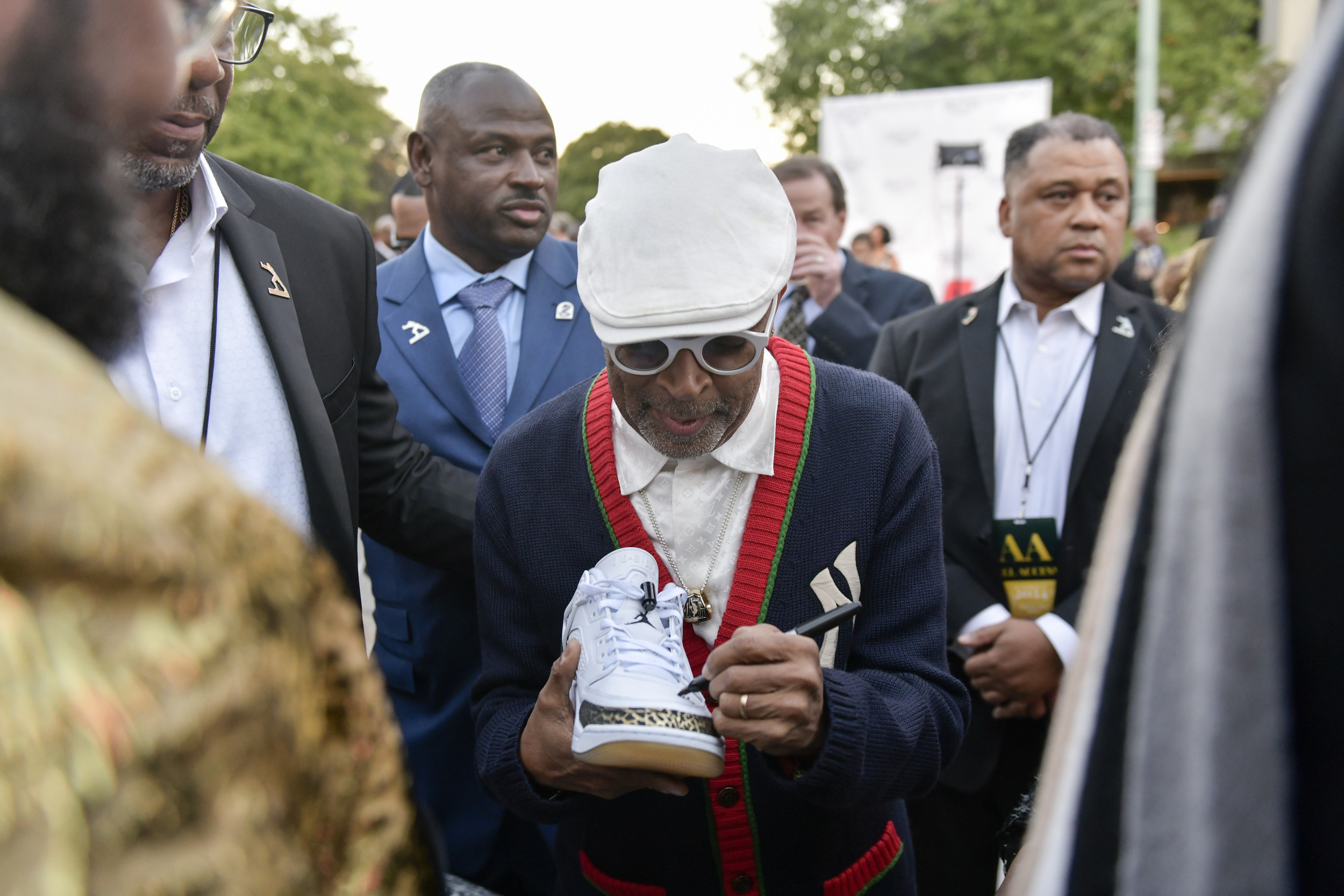
On the red carpet for the event, Lee signed Air Jordans, took photos with fellow Morehouse College alumni and cracked jokes with members of the NBA‘s Memphis Grizzlies before entering the venue.
“Spike is an integral member of the Jordan family and someone who, like Michael and the Jordan Brand, represents greatness and inspires others to do the same,” said Sarah Mensah, president of Jordan Brand, the event’s presenting sponsor.
Occurring just days before one of the contentious 2024 presidential election, the symposium was filled with political energy.
Ifill and Clayton implored the crowd to push for a “new American democracy” and for a brighter future, while Lee urged the crowd to support Vice President Kamala Harris while taking shots at the racial rhetoric of former President Donald Trump.
Ahead of the ceremony, hosted by rapper MC Lyte, Newsweek sat down with the acclaimed director to talk New York sports, the coming election, the legacy of Malcolm X and his history of bold predictions.
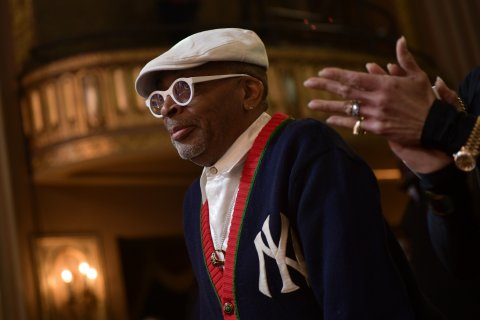
Director Spike Lee signs a sneaker on the red carpet of the Freedom Award ceremony, presented by the National Civil Rights Museum. Director Spike Lee signs a sneaker on the red carpet of the Freedom Award ceremony, presented by the National Civil Rights Museum. Courtesy of the National Civil Rights Museum/Brandon Dill
Spike Lee: What’s up, baby? How you doing? What’s your name?
Newsweek: Devin Robertson.
SL: What’s up, baby? Coming in with the fresh Jordans. Fresh Jordans. Hit me with the freshness, huh? Yeah, you said. You said you had to leave the dirty Spiz’ikes back home. All love, all love. And every time I come to Memphis. All love, all love.
NW: So, how are you feeling as a New York sports fan? You got the Liberty going into Game 3 [of the WNBA Finals]. You got the Yankees going into Game 2 [of the ALCS].
SL: No, we won Game 2 last night. Aaron Judge hit home at two. We’ll leave football out of it.
The Knicks. Let me piece some game to you. This ring right here, this is a ring from the 1972-’73 world championship New York Knicks. That’s the last time we won. We have two championships, ’69-’70 and the ’72-’73 team. It was all 50 years. But this year, F-I-Y-A–fire “orange and blue skies.” You know, I got the copyright? I got to talk to [ESPN pundit] Stephen A ’cause I got that. I copyrighted that. Yeah. Pat Riley copyrighted “threepeat.” Yeah, go ahead. So “orange and blue skies” is copyrighted.
NW: With the sports team, is it different when the expectations are high, or is it—
SL: Look, we. We haven’t won. I just told you, we haven’t won over five decades. That’s 50 years. Been to the finals twice, lost to Houston. We were up 3-2, lost Games 6 and 7. And then we lost against San Antonio.
But this year, expectations, New York City and Knick Nation are like sky-high. Now we got KAT too. Sorry Donte [DiVincenzo] had to go, but Minnesota’s not making that deal unless Donte was part of it. So, I feel we had the best point guard. Unless you say Steph [Curry] is a–You say Steph is your one or two?
NW: You know, it depends, because Draymond [Green] does a lot of the facilitating on that. And, you know, Steph is always moving without the ball. I would put him as more of a two.
SL: All right, so you just said it. My brother just said Steph is a two. So that means Jalen Brunson is the best point guard in the National Basketball Association. What?
And I know you got a guy here in Memphis. Peace and love. I will make no arguments, peace and love. But the people know it’s Brunson.
NW: So, as one of this year’s Freedom Award honorees, how would you like people to reflect on your contributions to promoting justice and equality?
SL: I think it’s really, in the films I’ve done, those are stories I’ve told, and a lot of those films have themes and messages that reflect what’s going on at that time when the film came out. Even still today, you have, you watched this past summer, June 30 was the 35th anniversary of Do The Right Thing. If you look at that film, I mean, you look at Ray Raheem, you don’t think about George Floyd? I wrote that script, came out ’89, wrote it in ’88. We’re talking about gentrification, global warming, a whole bunch of stuff.
It’s like I had a crystal ball. And that’s why my friends sometimes call me “Negro-damus.” (laughs) Come on, you give me some. Give me some “Negro-damus.” You predict this s*** before this s*** happens.
NW: And still relevant to these to this day, next year is going to be the 100th anniversary of Malcolm X’s birth.
SL: May 19
NW: And the 33rd anniversary of your film. I was just wondering if you could reflect on—
SL: Oh, yeah, look, none of that would be possible [without] Denzel Washington, that performance he gave will live forever. I think one of the best performances in a biopic that’s ever been done. A lot of obstacles, but we had, you could say, Allah was with us. We made that through.
We made that film through hell and high water. And also, I mean, that film went through various permutations. I mean, like 30, 40. You know, years to get that film made. So, uh, it almost killed me, though. We got it done.
Spike Lee watches the Freedom Award ceremony hosted by MC Lyte. Spike Lee watches the Freedom Award ceremony hosted by MC Lyte. Courtesy of the National Civil Rights Museum/Brandon Dill
NW: That’s incredible because the story about the funding of that movie is like the stuff of Black legends.
SL: Yes. I had Warner Bros. not want the film to be 3 hours. So, they put the gun to my head and said, ‘if you’re not gonna cut the film, then we’re gonna get the film to just give it off to the bond company.’ They took the bond company, took the film over, and I had already put a million dollars. So, then they fired all, the entire production team got fired, registered letter, and I was stuck. And then it hit me because I became a student of Malcolm in doing this film. I read the autobiography of Malcolm X in junior high school. And that’s a book, that’s the most important book I’ve ever read. And I read that every year. And these two things kept coming in my mind. Self-reliance, self-determination.
I say, you know what? I know some Black folks got some cash, and I only, I got their phone numbers. But the tricky thing was, is that it was, they would not be, per se, getting an investment in the film to get money back. It was not a tax, it was just a gift. So, I made my list and Black folks came through and we were able to continue postproduction.
And then at Malcolm X’s birthday, I gave a press conference at the Schomburg library in Harlem, 135th street and Lenox, and told the world that these individuals gave us money.
And that was Malcolm’s birthday. February. No, no, it wasn’t. It wasn’t Malcolm’s birthday. Anyway, then once they made the announcement, the studio came back and, you know, started financing the film again.
But I was, there was some very dark days, you know, when they just fired production crew because, you know, we imposed production.
Funny story, though. So, we show. The first time the two presidents on Warner Bros. saw the film was the day of the L.A. uprising. I mean, you got me. The day L.A. is burning down is the day we show the first cut of Malcolm X.
So, to their credit, they stayed throughout that, and that cut was four hours. But, uh, I did not want that. They wanted me to cut the film to two hours. I wasn’t doing that. You know, that’s what happened.
NW: People are still drawing from Do The Right Thing.
SL: And I…I’ve been very proud of representing the culture.
The culture. And that’s where my soul is, my presence, who I am, the culture. And, you know, our stuff’s very specific, but loved all over the world.
NW: I get what you’re saying.
SL: You know what time it is.
NW: If you don’t mind us getting a little bit more serious.
SL: No, I’m with you, man. Whatever you want to do.
NW: Election time is coming up. You’ve been outspoken about telling everybody to get out. You were at the DNC [Democratic National Convention] earlier.
SL: Chicago. Yeah.
NW: What do you think are some of the most pressing issues and why do you feel it’s so important to share that message?
SL: Right now. Well, I’m just glad my brother [former President Barack Obama], he’s on the road. He’s really out there campaigning for a sister vice president [Harris], and he’s been really hammering. I mean, he’s really focused on Black men. Brothers, don’t go for the okie doke. Register to vote. And let’s get our sister in the White House. If you think that this guy [Trump] has done stuff for Black people, all I got to say is, “crack is whack.”
I’m not trying to be funny. This guy has never done nothing for Black folks, but him and his father were building buildings in New York City. Black folks couldn’t get in them. Don’t go for the okie doke. And definitely don’t go for the three S’s. Shenanigans, subterfuge. And the last one is a killer—skulduggery.
Don’t go for the okie doke. I mean, I don’t know how in your right mind you could think that. Let me finish to. Can I finish, please? All right. I don’t know. I don’t know how these young brothers in their right minds could think that this guy has, in his heart, what’s best for you.
Don’t do it. Don’t do it. Don’t do it. Support our sister. Let’s make her the first woman to be president of the United States, the first woman of color. And also don’t get tripped up that her mother’s Indian. A lot of us. Come on now. And we, you know, we go by the one drop rule. She’s Black. Peace and love. We good to wrap it up, my brother?
NW: I appreciate you.
SL: Thank you. Thank you.
Now, another thing I’d like to say. Behind me are two brothers. Young brothers. I see you got a team. And that makes me feel good that the young brothers out there doing their own thing and, you know, gotta keep this s*** going. So, the young generation. Young generation. Come on now. You know, myself, people for me have paved the paths for you guys. Get the handoff. We can’t fumble it, though. No fumbles. Put the work in. Put the work in.
fairness meter
fairness meter
Newsweek is committed to journalism that’s factual and fair.
Hold us accountable and submit your rating of this article on the meter.
Newsweek is committed to journalism that’s factual and fair.
Hold us accountable and submit your rating of this article on the meter.
Click On Meter To Rate This Article
About the writer
Devin Robertson
To read how Newsweek uses AI as a newsroom tool, Click here.