ISLAMABAD – The Pakistan Sports Board (PSB), in its 31st Board meeting, introduced a series of transformative reforms to elevate the governance and operational standards of sports federations in the country.
Among the key measures approved are the implementation of the Pakistan Code of Ethics and Governance in Sports (PCEGS), the establishment of an independent Election Commission, and the creation of a dedicated tribunal for sports-related disputes. These initiatives align with the principles of the International Olympic Committee (IOC) Charter. The meeting, chaired by Rana Sanaullah Khan, Adviser to the Prime Minister on Inter-Provincial Coordination and President of the PSB, took significant steps to ensure transparency, integrity, and accountability in sports management. These reforms reflect international best practices already adopted by countries like the UK, Australia, and Switzerland.
The key decisions approved during the meeting include Pakistan Code of Ethics and Governance in Sports (PCEGS): This framework aims to ensure transparency and integrity by addressing corruption, nepotism, and doping within sports federations. It aligns governance with national laws and international standards.
Independent Election Commission: A new commission will oversee all sports federation elections, ensuring free, fair, and transparent processes. This step fulfills directives from the Islamabad High Court and adheres to IOC principles.
Dedicated Tribunal for Sports Governance Disputes:The tribunal will handle disputes, complaints, and appeals related to sports governance, offering impartial and timely resolutions to maintain smooth operations within federations.
Model Constitution for Federations: Sports federations are mandated to align their governance frameworks with the IOC Charter and their respective international federation structures, reinforcing transparency and autonomy.
Enhanced Athlete Rewards and Gold Card Introduction:The revised cash reward policy increases incentives for international gold medalists, with up to PKR 10 million as a prize. Medal-winning athletes will also receive Gold Cards, granting access to PSB facilities nationwide for enhanced training and resources.
The Board members, including representatives from the Higher Education Commission, Pakistan Tennis Federation, and Pakistan Billiards & Snooker Association, unanimously supported the reforms. However, President POA Syed Mohammad Abid Qadri Gillani opposed the implementation of the Code of Ethics, Election Commission, and Tribunal, citing concerns about their alignment with IOC governance principles.
The PSB expressed confidence that these measures would promote good governance, elevate Pakistan’s sports standards, and provide athletes with the support they need to compete on international platforms.
In picking billionaire Elon Musk to be “our cost cutter” for the U.S. government, President-elect Donald Trump won’t be the first American president to empower a business tycoon to look for ways to dramatically cut federal regulations.
President Ronald Reagan tapped J. Peter Grace to lead a bureaucratic cost-cutting commission in 1982. Still, the chemical business magnate had fewer conflicts of interest than the world’s richest man does today.
Musk’s SpaceX holds billions of dollars in NASA contracts. He’s CEO of Tesla, an electric car business that benefits from government tax incentives and is subject to auto safety rules. His social media platform X, artificial intelligence startup xAI, brain implant maker Neuralink and tunnel-building Boring company all intersect with the federal government in various ways.
“There’s direct conflicts between his businesses and government’s interest,” said Ann Skeet, director of leadership ethics at Santa Clara University’s Markkula Center. “He’s now in a position to try and curry favor for those enterprises.”
Musk is also more influential, having pumped an estimated $200 million through his political action committee to help elect Trump, made himself a fixture at Mar-a-Lago since the presidential election and is on regular speaking terms with like-minded political world leaders, from Argentina’s President Javier Milei to Italy’s Prime Minister Giorgia Meloni.
Trump has said Musk and former GOP presidential candidate Vivek Ramaswamy will lead a new “Department of Government Efficiency,” or DOGE, — a joke name that references the cryptocurrency Dogecoin and appeals to Musk’s sense of humor.
“We finally have a mandate to delete the mountain of choking regulations that do not serve the greater good,” Musk said Wednesday on X.
Trump has said that Musk and Ramaswamy will work from outside the government to offer the White House “advice and guidance” and will partner with the Office of Management and Budget to drive structural reform — some of which could only be done through Congress.
“If it’s a commission, it’s outside the government” and Musk could not have a White House office or official government title, said Richard Painter, a White House ethics lawyer during the George W. Bush administration. “Then, the president takes the advice or doesn’t.”
If it were a true government agency, however, Musk would run afoul of federal conflict of interest laws unless he divested from his businesses or recused from government matters involving them, Painter said.
Trump could grant a rare waiver exempting Musk from those laws, a move that has been politically unpopular in the past, Painter said.
Tesla, SpaceX and X didn’t immediately respond to requests for comment Wednesday about whether Musk would recuse himself. The Trump transition team also didn’t immediately respond to a request for comment.
However it is structured, Musk’s ideas are expected to have an influence.
Tesla, the electric vehicle company that made Musk the world’s wealthiest person, has had repeated skirmishes with the National Highway Traffic Safety Administration, which regulates vehicle safety. So any cuts to NHTSA funding or staffing could help Tesla.
The agency has forced Tesla to do recalls it didn’t want, and it has opened investigations of Tesla vehicles, some of which raised questions about Musk’s claims that Tesla is close to deploying autonomous vehicles without human drivers. The agency also is working on regulations that cover vehicle automation.
Auto safety advocates are worried that a Department of Government Efficiency co-chaired by Musk could propose draconian cuts at NHTSA.
“That could be incredibly problematic because that would impact every rule-making from all of the agencies that currently oversee companies that Musk owns,” said Michael Brooks, executive director of the nonprofit Center for Auto Safety, a watchdog group.
If implemented, Musk’s plan for efficiency at NHTSA could mirror what he did when he took over Twitter — draconian staff cuts, said Missy Cummings, director of the autonomy and robotics center at George Mason University and a former safety adviser to NHTSA.
While Cummings concedes there is room for much of the federal government to become more efficient, she said that NHTSA is already understaffed and she predicted that Musk would try to slow or stop NHTSA investigations or handicap the agency so it would have trouble enforcing regulations.
“It would just leave it as a shell of the agency that it was,” she said. “Their whole job would be to put out commercials reminding people to just wear their seat belts.”
Launching test flights out of South Texas, SpaceX’s mega rocket Starship is how NASA intends to land astronauts on the moon for the first time in more than a half-century. NASA has awarded more than $4 billion to SpaceX for the first two human moon landings coming up later this decade under the Artemis program. Musk has been at odds with the Federal Aviation Administration for slowing Starship over what he contends is excessive bureaucracy.
SpaceX also has racked up multiple contracts with NASA over the past decade for launching supplies and astronauts to the International Space Station. The contracts for crew flights alone from 2020 through 2030 total $5 billion.
More recently, in June, NASA awarded an $843 million contract to SpaceX to provide the vehicle for deorbiting the International Space Station at the end of its lifetime in early 2031, directing it to a fiery re-entry over the Pacific.
SpaceX also has multiple contracts with the Defense Department, some classified and said to be worth billions. In addition, the Pentagon has purchased internet services in Ukraine from SpaceX’s Starlink constellation. The militarized version of Starlink is called Starshield.
The social media platform X is another Musk company that has drawn scrutiny from federal regulators. The Federal Trade Commission has probed Musk’s handling of sensitive consumer data after he took control of the company in 2022 but has not brought enforcement action. The SEC has an ongoing investigation of Musk’s purchase of the social media company.
Musk has been forceful with his political views on the platform, changing its rules, content moderation systems and algorithms to conform with his world view. After Musk endorsed Trump following an attempt on the former president’s life last summer, the platform has transformed into a megaphone for Trump’s campaign, offering an unprecedented level of free advertising that is all but impossible to calculate the value of.
Musk’s strong interest in AI is also likely to play a role. He’s in the process of building an AI supercomputer in Memphis, Tennessee, for his AI startup xAI.
But environmental groups have raised concerns about pollution generated by the facility’s gas turbines and its strain on the local power grid, prompting attention from the Environmental Protection Agency.
The facility is located near predominantly Black neighborhoods that have long dealt with pollution and health risks from factories and other industrial sites.
_____
AP reporter Adrian Sainz in Memphis, Tennessee, and AP Aerospace Writer Marcia Dunn in Cape Canaveral, Florida, contributed to this report.
LONDON — Details of a proposed law to legalize assisted dying in England and Wales have been published, rekindling debate on the controversial topic ahead of a vote in Parliament later this month.
The draft bill, published Monday, proposes allowing terminally ill adults expected to have less than six months to live to ask for and be provided with help to end their own life, subject to safeguards and protections.
Opponents have voiced concerns that the bill would mean people could become pressured to end their lives.
But Labour lawmaker Kim Leadbeater, who proposed the bill, said the law has robust safeguards built into it and contains “three layers of scrutiny” — two doctors and a High Court judge will have to sign off on any decision.
A debate and first vote on the bill is expected to take place on Nov. 29.
Prime Minister Keir Starmer said Tuesday he will study the details of the bill and “will not be putting pressure on any MP (Member of Parliament) to vote one way or the other.”
Here’s a look at what’s in the Terminally Ill Adults (End of Life) Bill and the next steps:
Under the draft legislation, only those over 18-years-old in England and Wales and who are expected to die within six months can request assisted dying.
They must have the mental capacity to make a choice about the end of their life and will be required to make two separate declarations about their wish to die. Two independent doctors have to be satisfied the person is eligible and a High Court judge will need to approve the decision.
Anyone found guilty of pressuring, coercing or dishonestly getting someone to make a declaration that they wish to die will face up to 14 years in prison.
Assisted suicide is currently banned in most parts of the U.K. It is not a specific criminal offense in Scotland, but assisting the death of someone can result in a criminal charge.
The patient must self-administer the life-ending medication themselves. No doctor or anyone else can give the medication.
No health professional is under any obligation to provide assistance to the patient.
Doctors who do take part would have to be satisfied the person making their declaration to die has made it voluntarily. They also must ensure the person is making an informed choice.
The bill will be debated in Parliament and lawmakers will be able to vote on it according to their conscience, rather than along party lines.
Opinion among lawmakers appears to be divided, though some senior ministers including Health Secretary Wes Streeting has said he intended to vote against the bill. Starmer has previously supported assisted dying, but the government says it will remain neutral on the issue.
If the bill passes the first stage in the House of Commons, it will face further scrutiny and votes in both Houses of Parliament. Leadbeater suggested that any new law is unlikely to come into effect within the next two to three years.
One argument supporting the bill is that wealthy individuals can travel to Switzerland, which allows foreigners to go there to legally end their lives, while others have to face possible prosecution for helping their loves ones to die.
Other countries that have legalized assisted suicide include Australia, Belgium, Canada and parts of the United States, with regulations on who is eligible varying by jurisdiction.
Assisted suicide is different to euthanasia, allowed in the Netherlands and Canada, which involves healthcare practitioners killing patients with a lethal injection at their request and in specific circumstances.
Television advertisements from the Americans 4 Security PAC painted Paul Bondar as a Texan trying to “buy” an Oklahoma congressional seat in the 2024 Republican primary. (Screenshot)
Support Journalism
The City of Norman has announced litigation against the architects and builders of its doomed $39 million library, which closed in November after four years of operation due to widespread mold. Perhaps Norman will have more success going on offense than the University of Oklahoma has had so far in the Southeastern Conference.
Former congressional candidate Paul Bondar also filed a lawsuit recently. Bondar is suing three media groups and a PAC for defamation over reports that he does not live in Oklahoma and has ties to Russian President Vladimir Putin.
Meanwhile, the Oklahoma Ethics Commission had a busy meeting Friday, approving a settlement agreement with a state bureaucrat who violated impartiality rules, granting a sitting representative an extra 30 days to file an amended campaign expense report and walking back extra fees the commission had issued to lobbyists in violation of state statute.
Read about all of that — and more — in this roundup.
Paul Bondar lawsuit alleges defamation by media, PAC
Former political candidate Paul Bondar is seeking more than $10 million in alleged damages from Gannett, Nexstar Media Group, ABC News and the Americans 4 Security PAC for defamation he claims to have faced while trying to unseat Oklahoma’s most powerful congressman.
Bondar spent millions of his own dollars to flood airwaves with advertising as he pursued the GOP nomination for Oklahoma’s 4th Congressional District. But while Bondar spent weeks assailing incumbent Rep. Tom Cole (R-OK4) for his long tenure in Congress, he only finished with 25.8 percent of the June 18 Republican vote. Cole, the current chairman of the powerful House Appropriations Committee, won his party’s nomination with 64.6 percent support.
During the campaign, Cole was boosted and Bondar was blasted by the Americans 4 Security Super PAC, which ran ads mocking the challenger’s ritzy Dallas lifestyle, tailing him at motel stops and instructing voters, “Don’t buy Bondar’s Texas bull.”
According to his Sept. 24 filed in the district court of Cook County, Illinois — where his insurance company has been headquartered — Bondar is suing Gannett because The Oklahoman reported that Bondar was living in a condominium owned by a man with connections to Russian President Vladimir Putin. Bondar is suing Nexstar because the news outlet reported that it could not confirm Bondar was a resident of Oklahoma. An ABC News affiliate also reported that “Bondar’s wife may have a loose connection to a Russian pop star who has received awards from Putin — a tie that Bondar’s campaign rejects.”
In his lawsuit petition, Bondar claims a “loss” of $6 million he “invested” into his ill-fated run for Congress. In the suit, Bondar claims to be a resident of Oklahoma and denies having any connection with Putin.
Bondar also claims the reporting damaged an ongoing business relationship with Alera Group, Inc., an insurance conglomerate that purchased Bondar Insurance Group in 2021. Bondar has remained with the company as a managing partner of the subsidiary bearing his surname.
“Alera threatened to terminate its relationship with (the) plaintiff and to rescind a portion of the prior sale because of the false and negative media reporting and the resulting public relations fallout and effect on Alera’s stock price,” the lawsuit alleges. “[Bondar] suffered severe mental and emotional distress as a result of the same, as well as damage to his business reputation, and [Bondar’s] business relationship with Alera was significantly damaged as a result of the defamatory statements.”
Cook County’s court system shows the defendants were served with the lawsuit in early October and that an initial court date has been scheduled for Nov. 27.
Ethics Commission fines state’s chief information officer
State Rep. Ajay Pittman (D-OKC) appears Friday, Oct. 11, 2024, before members of the Oklahoma Ethics Commission. (Michael McNutt)
The official in charge of developing and implementing information technology and telecommunications initiatives for the state has been fined $2,500 for violating Oklahoma’s ethics rules.
On Friday, the Oklahoma Ethics Commission approved a settlement agreement with Joe McIntosh, chief information officer for the Oklahoma Office of Management and Enterprise Services. The commission found he violated two ethics rules, one dealing with state officer impartiality and the other addressing misuse of office by a state officer.
As part of the settlement, McIntosh must pay the money within 60 days to the state’s General Revenue Fund. The settlement notes he has no previous ethics rules violations and that corrective measures have been established, including that he no longer has oversight, control or decision making, or takes part in any manner regarding contracts entered between the state and his wife’s employer or any of its subsidiaries. If his spouse changes jobs, McIntosh agrees in the settlement to ensure similar measures with that employer.
The agreement takes into account that he self-reported the incidents to OMES and to the Ethics Commission’s executive director.
McIntosh must attend an Ethics Commission continuing education training program related to conflicts of interest within one year. He attended ethics training within OMES in the past two months, according to the settlement.
In other matters, commissioners agreed to give State Rep. Ajay Pittman another 30 days to file amended campaign reports as a result of a May settlement agreement in which she admitted spending nearly $18,000 of campaign funds for her personal use instead of campaign purposes as intended by donors.
Pittman (D-OKC) agreed to use personal funds to reimburse her 2020 and 2022 campaign accounts $17,848.22. On top of that, she agreed to pay a fine of $17,141.78 to the state’s General Revenue Fund. She paid $5,000 from her personal funds to her 2020 and 2022 campaign accounts as required on May 31. By May 31, 2025, Pittman has agreed to pay $12,000 to her 2022 campaign account. And by May 31, 2026, Pittman must pay $858.22 to her 2022 campaign account and $17,141.78 in a civil penalty.
Pittman, who is unopposed in next month’s general election, won reelection to the House District 99 seat in Oklahoma’s June 18 Democratic primary.
The Ethics Commission has required Pittman to amend campaign reports to reflect actual disbursements and reimbursement, but she said Friday that she had difficulty making the changes to all the reports by the required deadlines.
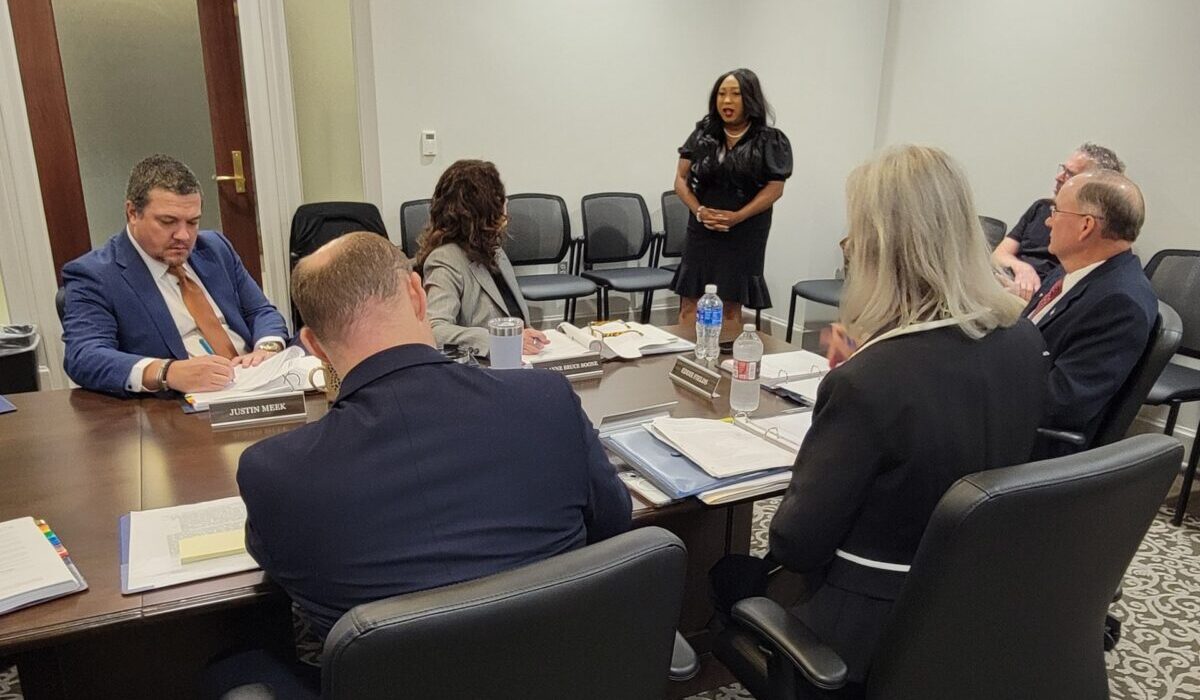
On another topic, the Ethics Commission’s executive director, Lee Anne Bruce Boone, told commissioners they lacked the authority to increase registration fees for lobbyists last year. In June 2023, commissioners increased the registration fees from $100 to $125. However, commissioners overlooked a state law that states lobbyists are to pay a registration fee of $100. The higher fee affected lobbyists who registered for this year. Those who register again next year will be charged only $75 to make up the difference, and commissioners will look at how to refund those who paid the additional $25 in 2024 but ultimately do not register again in 2025.
As of July 1, 2023, when the new rate took effect, 758 lobbyists registered; 185 were new and 573 were renewals. Boone said her staff will contact the Attorney General’s Office for help in clarifying if the definition of lobbyists also includes lobbyist principals, which are private or public entities that employ or retain another person to lobby, and legislative liaisons, who are state officers or employees who lobby. There are 1,261 lobbyist principals and 176 legislative liaisons registered with the Ethics Commission, Boone said.
Depending on interpretation, she said the refund in fees could range from about $36,000 to nearly $100,000.
Mental health commissioner mum on treatment specifics, Donahue funding gap
Oklahoma Department of Mental Health and Substance Abuse Services Commissioner Allie Friesen answers questions during her Senate committee confirmation hearing Thursday, May 23, 2024. (Tres Savage)
Although state leaders rejected a proposed consent decree Oct. 8 to settle a class-action lawsuit alleging unconstitutional delays of mental health competency restoration services, Mental Health and Substance Abuse Services Commissioner Allie Friesen claimed at a press conference Oct. 10 that her department is making progress in treating jail detainees who have been judged mentally incompetent.
Underscoring concerns about the agency’s transparency, however, Friesen said she could not provide specific details about ODMHSAS’ work with criminal defendants deemed mentally incompetent because of the pending litigation.
“Lawsuit or not, and no matter where we go from this point, the work will continue to improve the quality of services,” Friesen said. “We are continuing to provide as many services as we are legally able to provide at this point, and we’ll continue monitoring the quality of those services and improving them where they need to be improved.”
Friesen said people should “never hear from me that we’ve reached our goal and we don’t need to go any further.”
“No matter what domain of service, if we’re talking criminal justice or crisis care or pediatrics, we should always be doing better,” she said. “So, everything that we have been (doing), within our legal parameters that we can execute on to improve care, we are doing and will continue to do.”
Asked about the number of Oklahoma detainees waiting for competency restoration services — which plaintiff attorneys have said is more than 200 — Friesen declined to discuss specifics.
“I would lump that in under we are improving the quality of care and processes, yes,” she said.
Friesen made her comments during a press conference called to unveil the agency’s new vision, mission and strategic plan. Friesen, who said she was the first mental health commissioner who came from outside the state since 1999, was appointed commissioner by Gov. Kevin Stitt in January and took office in February.
“Every single person that has come before me in this role has had their own priority,” she said. “From where I stand or sit, our patient care has not been a priority in many, many, many years. And I do not mean that disrespectfully. There are different phases, there are different needs in the community at different times.”
Friesen said her agency is “blessed to have a significant budget,” and she said one of her top priorities is using that money to improve state mental health facilities.
“Our facilities have been neglected. There are no words for the environment of care we have allowed our patients and employees to operate within,” she said. “We have sewage that has come through the wall in one of our crisis facilities for years and years and years. We have toilets that do not work in patient care areas so that patients have to line up like kindergartners and go to the bathroom. So, when I say we are making things better, I say we are making things better because none of that should be tolerated, and we should not have any privilege to do anything else until we figure that out.”
Friesen said she is working on building out a system-wide digital infrastructure that will allow the management of safety events in real time. In a six-month period this year, from Jan. 1 to June 15, the agency had 1,044 incidents of employees and health care providers being assaulted.
“There is no world in which I can tolerate 1,044 assaults on employees in a health care setting,” she said. “This has been tolerated, purposely or otherwise, and we’re not doing that anymore.”
Friesen said it is a priority of the agency to keep patients safe.
“We are equipping our staff with the tools they need to be successful,” she said. “We are equipping them with training that goes beyond the standard package of mental health training so that they feel empowered and confident when they enter into these high-risk situations. (…) Patient care always comes first, but we will not have any employees, clinicians or physicians left if we continue to let them be treated this way.”
Asked the status of the delayed Donahue Behavioral Health Hospital, slated to become the state’s primary mental health facility serving central Oklahoma, Friesen said the agency has hired J.E. Dunn Construction as construction manager. The construction company led the recent renovation, repair and restoration of the exterior of the Oklahoma State Capitol.
“We are finally at a point where we have concrete plans, concrete numbers, concrete figures,” Friesen said. “And now it’s a matter of essentially putting a menu in front of the decision makers at the Legislature and in the executive branch to make sure that everybody’s on the same page and so that we can get this done the right way. We are on track.”
The Donahue is deesigned to be a 200,000-square-foot behavioral health facility on the OSU-OKC campus, and it is intended to replace the Griffin Memorial Hospital in Norman, which served as the state’s primary mental health hospital for more than a century.
According to agency documents provided to lawmakers last session, the Donahue was targeted for a December 2026 move-in. Friesen said Thursday that its opening will be pushed back to 2027.
On April 30, legislators asked ODMHSAS officials about the Norman property, which was anticipated to net $50 million when sold. With that $50 million unrealized, Friesen provided legislators with a spreadsheet showing a $78.6 million funding hole for the Donahue hospital.
Asked Thursday if that funding hole had changed, Friesen declined to discuss it.
“Out of respect for the leaders that we have not had a chance to sit down with, I’m not going to give you specifics on numbers,” Friesen said. “When we come back with the figures for the funding gap, we will have a specific opening date as well.”
City of Norman sues library construction companies
Nearly a full year after what was initially intended to be a one-week mold remediation project, the central branch of the Norman Public Library remains shuttered because leaks and mold have plagued the building. Now, the City of Norman has filed a lawsuit against the library’s architects and builders.
Oklahoma-based construction group FlintCo and Oklahoma-based architectural firm ADG Blatt are named as defendants in the lawsuit, which alleges each of the defendants failed to use “the ordinary skill, care and diligence of (…) a reasonably prudent” contractor. Minnesota-based architecture firm Meyer, Scherer and Rockcastle was also named as a defendant, along with 20 John Does who supplied building materials and subcontracted construction work, the names of whom are “not yet known to (the) plaintiff.”
The $39 million building, funded by Norman’s MAPS-like Norman Forward sales tax, opened in November 2019 and closed in November 2023. Norman Parks and Recreation director Jason Olsen said at the time of the building’s closure that his department had been “nonstop chasing leaks” as soon as the building opened. The building’s roof was replaced and windows were resealed annually, but nothing curbed the widespread water intrusion.
In April, Olsen shut down rumors that the library would need to be torn down, but he acknowledged the city does not have enough funding to make the repairs necessary on its own.
“We’re going to need some help getting this building across the finish line,” Olsen told the Norman Public Library Board, adding that the city was entering “a phase of litigation.” The lawsuit was officially filed Oct. 2.
KFOR published excerpts from a report by Norman-based architecture firm McKinney Partnership Architects, which is not named as a defendant in the lawsuit. Dated September 2018, the report detailed extensive mold growth on the library’s second and third floors prior to it even opening to the public.
“There could be a high probability that the mold could show up after the building is 100 percent enclosed,” the report said.
Pemberton out, Lepak in as Stitt general counsel
Trevor Pemberton, general counsel for Oklahoma Gov. Kevin Stitt, listens during Stitt’s inauguration for a second term Monday, Jan. 9, 2023. (Michael Duncan)
On Monday, Gov. Kevin Stitt announced that a new general counsel will replace his current top attorney, Trevor Pemberton.
State Chamber Research Foundation executive director Ben Lepak will join Stitt’s administration as Pemberton approaches his last day on the job Nov. 1. Lepak is the son of state Rep. Mark Lepak (R-OKC) and the brother of State Board of Education member Sarah Lepak.
“It’s an honor to serve my state in this capacity,” Lepak said in a press release. “I’ve long admired the governor’s business acumen and commitment to free market principles. I look forward to helping him advance his top 10 agenda.”
Ben Lepak currently sits on the Statewide Charter School Board, and he was critical of having an attorney from Attorney General Gentner Drummond’s office represent the board at a recent meeting. Typically, state boards can receive legal counsel from the AG’s office or hire their own attorneys, although Drummond successfully sued to block the board’s creation of a Catholic charter school.
At the SCSB’s July 30 meeting, Lepak and other members of the board disagreed with Drummond’s decision to attempt to remove the board’s outside attorney from the role. The board decided at that meeting to continue to retain its outside counsel and pursue a U.S. Supreme Court appeal of the Oklahoma Supreme Court’s June decision to block a potential new Catholic charter school from opening. Lepak voted in favor of both measures. Drummond has been a staunch opponent of the idea of allowing religious charter schools, which are public schools that can be privately run.
Lepak will join an administration steeped in legal questions, such as how Oklahoma should handle jurisdictional questions in the wake of the U.S. Supreme Court’s 2020 McGirt decision, which functionally affirmed eastern Oklahoma as a series of Indian Country reservations. Stitt has been critical of the decision and vocal in his calls to overturn it, often angering tribal officials.
“Ben has worked tirelessly in the public and private sectors to advance free market principles,” Stitt said. “I’m excited to add his legal and policy expertise to my team as we continue to make Oklahoma a top 10 state for business.”
It is unclear where Pemberton, who held his position for three years, will go after he leaves the governor’s office. He shared words of faith in the press release announcing his departure.
“Three years ago, I accepted this incredible opportunity out of obedience to the Lord’s call on my life, and I am laying it down all the same,” Pemberton said. “We are called to be strong and courageous, to not be frightened or dismayed; the lord our God is with us wherever we go. Indeed, he has been. May the lord continue to bless this great state and Gov. Kevin Stitt.”
Pemberton has advised Stitt’s office that Lepak will not need to step down from the Statewide Charter School Board, according to Abegail Cave, the governor’s director of communications.
Former OKC councilman Larry McAtee dies
Longtime Oklahoma City Ward 3 City Councilman Larry McAtee died Friday. McAtee, 87, served on the OKC City Council from 2001 to 2021 and became the second-longest-serving member of the council during that time.
Former OKC Councilman Larry McAtee. (Provided)
McAtee also held positions on numerous boards during his time in city government, including chairing the airport trust, economic development trust and sports facilities oversight board, among others.
OKC Mayor David Holt praised McAtee as the epitome of an elected official.
“Councilman Larry McAtee was a model public servant who connected with his constituents on a personal level to solve problems and seize opportunities,” Holt said. “Though his first priority was always his ward, Larry was also a contributor to the many citywide accomplishments we realized during his two decades of service, including the passage of three MAPS initiatives and the arrival of major league professional sports. We are grateful for his lifetime of service, and we send our deepest condolences to his family.”
Last year, a park in Crystal Lake — just southwest of the Interstate 40 and MacArthur Boulevard intersection — was named after McAtee, who championed neighborhoods and city beautification efforts during his time in office.
“It was an honor to serve the residents of Ward 3 and the City of Oklahoma City for 20 years,” McAtee said at the park dedication, according to a press release. “It was my privilege to serve alongside neighborhood leaders and city staff who were passionate about growing and improving our great city. May God continue to bless the City of Oklahoma City.”