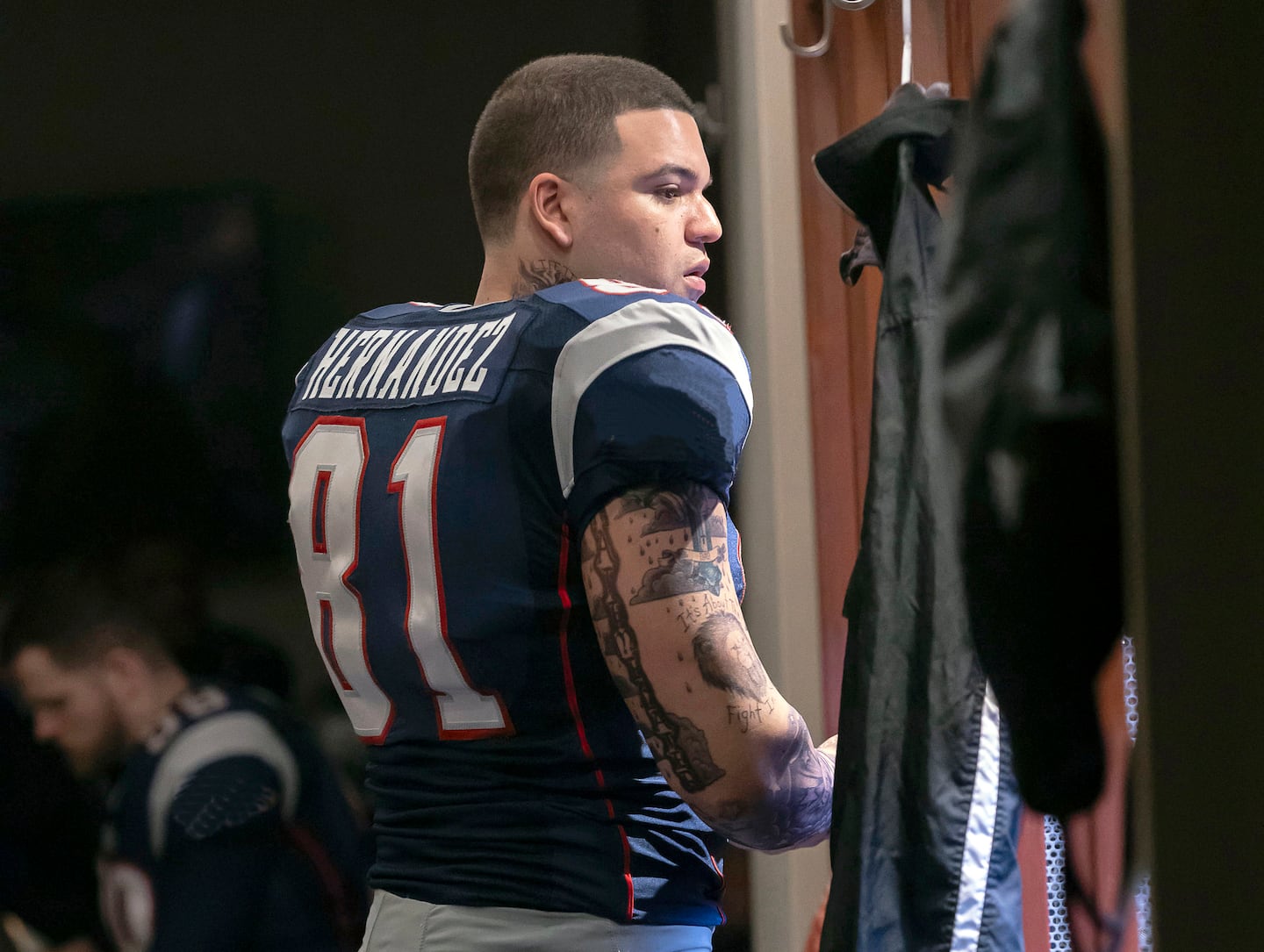
It’s all downhill from here. That’s the impression one gets watching episode 5 of “American Sports Story: Aaron Hernandez,” which aired Tuesday night on FX.
The latest chapter of the Ryan Murphy-produced show dramatizes Hernandez’s arrival in Foxborough, where he quickly learns that coach Bill Belichick has no interest in keeping tabs on his team’s new offensive weapon, and no ability to keep Hernandez on the straight and narrow once it’s clear he’s coming undone.
“This is a man’s team, be a man,” Belichick tells the player at one point.
It doesn’t take long for Hernandez’s lackadaisical approach in practice to bother his coach. In one scene, Belichick appears to punish Hernandez for lining up incorrectly, ordering up a series of plays that puts the tight end in the running-back position. As a result, Hernandez takes a series of huge hits that leave him dazed, underscoring the effect repeated blows to the head may have had on his behavior.
Get Starting Point
A guide through the most important stories of the morning, delivered Monday, Wednesday, and Friday.
“I’m getting my head beat in. I’m not a running back,” Hernandez pleads.
“I’ll tell you what you are,” Belichick barks.
The episode ends with Hernandez at the wheel of an idling car at night, staring at a traffic light as if in a trance.
Belichick is portrayed in the show, which is based on The Boston Globe’s Spotlight series and accompanying podcast, produced by The Boston Globe and Wondery, as a social misfit whose only interests are football and … Bon Jovi. There’s an amusing scene in which the coach (played by Tony-winning stage actor Norbert Leo Butz) gets hyped for practice by listening to “It’s My Life” with the volume turned up.
In episode 5, we’re also introduced to two characters who may play the most pivotal roles in Hernandez’s last few years. One is Shayanna Jenkins, a former high school flame with whom Hernandez reconnects after he’s drafted by the Patriots. (The pair eventually get engaged and have a daughter.)
The other is Alexander Bradley. While Jenkins is portrayed as a stabilizing force in Hernandez’s life, Bradley is the opposite. A drug dealer who’s spent time behind bars, Bradley tells Hernandez that the NFL and prison are more similar than it might seem.
“Ain’t no difference between the warden and the owner of that team,” Bradley says. “White dudes overseeing a whole bunch of Black folk. … They snap their finger and take everything away. You only think you free.”
Mark Shanahan can be reached at mark.shanahan@globe.com. Follow him @MarkAShanahan.
Aaron Hernandez was football’s shooting star – the big, fast and tough receiver you couldn’t take your eyes off. Deployed as a tight end, the name for the double duty players on offense who block as well as catch passes, Hernandez quickly emerged as the nation’s best while winning a college championship at the University of Florida in 2009. After joining the NFL the following year at the tender age of 20, Hernandez helped evolve the tight end position from complementary to headlining role on the way to reaching the Super Bowl and signing a $40m contract extension. Ultimately, though, his penchant for self-destruction proved greater than his knack for wrecking game plans. In 2017 Hernandez was found dead at age 27 while serving life in prison for fatally shooting a close friend who played semi-pro ball. His spectacular fall from grace became the biggest media scandal since the OJ Simpson saga – so it’s no wonder that Hernandez has also received the Ryan Murphy treatment.
This week marks the debut of American Sports Story: Aaron Hernandez – a 10-part Murphy-branded limited series chronicling Hernandez’s star-crossed sports celebrity. Created and executive produced by Stuart Zicherman, best known for his work on The Americans, American Sports Story is the first fictional treatment to follow the raft of journalistic projects that sprang up after Hernandez was found dead by suicide, days after he was acquitted of charges in an unrelated double homicide. The show is based on a six-part newspaper series produced by the Boston Globe’s award-winning Spotlight investigative arm, which delves more deeply into Hernandez’s tortured upbringing and troubled teenage years.
Two reporters from the Spotlight team join this sharply drawn project, made more authentic by writers like the NFL veteran turned TV analyst Domonique Foxworth – who not only played against Hernandez, but advocated on his behalf while an executive on the players’ union. Highlights from Hernandez’s playing career, one of the advantages of making a drama for a football TV rights holder, lend further credibility – but not enough to stop fans from picking apart actors for not looking exactly like their sports heroes. If Clipped, FX’s most recent foray into ripped-from-the-sports-pages storytelling, is a guide, then Patrick Schwarzenegger isn’t going to escape the jokes about his Mr Universe father failing to adequately prepare him to fill out the role of the football hunk Tim Tebow – even though the actor gets Tebow’s muscular Christianity tics right.
Likewise, the Hunger Games breakout Josh Andrés Rivera makes himself believable enough as Hernandez, especially when the focus tightens on this dark and brooding production – which is often. The close-ups are part of a larger push to place viewers inside Hernandez’s head – the black box that kept him edging from rage to paranoia, prompting his escape into marijuana. Reflecting on his college years, Hernandez reportedly said: “Every time I was on the field I was high on weed.”
It wasn’t until after Hernandez died and his brain was donated to science that he was diagnosed with chronic traumatic encephalopathy, or CTE; the disease, which can only be identified posthumously, is the result of repeated hits to the head and has been attributed to the deaths of football players as young as high-school age. When Hernandez’s brain was examined at Boston University, home of the world’s largest CTE brain bank, researchers there diagnosed him with the most severe case ever discovered in a person his age – damage that would have significantly contributed to his difficulties making decisions, controlling his impulses and regulating his emotions.
CTE might well have summed up Hernandez’s downfall – just as it does Chicago’s Dave Duerson, San Diego’s Junior Seau and more NFL legends – if Hernandez hadn’t left behind a suicide note addressed to his jailhouse lover. That opened the door to a frenzy of speculation about Hernandez’s potential inner torment as a closeted bisexual man. After an investigative journalist outed Hernandez on a Boston sports talk radio program immediately following his death, his brother told Dr Oz that the family feared he had become a murderer to hide his secret sex life; Hernandez’s fiancee – also the mother of his only child, a daughter – maintains that he never expressed gay or bisexual desires to her. This project will almost certainly visit more distress upon his survivors.
Zicherman et al don’t just fill in the blanks in Hernandez’s sexual identity; they make it central to his character, using his family’s suspicions as cover for a broader critique of the inherent homoeroticism of male sport. Those who don’t outright dismiss this latest FX series as yet another product of the Hollywood agenda will be riveted by how clever the series is about finding and impregnating the emotional beats along this sporty narrative arc. His complicated relationship with his physically abusive father (who died while Aaron was a teenager), the sense of abandonment he felt after being pushed out of college once he had served his purpose, the dissociative episodes he suffers while interviewing with NFL teams – all of it enhances the picture of a truly lost soul, upgrading Hernandez from sports cautionary tale to tragic American myth.
Like football itself, American Sports Story makes itself tough to watch. It makes you wish things had turned out differently for Hernandez. It makes clear: he was as good as doomed.