hacklink hack forum hacklink film izle hacklink marsbahisizmir escortsahabetpornJojobet

Tag: humans

  • Can AI help humans understand animals and reconnect with nature? A nonprofit research lab thinks so

    Can AI help humans understand animals and reconnect with nature? A nonprofit research lab thinks so

    MONTREAL — Peeps trickle out of a soundproof chamber as its door opens. Female zebra finches are chattering away inside the microphone-lined box. The laboratory room sounds like a chorus of squeaky toys.

    “They’re probably talking about us a little bit,” says McGill University postdoctoral fellow Logan James.

    It’s unclear, of course, what they are saying. But James believes he is getting closer to deciphering their vocalizations through a partnership with the Earth Species Project. The nonprofit laboratory has drawn some of the technology industry’s wealthiest philanthropists — and they want to see more than just scientific progress. On top of breakthroughs in animal language, they expect improved interspecies understanding will foster greater appreciation for the planet in the face of climate change.

    The Earth Species Project hopes to decode other creatures’ communications with its pioneering artificial intelligence tools. The goal is not to build a “translator that will allow us to speak to other species,” Director of Impact Jane Lawton said. However, she added, “rudimentary dictionaries” for other animals are not only possible but could help craft better conservation strategies and reconnect humanity with often forgotten ecosystems.

    “We believe that by reminding people of the beauty, the sophistication, the intelligence that is resident in other species and in nature as a whole, we can start to, kind of, almost repair that relationship,” Lawton said.

    At McGill University, the technology generates specific calls during simulated conversations with live finches that help researchers isolate each unique noise. The computer processes calls in real time and responds with one of its own. Those recordings are then used to train the Berkeley, California-based research group’s audio language model for animal sounds.

    This ad hoc collaboration is only a glimpse into what ESP says will come. By 2030, Lawton said, it expects “really interesting insights into how other animals communicate.” Artificial intelligence advancements are expediting the research. New grants totaling $17 million will help hire engineers and at least double the size of the research team, which currently has roughly seven members. Over the next two years, Lawton said, the nonprofit’s researchers will select species that “might actually shift something” in people’s relationship with nature.

    Standing to benefit are animal groups threatened by habitat loss or human activity that could be better protected with better understandings of their languages. Existing collaborations aim to document the vocal repertoires — the distinct calls and their different contexts — of the Hawaiian crow and St. Lawrence River beluga whales.

    After spending more than two decades extinct in the wild, the crows have been reintroduced to their home of Maui. But some conservationists fear that critical vocabulary has faded in captivity. Lawton said the birds might need to relearn some “words” before they reenter their natural habitat in droves.

    In Canada’s St. Lawrence River, where shipping traffic imperils the marine mammals who feed there, the group’s scientists are exploring whether machine learning can categorize unlabeled calls from the remaining belugas. Perhaps, Lawton suggested, authorities could alert nearby vessels if they understood that certain sounds signaled the whales were about to surface.

    Big donors include LinkedIn co-founder Reid Hoffman, the family charity founded by late Microsoft co-founder Paul G. Allen and Laurene Powell Jobs’ Waverley Street Foundation. The latter aims to support “bottom-up” solutions to the “climate emergency.” At the root of that crisis, according to Waverley Street Foundation President Jared Blumenfeld, is the idea that humans deserve “dominion” over the world.

    Blumenfeld finds that ESP’s work is an important reminder that we are instead stewards of the planet.

    “This is not a silver bullet,” he said. “But it’s certainly part of a suite of things that can help transform how we view ourselves in relation to nature.”

    Gail Patricelli — an unaffiliated animal behavior professor at the University of California, Davis — remembers when such tools were just “pie in the sky.” Researchers previously spent months laboring to manually comb through terabytes of recordings and annotate calls.

    She said she’s seen an “exponential takeoff” the past few years in bioacoustics’ use of machine learning to accelerate that process. While she finds that ESP has the promise to make finer distinctions in existing “dictionaries,” especially for harder-to-reach species, she cautioned observers against attributing human characteristics to these animals.

    Considering this research’s high equipment and labor costs, Patricelli said she’s happy to see big philanthropists backing it. But she said the field shouldn’t rely too much on one funding source. Government support is still necessary, she noted, because ecosystem protection also requires that conservationists examine “unsexy” species that she expects get less attention than more charismatic ones. She also encouraged funders to consult scientists.

    “There’s a lot to learn and it’s very expensive,” she said. “That might not be a big deal to some of these donors but it’s very hard to come up with the money to do this.”

    The current work largely involves developing baseline technologies to do all this. A separate initiative has recently described the basic elements of how sperm whales might talk. But ESP is trying to be “species agnostic,” AI Research Director Olivier Pietquin said, to provide tools that can sort out many animals’ speech patterns.

    ESP introduced NatureLM-audio this fall, touting the system as the first large audio-language model fit for animals. The tool can identify species and distinguish characteristics such as sex or stage of life. When applied to a population — zebra finches — it had not been trained on, NatureLM-audio accurately counted the number of birds at a rate higher than random chance, according to ESP. The results were a positive sign for Pietquin that NatureLM might be able to scale across species.

    “That is only possible with a lot of computing, a lot of data and many, many collaborations with ecologists and biologists,” he said. “That, I think, makes us, makes it, quite serious.”

    ESP acknowledges that it isn’t sure what will be discovered about animal communications and won’t know when its model gets it absolutely right. But the team likens AI to the microscope: advancements that allowed scientists to see far more than previously considered possible.

    Zebra finches are highly social animals with large call repertoires. Whether congregating in pairs or by the hundreds, they produce hours of data — a help to the nonprofit’s AI scientists given that animal sounds aren’t as abundant as the pages of internet text scraped to train chatbots.

    James, an affiliated researcher with the Earth Species Project, struggles with the concept of decoding animal communications. Sure, he can clearly distinguish when a chick is screaming for food. But he doesn’t expect to ever translate that call or any others into a human word.

    Still, he wonders if he can gather more hints about their interactions from aspects of the call such as its pitch or duration.

    “So can we find a link between a form and function is sort of our way of maybe thinking about decoding,” James said. “As she elongates her call, is that because she’s trying harder to elicit a response?”

    ___

    Associated Press coverage of philanthropy and nonprofits receives support through the AP’s collaboration with The Conversation US, with funding from Lilly Endowment Inc. The AP is solely responsible for this content. For all of AP’s philanthropy coverage, visit https://apnews.com/hub/philanthropy.
    Source link

  • Giant sloths, mastodons coexisted with humans for millennia in Americas

    Giant sloths, mastodons coexisted with humans for millennia in Americas

    SAO PAULO, Brazil — Sloths weren’t always slow-moving, furry tree-dwellers. Their prehistoric ancestors were huge — up to 4 tons (3.6 metric tons) — and when startled, they brandished immense claws.

    For a long time, scientists believed the first humans to arrive in the Americas soon killed off these giant ground sloths through hunting, along with many other massive animals like mastodons, saber-toothed cats and dire wolves that once roamed North and South America.

    But new research from several sites is starting to suggest that people came to the Americas earlier — perhaps far earlier — than once thought. These findings hint at a remarkably different life for these early Americans, one in which they may have spent millennia sharing prehistoric savannas and wetlands with enormous beasts.

    “There was this idea that humans arrived and killed everything off very quickly — what’s called ‘Pleistocene overkill,’” said Daniel Odess, an archaeologist at White Sands National Park in New Mexico. But new discoveries suggest that “humans were existing alongside these animals for at least 10,000 years, without making them go extinct.”

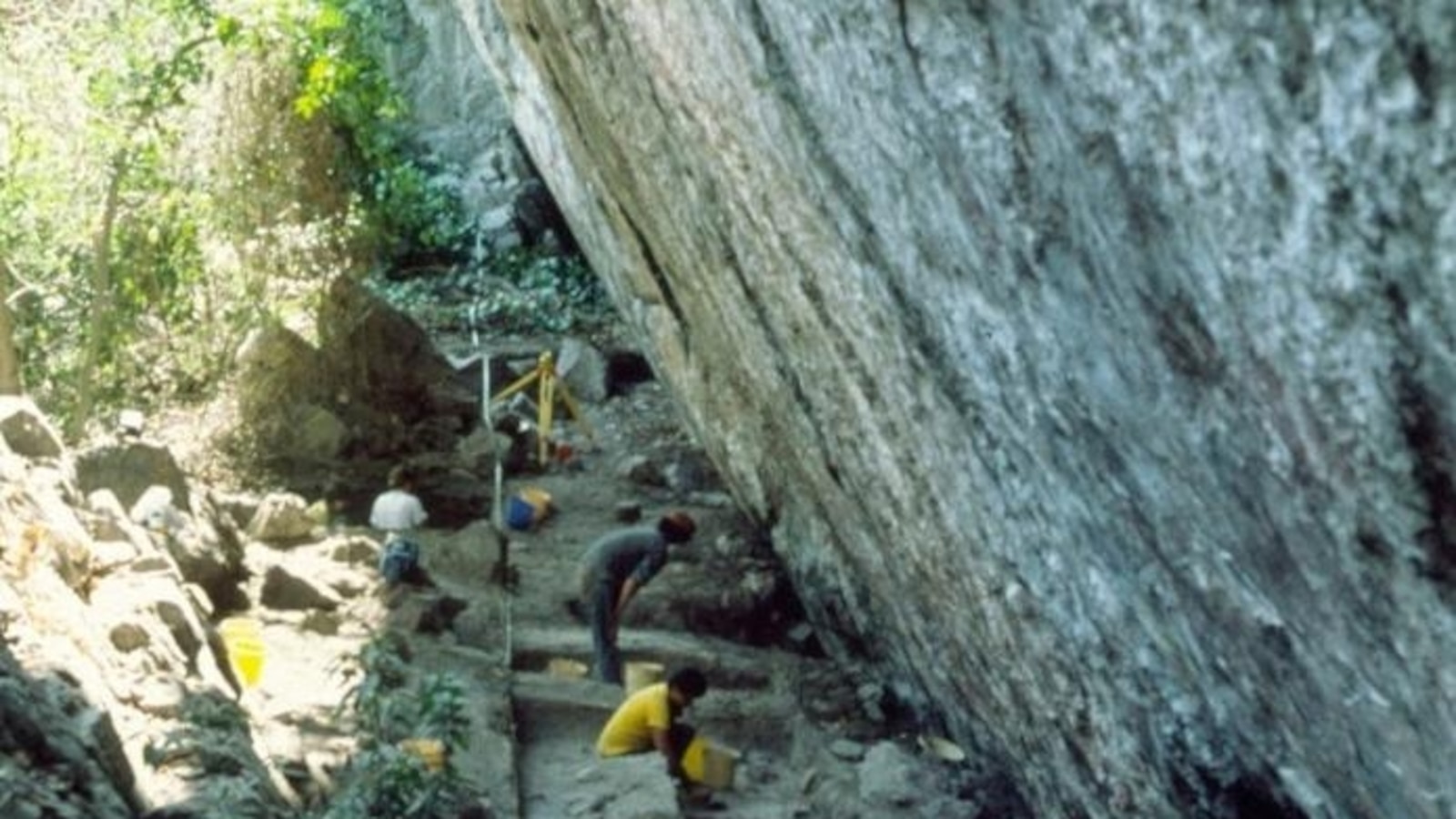
    Some of the most tantalizing clues come from an archaeological site in central Brazil, called Santa Elina, where bones of giant ground sloths show signs of being manipulated by humans. Sloths like these once lived from Alaska to Argentina, and some species had bony structures on their backs, called osteoderms — a bit like the plates of modern armadillos — that may have been used to make decorations.

    In a lab at the University of Sao Paulo, researcher Mírian Pacheco holds in her palm a round, penny-sized sloth fossil. She notes that its surface is surprisingly smooth, the edges appear to have been deliberately polished, and there’s a tiny hole near one edge.

    “We believe it was intentionally altered and used by ancient people as jewelry or adornment,” she said. Three similar “pendant” fossils are visibly different from unworked osteoderms on a table — those are rough-surfaced and without any holes.

    These artifacts from Santa Elina are roughly 27,000 years old — more than 10,000 years before scientists once thought that humans arrived in the Americas.

    Originally researchers wondered if the craftsmen were working on already old fossils. But Pacheco’s research strongly suggests that ancient people were carving “fresh bones” shortly after the animals died.

    Her findings, together with other recent discoveries, could help rewrite the tale of when humans first arrived in the Americas — and the effect they had on the environment they found.

    “There’s still a big debate,” Pacheco said.

    Scientists know that the first humans emerged in Africa, then moved into Europe and Asia-Pacific, before finally making their way to the last continental frontier, the Americas. But questions remain about the final chapter of the human origins story.

    Pacheco was taught in high school the theory that most archaeologists held throughout the 20th century. “What I learned in school was that Clovis was first,” she said.

    Clovis is a site in New Mexico, where archaeologists in the 1920s and 1930s found distinctive projectile points and other artifacts dated to between 11,000 and 13,000 years ago.

    This date happens to coincide with the end of the last Ice Age, a time when an ice-free corridor likely emerged in North America — giving rise to an idea about how early humans moved into the continent after crossing the Bering land bridge from Asia.

    And because the fossil record shows the widespread decline of American megafauna starting around the same time — with North America losing 70% of its large mammals, and South America losing more than 80% — many researchers surmised that humans’ arrival led to mass extinctions.

    “It was a nice story for a while, when all the timing lined up,” said paleoanthropologist Briana Pobiner at the Smithsonian Institution’s Human Origins Program. “But it doesn’t really work so well anymore.”

    In the past 30 years, new research methods — including ancient DNA analysis and new laboratory techniques — coupled with the examination of additional archaeological sites and inclusion of more diverse scholars across the Americas, have upended the old narrative and raised new questions, especially about timing.

    “Anything older than about 15,000 years still draws intense scrutiny,” said Richard Fariña, a paleontologist at the University of the Republic in Montevideo, Uruguay. “But really compelling evidence from more and more older sites keeps coming to light.”

    In Sao Paulo and at the Federal University of Sao Carlos, Pacheco studies the chemical changes that occur when a bone becomes a fossil. This allows her team to analyze when the sloth osteoderms were likely modified.

    “We found that the osteoderms were carved before the fossilization process” in “fresh bones” — meaning anywhere from a few days to a few years after the sloths died, but not thousands of years later.

    Her team also tested and ruled out several natural processes, like erosion and animal gnawing. The research was published last year in the journal Proceedings of the Royal Society B.

    One of her collaborators, paleontologist Thaís Pansani, recently based at the Smithsonian Institution, is analyzing whether similar-aged sloth bones found at Santa Elina were charred by human-made fires, which burn at different temperatures than natural wildfires.

    Her preliminary results suggest that the fresh sloth bones were present at human campsites — whether burned deliberately in cooking, or simply nearby, isn’t clear. She is also testing and ruling out other possible causes for the black markings, such as natural chemical discoloration.

    The first site widely accepted as older than Clovis was in Monte Verde, Chile.

    Buried beneath a peat bog, researchers discovered 14,500-year-old stone tools, pieces of preserved animal hides, and various edible and medicinal plants.

    “Monte Verde was a shock. You’re here at the end of the world, with all this organic stuff preserved,” said Vanderbilt University archaeologist Tom Dillehay, a longtime researcher at Monte Verde.

    Other archaeological sites suggest even earlier dates for human presence in the Americas.

    Among the oldest sites is Arroyo del Vizcaíno in Uruguay, where researchers are studying apparent human-made “cut marks” on animal bones dated to around 30,000 years ago.

    At New Mexico’s White Sands, researchers have uncovered human footprints dated to between 21,000 and 23,000 years ago, as well as similar-aged tracks of giant mammals. But some archaeologists say it’s hard to imagine that humans would repeatedly traverse a site and leave no stone tools.

    “They’ve made a strong case, but there are still some things about that site that puzzle me,” said David Meltzer, an archaeologist at Southern Methodist University. “Why would people leave footprints over a long period of time, but never any artifacts?”

    Odess at White Sands said that he expects and welcomes such challenges. “We didn’t set out to find the oldest anything — we’ve really just followed the evidence where it leads,” he said.

    While the exact timing of humans’ arrival in the Americas remains contested — and may never be known — it seems clear that if the first people arrived earlier than once thought, they didn’t immediately decimate the giant beasts they encountered.

    And the White Sands footprints preserve a few moments of their early interactions.

    As Odess interprets them, one set of tracks shows “a giant ground sloth going along on four feet” when it encounters the footprints of a small human who’s recently dashed by. The huge animal “stops and rears up on hind legs, shuffles around, then heads off in a different direction.”

    ___

    The Associated Press Health and Science Department receives support from the Howard Hughes Medical Institute’s Science and Educational Media Group. The AP is solely responsible for all content.

    Source link

  • Muddy footprints suggest 2 species of early humans were neighbors in Kenya 1.5 million years ago

    Muddy footprints suggest 2 species of early humans were neighbors in Kenya 1.5 million years ago

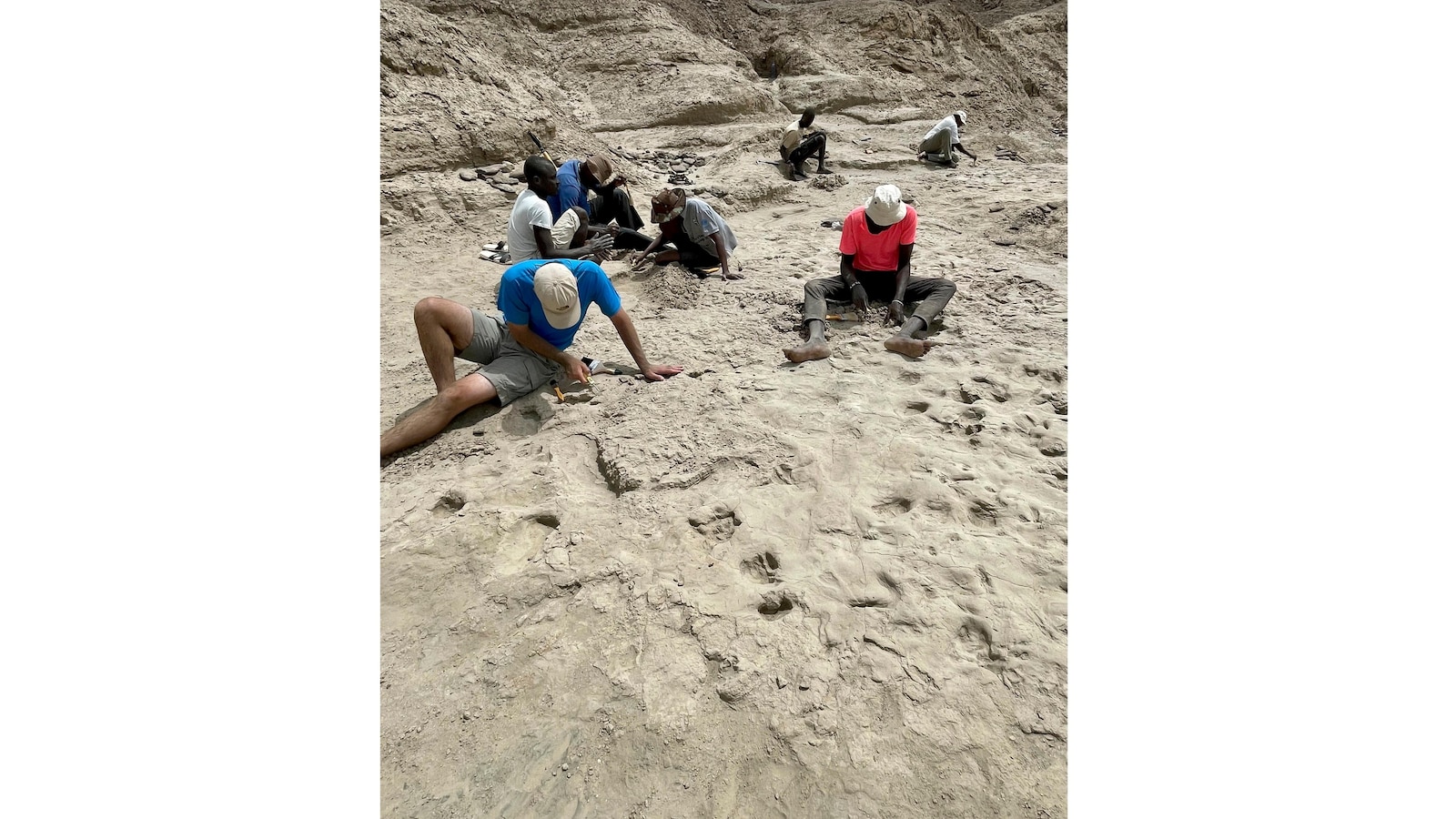
    WASHINGTON — Muddy footprints left on a Kenyan lakeside suggest two of our early human ancestors were nearby neighbors some 1.5 million years ago.

    The footprints were left in the mud by two different species “within a matter of hours, or at most days,” said paleontologist Louise Leakey, co-author of the research published Thursday in the journal Science.

    Scientists previously knew from fossil remains that these two extinct branches of the human evolutionary tree – called Homo erectus and Paranthropus boisei – lived about the same time in the Turkana Basin.

    But dating fossils is not exact. “It’s plus or minus a few thousand years,” said paleontologist William Harcourt-Smith of Lehman College and the American Museum of Natural History in New York, who was not involved in the study.

    Yet with fossil footprints, “there’s an actual moment in time preserved,” he said. “It’s an amazing discovery.”

    The tracks of fossil footprints were uncovered in 2021 in what is today Koobi Fora, Kenya, said Leaky, who is based at New York’s Stony Brook University.

    Whether the two individuals passed by the eastern side of Lake Turkana at the same time – or a day or two apart – they likely knew of each other’s existence, said study co-author Kevin Hatala, a paleoanthropologist at Chatham University in Pittsburgh.

    “They probably saw each other, probably knew each other was there and probably influenced each other in some way,” he said.

    Scientists were able to distinguish between the two species because of the shape of the footprints, which holds clues to the anatomy of the foot and how it’s being used.

    H. erectus appeared to be walking similar to how modern humans walk – striking the ground heel first, then rolling weight over the ball of the foot and toes and pushing off again.

    The other species, which was also walking upright, was moving “in a different way from anything else we’ve seen before, anywhere else,” said co-author Erin Marie Williams-Hatala, a human evolutionary anatomist at Chatham.

    Among other details, the footprints suggest more mobility in their big toe, compared to H. erectus or modern humans, said Hatala.

    Our common primate ancestors probably had hands and feet adapted for grasping branches, but over time the feet of human ancestors evolved to enable walking upright, researchers say.

    The new study adds to a growing body of research that implies this transformation to bipedalism – walking on two feet — didn’t happen at a single moment, in a single way.

    Rather, there may have been a variety of ways that early humans learned to walk, run, stumble and slide on prehistoric muddy slopes.

    “It turns out, there are different gait mechanics – different ways of being bipedal,” said Harcourt-Smith.

    ___

    The Associated Press Health and Science Department receives support from the Howard Hughes Medical Institute’s Science and Educational Media Group. The AP is solely responsible for all content.

    Source link