hacklink hack forum hacklink film izle hacklink marsbahisizmir escortsahabetpornJojobet

Tag: Kenya

  • Muddy footprints suggest 2 species of early humans were neighbors in Kenya 1.5 million years ago

    Muddy footprints suggest 2 species of early humans were neighbors in Kenya 1.5 million years ago

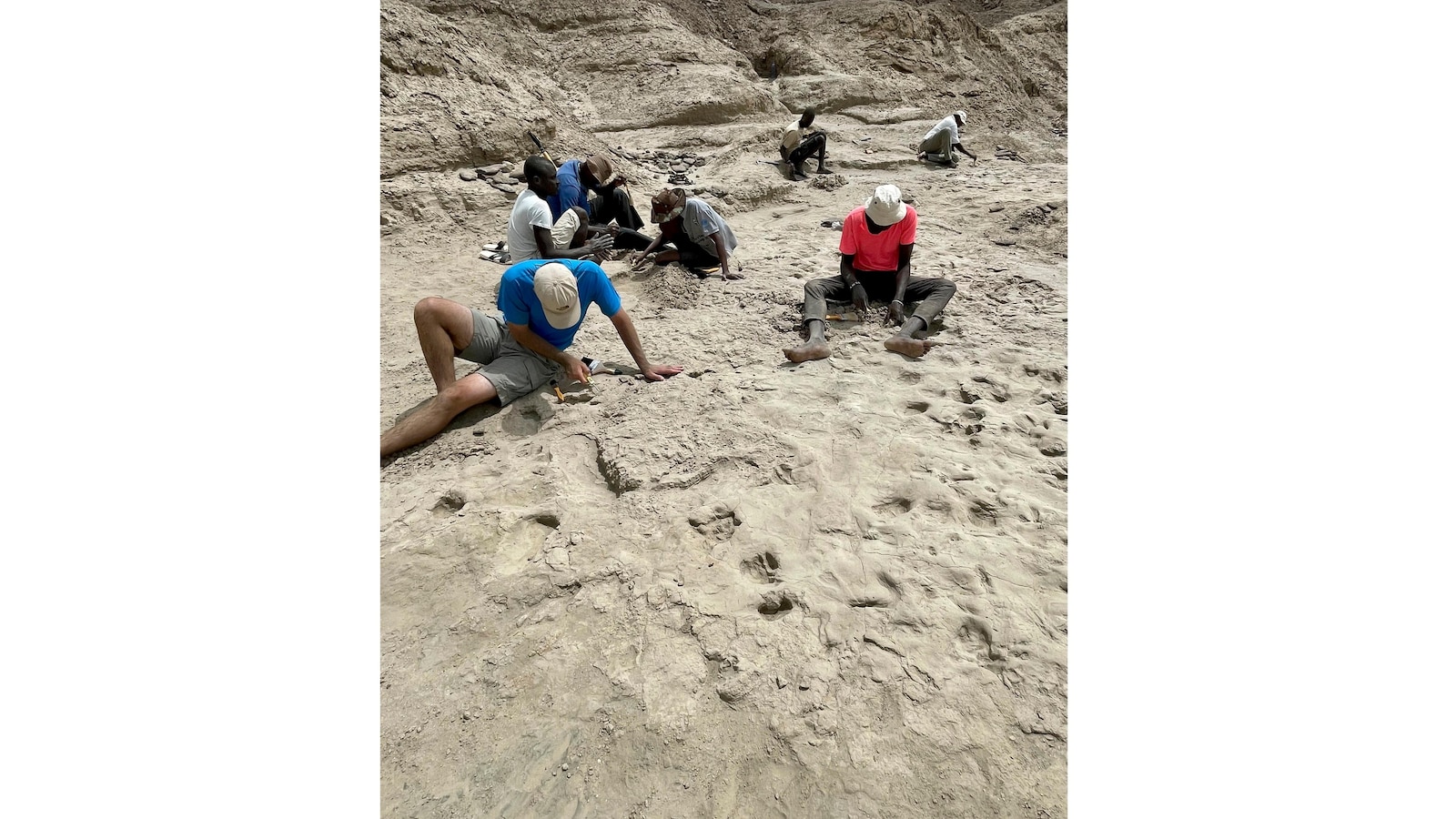
    WASHINGTON — Muddy footprints left on a Kenyan lakeside suggest two of our early human ancestors were nearby neighbors some 1.5 million years ago.

    The footprints were left in the mud by two different species “within a matter of hours, or at most days,” said paleontologist Louise Leakey, co-author of the research published Thursday in the journal Science.

    Scientists previously knew from fossil remains that these two extinct branches of the human evolutionary tree – called Homo erectus and Paranthropus boisei – lived about the same time in the Turkana Basin.

    But dating fossils is not exact. “It’s plus or minus a few thousand years,” said paleontologist William Harcourt-Smith of Lehman College and the American Museum of Natural History in New York, who was not involved in the study.

    Yet with fossil footprints, “there’s an actual moment in time preserved,” he said. “It’s an amazing discovery.”

    The tracks of fossil footprints were uncovered in 2021 in what is today Koobi Fora, Kenya, said Leaky, who is based at New York’s Stony Brook University.

    Whether the two individuals passed by the eastern side of Lake Turkana at the same time – or a day or two apart – they likely knew of each other’s existence, said study co-author Kevin Hatala, a paleoanthropologist at Chatham University in Pittsburgh.

    “They probably saw each other, probably knew each other was there and probably influenced each other in some way,” he said.

    Scientists were able to distinguish between the two species because of the shape of the footprints, which holds clues to the anatomy of the foot and how it’s being used.

    H. erectus appeared to be walking similar to how modern humans walk – striking the ground heel first, then rolling weight over the ball of the foot and toes and pushing off again.

    The other species, which was also walking upright, was moving “in a different way from anything else we’ve seen before, anywhere else,” said co-author Erin Marie Williams-Hatala, a human evolutionary anatomist at Chatham.

    Among other details, the footprints suggest more mobility in their big toe, compared to H. erectus or modern humans, said Hatala.

    Our common primate ancestors probably had hands and feet adapted for grasping branches, but over time the feet of human ancestors evolved to enable walking upright, researchers say.

    The new study adds to a growing body of research that implies this transformation to bipedalism – walking on two feet — didn’t happen at a single moment, in a single way.

    Rather, there may have been a variety of ways that early humans learned to walk, run, stumble and slide on prehistoric muddy slopes.

    “It turns out, there are different gait mechanics – different ways of being bipedal,” said Harcourt-Smith.

    ___

    The Associated Press Health and Science Department receives support from the Howard Hughes Medical Institute’s Science and Educational Media Group. The AP is solely responsible for all content.

    Source link

  • Create robust systems that nurture Olympics talent for Kenya

    Create robust systems that nurture Olympics talent for Kenya

    Kenya’s performance at the Paris Olympic Games exemplified the foothold we have in both middle and long-distance races.

    Kenya was ranked 17th globally and emerged as Africa’s top performer having won 11 medals – four gold, two silver, and five bronze. This outing was an improvement from the Tokyo 2020 Olympics where Kenya finished 19th with 10 medals, but a decline from the 2016 Rio Olympics where we secured 13 medals, finishing 15th and the best in the continent. 

    Since our first participation in the Olympics 60 years ago, Kenya’s medal count stands at 124. Except for seven boxing medals won in the 1980s, all the medals have come from middle and long-distance running. What happened to Boxing? Why haven’t we won any more boxing medals? Did we run out of talent? This was the first time Kenya did not qualify a boxer in the history of the Olympics.

    In previous editions, we have qualified in Rugby, women’s Volleyball, Swimming, Weightlifting, Judo, Shooting, Hockey, and recently Fencing. Considering there are about 30 active Olympic sports disciplines in Kenya, one must wonder why the rest never qualify, least of all, win medals.

    The stars of the show in Paris were the women athletes, who demonstrated a gratifying duel on the tracks to emerge top, ensuring that Kenya maintains its legacy of excellence in athletics.

    Faith Kipyegon secured gold and silver in the 1,500 and 5,000 metres races, respectively, while Beatrice Chebet claimed gold in the 5,000 and 10,000 metres events. This is the first time since our first Olympic medal duck in 1964 that women have outshone men. In the men’s category, Emmanuel Wanyonyi was the sole gold medal winner for Kenya after emerging top in the 800 metres.

    Our overall performance at the Paris Olympic Games has revealed areas that should inform our preparations for the next event scheduled for Los Angeles in 2028. The key takeaways provide learnings and a myriad of opportunities that, if exploited, will bolster our sports and future performances, if indeed we are intent on improving our winning streak.

    Kenya’s dominance in track events demonstrates incredible talent amongst our sportsmen and women. It makes us imagine that they are naturally gifted and that winning medals comes easily. I have had many say that Steeplechase was our race, what happened? Is Steeplechase going the boxing route?

    It is high time we evaluated why we are doing well in certain disciplines and not others. What is Athletics Kenya doing in the middle and long-distance running that other federations are not doing? Or is it pure genetic talent?

    A closer look at our champions, however, reveals a different story. It is not all about talent. It takes dedication, time, and energy to excel in sports. Those winning medals have not held formal employment, and some do not even further their studies.

    They join training camps immediately after completing their secondary school education, and their lives revolve around a daily loop of sleep, training, eating, and running. Faith Kipyegon started running at 14 and has not stopped or paused since.

    For six days a week, she is at the training camp, maintaining a rigorous schedule that ensures she remains in top form. Eliud Kipchoge was quoted as having been at the training camps for the last 21 years, following the same six-day regiment.

    Also worth noting is that most of our medal-winning athletes – current and past are employees of our disciplined forces, where they are allowed time off to be at the camps while continuing to draw a salary. This arrangement allows them to support themselves and their families before making it to the paid ranks in athletics.

    Now contrast that with our Rugby and Volleyball players, the majority of whom have day jobs and can only dedicate a few hours each day to the sport. No matter how talented they may be, it will be difficult to compete against athletes who eat and sleep rugby for 12 months. Talent alone is insufficient for sustained success in sports. 

    The Ministry of Sports and sports federations, in partnership with other stakeholders, should create robust systems that not only identify talent but provide an environment for it to grow world-class athletes. This will include the establishment of high-performance programmes that will provide a livelihood for the participants as they pursue a career in professional sports.

    Such programmes must cut across all sports if we are to improve our 17th-place finish in Los Angeles.

    Source link

  • Robot waiters in Kenya create a buzz. But there are concerns about what it means for human labor

    Robot waiters in Kenya create a buzz. But there are concerns about what it means for human labor

    NAIROBI, Kenya — Children giggle as young people flash their smartphones to film robots carrying plates of freshly prepared meals on their inbuilt trays to deliver to diners in a busy eatery in Kenya’s capital.

    Nairobi has a vibrant tech industry with various startups and innovations in operation and has positioned itself as a tech hub in the East African region bearing the nickname The Silicone Savanna.

    This is the Robot Cafe, believed to be the first of its kind in Nairobi and East Africa, where three robots glide among human waiters serving food to mesmerized customers.

    These preprogrammed robots were acquired for entertainment. Cafe owner Mohammed Abbas says he experienced robot service in Asian and European countries and decided to invest in them.

    “It was very expensive to import the robots,” he says, but adds that the investment has borne fruit, because the restaurant is “often busy with curious customers” who come to experience robot service.

    One customer, Packson Chege, picks up a plate of fries from the robot tray as his friend films the experience across the table.

    “I can say it is something unique because here in our country Kenya, I have never seen a restaurant like this one so I think for me, it is a good idea from the owner of this restaurant,” he said.

    The three robots, which are named Claire, R24 and Nadia, aren’t programmed to have a full conversation with customers, but they can say “Your order is ready, Welcome” and then people have to press an exit button after picking up their food from the tray.

    They are commanded by waiters through an application on an iPad.

    Human waiters are still important in the operations of the cafe, because they take orders from customers who don’t use the online ordering option. The waiters then place the food on the robot tray when it’s ready and deliver drinks in person.

    The technology is predicted to disrupt the future workforce globally, and especially in Africa, where there is a youthful population with a median age of 19 years.

    But the cafe’s manager says the robots aren’t a replacement for human waiters as they can’t offer all services.

    “At no point are the robots able to fully function in all the services that are supposed to be ongoing in the restaurant without the human touch,” John Kariuki said. “The robots are actually way too expensive for us to acquire, so if you are trying to save money, it is not going to work if you choose to go the robotic way.”

    A hospitality industry expert, Edith Ojwang, said that there’s room for robotic and human service to coexist in the industry.

    “The hospitality industry is very diverse. We have clients who will prefer robotic service and full automation, while we also have clients who will prefer human service, the human touch and warmth that comes with human service so it is not entirely a threat to human labor because of the diverse nature of the hospitality client base,” she said.

    Source link