hacklink hack forum hacklink film izle hacklink marsbahisizmir escortsahabetpornJojobetcasibompadişahbetGorabetcasibom9018betgit casinomarsbahismatbetmatbetcasibom

Tag: Kenyan

  • The Kenyan headteacher in a remote Ethiopia school

    The Kenyan headteacher in a remote Ethiopia school

    When we set out on a trip to the town of Homosha, in the north western part of Ethiopia, we would not have imagined that there was any chance of meeting a Kenyan in such a remote area, more than 600 kilometers from Addis Ababa.

    The one-hour flight from the capital lands in Assosa, the regional headquarters of the state of Benishangul-Gumuz, before embarking on a 30-kilometer drive through a fairly decent highway, with the occasional crater-like pothole, to Homosha.

    As you drive along the heavily forested terrain, there is little indication of the existence of a state-of the-art educational facility. Almost out of nowhere, an imposing gate announces the entrance to the Pharo School Homosha, a modern fully-fledged campus with boarding facilities for more than 200 girls sitting on 16 hectares.

    It is sunset when we pull into the large compound which appears unusually dark.

    “Is there an electricity outage?” we enquire. “No, here we rely on generator power because there is no supply from the grid,” says a gentleman who warmly receives us.

    “The generator is just about to be switched on for the evening’s activities.”

    There is something about his accent that sounds distinctly familiar.

    “Karibu Homosha,” he says.

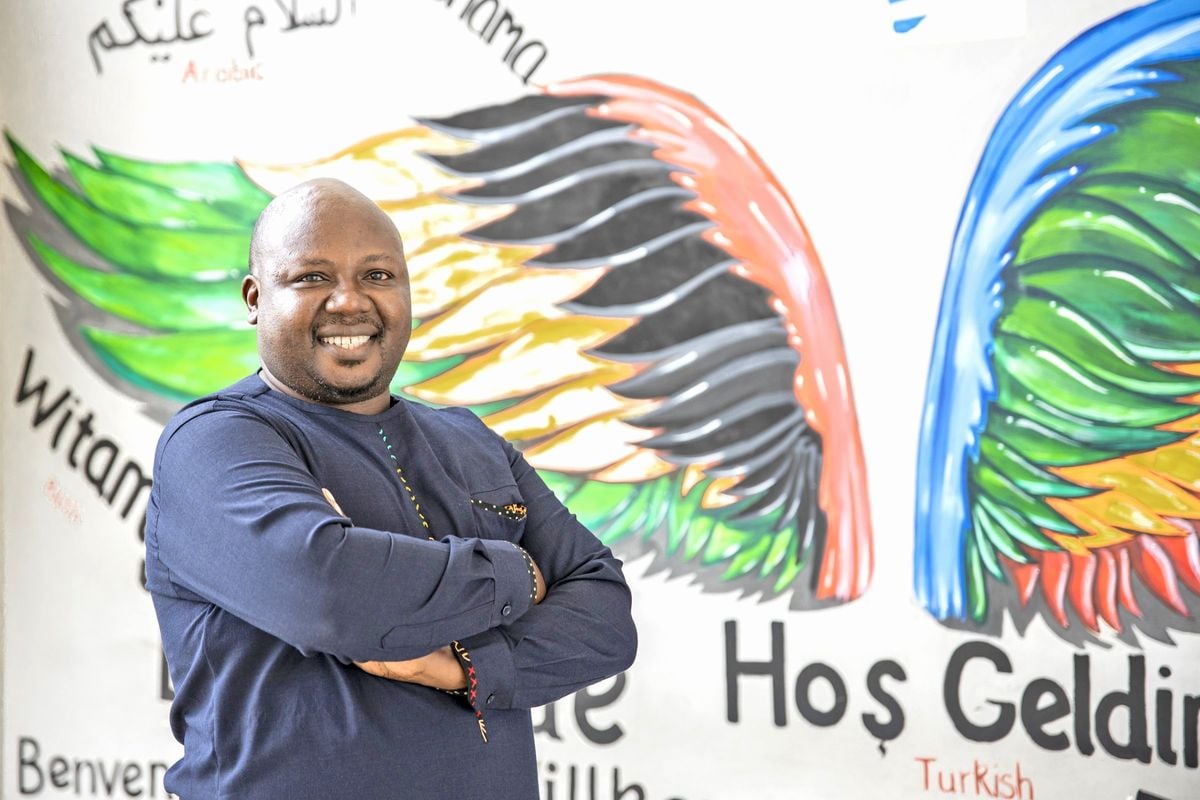
    Benson Majiwa, a Kenyan teacher, is the principal of the Pharo School Homosha.

    Mr Majiwa has been teaching the Ethiopian curriculum for four years now, and has been the head of the school for two years now. A graduate of Moi University (Languages) and Egerton University (Education), he started his career as a teacher in Kenya, teaching the Kenyan public school system. He then spent 12 years teaching the British curriculum, including an eight-year stint at Nairobi Jaffrey Academy.

    While studying for his Master’s, his academic project on psychology was based on research at the Juvenile Remand Home in Lower Kabete.

    “I found many young people who had become delinquents because they lacked someone to help them navigate life during their teenage years. That was a turning point in my life as an educationist.”

    How did he end up in this remote part of Ethiopia?

    During the Covid-19 pandemic, he was working at the Kinderworld International School as it transitioned from the Kenyan system to the British curriculum. During that time, he met Akif Naqvi, a British School Overseas Inspector, who would later become the Principal of the Pharo School in Homosha. Naqvi, an internationally experienced headteacher, was impressed with Mr Majiwa’s skills and headhunted him to deputise as school head at the new school in Ethiopia.

    “My father was a forest officer and I grew up moving from one forest station to another, I am used to living in remote areas so this opportunity to move to a remote part of a foreign country did not faze me,” says Mr Majiwa.

    Mr Majiwa with the Ethiopian classical pianist Girma Yifrashewa during the handover of a new upright piano to the school.

    Photo credit: Pool

    “I was also inspired by what the Pharo Foundation was doing, transforming the lives of the young girls and the community surrounding the school.”

    Pharo Foundation is a privately funded organisation with headquarters in London that runs programmes in education, health, water and agriculture in Ethiopia, Somaliland, Rwanda and Kenya. Before the school in Homosha opened in February 2020, the enrolment rate for girls in the region was as low as 32 percent for those from certain communities in the region.

    Mr Majiwa moved to Homosha as Deputy Head of School in August 2021, and two years later, he succeeded Naqvi as Principal. He discovered that boarding school is a relatively new concept in Ethiopia, unlike in Kenya where the model has historically been an essential part of the education system.

    “There were no routines. No night preps, lessons would go on till 5pm in a region where temperatures hit 40 degrees. There was no proper dress code and the students used tiny exercise books that would fill up in a week,” he says.

    He had to establish a system that would enable the students to operate within a set of rules while allowing them to also have sufficient time for co-curricular activities. In September 2024, the school received an upright piano from Pharo Foundation in the UK, and according to the principal, the performing arts aligns with the new curriculum in Ethiopia, which just like the CBC in Kenya, is founded on practical skills.

    “Many of the girls can sing, and so the piano is a welcome addition that will enable them enhance their talents,” he says.

    The school admits girls in Grade 9, to undertake four years of secondary education. At the moment there are 133 students and last Saturday they conducted interviews for a fresh cohort of Grade 9 with a target to hit 200 students.

    Admission is based on a scholarship model, where students sit for an entrance examination to test their aptitude and academic level. For the first three years of operation, the school provided the students with all the essentials: books, uniforms, meals and sanitary pads, but parents are now required to contribute part of the children’s upkeep. However, the majority of the girls are children of peasant farmers drawn from the rural community in Homosha and require absolute support.

    “The students are very committed, and teachers spend less time on supervision because the girls know what is required of them,” says Mr Majiwa.

    During his first year in charge, the school attained a 100 percent pass mark in the Grade 12 national examinations and his colleagues have taken to jokingly referring to him as the “100 percent principal.”

    That success was achieved despite the tremendous odds facing the institution, not least the lack of power supply which means the school is reliant on generator for 13 hours in a day.

    The generator is switched on at 5.45am so that students can prepare for breakfast. It is then turned off at 12pm during lunch break and switched back on at 1pm when afternoon classes begin and go on until 5pm (classes end at 3pm). It is then turned back on at 6.45pm and switched off at 10.30pm until the next morning. Ironically the Grand Ethiopian Renaissance Dam, which has reportedly doubled Ethiopia’s electricity production, is located in the Benishangul Gamuz region.

    The region is also surrounded by conflict areas such as Amhara, Gambela and Oromia, where the Oromo Liberation Army is engaged in a long-running conflict with the federal government. It also borders the Republic of Sudan to the north.

    “I know in Kenya schools only need a few askaris, but here security is a huge issue and the head of security is actually a former police officer,” says Mr Majiwa.

    He manages a team of 19 teachers and 58 support staff, of which 19 are security personnel.

    He has learnt the Ethiopian way of life, which means being philosophical about every situation.

    “They are a very hospitable people who always greet you with a smile. On the flip side, I have learnt to be very patient because people do things at their own pace. I have made my team know that there are tasks that must meet a deadline, but there are other duties which I ask them to tell me when they are comfortable completing,” he explains.

    Last year, another Kenyan, Salome Maina, a teacher of English, joined the staff at the Pharo School Homosha. “Finding Mr Majiwa here was very reassuring for me and helped me settle down a lot faster,” says Ms Maina.

    Salome Maina, a Kenyan who teaches English at the Pharo School, Homosha, Ethiopia. 

    Photo credit: Pool

    Her previous job at a school at the Dadaab Refugee camp run by the humanitarian organisation, Windle International Kenya, prepared her for the experience of working in locations with extreme conditions. Last year she taught the Junior Secondary class, and this will be her first year with Grade 11 and the Grade 12 examination candidates.

    “The students have a fairly good grasp of English, and whenever there are difficulties in understanding something, then I will identify the students who have understood and ask them to explain to the others in Amharic or the other local languages.”

    The foreign teachers have also had to adopt to the Ethiopian school calender that begins in September and ends in July.

    “When we are here, we use the Ethiopian calendar, which consists of 13 months, so we just celebrated our New Year 2017 on September 11,” says Mr Majiwa with a smile.

    “I also celebrate Christmas Day twice, on December 25 and January 7 with the Ethiopian Orthodox Church”. These Kenyan teachers are motivated by the experience of making a difference to the futures of young girls in a far-flung region of Ethiopia, whose lives might have turned out very differently if they didn’t get a chance at education.

    Source link

  • The Kenyan headteacher in a remote Ethiopia school

    The Kenyan headteacher in a remote Ethiopia school

    When we set out on a trip to the town of Homosha, in the north western part of Ethiopia, we would not have imagined that there was any chance of meeting a Kenyan in such a remote area, more than 600 kilometers from Addis Ababa.

    The one-hour flight from the capital lands in Assosa, the regional headquarters of the state of Benishangul-Gumuz, before embarking on a 30-kilometer drive through a fairly decent highway, with the occasional crater-like pothole, to Homosha.

    As you drive along the heavily forested terrain, there is little indication of the existence of a state-of the-art educational facility. Almost out of nowhere, an imposing gate announces the entrance to the Pharo School Homosha, a modern fully-fledged campus with boarding facilities for more than 200 girls sitting on 16 hectares.

    It is sunset when we pull into the large compound which appears unusually dark.

    “Is there an electricity outage?” we enquire. “No, here we rely on generator power because there is no supply from the grid,” says a gentleman who warmly receives us.

    “The generator is just about to be switched on for the evening’s activities.”

    There is something about his accent that sounds distinctly familiar.

    “Karibu Homosha,” he says.

    Benson Majiwa, a Kenyan teacher, is the principal of the Pharo School Homosha.

    Mr Majiwa has been teaching the Ethiopian curriculum for four years now, and has been the head of the school for two years now. A graduate of Moi University (Languages) and Egerton University (Education), he started his career as a teacher in Kenya, teaching the Kenyan public school system. He then spent 12 years teaching the British curriculum, including an eight-year stint at Nairobi Jaffrey Academy.

    While studying for his Master’s, his academic project on psychology was based on research at the Juvenile Remand Home in Lower Kabete.

    “I found many young people who had become delinquents because they lacked someone to help them navigate life during their teenage years. That was a turning point in my life as an educationist.”

    How did he end up in this remote part of Ethiopia?

    During the Covid-19 pandemic, he was working at the Kinderworld International School as it transitioned from the Kenyan system to the British curriculum. During that time, he met Akif Naqvi, a British School Overseas Inspector, who would later become the Principal of the Pharo School in Homosha. Naqvi, an internationally experienced headteacher, was impressed with Mr Majiwa’s skills and headhunted him to deputise as school head at the new school in Ethiopia.

    “My father was a forest officer and I grew up moving from one forest station to another, I am used to living in remote areas so this opportunity to move to a remote part of a foreign country did not faze me,” says Mr Majiwa.

    Mr Majiwa with the Ethiopian classical pianist Girma Yifrashewa during the handover of a new upright piano to the school.

    Photo credit: Pool

    “I was also inspired by what the Pharo Foundation was doing, transforming the lives of the young girls and the community surrounding the school.”

    Pharo Foundation is a privately funded organisation with headquarters in London that runs programmes in education, health, water and agriculture in Ethiopia, Somaliland, Rwanda and Kenya. Before the school in Homosha opened in February 2020, the enrolment rate for girls in the region was as low as 32 percent for those from certain communities in the region.

    Mr Majiwa moved to Homosha as Deputy Head of School in August 2021, and two years later, he succeeded Naqvi as Principal. He discovered that boarding school is a relatively new concept in Ethiopia, unlike in Kenya where the model has historically been an essential part of the education system.

    “There were no routines. No night preps, lessons would go on till 5pm in a region where temperatures hit 40 degrees. There was no proper dress code and the students used tiny exercise books that would fill up in a week,” he says.

    He had to establish a system that would enable the students to operate within a set of rules while allowing them to also have sufficient time for co-curricular activities. In September 2024, the school received an upright piano from Pharo Foundation in the UK, and according to the principal, the performing arts aligns with the new curriculum in Ethiopia, which just like the CBC in Kenya, is founded on practical skills.

    “Many of the girls can sing, and so the piano is a welcome addition that will enable them enhance their talents,” he says.

    The school admits girls in Grade 9, to undertake four years of secondary education. At the moment there are 133 students and last Saturday they conducted interviews for a fresh cohort of Grade 9 with a target to hit 200 students.

    Admission is based on a scholarship model, where students sit for an entrance examination to test their aptitude and academic level. For the first three years of operation, the school provided the students with all the essentials: books, uniforms, meals and sanitary pads, but parents are now required to contribute part of the children’s upkeep. However, the majority of the girls are children of peasant farmers drawn from the rural community in Homosha and require absolute support.

    “The students are very committed, and teachers spend less time on supervision because the girls know what is required of them,” says Mr Majiwa.

    During his first year in charge, the school attained a 100 percent pass mark in the Grade 12 national examinations and his colleagues have taken to jokingly referring to him as the “100 percent principal.”

    That success was achieved despite the tremendous odds facing the institution, not least the lack of power supply which means the school is reliant on generator for 13 hours in a day.

    The generator is switched on at 5.45am so that students can prepare for breakfast. It is then turned off at 12pm during lunch break and switched back on at 1pm when afternoon classes begin and go on until 5pm (classes end at 3pm). It is then turned back on at 6.45pm and switched off at 10.30pm until the next morning. Ironically the Grand Ethiopian Renaissance Dam, which has reportedly doubled Ethiopia’s electricity production, is located in the Benishangul Gamuz region.

    The region is also surrounded by conflict areas such as Amhara, Gambela and Oromia, where the Oromo Liberation Army is engaged in a long-running conflict with the federal government. It also borders the Republic of Sudan to the north.

    “I know in Kenya schools only need a few askaris, but here security is a huge issue and the head of security is actually a former police officer,” says Mr Majiwa.

    He manages a team of 19 teachers and 58 support staff, of which 19 are security personnel.

    He has learnt the Ethiopian way of life, which means being philosophical about every situation.

    “They are a very hospitable people who always greet you with a smile. On the flip side, I have learnt to be very patient because people do things at their own pace. I have made my team know that there are tasks that must meet a deadline, but there are other duties which I ask them to tell me when they are comfortable completing,” he explains.

    Last year, another Kenyan, Salome Maina, a teacher of English, joined the staff at the Pharo School Homosha. “Finding Mr Majiwa here was very reassuring for me and helped me settle down a lot faster,” says Ms Maina.

    Salome Maina, a Kenyan who teaches English at the Pharo School, Homosha, Ethiopia. 

    Photo credit: Pool

    Her previous job at a school at the Dadaab Refugee camp run by the humanitarian organisation, Windle International Kenya, prepared her for the experience of working in locations with extreme conditions. Last year she taught the Junior Secondary class, and this will be her first year with Grade 11 and the Grade 12 examination candidates.

    “The students have a fairly good grasp of English, and whenever there are difficulties in understanding something, then I will identify the students who have understood and ask them to explain to the others in Amharic or the other local languages.”

    The foreign teachers have also had to adopt to the Ethiopian school calender that begins in September and ends in July.

    “When we are here, we use the Ethiopian calendar, which consists of 13 months, so we just celebrated our New Year 2017 on September 11,” says Mr Majiwa with a smile.

    “I also celebrate Christmas Day twice, on December 25 and January 7 with the Ethiopian Orthodox Church”. These Kenyan teachers are motivated by the experience of making a difference to the futures of young girls in a far-flung region of Ethiopia, whose lives might have turned out very differently if they didn’t get a chance at education.

    Source link

  • Kenyan female wine tasters shine at World Tasting Championship

    Kenyan female wine tasters shine at World Tasting Championship

    In a remarkable feat, Kenyan wine tasters have outperformed traditional wine powerhouses like England at the prestigious World Tasting Championship, often dubbed the “Wine Olympics.”

    The event, held in France, sees competitors blind-taste a diverse array of unlabelled wines, guessing their region, vintage, and grape variety.

    Representing Kenya this year was an all-female team: Janet Kangethe, Soraya Ladak, Kenyalyn Oddenyo, Joy Adero, and Victoria Mulu-Munywoki.

    This marked Kenya’s third appearance in the competition, and the team had been diligently preparing through rigorous training sessions at The Wine Shop in Nairobi.

    During these sessions, the team honed their skills by sampling tens of wines from different regions. In one of the sessions attended by Lifestyle, Joy described the wine: “I’m tasting high acidity, minerality, and a hint of barnyard—not the red wine kind, though.” Meanwhile, Soraya pinpointed notes of asparagus and unripe passion fruit, guessing a Bordeaux blend from 2022.

    Such expertise helped Team Kenya finish just two spots behind France, showcasing their talent on the global stage.

    Speaking to Lifestyle from Francethe team could not hide their excitement on the ability to compete against established wine countries. South Africa, the other African representative in the competition, ranked 26th.

    The team shared their journey on how their camaraderie blossomed through their shared passion for wine.

    From left: Team Wine Kenya group members Janet Kange’the, Soraiya Ladak, Victoria Mulu-Munywoki, Joy Adero, and Kenyalyn Oddenyo pose for a photo during practice for the blind wine competition at the Wine Shop Kenya in Nairobi on September 21, 2024.

    Photo credit: Bonface Bogita | Nation

    Janet Kangethe: The newcomer 

    Janet Kangethe fell in love with wine in 2014.  “Working in hospitality, you must go through wine training, and I enjoyed learning about wine,” she said. During the pandemic, Janet deepened her knowledge by reading about wine, leading her to South Africa’s vineyards to learn about winemaking. “When I came back, I did my first wine qualification, my WSET Level 2 [a wine and sprits certification].”

    She joined Team Wine Kenya this year but had been attending training sessions since 2022. “My relationship with wine is like a beautiful love affair. It has elevated my career. I started as a restaurant hostess, and I’m now an award-winning restaurant manager,” Janet, a beverage manager at The Social House, said.

    Training sessions were intense and demanding. “We’d taste six to seven wines a day, using all our senses to decipher each one’s origin, grape, and vintage. Our wine-tasting training started at 10am. Our coach, Victoria Munywoki always reminded us to read about wine,” Janet said.

    They meticulously documented their tastings in notebooks, ensuring they remembered the nuances of each wine.

    “I’d walk around with three different types of books; one to help me with my sensory notes to learn how to tell the wines through the senses. The other book helped me to distinguish the different types of grapes and learn how to differentiate wine grapes from the other kinds of grapes. I also have my WSET Level 3 book which helped me to identify the different regions where the wine is coming from.”

    Maintaining a sensitive palate was crucial. Janet explained, “I avoid food or drinks before practice, even steering clear of perfume, as it can distort our sense of smell,” the 32-year-old said.

    Soraiya Ladak: The returning competitor

    Soraiya Ladak is a returning competitor, having joined the original team in 2022.

    “I missed last year’s competition due to my pregnancy. The competition is challenging for me, but I like it because it helps me improve my wine-tasting skills. Even as a sommelier, every day is learning more about wine,” said the WSET Level 3 sommelier.

    Her relationship with wine began after her first pregnancy. “Pregnancy heightened my senses. I would throw up and always feel nauseated and that didn’t go away even after I gave birth. So, when my baby got older and I took wine, everything was fine,” the mother of three said.

    Soraiya Ladak, one of the directors at the Wine Shop Kenya in Nairobi, at the shop on September 21, 2024.

    Photo credit: Bonface Bogita | Nation

    For Soraya, training for the competition was not just about tasting wine; it required discipline and sacrifice, balancing family and career commitments.

    “People assume we’re just drinking alcohol, but this is a craft. It’s not all fun. You don’t want to drink wine after these training sessions; you crave tea or coffee. There is also palate fatigue. We tasted over 200 different types of wines. You also have to maintain discipline, balancing this passion with family and career, but we believe in ourselves and want to put Kenya on the wine map.”

    As one of the directors of The Wine Shop, Soraiya says that part of their role was to provide training wines for the competitors and a place to practice.

    “We hosted the team, provided wine…This year we were fortunate to have Barton and Guestier provide us with the wines used for practice,” she said.  

    For those looking to make wine a career, Soraya says, “You have to remember at the end of the day, this is alcohol. It is a slippery slope, and I have seen many people fall victim to alcoholism. If it is your career, you need to respect the trade and do everything in moderation.”

    To maintain her palate, Soraya avoids chilli. “Also, giving my palate a break is always very helpful. I give myself a break and only enjoy my wine during the weekend,” the 42-year-old said.

    Kenyalyn Oddenyo: The chef-turned-sommelier

    Kenyalyn Oddenyo, who is joining Team Wine Kenya for the first time this year, has grown up surrounded by wine. “My parents would host guests a lot when I was growing up. All the meals were accompanied by wine. Then I went to a culinary school in South Africa, where wine is a huge part of their culture. This is where I got to better understand wine,” the 28-year-old said. 

    Now, she is the group sommelier and retail manager at Wine Box in Nairobi.

    “For me, wine means family, happiness, and love. It is a long-term investment,” she said.

    Barton and Guestier Sparkling rose wine pictured at the Wine Shop Kenya in Nairobi on September 21, 2024.

    Photo credit: Bonface Bogita | Nation

    Joy Adero: The wine enthusiast turned professional

    Joy Adero got into wine simply because of curiosity. “I identify as a wine enthusiast. It all started in 2012 when I would receive bottles of wine as gifts from friends, which sparked my curiosity. I began self-teaching, going to the internet and reading wine enthusiast and wine spectator magazines. It was a hobby until 2019 when I decided to take it up as a career. I undertook my WSET classes and topped my Level 1 and 2 classes. I saw this as a sign that I can take it up professionally.” Now, Joy is a wine writer and a sommelier.

    Victoria Mulu-Munywoki: The coach, captain and mentor

    Victoria Mulu-Munywoki wears many hats for Team Wine Kenya as a coach, captain, and mentor of Team Wine Kenya. She says the biggest drive for her was to provide mentorship and ensure that this hobby goes beyond a few sommeliers.

    “I wanted for us to have a pipeline of expertise that lasted beyond me hence the difference in age in the competitors. We are trying to make this a generation thing. Every year, we try to have some new people joining the team,” the 47-year-old said.

    Victoria Mulu-Munywoki holding a glass of wine during practice for the blind wine competition at the Wine Shop Kenya in Nairobi on September 21, 2024. 

    Photo credit: Bonface Bogita | Nation

    Victoria said the most important qualification to be a competitor was a person’s attitude. “While the person needed to be at a certain level with their knowledge of wine, what mattered more was the ability to work well with a team. Everything we do is teamwork. Finally, I looked for a person who is willing to mentor others so that we can ensure that there is always Team Wine Kenya,” she says.

    Last year, Team Wine Kenya was position 26, beating wine-rich countries such as Italy, Scotland, and Sweden, and Victoria was part of the team.

    Only women have been competing in the wine competitions, are there plans to include men next year?

    “There are plans to have men join us. Every year, we call out to men to join, but sometimes it is the ladies who are committed to getting through the training. Though this will be streamlined with the formation of the Sommelier Association of Kenya, for now, as an all-girls team, we have been working well, but we are open to having more men join us,” Victoria said.

    Source link