BEIJING — Rescue workers in the freezing, high-altitude Tibet region in western China searched Wednesday for more survivors and victims of a strong earthquake that struck a day earlier near a holy city for Tibetan Buddhists, killing at least 126 people and leveling thousands of houses.
Tents, quilts and other relief items were being delivered to people whose homes were uninhabitable or unsafe. Temperatures fell well below freezing overnight in an area with an average altitude of about 4,200 meters (13,800 feet).
The confirmed death toll stood at 126 with another 188 injured as of Tuesday evening. The earthquake struck the city of Xigaze, the traditional seat of the Panchen Lama, the second-highest figure in Tibetan Buddhism. It was not immediately known whether he was in his Tashi Lhunpo Monastery at the time of the quake or how much damage the city sustained. The quake’s distance from Xigaze, which sprawls across a high altitude plain, was about 25 kilometers (15 miles).
The Chinese government and followers of the Dalai Lama, Tibetan Buddhism’s highest figure, have feuded over who should hold the position of Panchen Lama since a boy appointed by the Dalai Lama disappeared in the mid-1990s and a Chinese-backed candidate was approved for the position. The Dalai Lama, viewed by the Chinese government as a dangerous separatist, denounced the move and has refused to recognize the current Panchen Lama.
China’s government says Tibet has been part of its territory for centuries, but many Tibetans say they were functionally independent for most of that time. China’s People’s Liberation Army invaded the territory in 1950 and the Dalai Lama fled to India nine years later during an uprising against Chinese rule, seen as eroding Tibet’s unique Buddhist culture.
More than 500 aftershocks were recorded after the earthquake, which the U.S. Geological Survey said measured magnitude 7.1. China’s earthquake center recorded a magnitude of 6.8.
The quake was also about 75 kilometers (50 miles) from Mount Everest and the border with Nepal, where the shaking sent people running out of their homes in the capital.
The dead included at least 22 of the 222 residents of Gurum, the official Xinhua News Agency cited the village’s Communist Party chief, Tsering Phuntsog, as saying. The victims included his 74-year-old mother, and several other of his relatives remained buried in the debris.
“Even young people couldn’t run out of the houses when the earthquake hit, let alone old people and children,” Tsering Phuntsog said.
More than 3,600 houses collapsed, according to a preliminary survey, and 30,000 residents have been relocated, Xinhua said, citing the city government in Xi, also known by its Tibetan spelling, Shigatse.
The Ministry of Emergency Management has 1,850 rescuers on the ground along with firefighters and others, state broadcaster CCTV said.
Tibet is generally closed to foreign journalists over reports about the ill treatment of the native population by Chinese authorities.
Chinese leader Xi Jinping ordered “all-out rescue efforts to save lives and minimize casualties,” Xinhua reported. Communications in the area have also been restored, allowing smoother delivery of emergency goods, it said.
A candlelight vigil was planned in Dharamsala, India, home of the Dalai Lama and a large Tibetan population, on Wednesday night, and an announcement on the Dalai Lama’s website said he would lead a prayer ceremony in memory of the victims on Thursday.
Asked about the prayer ceremony, Chinese Foreign Ministry spokesperson Guo Jiakun said, “We are very clear about the separatist nature and political schemes of the Dalai Lama and remain highly vigilant.”
Guo expressed confidence that the people in the earthquake zone would be able to rebuild under “the strong leadership” of the Communist Party.
NEW YORK — He’s one of the most famous and widely admired corporate leaders in the world. But it’s the haters that companies like Mark Zuckerberg’s Meta worry about.
In an era when online anger and social tensions are increasingly directed at the businesses consumers count on, Meta last year spent $24.4 million on guards, alarms and other measures to keep Zuckerberg and the company’s former chief operating officer safe.
Some high-profile CEOs surround themselves with security. But the fatal shooting this week of UnitedHealthcare CEO Brian Thompson while he walked alone on a New York City sidewalk has put a spotlight on the widely varied approaches companies take in protecting their leaders against threats.
Thompson had no personal security and appeared unaware of the shooter lurking before he was gunned down.
And today’s political, economic and technological climate is only going to make the job of evaluating threats against executives and taking action to protect them even more difficult, experts say.
“We are better today at collecting signals. I’m not sure we’re any better at making sense of the signals we collect,” says Fred Burton of Ontic, a provider of threat management software for companies.
After Thompson’s shooting, Burton said, “I’ve been on the phone all day with some organizations asking for consultation, saying, ’Am I doing enough?”
Some of the biggest U.S. companies, particularly those in the tech sector, spend heavily on personal and residential security for their top executives.
Meta, whose businesses include Facebook and Instagram, reported the highest spending on personal security for top executives last year, filings culled by research firm Equilar show.
Zuckerberg “is synonymous with Meta and, as a result, negative sentiment regarding our company is directly associated with, and often transferred to, Mr. Zuckerberg,” the Menlo Park, California, company explained earlier this year in an annual shareholder disclosure.
At Apple, the world’s largest tech company by stock valuation, CEO Tim Cook was tormented by a stalker who sent him sexually provocative emails and even showed up outside his Silicon Valley home at one point before the company’s security team successfully took legal action against her in 2022.
Cook is regularly accompanied by security personnel when he appears in public. Still, the company’s $820,000 allotted last year to protect top executives is a fraction of what other tech giants spent for CEO security.
Just over a quarter of the companies in the Fortune 500 reported spending money to protect their CEOs and other top executives. Of those that did, the median payment for personal security doubled over the last three years to about $98,000.
In many companies, investor meetings like the one UnitedHealthcare’s Thompson was walking to when he was shot are viewed as very risky because details on the location and who will be speaking are highly publicized.
“It gives people an opportunity to arrive well in advance and take a look at the room, take a look at how people would probably come and go out of a location,” said Dave Komendat, president of DSKomendat Risk Management Services, which is based in the greater Seattle area.
Some firms respond by beefing up security. For example, tech companies routinely require everyone attending a major event, such as Apple’s annual unveiling of the next iPhone or a shareholder meeting, to go through airport-style security checkpoints before entering.
Others forgo in-person meetings with shareholders, including Amazon, which holds its annual shareholder meetings virtually.
“But there are also company cultures that really frown on that and want their leaders to be accessible to people, accessible to shareholders, employees,” Komendat said.
Depending on the company, such an approach may make sense. Many top executives are little known to the public, operating in industries and locations that make them far less prone to public exposure and to threats.
“Determining the need for and appropriate level of an executive-level protection program is specific to each organization,” says David Johnston, vice president of asset protection and retail operations at the National Retail Federation. “These safeguards should also include the constant monitoring of potential threats and the ability to adapt to maintain the appropriate level of security and safety.”
Some organizations have a protective intelligence group that uses digital tools such as machine learning or artificial intelligence to comb through online comments to detect threats not only on social media platforms such as X but also on the dark web, says Komendat. They look for what’s being said about the company, its employees and its leadership to uncover risks.
“There are always threats directed towards senior leaders at companies. Many of them are not credible,” Komendat said. “The question always is trying to determine what is a real threat versus what is someone just venting with no intent to take any additional action.”
Burton, a former special agent with the U.S. Diplomatic Security Service, points out that despite the current climate, there is little in the way of organized groups that target companies.
Today, one of the primary worries are loners whose rantings online are fed by others who are like-minded. It’s up to corporate security analysts to zero in on such dialogue and decide whether or not it represents a real threat.
And CEOs aren’t the only targets of disgruntled customers. In the U.S., there were 525 workplace fatalities due to assault in 2022, according to the National Safety Council. Industries including healthcare, education and service providers are more prone to violence than others, and taxi drivers are more than 20 times more likely to be murdered on the job than other workers, the group said.
But the ambush of UnitedHealthcare’s Thompson this week is bound to get some CEOs second-guessing.
“What invariably happen at moments like this in time is you will get additional ears listening” to security professionals seeking money to beef up executive protection, Burton says.
“Because I can guarantee you there’s not a CEO in America who’s not aware of this incident.”
___
Associated Press writers Anne D’Innocenzio and Haleluya Hadero in New York contributed.
MAUMERE, Indonesia — Indonesia’s National Disaster Management Agency said Monday that at least six people have died as a series of volcanic eruptions widens on the remote island of Flores.
The eruption at Mount Lewotobi Laki Laki just after midnight on Monday spewed thick brownish ash as high as 2,000 meters (6,500 feet) into the air and hot ashes hit a nearby village, burning down several houses including a convent of Catholic nuns, said Firman Yosef, an official at the Mount Lewotobi Laki Laki monitoring post.
The Disaster Management Agency lowered the known death toll from an earlier report of nine, saying it had received updated information from local authorities. It said that information was still being collected about the extent of casualties and damage, as local media reports said more people were buried in collapsed houses.
Authorities also raised the danger level and widened the danger zone for Mount Lewotobi Laki Laki on Monday, following a series of eruptions that began last week.
The country’s volcano monitoring agency increased the volcano’s alert status to the highest level and more than doubled the exclusion zone to a 7-kilometer (4.3-mile) radius after midnight on Monday as eruptions became more frequent.
The agency said at least 10,000 people have been affected by the eruption in Wulanggitang District, in the six nearby villages of Pululera, Nawokote, Hokeng Jaya, Klatanlo, Boru and Boru Kedang.
In Ile Bura District, 4 villages were affected, namely Dulipali Village, Nobo, Nurabelen and Riang Rita, while in Titehena District it affected four villages, namely Konga Village, Kobasoma, Bokang Wolomatang and Watowara.
He said volcanic material was thrown up to 6 kilometers (3.7 miles) from its crater, blanketeing nearby villages and towns with tons of volcanic debris and forcing residents to flee.
A nun in Hokeng village died and another was missing, said Agusta Palma, the head of the Saint Gabriel Foundation that oversees convents on the majority-Catholic island.
“Our nuns ran out in panic under a rain of volcanic ash in the darkness,” Palma said.
Photos and videos circulated on social media showed tons of volcanic debris covering houses up to their rooftops in villages like Hokeng, where hot volcanic material set fire to houses.
It’s Indonesia’s second volcanic eruption in as many weeks. West Sumatra province’s Mount Marapi, one of the country’s most active volcanos, erupted on Oct. 27, spewing thick columns of ash at least three times and blanketing nearby villages with debris, but no casualties were reported. ___ Associated Press writers Niniek Karmini and Edna Tarigan contributed to this report.
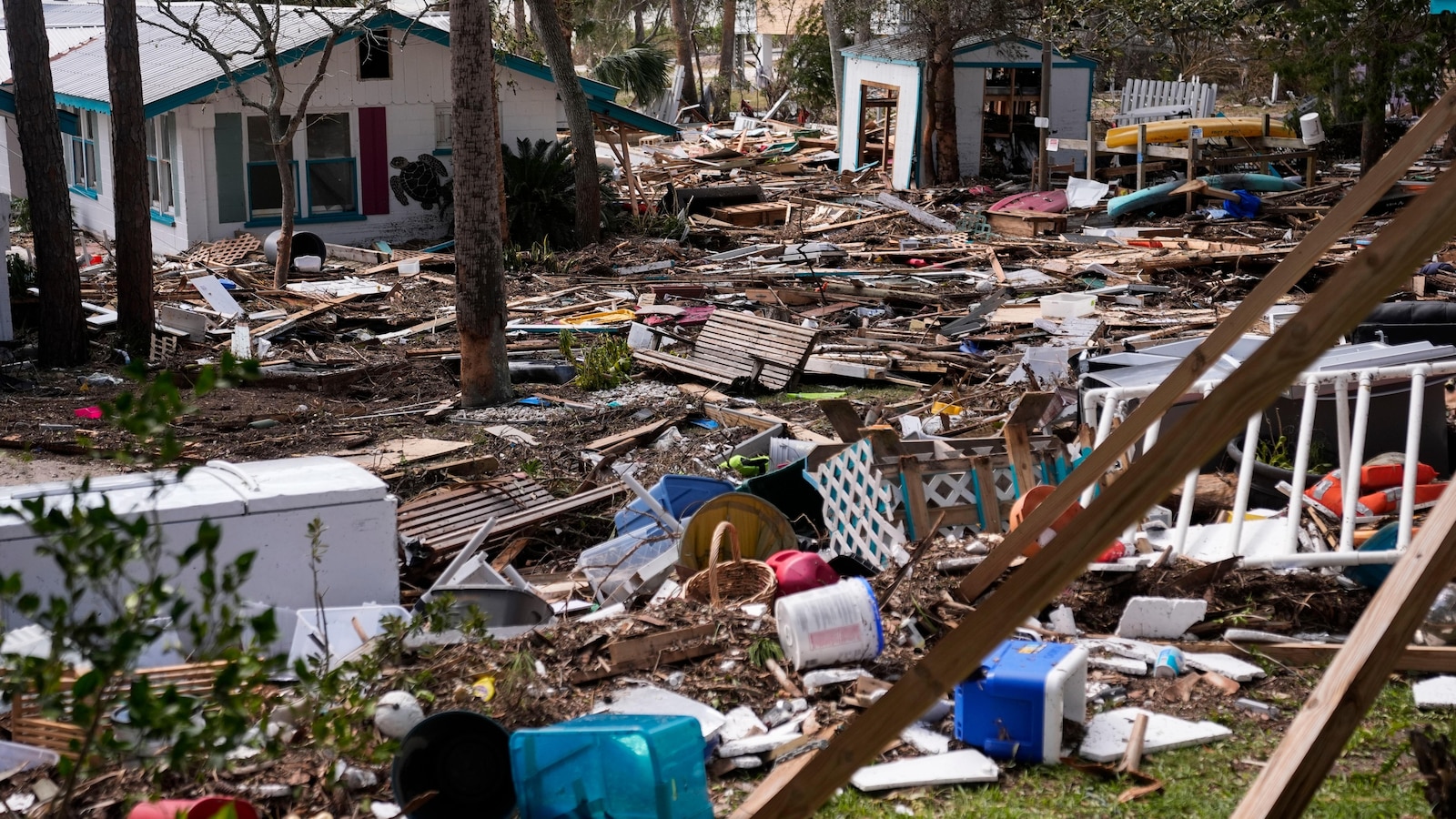
Hurricanes in the United States end up hundreds of times deadlier than the government calculates, contributing to more American deaths than car accidents or all the nation’s wars, a new study said.
The average storm hitting the U.S. contributes to the early deaths of 7,000 to 11,000 people over a 15-year period, which dwarfs the average of 24 immediate and direct deaths that the government counts in a hurricane’s aftermath, the study in Wednesday’s journal Nature concluded. Study authors said even with Hurricane Helene’s growing triple digit direct death count, many more people will die partly because of that storm in future years.
“Watching what’s happened here makes you think that this is going to be a decade of hardship on tap, not just what’s happening over the next couple of weeks,” said Stanford University climate economist Solomon Hsiang, a study co-author and a former White House science and technology official.
“After each storm there is sort of this surge of additional mortality in a state that’s been impacted that has not been previously documented or associated with hurricanes in any way,” Hsiang said.
Hsiang and University of California Berkeley researcher Rachel Young looked at hurricane deaths in a different way than previous studies, opting for a more long-term public health and economics-oriented analysis of what’s called excess mortality. They looked at states’ death rates after 501 different storms hitting the United States between 1930 and 2015. And what they found is that after each storm there’s a “bump” in death rates.
It’s a statistical signature that they see over and over, Hsiang said. Similar analyses are done for heat waves and other health threats like pollution and disease, he said. They compare to pre-storm times and adjust for other factors that could be causing changes in death rates, he said. Complicating everything is that the same places keep getting hit by multiple storms so there are death bumps upon death bumps.
Just how storms contribute to people’s deaths after the immediate impact is something that needs further study, Hsiang said. But he theorized it includes the health effects of stress, changes in the environment including toxins, people not being able to afford health care and other necessities because of storm costs, infrastructure damage and government changes in spending.
“When someone dies a few years after a hurricane hit them, the cause will be recorded as a heart attack, stroke or respiratory failure,” said Texas A&M University climate scientist Andrew Dessler, who wasn’t part of the study but has done similar studies on heat and cold deaths. “The doctor can’t possibly know that a hurricane contributed/triggered the illness. You can only see it in a statistical analysis like this.”
Initially Hsiang and Young figured the storm death bump would go away in a matter of months, but they were surprised when they examined hundreds of bumps and found they stretch out, slowly, over 15 years, Hsiang said.
It’s “almost like a trickle of mortality, like each month we’re talking about five to 10 individuals who are dying earlier than they would have otherwise,” Hsiang said.
These people don’t realize that 10 or 15 years later their health issues are associated with a storm in some way, but Hsiang said it shows up in the data: “They would not have died at those times had the storm not arrived. And so essentially, these storms are accelerating people’s deaths.”
The numbers proved so high that the researchers kept looking for mistakes or complicating factors they had missed. “It took years for us to really fully accept that this was happening,” Hsiang said.
Storms are a factor in between 55,000 to 88,000 excess deaths a year, the study concluded. So for the 85 years studied, the team calculated between 3.6 and 5.2 million people died with storms being a factor. That’s more than the 2 million car accident deaths over that period, the study said.
Before now the public looked at storms “as an inconvenience that is tragic for a small number of community members,” Hsiang said. But they really are “a major threat to public health,” he said.
Hsiang said he and Young saw a trend of increasing hurricane-connected deaths, predominantly because of population growth. Starting in 2000, there’s been a big jump in the total volume of storms hitting large population, he said.
Three outside scientists said the study made sense.
“It seems like what they’re doing is reasonable,” said University of Albany hurricane expert Kristen Corbosiero, who wasn’t part of the research. “The numbers are really staggering.”
Texas A&M’s Dessler said this is an important study because it brings home the deadly nature of climate change and extreme weather. He said he and his fellow climate scientists have been accurate in their warnings of the physics of what climate change would mean, but failed to emphasize enough how it would hurt people.
“Reading this, it’s clear that humanity is very vulnerable to weather shocks, even in an incredibly rich country like ours,” Dessler said in an email.
The Associated Press’ climate and environmental coverage receives financial support from multiple private foundations. AP is solely responsible for all content. Find AP’s standards for working with philanthropies, a list of supporters and funded coverage areas at AP.org.
On the day that Jayvion Taylor collapsed during an afternoon football practice in Hopewell, Virginia, it wasnearly 90 degrees. By the heat index, it felt much hotter.
Taylor, 15, had just taken a water break after about 40 minutes of light drills that followed “standard safety protocols,” according to Hopewell City Public Schools. Coaches surrounded the wide receiver, who was sweating profusely and unresponsive, tried to revive him and doused him with cold water, a caller told 911.
“They’re still thinking he’s got a heat stroke,” the caller said.
Taylor died shortly after EMS personnel got him to a local hospital.
His official cause of death has not yet been released, but his mother, believes the heat had something to do with it. Alicia Trotter, a nurse, expressed concern that there was no athletic trainer present, a professional specially trained to follow the best practices in sports medicine and save lives when an emergency occurs.
Though Trotter said the team had been training since June, the athletic trainer’s contract was not set to begin until August 12, according to the school district, which called the death a tragic accident and said the staff who were there acted appropriately.
“You would think that if you’re not gonna have a trainer, that these coaches know what to do if something was to happen,” Trotter said. “But I really don’t know. I just know I sent him to school and he didn’t come back home.”
Taylor is one of at least eight young student athletes who died suddenly since Aug. 5 after training outdoors in blazing summer heat. Authorities have not determined official causes for all of them, but the deaths have renewed concerns about students practicing sports in sweltering conditions.
Heat stroke is one of the leading causes of death among high school athletes. Global temperatures are continuing to rise, and heat deaths in the United States already have reached record highs.
Experts say simple steps can be taken to save students’ lives, including modifying practices based on temperature and requiring sideline cooling equipment. They say state and school officials need to do more to enforce these best practices, particularly during the hottest part of the year.
It is “crushing” every time a student athlete dies of heatstroke because these life-saving policies are proven to be incredibly effective, said Rebecca Stearns, an athletic trainer and chief operating officer at the Korey Stringer Institute, a University of Connecticut nonprofit dedicated to preventing sudden death in sports.
“It is tough because you know the next one’s coming,” she said. “It’s really sad.”
‘Heatstroke is 100% preventable’ with simple policies
The week after Taylor’s death on Aug. 5, 14-year-old Semaj Wilkins collapsed while warming up during an afternoon football practice at New Brockton High School, in Coffee County, Alabama. Temperatures in the area hit 98 degrees that day.
Wilkins’ mother, Regena Johnson-Adams, rushed first to the field and then to the emergency room to see her son, who she remembers as a “people person” who loved learning, football and basketball. He had ice packs on his body and a medical device on his chest. He later died in the hospital.
“It’s a tragic loss,” an emotional Johnson-Adams told USA TODAY. “I hate that I lost my son, and I’m just waiting. I’m just ready for some answers.”
As she awaits word on his official cause of death, Johnson-Adams said she believes more can be done to protect student athletes.
“I would say [there] needs to be some more safety precautions,” she said. “And if any of it was heat related, maybe we need to try to see about practicing early, during the morning time when it’s cool.”
Research shows that implementing a number of low-cost, gold standard policies can dramatically reduce the number of high school athletes suffering heat illnesses, Stearns said.
She said teams should slowly ramp up the duration and intensity of initial practices to allow returning athletes to adjust to training in the heat and modify further based on the “wet bulb globe temperature,” a measurement which takes into account air temperature, humidity and radiant heat from the playing field.
If a player does overheat, schools should have cold water immersion tubs on site to start cooling them before paramedics transport them to the hospital, she said. Having an athletic trainer and a venue-specific emergency action plan are also crucial components to ensure athlete safety.
“Any kind of heat illness or heatstroke is 100% preventable,” said Jordan Clark, a climatologist and a senior policy associate for the Heat Policy Innovation Hub at Duke University. “These really robust policies and really having a lot of vigilance truly would prevent it.”
No state in the country requires all the best practices for student athlete safety identified by the Korey Stringer Institute, but Georgia, Louisiana, New Hampshire and New Jersey ranked highest for their heat safety policies, according to the institute’s 2023 analysis. California, Colorado, Maine and Vermont ranked lowest.
State high school sports associations are the primary governing body tasked with implementing these rules, but their power can be limited and enforcement mechanisms nonexistent.
In Virginia, where Taylor died, the Virginia High School League offers guidelines around heat safety including monitoring the wet bulb globe temperature and modifying practices early in the season, but following them is not required, according to Billy Haun, the league’s executive director.
Kelly Cobb, the superintendent of Coffee County Schools in Alabama, declined to answer specific questions about what happened to Wilkins and whether his high school followed policy that day. But she said the school district follows the Alabama High School Athletic Association’s exertional heat illness policy, which includes many of the gold standard practices.
“It’s really hard to make sure that all the participating schools in a given association and all sports are correctly measuring, like the wet bulb globe temperature for example, and they’re measuring it every time,” said Clark, of Duke University. “It’s very hard to enforce those rules.”
August ‘the deadliest month’ for high school athletes
Players who’ve been off for a few months and weather conditions in July and August, the two hottest months of the year, make for a dangerous combination, said Madeleine Orr, an associate professor in sport ecology at the University of Toronto in Ontario and author of “Warming Up: How Climate Change is Changing Sport.”
At least 77 heat-related deaths have been reported among athletes since 2000, with 65 of those among teenagers, according to data compiled by the Louisville Courier Journal, part of the USA TODAY Network.
The true toll is likely much higher, experts say, since officials signing a death certificate may not be aware of the circumstances that led to the hospitalization or death, and in order to attribute a death to exertional heat stroke, Orr said someone must take an internal body temperature right away.
“If coaches don’t know to check, by the time the athlete gets to the hospital the illness might be attributed to something else,” she said.
Three of the student deaths this summer have been attributed to sudden cardiac arrest, but studies have previously linked heat as a factor in some cardiac deaths. To prevent sudden cardiac death in athletes, the Korey Stringer Institute recommends avoiding practice in extreme heat or cold.
“August is the deadliest month for high school athletes,” Orr told USA TODAY. “Temperatures are higher and the athletes aren’t yet acclimatized to playing in tough conditions. It’s when the athletes are the least ready and it’s the hottest time.”
On top of the weather, the period before the school year begins is like “the wild wild west, meaning we don’t have a lot as much supervision, there are less rules,” said Douglas Casa, CEO of the Korey Stringer Institute.
In Kansas, following a heat acclimatization plan and having an emergency action plan are mandatory during the fall sports season, according to Jeremy Holaday, assistant executive director of the Kansas State High School Activities Association. But the rules don’t necessarily apply in the summer, a period when many teams hold preseason training sessions.
“We don’t govern the summer,” Holaday said.
Just days before the fall season began on Aug. 19, Ovet Gomez-Regalado, a 15-year-old football player at Shawnee Mission High School in Shawnee, Kansas died after collapsing following an afternoon training session, suffering a “medical emergency.” That morning, the weather service had issued a heat advisory for the area, warning heat index values could reach 106 and to stay indoors.
David Smith, a spokesperson for the Shawnee Mission School District, said the preseason conditioning workout was voluntary and Gomez-Regalado had lifted weights inside before heading outside to run.
“I think it’s premature to say that this was heat related,” Smith said, adding that Gomez-Regalado was outside for less than 10 minutes.
Gomez-Regalado’s family could not be reached for comment.
Smith said the school had a cold water immersion tub on site and the team was “well within” restrictions placed on activities based on wet bulb temperatures. He could not confirm what the wet bulb globe temperature was that day and declined to explain how Gomez-Regalado was treated or whether he was immersed in the cold-water tub.
Holaday, of the state’s high school activities association said such safeguards are recommended but not required, in part due to the cost.
Stearns, of the Korey Stringer Institute, said cost should not be an issue. A 150-gallon cold tub is about $200 and a wet bulb globe temperature monitor ranges from $100-$750.
“Everything that goes into having a sports program has a cost,” she said. “And so we look at the relative cost of these items that we talk about that can save a life, it is dwarfed in contrast to the cost of having an athletics program.”
Deaths spur states to change athlete heat policies
More than a dozen states have overhauled their heat policies in recent years, which Casa called “massive progress.” He said state legislatures are sometimes prompted to create stricter rules after high profile deaths.
In Maryland, a law went into effect in July requiring colleges and universities to develop venue-specific heat illness emergency action plans that include using cold-water immersion equipment and automatic external defibrillators. The bill is named after Jordan McNair, who died in 2018 after suffering heat stroke during a workout on the University of Maryland’s football field. A law implementing similar requirements for middle and high schools named after late high school football player Elijah Gorham was signed by then-Maryland Gov. Larry Hogan in 2022.
Despite increased protections, deaths can still occur. Just after 9 a.m. on Aug. 14, Leslie Noble experienced a medical emergency on the football field at Franklin High School in Reisertown, Maryland, where the temperature that day reached 82 degrees and conditions were hazy from Canadian wildfire smoke.
Police dispatchers said that the initial 911 call indicated Noble had suffered heat stroke, the Baltimore Sun reported. The Baltimore County 911 Center denied a records request from USA TODAY, citing an “open and ongoing law enforcement investigation.” Noble’s family did not respond to a request for comment from USA TODAY.
Charles Herndon, a spokesperson for Baltimore County Public Schools, declined to answer specific questions about what happened to Noble, but said the district has a heat acclimatization policy and guidelines restricting activities based on the heat index and wet bulb globe temperature.
“The only things we can add were that there was an athletic trainer present at the time and that all schools do have an emergency/safety plan,” Herndon said.
Casa said even more dramatic changes may need to be made to high school sports, particularly as global temperatures continue to rise.
Last year was the hottest year in recorded history, and the sweltering temperatures have stoked health and safety concerns for athletes, coaches and spectators across the athletic spectrum, from Olympians to high school and youth sports leagues.
“It’s not gonna ever get better in terms of the environmental conditions we need to consider,” Casa said. “So, I’m a big believer that in 20 years, high school football will be a spring sport and not a fall sport.”
Until such major changes occur, student athletes will keep dying in the heat, Stearns said.
“It’s really dark to say, but we know another death is going to happen because we know every high school athletes’ not going to have access to these lifesaving policies and equipment.”
Contributing: Ahjané Forbes, USA TODAY; Bill Atkinson, Petersburg Progress-Index; Stephanie Kuzydym, Louisville Courier Journal