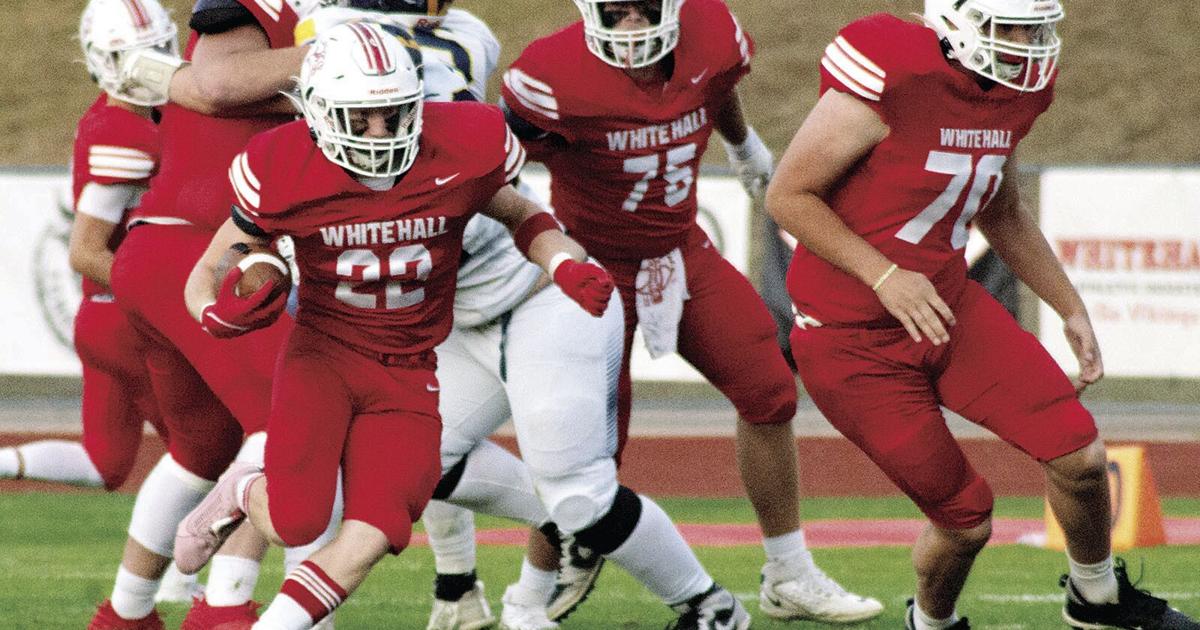
BIG RAPIDS – Revenge is sweet it’s said, and the Whitehall football team relished the taste Nov. 8 when the Vikings upset Big Rapids, 17-7 on the Cardinals’ field to win the Division 4 district title and move on to this week’s regional championship.
The Cardinals (9-2) dealt the Vikings a heartbreaking 28-27 loss in last year’s district final, but couldn’t anything going against the Vikings in this one, ending their nine-game winning streak.
Whitehall held the Cardinals to just 185 yards total offense, including just 74 yards rushing in establishing complete control of the game, and the time of possession.
Meanwhile, the Vikings displayed a balanced offensive attack, totaling an impressive 287 yards, 139 rushing and 142 passing in smashing the Cardinals.
“It was a lot of fun. It was pretty special,” Viking coach Tony Sigmon said. “There were some untimely penalties on us, and they were all effort-based penalties like holding and stuff like that. Just kind of at the wrong time.
“I felt like we were really behind the sticks for really pretty much the whole first half, and then we had a couple of balls that were on the ground.
“We lost one fumble as we were getting ready to go into the red zone. It seemed like any time we had momentum in the first half something just kind of stalled it, whether it was a ball on the ground or an untimely penalty.
“Truthfully, road games are tough, but road playoff games are even tougher.”
Despite some first half foibles, the Vikings kept the Cardinals offense under wraps by forcing some fumbles as well, and getting some key stops at crucial times.
Judd Musk gave the Vikings a slim 3-0 lead at the half with a 28-yard field goal after a fumble deep in Big Rapids territory cost them an earlier chance to score.
Neither team scored in the third quarter, but the Vikings would strike two minutes into the fourth to extend their lead to 10-0 when quarterback Camden Thompson pitched a 28-yard scoring strike to Hunter Osborne and Musk kicked the extra point.
Osborne also scored on an 11-yard run with just 3:23 left and Musk again booted the extra point to make it 17-0.
Big Rapids finally cracked the scoring column with 2:11 to play.
“The defense was fantastic all night long, and I think that starts in a couple areas,” Sigmon said. “Number one, all the credit goes to our kids because they have stepped up in a big way, in a lot of different places.
“A lot of places on the defensive line, the linebacking corps and the secondary this year. We’ve been beat up a lot this year, and it seems we’ve had to sub a person in that maybe wasn’t on the original starting lineup from what we projected Week One.
“Our team has done a wonderful job, and that showed on defense (against Big Rapids). And then a lot of credit has to go our assistant coaches. They put together a heck of a game plan, and they were able to teach it at high level, and really put our kids in a great position to be successful. There’s a lot of finger prints on that game.”
Gavin Craner had 79 yards rushing on 19 carries to lead the Vikings, Nathan Betz contributed 36 on seven carries and Thompson added 23 on 14 runs.
Thompson, who was a nearly perfect 5-of-6 passing in the first half, hit on both of his throws in the second half to end the night completing 7-of-8 for 142 yards and one score.
Osborne caught three passes for 84 yards and a TD, while Corde Anderson had two receptions for 38.
Anderson was in on nine tackles to lead the Vikings defense, and had one sack. Craner finished with seven stops, and Jack Ambrose five.
Whitehall will be looking for more revenge this week when the Vikings (8-3) host Grand Rapids South Christian (7-4) in the regional finals.
The Sailors defeated top-ranked Hudsonville Unity Christian, 35-28 in their district title game. They lost to Harper Woods, 33-27, in last year’s state final.
Michigan Tech’s Logan Morrel, center, protects goalie Derek Mullahy, right, as Northern Michigan University’s Colby Browne goes in for a rebound during their CCHA game played at the MacInnes Student Ice Arena in Houghton on Saturday. (Photo courtesy Cara Kamps)
MARQUETTE — A pair of one-win teams collide at the Berry Events Center beginning tonight to kick off the annual Cappo Cup series.
Northern Michigan University is 1-7 and Lake Superior State is 1-5 with games at 7:07 p.m. today and 6:07 p.m. Saturday in Marquette. Both will be broadcast on radio station WUPT 100.3 FM The Point with streaming coverage on Midco Sports Plus.
And fans can follow @NMUHockey on X (formerly Twitter) to get updates leading up to games and for live updates during contests. Or visit the NMU athletics website at nmuwildcats.com and look under the hockey schedule for links to live video, live audio, live statistics, ticket information and a series preview and history.
NMU Sports Information also wants to inform fans they can join them after Saturday’s game for a fourth-period party hosted and sponsored by Slabz Bar and Grill. Located inside the Ramada Inn on West Washington Street in Marquette, Slabz is a relaxed bar and restaurant offering “big” local food.
The Cappo Cup, decided annually between these Upper Peninsula rivals since the 1994-95 season, is given to the series winner. The return series will be in Sault Ste. Marie in early February.
Despite splitting the season series 2-2 last year, Northern lost the Cappo Cup 17-13 on goal differential.
Between them, this season the two U.P. teams have played just two league games, Northern’s 3-0 and 6-3 home-and-home sweep by Michigan Tech last weekend.
“(Lake Superior State) is in the U.P., it’s bragging rights and we should have good crowds again,” NMU head coach Dave Shyiak said in an NMU SI news release previewing the series. “They’re league … games and we’ve got to find a way to continue to get better, as we have been; but at the same time, you want to be able to fit some wins in (the schedule).
“This is an opportunity for us to build on some of our mistakes last weekend, but still be able to create the offense like we did.”
Shyiak found positives from his group despite the losses to MTU, which included two empty-net goals by the Huskies on Saturday in Houghton.
“I gotta give Tech credit, they found (a way) in their building to come back and win it,” he said about the Wildcats’ building a 3-1 lead after one period on Saturday. “We had chances, I thought, to make it a three-goal lead and we didn’t convert; nonetheless, I thought it was a great game on Saturday night.
“The positives were we got three goals, won the special teams battle and won the faceoff battle.”
Despite not denting the scoresheet at the BEC on Friday, Shyiak gave his players props for their offense.
“I think that was the most chances we’ve generated this year,” the coach said. “I think the chances were 18 to 18, I think we had 12 in the third (period) with a chance to convert, and they had two power-play goals and only one 5-on-5 goal.”
NMU’s Grayden Slipec scored two goals and added an assist on Saturday to earn himself CCHA Rookie of the Week honors. His linemates also found success, as Jakub Altrichter recorded three assists and Medrick Bolduc picked up a goal.
“When you have a young group, you’re always tinkering to find chemistry, and that (line) was probably one of the best lines on the ice that night,” Shyiak said. “They all bring a different element, and it was nice to see them rewarded.
“You gotta be able to finish plays off, and all three of them did.”
Over their past dozen games in this rivalry, NMU is 8-4 and outscored LSSU 41-35, going 4-2 both at home and in Sault Ste. Marie.
Slipec leads all CCHA freshmen with two power play goals and five points, while teammate Tynan Ewart leads league defensemen with four assists and five points, also coming in fourth in blocked shots with 20. Slipec and Ewart are Northern’s top scorers each with their five points.
Wildcats’ goaltender Ryan Ouellette is second in the CCHA with 268 saves and third with a .934 saves percentage, a particularly important stat as NMU is still being outshot more than 2-to-1, 328-156.
Northern leads the nation in blocks with 160, and in the CCHA, is third in faceoffs won with 249 and fourth in several other categories — faceoff percentage won at 51.2%, power play conversions at 15.8% and penalty kill at 86.2%.
Meanwhile, the Lakers only have a single win, a 3-0 decision against Stonehill, a Massachusetts school in its third year of playing NCAA Division I hockey. They were also swept at Michigan State, one game going to overtime, and allowed 15 goals in two games while being swept at Ohio State last weekend.
Reagan Milburn leads LSSU in scoring, matching NMU’s leaders with five points, including two goals. He has a four-game point streak.
Goalie Rorke Applebee has backstopped the past four Lakers’ contests and started another, too, sporting a 3.78 goals-against average and .891 saves percentage with 165 saves and the Rockhill shutout.
The Lakers are a conference-worst in allowing 4.3 goals per game while only averaging 1.8, but also have the CCHA’s best penalty kill at 100%, which doesn’t even take into account their shorthanded goal. Applebee has 43 saves while his team is shorthanded, a perfect 1.000 saves percentage.
Information compiled by Journal Sports Editor Steve Brownlee. His email address is sbrownlee@miningjournal.net.
So here’s the upshot of the “bold new era” Silver Lake and an NZR board living in la-la land promised us almost three years ago. Since then …
NZR has lost almost $60 million in the past two years. Annual revenue has not increased since 2021 (which was before Silver Lake were brought in as the so-called geniuses of professional sport).
The $260m investment from the American private equity company has largely been squandered on bribes to provincial unions to persuade them to support the deal, and ill-considered digital media ventures like NZR+ are on life support.
Provincial unions now face major funding cuts with a reduction of $1.8m this year and more than $3m next year.
Professional players will be next as their 36.5% of NZR’s annual revenue takes a hit, raising the prospect of losing more stars to overseas clubs.
In the meantime, Silver Lake will start taking an annual $20m plus dividend from next year. In perpetuity.
There is no doubt Craig Fenton’s appointment as head of NZR Commercial (NZRC) was influenced by Silver Lake, who love to talk up their ability to provide governance advice (really?!!) as well as money.
Sports Insider heard varying reports on Fenton during his brief tenure. He was in equal parts described to this columnist by people who had encountered him as “super smart” but also that he had some “daft ideas”.
Clearly, Fenton and hyper-sensitive executives at NZR HQ didn’t get along, as evidenced by the press release announcing his departure.
“Craig and NZRC have agreed that Craig’s vision of change and approach to driving it are not fully aligned with the organisation,” it stated.
So does that mean the former leading Google executive hadn’t left that company’s monopolist attitude back in the UK when he shifted back to his native New Zealand?
Or does it mean over-protective NZR executives (and possibly a bunch of board directors) don’t want to face the prospect of executing the major surgery so obviously needed on the game here to prevent a terminal decline?
While all this nonsense is going down, those out battling in rugby’s heartlands watch with growing despair.
Was there ever a more poignant and passionate plea for sanity delivered than the one made by long-serving Taranaki NPC coach Neil Barnes in expressing his dismay to the Herald’s Liam Napier earlier this week?
The straight-shooting Barnes stated the obvious in his broadside at NZR, including that rugby fans have fallen in love again with the provincial championship – but the national union’s bosses don’t give a toss about that.
“In my mind, the NPC is an inconvenience to the people at the top level,” Barnes told Napier.
“When Silver Lake came along, there was funding put out there for people in the communities to grow our game and help facilitate it. Now all that funding has been taken away.”
“Our funding was cut by over $100,000 this year and they’re cutting another $250,000 off it next year. That’s on the back of [NZR boss] Mark Robinson sitting in my office, and I was challenging him over funding for our game at this level. He said there’s not a shortage of funds in New Zealand, it’s where you spend it.
“If that’s the case, it shows they don’t respect the importance of grassroots rugby.”
Barnes then pointed to the All Blacks, with 23 support staff, and All Blacks XV teams collectively sending more than 100 people to Japan and Europe this month.
Not that Silver Lake seem to care. It has been absent since day one, seemingly happy to have the All Blacks on its investment resume to impress others while largely doing nothing.
Fenton’s strategy seems to have been to simply create more teams using the All Blacks moniker and sending them on as many overseas promo trips as possible.
All of this, of course, has happened under the watch of an NZR board hopelessly out of its depth, excoriated by the Pilkington Report but with a clutch of directors grimly attempting to hold on to their blazers.
The current chair Dame Patsy Reddy has been a let-down and is not standing again. Provincial unions believe she has done them over but is still trying to influence who makes up the newly constituted board.
Several directors she has worked closely with and who helped enforce the Silver Lake deal on a suspicious rugby public are angling to keep their jobs and securing the vacant chair role.
That alone will be enough to scare worthy candidates away from nominating themselves for consideration.
The rot seems set to continue.
Does Sir Ben Ainslie need to watch his back?
Should Sir Ben Ainslie be worried about his job after failing to topple Peter Burling and Team New Zealand to win the America’s Cup?
Maybe Sir Ben should have a chat to another sporting knight in Sir Alex Ferguson, who seems to have been ostracised from Manchester United now that Ineos founder Sir Jim Ratcliffe is an influential owner of the storied English Premier League (EPL) club.
Ratcliffe, whose company is one of the world’s worst polluters (and also sponsors the All Blacks), is a renowned tight arse who has embarked on a ruthless cost-cutting exercise since buying into United last year.
The club’s popular and long-time historian has been sacked, free lunches for staff and players were cut and now Ratcliffe has come after “Fergie”, a Man United icon.
After previously banning the legendary manager from visiting the United changing rooms after matches, Ratcliffe has now cut Ferguson’s £2m ($4.4m) a year ambassador role for the club.
That prompted a savage tweet from another former United golden boy, Rio Ferdinand.
“If Sir Alex can be taken out, then NO ONE IS SAFE at @ManUtd – anyone in can get it now. Ineos sending a message to ANYONE at the club?!?”
Watch your back, Ben.
Former Manchester United defender Rio Ferdinand makes his feelings known regarding his former manager’s removal from his role at the club. Photo / Twitter @rioferdy5
Man City is a soulless club of shaggers
While on Manchester and the EPL, regular readers of Sports Insider will know this writer is no fan of United’s bitter cross-town rivals.
Now it seems the massively overpaid players themselves are adding a bunch more reasons to loathe City.
Former leading player Ben Mendy is laying bare the complete lack of morals at City during an employment tribunal process, in which he is suing the club for £11m of unpaid wages.
Mendy was sacked for alleged sexual offences but was later acquitted and is now going after the club. His argument? He says he was unfairly singled out in a squad of serial shaggers.
“Several Manchester City first-team players, including the club captain, were all present at parties that I attended and hosted. We all drank alcohol. We all had casual relations with women,” he told the tribunal.
That went down like a cup of cold sick with his former teammates and Kyle Walker, the captain. Raheem Sterling, named during the trial, has loaned Mendy the money to help clear pay his legal fees.
As for Walker, his wife filed for divorce last week, although that may have as much to do with her finding out about his mistress and their two secret love children. The mistress is now suing him.
The judgment on that sideshow is damning right down to the mistress threatening to move into a house next door to Walker and his wife if he didn’t buy her a £2m house and some £48,000 wardrobes.
His neighbour compared the affair to the film Fatal Attraction, claiming she was asked by the mistress to lean over the garden fence and record Walker’s conversations with his wife.
Like I said, it’s a classy club!
Can celebrities save us from cynicism?
Ed Sheeran’s sponsorship of newly-promoted EPL club Ipswich Town is being compared to the Ryan Reynolds–Rob McElhenney custodianship of Welsh club Wrexham, who also harbour EPL ambitions.
It raises the question of whether celebrities can save sport from shifty private equity types and ruthless owners like Ratcliffe.
We have our own little experiment about that going on Downunder with an Auckland FC ownership group that includes Ali Williams, Anna Mowbray, Steven Adams, Tim Brown, Winston Reid and Noah Hickey.
They’re off to a flyer after last Saturday and there’s no doubt the feel-good factor around the newly birthed A-League club is being helped by the big names attached to it. We will watch the rest of the season with increasing interest.
While on Auckland FC, there were shades of Joe Biden and his “Tan Blacks” gaffe when referring to the All Blacks and Ireland from our Prime Minister in the lead-up.
Christopher Luxon was a guest at the club’s pre-match function and talked up the impending all-Kiwi clash with the Wellington Phoenix, telling guests there were many great local derbies in world football including “the Rangers against the Celtics”.
We think he meant the Scottish Old Firm derby between Glasgow Rangers and Celtic.
NRL needs to show it’s serious about Christchurch
Another big league match in the Garden City, and another sellout.
It doesn’t seem to matter whether it’s the Warriors or the Kiwis, South Islanders seemingly can’t get enough of the 13-player code.
Among the 17,000 fans packing into Apollo Stadium on Sunday to watch the Kiwis play Australia for the first time in Christchurch in 35 years will be thousands making the trek from West Coast strongholds like Greymouth – and equally as many from Dunedin.
It comes at a time when Christchurch school St Thomas picked up the national title two years running over favoured Auckland schools and when five players with South Island heritage have been included in the squad to face the Kangaroos.
Add in the Crusaders being in the doldrums and, for the first time since 1995, the South Island not holding a single rugby championship of note, and the message is starkly clear.
There has never been more momentum for a South Island franchise in the Australian club competition.
But is the National Rugby League (NRL) listening?
This column has regularly suggested the NRL is merely paying lip service to Christchurch’s two bids and doesn’t really get the opportunity here due to their Aussie blinders being permanently wedged on.
One way to demonstrate that’s not the case will be to see if Australian Rugby League chairman Peter V’landys and his NRL CEO Andrew Abdo turn up at Apollo Stadium this weekend.
Pete and Andy talk a good game about international league but their failure to actually show up for anything outside Australia is a growing talking point among some league pundits.
Both say they will be there, hopefully to witness first-hand the snowballing enthusiasm for league in the south.
Let’s see, shall we?
Team of the Week
New Zealand: Has there ever been a weekend in Kiwi sport like the last one? Will there ever be another one like it again? Celebrate New Zealand, for that was special.
Liam Lawson: Added the cherry to the top on Monday morning with a top-10 finish in his reintroduction to F1. Is that Sergio Perez’s knees we can hear knocking?
Gayle Broughton: The Olympic rugby sevens gold medallist makes her league test debut for the Kiwi Ferns against the Australian Jillaroos in Christchurch on Sunday in the crucial five-eighth role, after a stellar maiden NRLW debut season with the Brisbane Broncos.
TOLEDO, Ohio — Steven Haller remembers the look of fear on people’s faces when toxic algae in Lake Erie made it into his community’s water supply 10 years ago, shutting it down for two days.
Since then, Haller, a clinical researcher in the University of Toledo’s department of medicine, has set out to help provide answers about how harmful algal blooms can affect the health of people who live and play nearby.
“I see all of the concern in the faces of people here,” Haller said. “They want the answers. They want to know.”
For residents in Lake Erie’s western basin, the blooms are a common sight. As spring rains push excess nutrients off farm fields and into the creeks and rivers of the watershed, the bacteria that live in the lake feed on that phosphorus and nitrogen, tinting the water green, producing a thick sludge when severe and potentially turning toxic to humans and animals.
Research has shown that toxins from these bacteria called microcystin can make animals and people sick when they come into contact with infected water. At Haller’s lab, researchers hope to better understand how these toxins affect people, especially those with health conditions like asthma.
At the lab, which Haller manages along with David Kennedy, an associate professor of medicine, researchers are examining how microcystin affect people with health conditions such as liver, gut or lung diseases by growing cell samples and exposing the cells to the toxin.
“We’ve shown that in all those instances, exposure to microcystin makes the disease process worse,” Haller said.
One new area of study here is the effects of the toxins when aerosolized — that is, made airborne. In the lab, scientists use a machine that uses high pressure to spray toxin onto human lung cells. At the lake, the toxins could aerosolize as waves hit rocks on shore or as boats and personal watercraft churn through the water.
Monitoring the air near Lake Erie is key to understanding how the toxins can get aerosolized.
On a warm afternoon around the peak of a bloom near Toledo, Kennedy climbed a ladder about 15 feet onto the top of a small concrete building near shore where an air monitor was collecting and filtering air from the lake. Kennedy installed a clean air filter after collecting the previous week’s, stained a light gray from airborne particles.
The sampling runs through the end of the bloom season, possibly through November, Kennedy said. After that, all the filters will be analyzed. It’s the first year they’ve conducted this research on Erie, but their work follows peer-reviewed research published in 2023 that found evidence of microcystin in the air at Grand Lake St. Mary’s, Ohio.
While Kennedy and Haller are waiting to see if microcystin is in the air near Lake Erie, they have initial results from their controlled experiments that show inflammation in lung cells increases when exposed to these aerosolized toxins. For asthma, it increases “significantly,” Haller said.
Some residents of Toledo said they’ve gotten used to taking precautions against the algae.
“When it starts getting like this, it’s bottled water for everything,” said Malissa Vallestero, who was fishing with family at a park on Lake Erie during this year’s bloom. “I don’t really drink the water that comes from here anymore.”
Dan Desmond, who was walking along the beach at Maumee Bay State Park with his grandnephew, said he checks on the bloom before getting near the lake.
“If I was coming down to go in the water, it would definitely ruin my day,” he said.
Along with their lab studies, Haller and Kennedy are enrolling community members in a study in collaboration with the University of Michigan. Over the next five years, they hope to study 200 people to see if algal blooms affect their health. Researchers will ask participants questions about their health during the course of the algal bloom season, run lung tests, take blood samples and try to quantify toxins in their bodies if they have them.
“I want to be able to provide those answers both ways, whether there’s an effect or there isn’t,” Haller said.
——
Follow Joshua A. Bickel on X and Instagram at @joshuabickel.
——
The Associated Press’ climate and environmental coverage receives financial support from multiple private foundations. AP is solely responsible for all content. Find AP’s standards for working with philanthropies, a list of supporters and funded coverage areas at AP.org.
OREGON, Ohio — On a warm late-summer evening, a small speedboat motored across a pea-green stretch of Lake Erie past a beach where a child sat splashing and a pair of newlyweds waded for a portrait photographer. On the sand, unseen or ignored, bright red signs warned people to stay out of the water due to dangerous algae toxins.
Some 70 miles away, farmer Bill Kellogg is trying to do something about the chronic algae blooms in America’s southernmost Great Lake. Instead of scattering fertilizer atop his fields, Kellogg now uses a strip till machine that knifes fertilizer pellets 8 inches into the soil — deep enough that heavy rains won’t wash it away.
He plants cover crops that strengthen the soil so it can absorb more nutrients. In other fields, he’s replaced some crops with buffer strips of grasses and other plants that can absorb nutrient runoff before it shoots into streams bound for Erie, where the runoff would be potent fuel for the algae.
“We accept that we have a target on our back in the agriculture community,” Kellogg said.
Bacteria commonly called blue-green algae are often present in bodies of water throughout the world, but if fed too much of the phosphorus and nitrogen in farm fertilizers, they can turn into harmful algae blooms that can affect drinking water, create oxygen-starved dead zones that kill marine life, spoil swimming, boating and tourism and endanger human health.
Western Lake Erie is an ideal environment for the bacteria to thrive: It’s about 30 feet deep, the shallowest part of the shallowest Great Lake, and it heats up faster when temperatures are warm. And it’s where nutrients from farm fields along streams and creeks throughout the basin eventually drain into the Maumee River, which dumps into Erie at Toledo.
Nutrient runoff from agricultural fields, mostly fertilizer, accounts for about 80% of the nutrients that flow into Lake Erie, and half of the nutrients reaching the lake arrive via the Maumee.
Reducing the amount of nutrients — specifically phosphorus — was one focus of a 2015 agreement between the United States and Canada to cut the phosphorus going into Erie by 40% by 2025. Researchers say progress has been made — the latest figure is that phosphorus is down about 32% — but the target likely won’t be met.
This year’s algae bloom in western Lake Erie was moderate compared to previous years. It appeared June 24, its earliest since monitoring began, and its late-summer peak covered about 660 square miles — larger than some previous years, but not nearly as thick as some other blooms.
Warming temperatures are expected to make algae blooms start earlier, last longer and potentially become more toxic as more intense rainstorms drive nutrients through waterways and higher temperatures warm the lake.
“If all things stay the same and the climate changes in the way we sort of expect it to over the coming decades, then things will get worse,” said Nate Manning, the interim director of the National Center for Water Quality Research.
For Kellogg, who farms 7,400 acres of corn and soybeans in Forest, Ohio, conservation efforts on his farm have long been a personal priority; he regularly visits Lake Erie with his family to fish and swim. But he became even more committed after a 2014 bloom that led to a temporary shutoff of drinking water for more than 400,000 people in Toledo and southern Michigan.
“Once that happened, it got us into high gear,” Kellogg said.
Kellogg spent more than $1 million for the strip-till machine and the tractor to pull it that lets him tuck the solid fertilizer several inches below ground. It was a big outlay, but he said he’s now spending about $300,000 less on fertilizer as less of it runs off. The liquid fertilizer he sometimes uses is stored in tanks that sit in a concrete basin to contain any leaks.
“Our yields have increased. Our fertilizer cost has dropped. Once you get hooked on something and you’ve proven it to yourself that it works, nobody has to pay us anything now to do it,” Kellogg said.
Near Sandusky Bay on the southwestern part of Lake Erie, the Ohio Department of Natural Resources is working with other conservation groups to restore wetlands that filter nutrient runoff before it gets into the bay. At one site, engineers reconnected water channels through areas of former farmland to return the area to a wetland state. At another, island barriers are being built near the shoreline in addition to wetland restoration to aid filtration.
As part of the H2Ohio program begun in 2019, the Ohio Department of Natural Resources and its conservation partners have completed 23 wetland restoration projects in the western Lake Erie Basin, with another 49 ongoing. These help, but they’re only one part of the solution, said Mary Mertz, the director of the Ohio Department of Natural Resources.
“You can’t just do wetlands and that’s going to clean up Lake Erie,” she said. “Other things have to happen.”
Researchers at the National Center for Water Quality Research in Tiffin constantly monitor phosphorus in the water. Their data show that the phosphorus load into western Lake Erie is trending downward, but the 40% reduction target hasn’t been met consistently.
“There’s a lot to be positive about,” Manning said.
But more funding is needed and more farmers must adopt conservation and nutrient management practices, said Emily Kelly, the agriculture and water coordinator for the Ohio Environmental Council. A 2023 report from that group and the Alliance for the Great Lakes found that Ohio needs to increase spending between $170 million and $250 million to meet these reduction goals. Michigan needs to spend between $40 million and $65 million.
Farmers in Ohio have enrolled about 1.5 million acres in the western Lake Erie basin in a nutrient management plan with the state, according to data from 2023. That’s about 43% of the basin’s cropland, with a goal of enrolling at least half, said Carissa Cochrane, a spokeswoman for the Ohio Department of Agriculture.
Farmers develop their own plan and are eligible for incentive payments up to $40 per acre, though they aren’t required to meet any nutrient load reduction targets. They work with local soil and water conservations districts to choose which practices, such as cover cropping and targeted fertilizer placement, might work best on their fields.
To get results, some farmers might need multiple practices, like buffer strips and expensive machines like Kellogg’s. All that can discourage some, said Jordan Hoewischer, director of water quality and research at the Ohio Farm Bureau.
Kellogg thinks if more farmers voluntarily adopt these conservation practices, there’s less chance that government would step in with regulations. He’d rather farmers do it on their own.
“We were probably part of the problem to begin with,” Kellogg said. “It’s upon us to be part of the solution.”
_____
The Associated Press’ climate and environmental coverage receives financial support from multiple private foundations. AP is solely responsible for all content. Find AP’s standards for working with philanthropies, a list of supporters and funded coverage areas at AP.org.
MONTAGUE – Trevor Trevino broke a scoreless deadlock late in the second half to lead the Wildcats to their first ever district title in a thriller over Fremont in the Michigan High School Athletic Association’s Division 3 district final, 1-0, Oct. 16.
Both teams were deadlocked at 0-0 at halftime and up until the 9:18 mark in the second half when Trevino broke through and got the game winner despite having three Fremont defenders around him.
Like everyone else after the game, Trevino was very excited and happy.
Trevino said about how he felt about the game-winning goal, saying, “It feels really good … It’s the first time in history ever, it’s so much energy and we all brought it today and they got me through it and we won.”
Trevino said about what through his mind when he scored, “I don’t remember, it was just crazy.
“All the fans here were really loud and I was really happy.’
During the game, the Wildcats were quite animated and excited on the sideline, something Trevino said gave them more energy.
“When we’re moving like that it beats the other team tired and we capitalize on it, move the ball around and it got us here,” Trevino said.
Before and after the goal, even though it appeared that Montague controlled much of the play with their speed, both teams had many rushes into each other’s end.
However, both teams also played a physical game.
Anytime Fremont tried to make something happen offensively, Montague was there to take away the ball. But it was a well-played game by both teams, offensively and defensively.
And after the game, the Wildcats got their first-ever chance to hold up the district award.
Also, after the game, Trevino said that the energy that came when he scored his three-goal hat trick during Monday’s district semifinal against Orchard View carried over to the district final.
“I knew it would come eventually,” Trevino said. “I knew I’d get the opportunities and capitalize on it and I did.”
About going to the regionals, Wildcats Head Coach Brandon Mahoney said, “It’s very exciting; first time for us, so it’s exciting that we cracked that egg at home at our field and win a district with this amazing home crowd.”
“There’s a banner in the gym with no district titles but now it will,” Mahoney said.
He also talked about Trevino’s goal, saying, “He’s good with feet, we talked at half and we felt that he could beat that outside defender and just told him you’re going to have to put a move on.”
“And obviously, we had other opportunities, we just didn’t finish in the first half,” Mahoney said.
“So, great work by Trevor to get us that goal and to the rest of the squad to hang on for the last six minutes and keep Fremont out of the net.”
The Wildcats begin regional play Tuesday, Oct. 22 in Clare against the winner of Kingsford and Grayling.
WHITEHALL — Playing suffocating defense, and winning the battle in the trenches, the Whitehall football team thoroughly dominated Manistee in racking up a big 49-6 victory in last Friday night’s Homecoming game in the West Michigan Conference Lakes Division.
An already giddy home crowd was in a particularly celebratory mood when Brady Tate wore the Homecoming King’s crown, and Sydney Shepherd wore the Queen’s crown at halftime.
By that time, Whitehall — the defending WMC Lakes champion — was in total control of the football game, its offensive and defensive lines pushing the Mariners — who had shut out Muskegon Orchard View, 41-0 two weeks ago — all around the field in building a 35-0 lead, and assuring a running clock to start the second half.
The Vikings set the defensive tone when, on Manistee’s first offensive series, they burst in a sacked quarterback Dayvion Neal-Berry for a substantial yardage loss.
Manistee’s offense simply weren’t able to move the ball for a good part of the game, while the Mariners defense struggled to stop the Vikings offense.
“I was really happy with our defense. I thought they did an awesome job,” said Vikings coach Tony Sigmon. “There were times when I felt like we were in really good rhythm tonight.
“I felt we had a pretty solid pocket for passing and everything. I love the way our skill kids don’t give up on a play.
“We had some stuff that we hit on early, and then for our kids to be able to keep coming back and making plays when the play breaks down is always an exciting thing for us.”
The offensive line has had to deal with some adversity, with two starters out and new personnel added to the mix.
“We got two new guys, but we’re a family here,” said lineman Jamison Jeffrey. “I think we do great together.”
Connor Nash added that everyone was able to bond, making for a smooth transition.
“When everyone gets rolling, like we all get rolling,” Nash said. “Everyone comes together, and we start feeding off each other’s energy.”
For Jack Ambrose, it’s staying in the moment.
“It’s just the little details that will get us,” Ambrose said. “If we do the little things, the big things will fall into place.”
Camden Thompson lit the fuse for the Vikings with an electrifying 55-yard punt return for a touchdown with 7:37 remaining in the first quarter, and a 7-0 lead.
Thompson ran for two more scores, of 54 and 15 yards, and also hit Hunter Osborne with a 20-yard strike. Osborne scored on a 19-yard run just five seconds before half.
Whitehall kept right on rolling in the second half, Ryan Goodrich busting in from a yard out, and Gavin Craner skirting around end on a two-yard run.
Manistee scored its touchdown with 9:30 left in regulation on a Neal-Berry 15-yard pass to Kaden Kott.
The Vikings improved to 3-2 overall and 3-0 in the WMC Lakes.
Season 4 cast member Monica Garcia brought a new round of controversy. Revelations about Monica and her involvement with RealityVonTease, an Instagram account known for trashing the RHOSLC cast, left viewers and fellow cast members speechless. Monica will not return for Season 5 of RHOSLC, but her influence will likely remain strong.
The new season of RHOSLC will feature Lisa Barlow, Heather Gay, Meredith Marks, and Whitney Rose—all Housewives who’ve remained on the show since the beginning. Mary Cosby from the first two seasons is also returning to the main cast, as is Season 4 veteran Angie Katsanevas. Bronwyn Newport is the lone new face in RHOSLC Season 5.
7 Lisa Barlow
Via Instagram
A native of New York, Lisa Barlow converted to Mormonism as a child with her family. After attending Brigham Young University, Lisa now runs her marketing company, LUXE, while she and her husband, John, founded VIDA tequila. The mother of two also has a business with her sons, Jack and Henry.
Barlow describes herself as “Mormon 2.0” and, in 2020, she explained to Andy Cohen that it involved aspects of orthodox Mormonism mixed with her lifestyle, especially her connection to alcohol. Lisa’s castmates have scrutinized her beliefs, notably when Lisa’s son, Jack, focused more on traditional tenets of the Mormon faith.
Lisa and fellow housewife Heather Gay met at BYU and her close friendship with Meredith Marks has been a focal point of the show. During Season 4, Lisa was at odds with Monica Garcia when the revelations about Monica’s connection to the RealityVonTease Instagram account came to light.
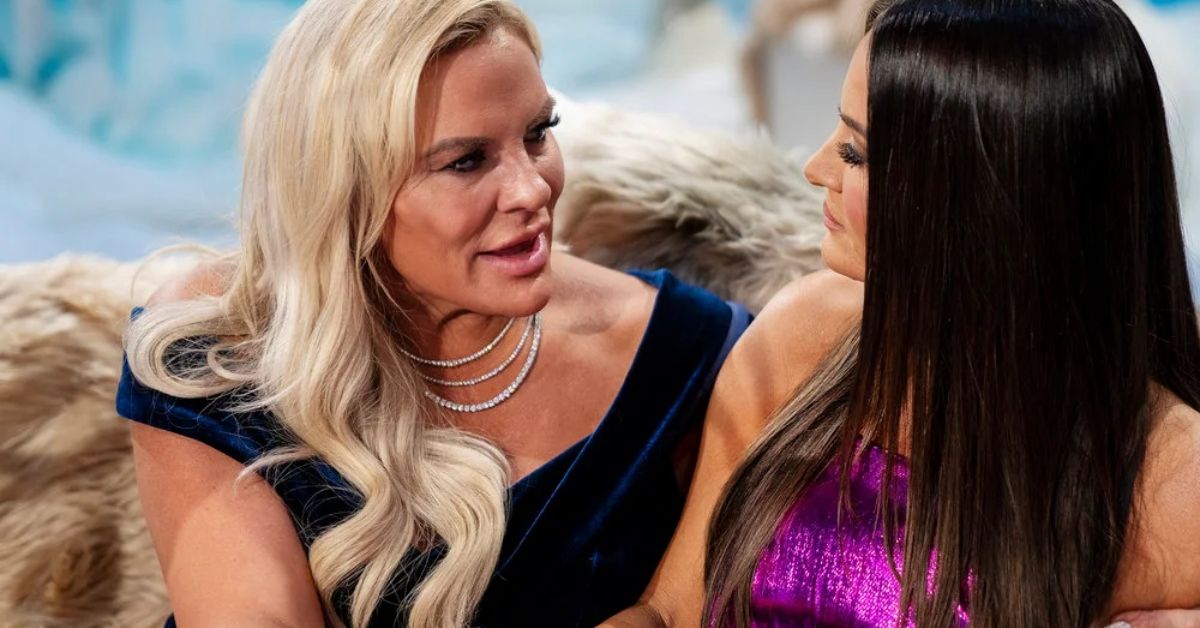
6 Heather Gay
via Bravo TV
Heather Gay co-owns Beauty Lab + Laser in Utah while raising her three daughters and navigating life as a divorcee in the Mormon church. Heather published a New York Times bestselling memoir called Bad Mormon in 2023, the success of which was a large focal point for the housewife and her family during Season 4 of RHOSLC.
“It’s disappointing [and] sad to know that body positivity was all a big lie… because it’s better to not be overweight.”
5 Meredith Marks
Via: Instagram/@meredithmarks
Chicago native Meredith Marks is a jewelry designer with a brand of luxury items, including caviar. In addition to her entrepreneurship, Meredith dedicates herself to numerous charitable causes.
After Meredith and her husband, Seth, experienced difficulty in their marriage during Season 1 of RHOSLC, the couple reconciled and maintained a strong relationship throughout the show. Often at odds with Lisa Barlow and Whitney Rose, Meredith has been accused of gossiping about her fellow cast members on numerous occasions.
Meredith talked about her “weird” medical condition on Page Six’s Virtual Reali-Tea podcast in early September 2024 to explain that she had a third breast-reduction surgery. She previewed that the subject would be part of the first episode of RHOSLC Season 5, noting that her castmates got a good chuckle over the fact that Meredith’s breasts continue to grow.
4 Whitney Rose
via: Bravo
Whitney Rose, who’s cousins with co-star Heather Gay, left Mormonism after an extramarital affair with her boss, Justin, and an unexpected pregnancy ended her first marriage. Now married, Whitney and Justin have two children, Bobbi and Brooks.
Whitney has a line of skincare products called Iris and Beau, assists her father as he navigates health issues, and launched a jewelry line during Season 4. In addition to tension with her cousin, Heather, Whitney has also struggled to maintain a friendship with Meredith.
3 Mary Cosby
Via Bravo
RHOSLC alum Mary Cosby returns to Season 5 as a full-time cast member. Mary’s initial exit from the show may have been related to her marriage to Robert Cosby Sr., her step-grandfather. Mary and Robert Sr. have a son, Robert Jr., whose new wife reportedly moved in with the family at some point during or after Season 4.
Mary’s return will likely reveal the cause of her broken friendship with Meredith Marks. Meredith told Extra in anticipation of Season 5 that she doesn’t “understand” what caused the feud between her and Mary:
“I don’t really know what the problem is there, which is a bit unsettling to me, because, usually when there’s a problem, I like to understand what it is… And usually when someone starts coming at me, there should be a reason for it, especially when I’ve been there for them for years when nobody else would be.”
2 Angie Katsanevas
Via Instagram
Promoted from “friend of” to main cast member between Seasons 3 and 4, Angie Katsanevas and her husband, hairdresser Shawn Trujillo, run Lunatic Fringe Salons in Utha, Ohio, and Idaho. Angie and Shawn share one daughter, Elektra, who excels as an equestrian.
Angie and Shawn’s marriage is often talked about, with rumors circulating about the couple’s stability. During Season 4, revelations that the couple had not been on a date in years prompted speculation that their relationship was in trouble. Angie insists that she and Shawn spend their time focusing on Elektra. Angie said at the Season 4 reunion, “This never came up ’til this rat came out of the sewer.”
The “rat” in question was Monica Garcia.
1 Bronwyn Newport
via: Bravo
Newcomer Bronwyn Newport was enlisted to the RHOSLC by veteran cast member Lisa Barlow. After Bronwyn got pregnant as a student at BYU, she was excommunicated by the Mormon church. She raised her daughter, Gwen, on her own until meeting Todd, her current husband.
Bronwyn’s website describes her as a “successful Broadway producer and influential fashion blogger.” As a socialite known for her taste and style, Bronwyn also participates in charitable activities and serves on multiple boards in Salt Lake City.
In addition to the main cast, RHOSLC will include friends Meili Workman, a model and mother of four, and Britani Bateman, a Utah native who works in real estate.
Season 5 of The Real Housewives of Salt Lake City will premiere at 9 p.m. ET/PT on Wednesday, Sept. 18 on Bravo. Episodes stream the following day on Peacock.