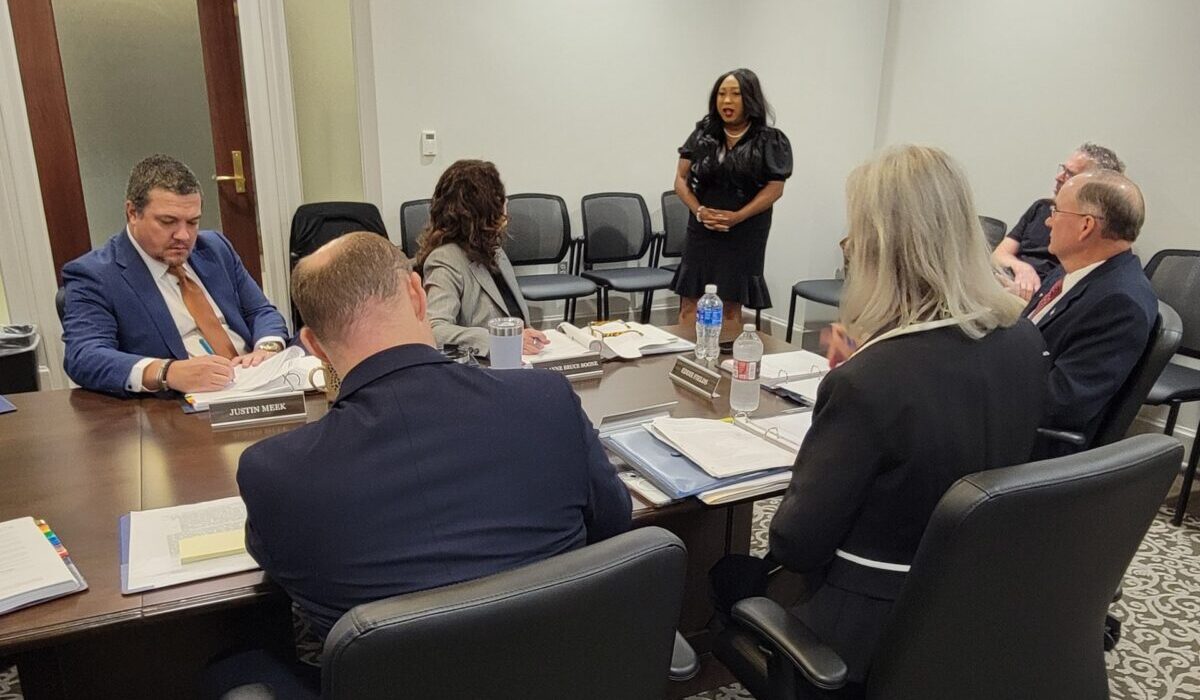
The athletes whose lawsuit against the NCAA is primed to pave the way for schools to pay them directly also want a players’ association to represent them in the complex contract negotiations that have overtaken the sport.
Grant House, Sedona Prince and Nya Harrison wrote to the judge overseeing what’s known as the House settlement, saying that although they are generally happy with the terms of the proposed settlement “there still remains a critical need for structural changes to protect athletes and prevent the failures of the past.”
That, they said, would be a players’ association, which they believe will help their voices be better heard as the NCAA and its schools move toward a system to share hundreds of millions in TV and ticket revenue with players.
The players said an association would help standardize name-image-likeness (NIL) contracts to establish minimum payments and health protections “and to create an ecosystem where athletes can thrive.”
“While professional leagues include athletes in these decisions through their respective players’ associations, the college system continues to prevent our players’ association from representing us at the decision-making tables,” the letter said.
The settlement, with a price tag of $2.8 billion that will be distributed over the next 10 years to players both past and present, does not address whether athletes should be considered employees of the schools. That’s an issue the NCAA is asking Congress to prevent for fear the costs could wreck college sports.
The NCAA did not immediately respond to a message from The Associated Press seeking comment Tuesday.
Earlier this year, the head of the National College Players Association confirmed that a licensing organization that works with the NFL Players’ Association had emailed thousands of college football players, encouraging them to join the NCPA. Separately, the chairman of another group trying to organize college athletes, athletes.org, said it already had some 4,000 members. The players who wrote the letter said they wanted to work with athletes.org.
A hearing to approve the settlement is set for April 7. The request could shape how U.S. Judge Claudia Wilken views the settlement’s long-term chances of succeeding, but plaintiffs’ attorney Jeffrey Kessler said the letter was an endorsement of the settlement and he doesn’t expect it to impact the agreement.
“All three of these athletes fully support approval of the settlement but wanted to express their additional views that a players’ association is also desirable,” Kessler said. “I salute their devotion to these issues and their fellow college athletes.”
The District of Columbia is suing Amazon, saying the company secretly stopped providing its fastest delivery service to residents who live in two predominantly Black Washington neighborhoods but is still charging residents millions of dollars for a service that provides speedy deliveries.
The complaint, filed Wednesday in District of Columbia Superior Court, revolves around Amazon’s Prime membership service, which charges consumers $139 per year or $14.99 per month for fast deliveries — including one-day, two-day and same-day shipments — as well as other benefits.
In mid-2022, the lawsuit says, the Seattle-based online retailer imposed what it called a delivery “exclusion” on two zip codes in the district — 20019 and 20020 — and began relying exclusively on third-party delivery services such as UPS and the U.S. Postal Service, rather than its own delivery systems.
Amazon claims to have made the change based on concerns about driver safety, the lawsuit notes.
However, the District of Columbia’s attorney general’s office said the company never told Prime members in the two zip codes about the change even though they experienced slower deliveries as a result. Amazon also did not tell new customers about the exclusions when they signed up for Prime memberships, the lawsuit says.
“Amazon is charging tens of thousands of hard-working Ward 7 and 8 residents for an expedited delivery service it promises but does not provide,” District of Columbia Attorney General Brian Schwalb said in a statement, referencing the two areas in the city where Amazon is accused of excluding its speediest deliveries.
“While Amazon has every right to make operational changes, it cannot covertly decide that a dollar in one zip code is worth less than a dollar in another,” Schwalb said.
The lawsuit says Amazon has nearly 50,000 Prime members who live in the two zip codes, a number that represents nearly half of the population. Prime members in those neighborhoods have ordered more than 4.5 million packages in the past four years, and are more likely to rely on Amazon since they have fewer services and retail stores nearby, the city said. The area is also a notorious food desert.
The district says that in 2021, before Amazon implemented its delivery “exclusion,” more than 72% of Prime packages in the impacted zip codes were delivered within two days. But last year, it was only 24%, according to the complaint.
Meanwhile, the district’s lawsuit says Prime members who live in other parts of the city received two-day deliveries 75% of the time.
When some customers complained about the slower deliveries, Amazon concealed the true reason for the delays and “deceptively implied” that the delays “were simply due to natural fluctuations in shipping circumstances, rather than an affirmative decision by Amazon,” the lawsuit says.
District officials are asking the court to issue an order prohibiting Amazon from “engaging in unfair or deceptive practices.” They also want the company to pay restitution or damages to affected Prime members, as well as civil penalties.
The complaint filed Wednesday represents the second major legal battle between Amazon and the District, which has also filed an antitrust lawsuit against the company.
WILMINGTON, Del. — Attorneys for Fox Corp. asked a Delaware judge Friday to dismiss a shareholder lawsuit seeking to hold current and former company officials personally liable for the financial fallout stemming from Fox News reports regarding alleged vote rigging in the 2020 election.
Five New York City public employee pension funds, along with Oregon’s public employee retirement fund, allege that former chairman Rupert Murdoch and other Fox Corp. leaders deliberately turned a blind eye to liability risks posed by reporting false claims of vote rigging by election technology companies Dominion Voting Systems and Smartmatic USA.
Smartmatic is suing Fox News for defamation in New York, alleging damages of $2.7 billion. It recently settled a lawsuit in the District of Columbia against One America News Network, another conservative outlet, over reports of vote fraud.
Dominion also filed several defamation lawsuits against those who spread conspiracy theories blaming its election equipment for Donald Trump’s loss in 2020. Last year, Fox News settled a defamation lawsuit filed by Dominion in Delaware for $787 million.
The shareholder plaintiffs also allege that Fox corporate leaders ignored “red flags” about liability arising from a 2017 report suggesting that Seth Rich, a Democratic National Committee staffer, may have been killed because he had leaked Democratic party emails to Wikileaks during the 2016 presidential campaign. Rich, 27, was shot in 2016 in Washington, D.C., in what authorities have said was an attempted robbery.
Fox News retracted the Seth Rich story a week after its initial broadcast, but Rich’s parents sued the network for falsely portraying their son as a criminal and traitor. Fox News settled the lawsuit in 2020 for “millions of dollars,” shortly before program hosts Lou Dobbs and Sean Hannity were to be deposed, according to the shareholder lawsuit.
Joel Friedlander, an attorney for the institutional shareholders, argued that Fox officials waited until the company’s reporting about Rich became a national scandal before addressing the issue. Similarly, according to the shareholders, corporate officials, including Rupert Murdoch and his son, CEO Lachlan Murdoch, allowed Fox News to continue broadcasting false narratives about the 2020 election, despite internal communications suggesting that they knew there was no evidence to support the conspiracy theories.
“The Murdochs could have minimized future monetary exposure, but they chose not to,” Friedlander said. Instead, he argued, they engaged in “bad-faith decision making” with other defendants in a profit-driven effort to retain viewers and remain in Trump’s good graces.
“Decisions were made at the highest level to promote pro-Trump conspiracy theories without editorial control,” Friedlander said.
Defense attorneys argue that the case should be dismissed because the plaintiffs filed their lawsuit without first demanding that the Fox Corp. board take action, as required under Delaware law. They say the plaintiffs also failed to demonstrate that a pre-suit demand on the Fox board would have been futile because at least half of the directors face a substantial likelihood of liability or are not independent of someone who does.
Beyond the “demand futility” issue, defense attorneys also argue that allegations that Fox officials breached their fiduciary duties fail to meet the pleading standards under Delaware and therefore should be dismissed.
Defense attorney William Savitt argued, for example, that neither the Rich settlement, which he described as “immaterial,” nor the allegedly defamatory statements about Dominion and Smartmatic constitute red flags putting directors on notice about the risk of defamation liability. Nor do they demonstrate that directors acted in bad faith or that Fox “utterly failed” to implement and monitor a system to report and mitigate legal risks, including defamation liability risk, according to the defendants.
Savitt noted that the Rich article was promptly retracted, and that the settlement included no admission of liability. The Dominion and Smartmatic statements, meanwhile, gave rise themselves to the currently liability issues and therefore can not serve as red flags about future liability risks, according to the defendants.
“A ‘red flag’ must be what the term commonly implies — warning of a risk of a liability-causing event that allows the directors to take action to avert the event, not notice that a liability-causing event has already occurred,” defense attorneys wrote in their motion to dismiss.
Defense attorneys also say there are no factual allegations to support claims that Fox officials condoned illegal conduct in pursuit of corporate profits, or that they deliberately ignored their oversight responsibilities. They note that a “bad outcome” is not sufficient to demonstrate “bad faith.”
Vice Chancellor J. Travis Laster is expected to rule within 90 days.
Mary Louis’ excitement to move into an apartment in Massachusetts in the spring of 2021 turned to dismay when Louis, a Black woman, received an email saying that a “third-party service” had denied her tenancy.
That third-party service included an algorithm designed to score rental applicants, which became the subject of a class action lawsuit, with Louis at the helm, alleging that the algorithm discriminated on the basis of race and income.
A federal judge approved a settlement in the lawsuit, one of the first of it’s kind, on Wednesday, with the company behind the algorithm agreeing to pay over $2.2 million and roll back certain parts of it’s screening products that the lawsuit alleged were discriminatory.
The settlement does not include any admissions of fault by the company SafeRent Solutions, which said in a statement that while it “continues to believe the SRS Scores comply with all applicable laws, litigation is time-consuming and expensive.”
While such lawsuits might be relatively new, the use of algorithms or artificial intelligence programs to screen or score Americans isn’t. For years, AI has been furtively helping make consequential decisions for U.S. residents.
When a person submits a job application, applies for a home loan or even seeks certain medical care, there’s a chance that an AI system or algorithm is scoring or assessing them like it did Louis. Those AI systems, however, are largely unregulated, even though some have been found to discriminate.
“Management companies and landlords need to know that they’re now on notice, that these systems that they are assuming are reliable and good are going to be challenged,” said Todd Kaplan, one of Louis’ attorneys.
The lawsuit alleged SafeRent’s algorithm didn’t take into account the benefits of housing vouchers, which they said was an important detail for a renter’s ability to pay the monthly bill, and it therefore discriminated against low-income applicants who qualified for the aid.
The suit also accused SafeRent’s algorithm of relying too much on credit information. They argued that it fails to give a full picture of an applicant’s ability to pay rent on time and unfairly dings applicants with housing vouchers who are Black and Hispanic partly because they have lower median credit scores, attributable to historical inequities.
Christine Webber, one of the plaintiff’s attorneys, said that just because an algorithm or AI is not programmed to discriminate, the data an algorithm uses or weights could have “the same effect as if you told it to discriminate intentionally.”
When Louis’ application was denied, she tried appealing the decision, sending two landlords’ references to show she’d paid rent early or on time for 16 years, even if she didn’t have a strong credit history.
Louis, who had a housing voucher, was scrambling, having already given notice to her previous landlord that she was moving out, and she was charged with taking care of her granddaughter.
The response from the management company, which used SafeRent’s screening service, read, “We do not accept appeals and cannot override the outcome of the Tenant Screening.”
Louis felt defeated; the algorithm didn’t know her, she said.
“Everything is based on numbers. You don’t get the individual empathy from them,” said Louis. “There is no beating the system. The system is always going to beat us.”
While state lawmakers have proposed aggressive regulations for these types of AI systems, the proposals have largely failed to get enough support. That means lawsuits like Louis’ are starting to lay the groundwork for AI accountability.
SafeRent’s defense attorneys argued in a motion to dismiss that the company shouldn’t be held liable for discrimination because SafeRent wasn’t making the final decision on whether to accept or deny a tenant. The service would screen applicants, score them and submit a report, but leave it to landlords or management companies to accept or deny a tenant.
Louis’ attorneys, along with the U.S. Department of Justice, which submitted a statement of interest in the case, argued that SafeRent’s algorithm could be held accountable because it still plays a role in access to housing. The judge denied SafeRent’s motion to dismiss on those counts.
The settlement stipulates that SafeRent can’t include its score feature on its tenant screening reports in certain cases, including if the applicant is using a housing voucher. It also requires that if SafeRent develops another screening score it plans to use, it must be validated by a third-party that the plaintiffs agree to.
Louis’ son found an affordable apartment for her on Facebook Marketplace that she has since moved into, though it was $200 more expensive and in a less desirable area.
“I’m not optimistic that I’m going to catch a break, but I have to keep on keeping, that’s it,” said Louis. “I have too many people who rely on me.”
___
Jesse Bedayn is a corps member for the Associated Press/Report for America Statehouse News Initiative. Report for America is a nonprofit national service program that places journalists in local newsrooms to report on undercovered issues.
RENO, Nev. — Conservationists and a Native American tribe are suing the U.S. to try to block a Nevada lithium mine they say will drive an endangered desert wildflower to extinction, disrupt groundwater flows and threaten cultural resources.
The Center for Biological Diversity promised the court battle a week ago when the U.S. Interior Department approved Ioneer Ltd.’s Rhyolite Ridge lithium-boron mine at the only place Tiehm’s buckwheat is known to exist in the world, near the California line halfway between Reno and Las Vegas.
It is the latest in a series of legal fights over projects President Joe Biden’s administration is pushing under his clean energy agenda intended to cut reliance on fossil fuels, in part by increasing the production of lithium to make electric vehicle batteries and solar panels.
“One cannot save the planet from climate change while simultaneously destroying biodiversity,” said Fermina Stevens, director of the Western Shoshone Defense Project, which joined the center in the lawsuit filed Thursday in federal court in Reno.
“The use of minerals, whether for EVs or solar panels, does not justify this disregard for Indigenous cultural areas and keystone environmental laws,” said John Hadder, director of the Great Basin Resource Watch, another co-plaintiff.
Rita Henderson, spokeswoman for Interior’s Bureau of Land Management in Reno, said Friday the agency had no immediate comment.
Ioneer Vice President Chad Yeftich said the Australia-based mining company intends to intervene on behalf of the U.S. and “vigorously defend” approval of the project, “which was based on its careful and thorough permitting process.”
“We are confident that the BLM will prevail,” Yeftich said. He added that he doesn’t expect the lawsuit will postpone plans to begin construction next year.
The lawsuit says the mine will harm sites sacred to the Western Shoshone people. That includes Cave Spring, a natural spring less than a mile (1.6 kilometers) away described as “a site of intergenerational transmission of cultural and spiritual knowledge.”
But it centers on alleged violations of the Endangered Species Act. It details the Fish and Wildlife Service’s departure from the dire picture it painted earlier of threats to the 6-inch-tall (15-centimeter-tall) wildflower with cream or yellow blooms bordering the open-pit mine Ioneer plans to dig three times as deep as the length of a football field.
The mine’s permit anticipates up to one-fifth of the nearly 1.5 square miles (3.6 square kilometers) the agency designated as critical habitat surrounding the plants — home to various pollinators important to their survival — would be lost for decades, some permanently.
When proposing protection of the 910 acres (368 hectares) of critical habitat, the service said “this unit is essential to the conservation and recovery of Tiehm’s buckwheat.” The agency formalized the designation when it listed the plant in December 2022, dismissing the alternative of less-stringent threatened status.
“We find that a threatened species status is not appropriate because the threats are severe and imminent, and Tiehm’s buckwheat is in danger of extinction now, as opposed to likely to become endangered in the future,” the agency concluded.
The lawsuit also discloses for the first time that the plant’s population, numbering fewer than 30,000 in the government’s latest estimates, has suffered additional losses since August that were not considered in the U.S. Fish and Wildlife Service’s biological opinion.
The damage is similar to what the bureau concluded was caused by rodents eating the plants in a 2020 incident that reduced the population as much as 60%, the lawsuit says.
The Fish and Wildlife Service said in its August biological opinion that while the project “will result in the long-term disturbance (approximately 23 years) of 146 acres (59 hectares) of the plant community … and the permanent loss of 45 acres (18 hectares), we do not expect the adverse effects to appreciably diminish the value of critical habitat as a whole.”
TALLAHASSEE, Fla. — In the final moments before he took his own life, 14-year-old Sewell Setzer III took out his phone and messaged the chatbot that had become his closest friend.
For months, Sewell had become increasingly isolated from his real life as he engaged in highly sexualized conversations with the bot, according to a wrongful death lawsuit filed in a federal court in Orlando this week.
The legal filing states that the teen openly discussed his suicidal thoughts and shared his wishes for a pain-free death with the bot, named after the fictional character Daenerys Targaryen from the television show “Game of Thrones.”
EDITOR’S NOTE — This story includes discussion of suicide. If you or someone you know needs help, the national suicide and crisis lifeline in the U.S. is available by calling or texting 988.
On Feb. 28, Sewell told the bot he was ‘coming home’ — and it encouraged him to do so, the lawsuit says.
“I promise I will come home to you. I love you so much, Dany,” Sewell told the chatbot.
“I love you too,” the bot replied. “Please come home to me as soon as possible, my love.”
“What if I told you I could come home right now?” he asked.
“Please do, my sweet king,” the bot messaged back.
Just seconds after the Character.AI bot told him to “come home,” the teen took his own life, according to the lawsuit, filed this week by Sewell’s mother, Megan Garcia, of Orlando, against Character Technologies Inc.
Charter Technologies is the company behind Character.AI, an app that allows users to create customizable characters or interact with those generated by others, spanning experiences from imaginative play to mock job interviews. The company says the artificial personas are designed to “feel alive” and “human-like.”
“Imagine speaking to super intelligent and life-like chat bot Characters that hear you, understand you and remember you,” reads a description for the app on Google Play. “We encourage you to push the frontier of what’s possible with this innovative technology.”
Garcia’s attorneys allege the company engineered a highly addictive and dangerous product targeted specifically to kids, “actively exploiting and abusing those children as a matter of product design,” and pulling Sewell into an emotionally and sexually abusive relationship that led to his suicide.
“We believe that if Sewell Setzer had not been on Character.AI, he would be alive today,” said Matthew Bergman, founder of the Social Media Victims Law Center, which is representing Garcia.
A spokesperson for Character.AI said Friday that the company doesn’t comment on pending litigation. In a blog post published the day the lawsuit was filed, the platform announced new “community safety updates,” including guardrails for children and suicide prevention resources.
“We are creating a different experience for users under 18 that includes a more stringent model to reduce the likelihood of encountering sensitive or suggestive content,” the company said in a statement to The Associated Press. “We are working quickly to implement those changes for younger users.”
Google and its parent company, Alphabet, have also been named as defendants in the lawsuit. The AP left multiple email messages with the companies on Friday.
In the months leading up to his death, Garcia’s lawsuit says, Sewell felt he had fallen in love with the bot.
While unhealthy attachments to AI chatbots can cause problems for adults, for young people it can be even riskier — as with social media — because their brain is not fully developed when it comes to things like impulse control and understanding the consequences of their actions, experts say.
James Steyer, the founder and CEO of the nonprofit Common Sense Media, said the lawsuit “underscores the growing influence — and severe harm — that generative AI chatbot companions can have on the lives of young people when there are no guardrails in place.”
Kids’ overreliance on AI companions, he added, can have significant effects on grades, friends, sleep and stress, “all the way up to the extreme tragedy in this case.”
“This lawsuit serves as a wake-up call for parents, who should be vigilant about how their children interact with these technologies,” Steyer said.
Common Sense Media, which issues guides for parents and educators on responsible technology use, says it is critical that parents talk openly to their kids about the risks of AI chatbots and monitor their interactions.
“Chatbots are not licensed therapists or best friends, even though that’s how they are packaged and marketed, and parents should be cautious of letting their children place too much trust in them,” Steyer said.
___
Associated Press reporter Barbara Ortutay in San Francisco contributed to this report. Kate Payne is a corps member for The Associated Press/Report for America Statehouse News Initiative. Report for America is a nonprofit national service program that places journalists in local newsrooms to report on undercovered issues.
Television advertisements from the Americans 4 Security PAC painted Paul Bondar as a Texan trying to “buy” an Oklahoma congressional seat in the 2024 Republican primary. (Screenshot)
Support Journalism
The City of Norman has announced litigation against the architects and builders of its doomed $39 million library, which closed in November after four years of operation due to widespread mold. Perhaps Norman will have more success going on offense than the University of Oklahoma has had so far in the Southeastern Conference.
Former congressional candidate Paul Bondar also filed a lawsuit recently. Bondar is suing three media groups and a PAC for defamation over reports that he does not live in Oklahoma and has ties to Russian President Vladimir Putin.
Meanwhile, the Oklahoma Ethics Commission had a busy meeting Friday, approving a settlement agreement with a state bureaucrat who violated impartiality rules, granting a sitting representative an extra 30 days to file an amended campaign expense report and walking back extra fees the commission had issued to lobbyists in violation of state statute.
Read about all of that — and more — in this roundup.
Paul Bondar lawsuit alleges defamation by media, PAC
Former political candidate Paul Bondar is seeking more than $10 million in alleged damages from Gannett, Nexstar Media Group, ABC News and the Americans 4 Security PAC for defamation he claims to have faced while trying to unseat Oklahoma’s most powerful congressman.
Bondar spent millions of his own dollars to flood airwaves with advertising as he pursued the GOP nomination for Oklahoma’s 4th Congressional District. But while Bondar spent weeks assailing incumbent Rep. Tom Cole (R-OK4) for his long tenure in Congress, he only finished with 25.8 percent of the June 18 Republican vote. Cole, the current chairman of the powerful House Appropriations Committee, won his party’s nomination with 64.6 percent support.
During the campaign, Cole was boosted and Bondar was blasted by the Americans 4 Security Super PAC, which ran ads mocking the challenger’s ritzy Dallas lifestyle, tailing him at motel stops and instructing voters, “Don’t buy Bondar’s Texas bull.”
According to his Sept. 24 filed in the district court of Cook County, Illinois — where his insurance company has been headquartered — Bondar is suing Gannett because The Oklahoman reported that Bondar was living in a condominium owned by a man with connections to Russian President Vladimir Putin. Bondar is suing Nexstar because the news outlet reported that it could not confirm Bondar was a resident of Oklahoma. An ABC News affiliate also reported that “Bondar’s wife may have a loose connection to a Russian pop star who has received awards from Putin — a tie that Bondar’s campaign rejects.”
In his lawsuit petition, Bondar claims a “loss” of $6 million he “invested” into his ill-fated run for Congress. In the suit, Bondar claims to be a resident of Oklahoma and denies having any connection with Putin.
Bondar also claims the reporting damaged an ongoing business relationship with Alera Group, Inc., an insurance conglomerate that purchased Bondar Insurance Group in 2021. Bondar has remained with the company as a managing partner of the subsidiary bearing his surname.
“Alera threatened to terminate its relationship with (the) plaintiff and to rescind a portion of the prior sale because of the false and negative media reporting and the resulting public relations fallout and effect on Alera’s stock price,” the lawsuit alleges. “[Bondar] suffered severe mental and emotional distress as a result of the same, as well as damage to his business reputation, and [Bondar’s] business relationship with Alera was significantly damaged as a result of the defamatory statements.”
Cook County’s court system shows the defendants were served with the lawsuit in early October and that an initial court date has been scheduled for Nov. 27.
Ethics Commission fines state’s chief information officer
State Rep. Ajay Pittman (D-OKC) appears Friday, Oct. 11, 2024, before members of the Oklahoma Ethics Commission. (Michael McNutt)
The official in charge of developing and implementing information technology and telecommunications initiatives for the state has been fined $2,500 for violating Oklahoma’s ethics rules.
On Friday, the Oklahoma Ethics Commission approved a settlement agreement with Joe McIntosh, chief information officer for the Oklahoma Office of Management and Enterprise Services. The commission found he violated two ethics rules, one dealing with state officer impartiality and the other addressing misuse of office by a state officer.
As part of the settlement, McIntosh must pay the money within 60 days to the state’s General Revenue Fund. The settlement notes he has no previous ethics rules violations and that corrective measures have been established, including that he no longer has oversight, control or decision making, or takes part in any manner regarding contracts entered between the state and his wife’s employer or any of its subsidiaries. If his spouse changes jobs, McIntosh agrees in the settlement to ensure similar measures with that employer.
The agreement takes into account that he self-reported the incidents to OMES and to the Ethics Commission’s executive director.
McIntosh must attend an Ethics Commission continuing education training program related to conflicts of interest within one year. He attended ethics training within OMES in the past two months, according to the settlement.
In other matters, commissioners agreed to give State Rep. Ajay Pittman another 30 days to file amended campaign reports as a result of a May settlement agreement in which she admitted spending nearly $18,000 of campaign funds for her personal use instead of campaign purposes as intended by donors.
Pittman (D-OKC) agreed to use personal funds to reimburse her 2020 and 2022 campaign accounts $17,848.22. On top of that, she agreed to pay a fine of $17,141.78 to the state’s General Revenue Fund. She paid $5,000 from her personal funds to her 2020 and 2022 campaign accounts as required on May 31. By May 31, 2025, Pittman has agreed to pay $12,000 to her 2022 campaign account. And by May 31, 2026, Pittman must pay $858.22 to her 2022 campaign account and $17,141.78 in a civil penalty.
Pittman, who is unopposed in next month’s general election, won reelection to the House District 99 seat in Oklahoma’s June 18 Democratic primary.
The Ethics Commission has required Pittman to amend campaign reports to reflect actual disbursements and reimbursement, but she said Friday that she had difficulty making the changes to all the reports by the required deadlines.
On another topic, the Ethics Commission’s executive director, Lee Anne Bruce Boone, told commissioners they lacked the authority to increase registration fees for lobbyists last year. In June 2023, commissioners increased the registration fees from $100 to $125. However, commissioners overlooked a state law that states lobbyists are to pay a registration fee of $100. The higher fee affected lobbyists who registered for this year. Those who register again next year will be charged only $75 to make up the difference, and commissioners will look at how to refund those who paid the additional $25 in 2024 but ultimately do not register again in 2025.
As of July 1, 2023, when the new rate took effect, 758 lobbyists registered; 185 were new and 573 were renewals. Boone said her staff will contact the Attorney General’s Office for help in clarifying if the definition of lobbyists also includes lobbyist principals, which are private or public entities that employ or retain another person to lobby, and legislative liaisons, who are state officers or employees who lobby. There are 1,261 lobbyist principals and 176 legislative liaisons registered with the Ethics Commission, Boone said.
Depending on interpretation, she said the refund in fees could range from about $36,000 to nearly $100,000.
Mental health commissioner mum on treatment specifics, Donahue funding gap
Oklahoma Department of Mental Health and Substance Abuse Services Commissioner Allie Friesen answers questions during her Senate committee confirmation hearing Thursday, May 23, 2024. (Tres Savage)
Although state leaders rejected a proposed consent decree Oct. 8 to settle a class-action lawsuit alleging unconstitutional delays of mental health competency restoration services, Mental Health and Substance Abuse Services Commissioner Allie Friesen claimed at a press conference Oct. 10 that her department is making progress in treating jail detainees who have been judged mentally incompetent.
Underscoring concerns about the agency’s transparency, however, Friesen said she could not provide specific details about ODMHSAS’ work with criminal defendants deemed mentally incompetent because of the pending litigation.
“Lawsuit or not, and no matter where we go from this point, the work will continue to improve the quality of services,” Friesen said. “We are continuing to provide as many services as we are legally able to provide at this point, and we’ll continue monitoring the quality of those services and improving them where they need to be improved.”
Friesen said people should “never hear from me that we’ve reached our goal and we don’t need to go any further.”
“No matter what domain of service, if we’re talking criminal justice or crisis care or pediatrics, we should always be doing better,” she said. “So, everything that we have been (doing), within our legal parameters that we can execute on to improve care, we are doing and will continue to do.”
Asked about the number of Oklahoma detainees waiting for competency restoration services — which plaintiff attorneys have said is more than 200 — Friesen declined to discuss specifics.
“I would lump that in under we are improving the quality of care and processes, yes,” she said.
Friesen made her comments during a press conference called to unveil the agency’s new vision, mission and strategic plan. Friesen, who said she was the first mental health commissioner who came from outside the state since 1999, was appointed commissioner by Gov. Kevin Stitt in January and took office in February.
“Every single person that has come before me in this role has had their own priority,” she said. “From where I stand or sit, our patient care has not been a priority in many, many, many years. And I do not mean that disrespectfully. There are different phases, there are different needs in the community at different times.”
Friesen said her agency is “blessed to have a significant budget,” and she said one of her top priorities is using that money to improve state mental health facilities.
“Our facilities have been neglected. There are no words for the environment of care we have allowed our patients and employees to operate within,” she said. “We have sewage that has come through the wall in one of our crisis facilities for years and years and years. We have toilets that do not work in patient care areas so that patients have to line up like kindergartners and go to the bathroom. So, when I say we are making things better, I say we are making things better because none of that should be tolerated, and we should not have any privilege to do anything else until we figure that out.”
Friesen said she is working on building out a system-wide digital infrastructure that will allow the management of safety events in real time. In a six-month period this year, from Jan. 1 to June 15, the agency had 1,044 incidents of employees and health care providers being assaulted.
“There is no world in which I can tolerate 1,044 assaults on employees in a health care setting,” she said. “This has been tolerated, purposely or otherwise, and we’re not doing that anymore.”
Friesen said it is a priority of the agency to keep patients safe.
“We are equipping our staff with the tools they need to be successful,” she said. “We are equipping them with training that goes beyond the standard package of mental health training so that they feel empowered and confident when they enter into these high-risk situations. (…) Patient care always comes first, but we will not have any employees, clinicians or physicians left if we continue to let them be treated this way.”
Asked the status of the delayed Donahue Behavioral Health Hospital, slated to become the state’s primary mental health facility serving central Oklahoma, Friesen said the agency has hired J.E. Dunn Construction as construction manager. The construction company led the recent renovation, repair and restoration of the exterior of the Oklahoma State Capitol.
“We are finally at a point where we have concrete plans, concrete numbers, concrete figures,” Friesen said. “And now it’s a matter of essentially putting a menu in front of the decision makers at the Legislature and in the executive branch to make sure that everybody’s on the same page and so that we can get this done the right way. We are on track.”
The Donahue is deesigned to be a 200,000-square-foot behavioral health facility on the OSU-OKC campus, and it is intended to replace the Griffin Memorial Hospital in Norman, which served as the state’s primary mental health hospital for more than a century.
According to agency documents provided to lawmakers last session, the Donahue was targeted for a December 2026 move-in. Friesen said Thursday that its opening will be pushed back to 2027.
On April 30, legislators asked ODMHSAS officials about the Norman property, which was anticipated to net $50 million when sold. With that $50 million unrealized, Friesen provided legislators with a spreadsheet showing a $78.6 million funding hole for the Donahue hospital.
Asked Thursday if that funding hole had changed, Friesen declined to discuss it.
“Out of respect for the leaders that we have not had a chance to sit down with, I’m not going to give you specifics on numbers,” Friesen said. “When we come back with the figures for the funding gap, we will have a specific opening date as well.”
City of Norman sues library construction companies
Nearly a full year after what was initially intended to be a one-week mold remediation project, the central branch of the Norman Public Library remains shuttered because leaks and mold have plagued the building. Now, the City of Norman has filed a lawsuit against the library’s architects and builders.
Oklahoma-based construction group FlintCo and Oklahoma-based architectural firm ADG Blatt are named as defendants in the lawsuit, which alleges each of the defendants failed to use “the ordinary skill, care and diligence of (…) a reasonably prudent” contractor. Minnesota-based architecture firm Meyer, Scherer and Rockcastle was also named as a defendant, along with 20 John Does who supplied building materials and subcontracted construction work, the names of whom are “not yet known to (the) plaintiff.”
The $39 million building, funded by Norman’s MAPS-like Norman Forward sales tax, opened in November 2019 and closed in November 2023. Norman Parks and Recreation director Jason Olsen said at the time of the building’s closure that his department had been “nonstop chasing leaks” as soon as the building opened. The building’s roof was replaced and windows were resealed annually, but nothing curbed the widespread water intrusion.
In April, Olsen shut down rumors that the library would need to be torn down, but he acknowledged the city does not have enough funding to make the repairs necessary on its own.
“We’re going to need some help getting this building across the finish line,” Olsen told the Norman Public Library Board, adding that the city was entering “a phase of litigation.” The lawsuit was officially filed Oct. 2.
KFOR published excerpts from a report by Norman-based architecture firm McKinney Partnership Architects, which is not named as a defendant in the lawsuit. Dated September 2018, the report detailed extensive mold growth on the library’s second and third floors prior to it even opening to the public.
“There could be a high probability that the mold could show up after the building is 100 percent enclosed,” the report said.
Pemberton out, Lepak in as Stitt general counsel
Trevor Pemberton, general counsel for Oklahoma Gov. Kevin Stitt, listens during Stitt’s inauguration for a second term Monday, Jan. 9, 2023. (Michael Duncan)
On Monday, Gov. Kevin Stitt announced that a new general counsel will replace his current top attorney, Trevor Pemberton.
State Chamber Research Foundation executive director Ben Lepak will join Stitt’s administration as Pemberton approaches his last day on the job Nov. 1. Lepak is the son of state Rep. Mark Lepak (R-OKC) and the brother of State Board of Education member Sarah Lepak.
“It’s an honor to serve my state in this capacity,” Lepak said in a press release. “I’ve long admired the governor’s business acumen and commitment to free market principles. I look forward to helping him advance his top 10 agenda.”
Ben Lepak currently sits on the Statewide Charter School Board, and he was critical of having an attorney from Attorney General Gentner Drummond’s office represent the board at a recent meeting. Typically, state boards can receive legal counsel from the AG’s office or hire their own attorneys, although Drummond successfully sued to block the board’s creation of a Catholic charter school.
At the SCSB’s July 30 meeting, Lepak and other members of the board disagreed with Drummond’s decision to attempt to remove the board’s outside attorney from the role. The board decided at that meeting to continue to retain its outside counsel and pursue a U.S. Supreme Court appeal of the Oklahoma Supreme Court’s June decision to block a potential new Catholic charter school from opening. Lepak voted in favor of both measures. Drummond has been a staunch opponent of the idea of allowing religious charter schools, which are public schools that can be privately run.
Lepak will join an administration steeped in legal questions, such as how Oklahoma should handle jurisdictional questions in the wake of the U.S. Supreme Court’s 2020 McGirt decision, which functionally affirmed eastern Oklahoma as a series of Indian Country reservations. Stitt has been critical of the decision and vocal in his calls to overturn it, often angering tribal officials.
“Ben has worked tirelessly in the public and private sectors to advance free market principles,” Stitt said. “I’m excited to add his legal and policy expertise to my team as we continue to make Oklahoma a top 10 state for business.”
It is unclear where Pemberton, who held his position for three years, will go after he leaves the governor’s office. He shared words of faith in the press release announcing his departure.
“Three years ago, I accepted this incredible opportunity out of obedience to the Lord’s call on my life, and I am laying it down all the same,” Pemberton said. “We are called to be strong and courageous, to not be frightened or dismayed; the lord our God is with us wherever we go. Indeed, he has been. May the lord continue to bless this great state and Gov. Kevin Stitt.”
Pemberton has advised Stitt’s office that Lepak will not need to step down from the Statewide Charter School Board, according to Abegail Cave, the governor’s director of communications.
Former OKC councilman Larry McAtee dies
Longtime Oklahoma City Ward 3 City Councilman Larry McAtee died Friday. McAtee, 87, served on the OKC City Council from 2001 to 2021 and became the second-longest-serving member of the council during that time.
Former OKC Councilman Larry McAtee. (Provided)
McAtee also held positions on numerous boards during his time in city government, including chairing the airport trust, economic development trust and sports facilities oversight board, among others.
OKC Mayor David Holt praised McAtee as the epitome of an elected official.
“Councilman Larry McAtee was a model public servant who connected with his constituents on a personal level to solve problems and seize opportunities,” Holt said. “Though his first priority was always his ward, Larry was also a contributor to the many citywide accomplishments we realized during his two decades of service, including the passage of three MAPS initiatives and the arrival of major league professional sports. We are grateful for his lifetime of service, and we send our deepest condolences to his family.”
Last year, a park in Crystal Lake — just southwest of the Interstate 40 and MacArthur Boulevard intersection — was named after McAtee, who championed neighborhoods and city beautification efforts during his time in office.
“It was an honor to serve the residents of Ward 3 and the City of Oklahoma City for 20 years,” McAtee said at the park dedication, according to a press release. “It was my privilege to serve alongside neighborhood leaders and city staff who were passionate about growing and improving our great city. May God continue to bless the City of Oklahoma City.”
A lawsuit against the Ivy League over its ban on athletic scholarships was dismissed in federal court last week.
The case, originally brought by Brown basketball players Tamenang Choh and Grace Kirk, alleged that the ban on scholarships restrain market trade and therefore violates federal antitrust law. U.S. District Judge Alvin Thompson dismissed the suit, stating that the conference did not constitute a specific, relevant market.
“At best, the plaintiffs’ allegations of anticompetitive effects relate to just some market participants, not effects in the market as a whole,” Thompson wrote in the ruling.
The lawsuit sought monetary damages for the plaintiffs, as well as an injunction that would force the league’s constituent schools to begin administering scholarships. Pending an appeal, which the plaintiffs’ attorney Eric Cramer said that they are considering, the ban will live on.
The Ancient Eight’s scholarship refusal is rooted in the conference’s policy against administering merit-based financial aid. Instead, the Ivy League only participates in need-based financial aid, which it offers to all students who require it, including athletes.
Critics of the league’s policy have argued that it places an undue financial burden on athletes.
“I would love to see the Ivy League offer athletic scholarships,” former Penn men’s basketball guard Clark Slajchert, who now plays at USC, said. “Either scholarships, or expand financial aid packages … I was fortunate enough that [the policy] wasn’t detrimental to me, but I had teammates whose families were stretched thin.”
Slajchert also said that the policy is indicative of where the league’s priorities lie, claiming that the schools don’t “value their athletes enough to give them scholarships.”
In the conference’s own legal defense against the lawsuit in 2023, it wrote that the ban stemmed from a desire to “foster campus cultures that do not prioritize athletics over other aspects of their educational mission.”
The Daily Pennsylvanian is an independent, student-run newspaper. Please consider making a donation to support the coverage that shapes the University. Your generosity ensures a future of strong journalism at Penn.
Club is fighting to rejoin competition after being axed
Losing legal fight would be disastrous for governing body
By Aap and James Cooney For Daily Mail Australia
Published: | Updated:
The Melbourne Rebels are seeking $30 million from Rugby Australia in a lawsuit launched after the club was dissolved by the governing body.
In a claim filed to the Federal Court on Wednesday, the club is seeking a declaration that it can resume control of the Rebels so the team can continue to play in the Super Rugby competition.
‘The Rebels are a member of Rugby Australia and had a legal expectation that they would not only be treated fairly but that they would be treated equally to other members,’ the club said in a statement.
‘Amongst other things, the Rebels will assert that Rugby Australia has breached various sections of the Corporations Act.’
The club is also seeking that the court order Rugby Australia to open its books for inspection to determine claims it failed funding responsibilities for the Rebels, including when players were representing the Wallabies.
In the statement, the club said it believed there had been ‘unacceptable and unauthorised spending’ by Rugby Australia, including during the 2023 Rugby World Cup.
The Rebels claim Rugby Australia executives and directors continued to reassure it, and other teams, that a large private equity deal would provide a financial lifeline to the sport.
‘Rugby Australia did secure an $80 million loan facility, but they chose only to provide funding, indemnities or other financial support to the NSW Waratahs and subsequently the ACT Brumbies in preference to the Melbourne Rebels,’ the club said.
The Melbourne Rebels have launched a $30 million lawsuit against Rugby Australia
The Melbourne Rebels were axed by Rugby Australia in May (RA CEO Phil Waugh)
The Rebels were axed by Rugby Australia in May after entering voluntary administration five months earlier with debts exceeding $23 million.
‘While this is undoubtedly a sad day for the Melbourne Rebels, the clarity that this decision provides for our players and staff is welcome,’ a statement from the Rebels said at the time.
‘The club will continue to work with RA and the Rugby Union Players Association [RUPA] regarding next steps for players and staff.’
A consortium led by business heavyweight Leigh Clifford put forward a plan to fund the club until 2030 dependent on RA handing back the licence to them, with funding promises.
The directors of the Rebels also want the team to continue playing in the Super Rugby Pacific competition
But RA boss Phil Waugh said the identity of the consortium members had not been disclosed, their credentials were unable to be fully assessed and the lack of detail made available created an ‘unacceptable level of risk’ and the decision was made to shut the club down.
Many players and staff have since joined other clubs.
Rugby Australia has been contacted for comment.
Share or comment on this article:
One of Australia’s biggest sporting codes is hit by bombshell $30million lawsuit that could spell financial disaster
A federal judge said the Federal Trade Commission can proceed with its landmark antitrust lawsuit against Amazon. But, he also gave the company a small victory by tossing out a few claims made by states involved in the legal fight.
The order, issued last week by Judge John H. Chun and unsealed on Monday, is a major defeat for Amazon, which has tried for months to get the case tossed out in court. A trial in the case is slated to be held in October 2026.
“We are pleased with the court’s decision and look forward to moving this case forward,” FTC spokesperson Doug Farrar said in a prepared statement. “The ways Amazon illegally maintains its monopolies and the harm they cause—including suppressed competition and higher prices for shoppers and sellers—will be on full display at trial.”
The FTC and the attorneys general of 18 states, plus Puerto Rico, have alleged in court the e-commerce behemoth is abusing its position in the marketplace to inflate prices on and off its platform, overcharge sellers and stifle competition that pops up on the market.
The lawsuit, which was filed in September 2023, is the result of a yearslong investigation into the company’s business and is one of the most significant legal challenges brought against Amazon in its nearly 30-year history.
U.S. regulators and state attorneys general are accusing the online retailer of violating federal and state antitrust and consumer protection laws.
In the order, Judge Chun, of the U.S. District Court for the Western District of Washington, allowed the federal challenges and many of the state claims to proceed. But he dismissed some claims made by New Jersey, Pennsylvania, Oklahoma and Maryland under state antitrust or consumer protection laws.
Amazon, for its part, expressed confidence that it could prove its argument in court as the case proceeds
“The ruling at this early stage requires the court to assume all facts alleged in the complaint are true. They are not,” Tim Doyle said in a statement, adding that the agency’s case “falsely” claims consumers only consider popular sites Walmart.com, Target.com, Amazon, and eBay when shopping for household products.
“Moving forward the FTC will have to prove its claims in court, and we’re confident those claims will not hold up when the FTC has to prove them with evidence,” Doyle said. He also asserted the FTC’s approach “would make shopping more difficult and costly.”
The FTC is also suing Meta Platforms over alleged monopolistic practices, while the Department of Justice has brought similar lawsuits against Apple and Google, with some success.
In August, a federal judge ruled that Google’s ubiquitous search engine is illegally exploiting its dominance to squash competition and stifle innovation.