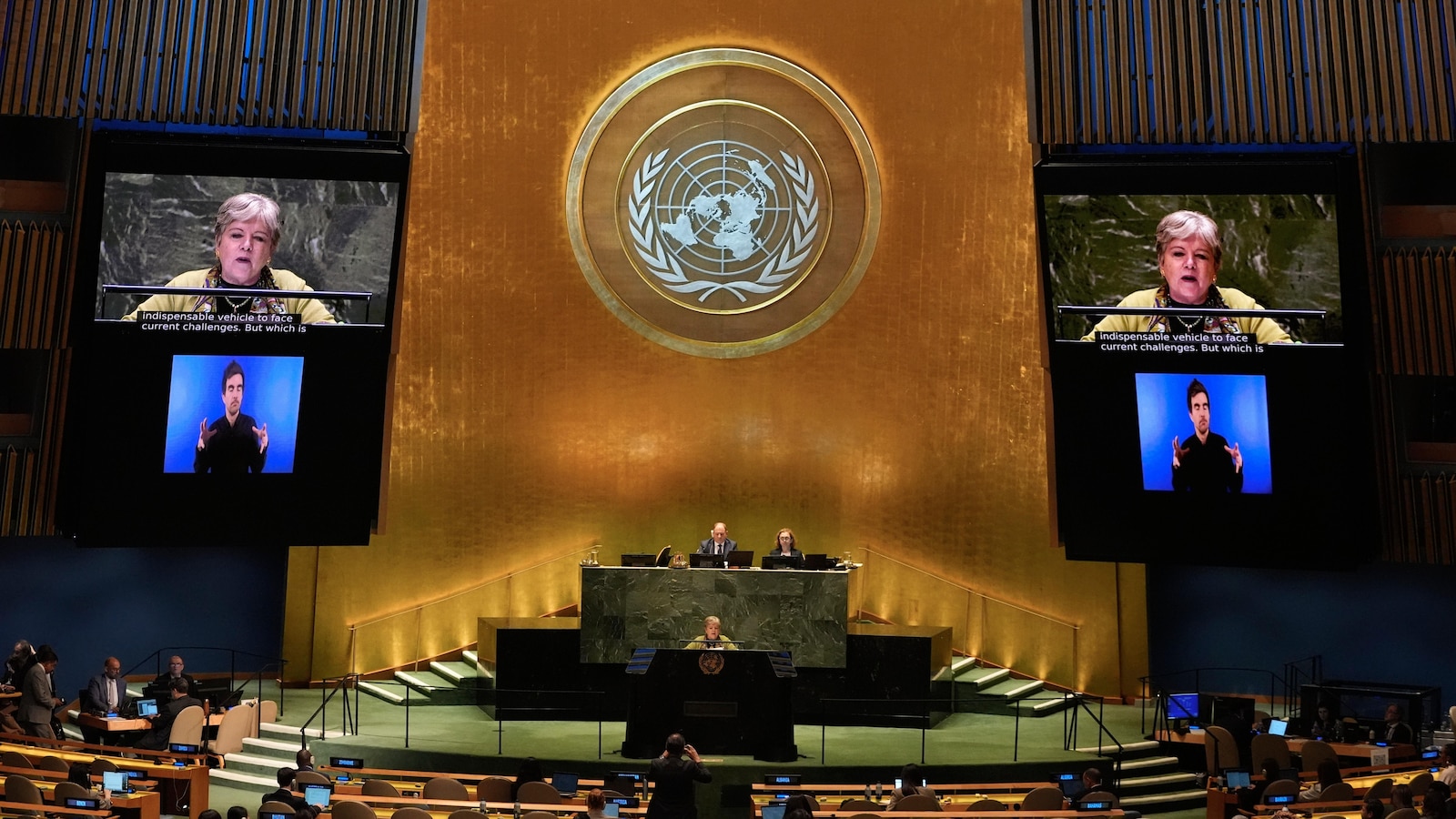
UNITED NATIONS — The U.N. General Assembly adopted a “Pact for the Future” to meet the challenges of the 21st century. Now comes the hard part: uniting the world’s divided nations to move quickly to implement its 56 actions.
U.N. Secretary-General Antonio Guterres thanked the 193-member world body for approving the pact and unlocking the door for nations to join forces to tackle challenges ranging from climate change and artificial intelligence to escalating conflicts and increasing inequality and poverty — and improve the lives of the world’s more than 8 billion people.
“We are here to bring multilateralism back from the brink,” he said. “Now it is our common destiny to walk through it. That demands not just agreement, but action.”
The 42-page pact was adopted at Sunday’s opening of a two-day “Summit of the Future,” which continues Monday. Among leaders slated to address the summit are Iran’s Masoud Pezeshkian, Ukraine’s Volodymyr Zelenskyy, U.S. Secretary of State Antony Blinken and Russian Deputy Foreign Minister Sergey Vershinin.
Whether the pact would be adopted was still a question when the assembly meeting began on Sunday. In fact, there was so much suspense that Guterres had three prepared speeches, one for approval, one for rejection, and one if things weren’t clear, U.N. spokesman Stephane Dujarric said.
Russia’s Vershinin launched the opening salvo. He proposed an amendment that would have significantly watered down the pact. “No one is happy with this pact,” he said.
It turned out he was wrong. Africa’s 54 nations opposed Russia’s amendments and speaking on their behalf, the Republic of Congo countered with a motion not to vote on the amendments. Mexico supported the Africans, and in a vote on their motion, the Africans got support from 143 countries,, with only six countries supporting Russia — Iran, Belarus, North Korea, Nicaragua, Sudan and Syria. 15 countries abstained.
Assembly President Philémon Yang then put the pact to a vote and banged his gavel, signifying the consensus of all U.N. member nations that was required for approval — to vigorous applause.
Russia has made significant inroads in Africa — in countries like Mali, Burkina Faso, Niger and Central African Republic — and the continent’s rejection of its amendments along with Mexico, a major Latin American power, was seen as a blow to Moscow by some diplomats and observers.
Guterres, clearly relieved at the outcome, then issued a challenge to the leaders: Implement the pact. Prioritize dialogue and negotiations. End “wars tearing our world apart” from the Middle East to Ukraine and Sudan. Reform the powerful U.N. Security Council. Accelerate reforms of the international financial system. Ramp up a transition from fossil fuels. Listen to young people and include them in decision-making.
The U.N.’s main bloc of developing countries — the Group of 77, which now has 134 members, including China — echoed Guterres in a speech by Ugandan Prime Minister Robinah Nabbanja.
“This pact should not become another futile exercise, but must garner political will and commitment across all levels of global leadership to pragmatically address current issues and lay a foundation for solutions for our future global progress and challenges,” he said.
Nabbanja stressed that the future should be “free from any oppression” and close widening gaps between developed and developing countries The G77 regrets that the pact doesn’t recognize actions that developed countries should take to close the gap, he said.
In a rare move at a high-level U.N. meeting where leaders often exceed the announced time limit, Yang announced at the start of their speeches that they would be muted after five minutes. Among those who kept talking after their mics were silenced: Brazilian President Luiz Inacio Lula da Silva, Kuwait’s Crown Prince Sheikh Sabah Khalid Al Sabah and Irish President Michael Higgins.
The Pact for the Future says world leaders are gathering “at a time of profound global transformation,” and it warns of “rising catastrophic and existential risks” that could tip people everywhere “into a future of persistent crisis and breakdown.”
Guterres singled out a number of key provisions in the pact and its two accompanying annexes, a Global Digital Compact and Declaration on Future Generations.
The pact commits world leaders to reform the 15-member Security Council, to make it more reflective of today’s world and “redress the historical injustice against Africa,” which has no permanent seat, and to address the under-representation of the Asia-Pacific region and Latin America.
It also “represents the first agreed multilateral support for nuclear disarmament in more than a decade,” Guterres said, and it commits “to steps to prevent an arms race in outer space and to govern the use of lethal autonomous weapons.”
The Global Digital Compact “includes the first truly universal agreement on the international governance of artificial intelligence,” the U.N. chief said.
As for human rights, Guterres said, “In the face of a surge in misogyny and a rollback of women’s reproductive rights, governments have explicitly committed to removing the legal, social and economic barriers that prevent women and girls from fulfilling their potential in every sphere.”
___
Edith M. Lederer, chief U.N. correspondent for The Associated Press, has covered foreign affairs for more than a half-century.
___
See more of AP’s coverage of the U.N. General Assembly at https://apnews.com/hub/united-nations
