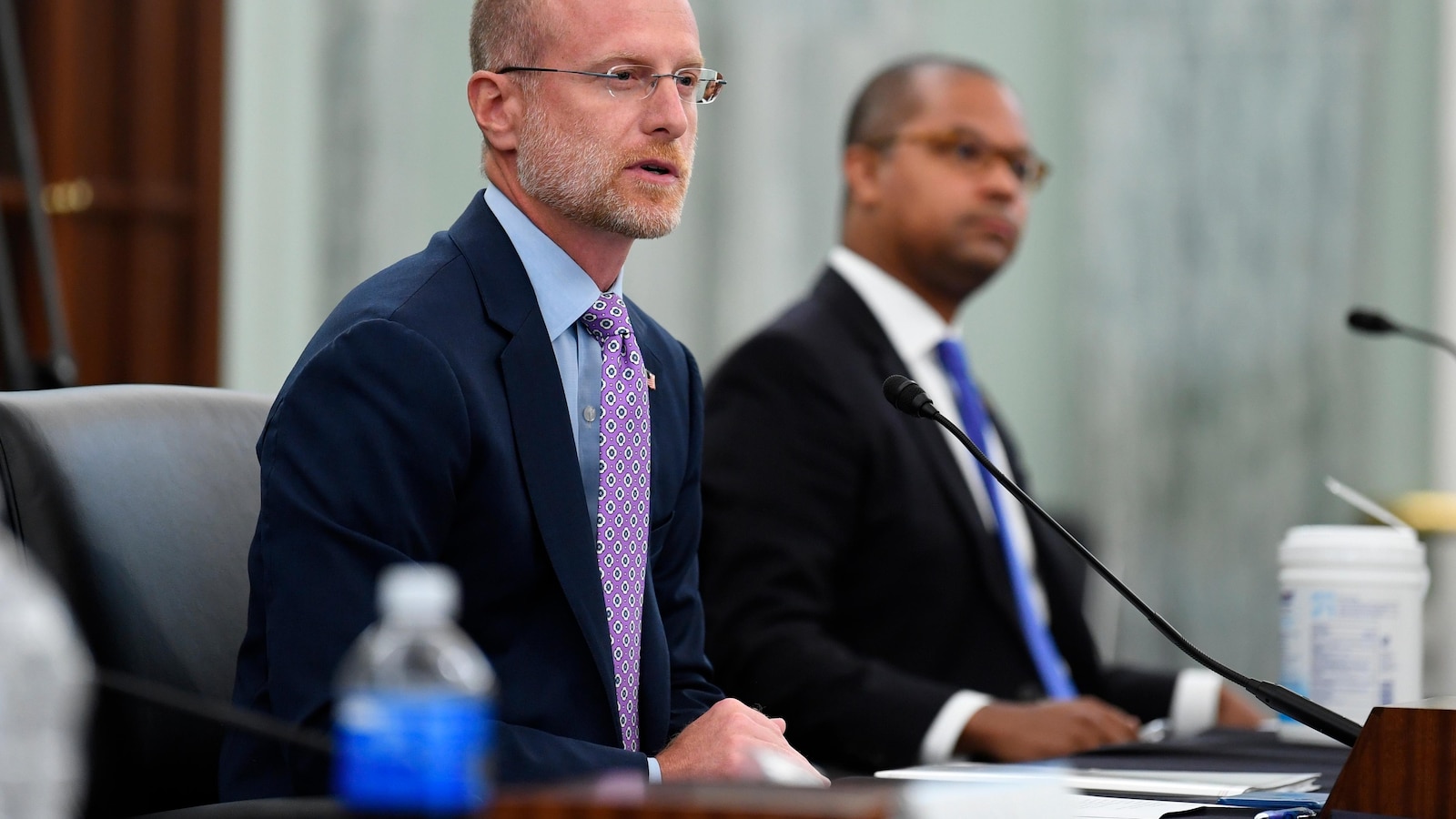
WEST PALM BEACH, Fla. — President-elect Donald Trump on Sunday named Brendan Carr, the senior Republican on the Federal Communications Commission, as the new chairman of the agency tasked with regulating broadcasting, telecommunications and broadband.
Carr is a longtime member of the commission and served previously as the FCC’s general counsel. He has been unanimously confirmed by the Senate three times and was nominated by both Trump and President Joe Biden to the commission.
The FCC is an independent agency that is overseen by Congress, but Trump has suggested he wanted to bring it under tighter White House control, in part to use the agency to punish TV networks that cover him in a way he doesn’t like.
Carr has of late embraced Trump’s ideas about social media and tech. Carr wrote a section devoted to the FCC in “ Project 2025,” a sweeping blueprint for gutting the federal workforce and dismantling federal agencies in a second Trump administration produced by the conservative Heritage Foundation.
Trump has claimed he doesn’t know anything about Project 2025, but many of its themes have aligned with his statements.
Carr said in a statement congratulating Trump on his win that he believed “the FCC will have an important role to play reining in Big Tech, ensuring that broadcasters operate in the public interest, and unleashing economic growth.”
“Commissioner Carr is a warrior for Free Speech, and has fought against the regulatory Lawfare that has stifled Americans’ Freedoms, and held back our Economy,” Trump said in a statement on Sunday. “He will end the regulatory onslaught that has been crippling America’s Job Creators and Innovators, and ensure that the FCC delivers for rural America.”
The five-person commission has a 3-2 Democratic majority until next year, when Trump gets to appoint a new member.
Also a prolific writer of op-eds, Carr wrote in an opinion piece for The Wall Street Journal last month decrying an FCC decision to revoke a federal award for Elon Musk’s satellite service, Starlink. He said the move couldn’t be explained “by any objective application of the facts, the law or sound policy.”
“In my view, it amounted to nothing more than regulatory lawfare against one of the left’s top targets: Mr. Musk,” Carr wrote.
BEIRUT — The leader of Hezbollah vowed Thursday to keep up daily strikes on Israel despite this week’s deadly sabotage of its members’ communication devices, and said Israelis displaced from homes near the Lebanon border because of the fighting would not be able to return until the war in Gaza ends.
Hezbollah and Israel launched fresh attacks across the border as Hassan Nasrallah spoke for the first time since the mass bombing of devices in Lebanon and Syria that he described as a “severe blow” — and for which he promised to retaliate.
The two days of attacks targeting thousands of Hezbollah pagers and walkie-talkies have been widely blamed on Israel, heightening fears that 11 months of near-daily exchanges of fire between Hezbollah and Israel will escalate into all-out war. Israel has neither confirmed nor denied involvement in the attacks.
During Nasrallah’s speech, Hezbollah struck at least four times in northern Israel, and two Israeli soldiers were killed in a strike earlier in the day. Israeli warplanes flew low over Beirut while Nasrallah spoke and broke the sound barrier, scattering birds and prompting people in houses and offices to quickly open windows to prevent them from shattering.
Israel also launched attacks in southern Lebanon on Thursday, saying it struck hundreds of rocket launchers and other Hezbollah infrastructure, though it was not immediately clear if there were any casualties. The army claimed the launchers were about to be used “in the immediate future.”
At the same time, the army ordered residents in parts of the Golan Heights and northern Israel to avoid public gatherings, minimize movements and stay close to shelters in anticipation of possible rocket fire.
In recent weeks, Israeli leaders have stepped-up warnings of a potential larger military operation against Hezbollah, saying they are determined to stop the group’s fire to allow tens of thousands of Israelis to return to homes near the border.
In a Thursday briefing, the Israeli defense minister said Hezbollah would “pay an increasing price” as Israel seeks to make conditions near its border with Lebanon safe enough for residents to return.
“The sequence of our military actions will continue,” he said.
The attack on electronic devices appeared to be the culmination of a monthslong operation by Israel to target as many Hezbollah members as possible all at once — but civilians were also hit. At least 37 people were killed, including two children, and some 3,000 wounded in the explosions Tuesday and Wednesday.
Nasrallah said the group is investigating how the bombings were carried out.
“Yes, we were subjected to a huge and severe blow,” he said. “The enemy crossed all boundaries and red lines,” he said. Pointing to the number of pagers and walkie-talkies, he accused Israel of intending to kill thousands of people at one time. “The enemy will face a severe and fair punishment from where they expect and don’t expect.”
He said Hezbollah will continue its barrages into northern Israel as long as the war in Gaza continues, vowing that Israel will not be able to bring its people back to the border region. “The only way is stop the aggression on the people of Gaza and the West Bank,” he said. “Neither strikes, nor assassinations nor an all-out war will achieve that.”
Earlier Thursday, Hezbollah said it had targeted three Israeli military positions near the border, two of them with drones. Israeli hospitals reported eight people lightly or moderately injured.
Hezbollah says its near daily fire is a show of support for Hamas. Israel’s 11-month-old war with Hamas in Gaza began after its militants led the Oct. 7 attack on Israel.
Israel has responded to Hezbollah’s attacks with strikes in southern Lebanon, and has struck senior figures from the group in the capital Beirut. The exchanges have killed hundreds in Lebanon and dozens in Israel and forced the evacuation of tens of thousands of residents on each side of the border.
Israel and Hezbollah have repeatedly pulled back from an all-out war under heavy pressure from the United States, France and other countries.
But in their recent warnings, Israeli leaders have said they are determined to change the status quo dramatically.
Speaking to Israeli troops on Wednesday, Gallant said, “We are at the start of a new phase in the war — it requires courage, determination and perseverance.” He made no mention of the exploding devices but praised the work of Israel’s army and security agencies, saying “the results are very impressive.”
He said that after months of fighting Hamas in Gaza, “the center of gravity is shifting to the north by diverting resources and forces.”
Israel began moving more troops to its border with Lebanon on Wednesday as a precautionary measure, Israeli officials said. Israel’s army chief, Lt. Gen. Herzi Halevi, said plans have been drawn up for additional action against Hezbollah, though media reported the government has not yet decided whether to launch a major offensive in Lebanon.
Lebanon is still reeling from the deadly device attacks of Tuesday and Wednesday.
The explosions have rattled anxious Lebanese fearing a full-scale war. The Lebanese Army said it has been locating and detonating suspicious pagers and communication devices, while the country’s civil aviation authorities banned pagers and walkie-talkies on all airplanes departing from Beirut’s international airport until further notice.
The attack was likely to severely disrupt Hezbollah’s internal communication as it scrambles to determine safe means to talk to each other. Hezbollah announced the death of five combatants Thursday, but didn’t specify if they were killed in the explosions or on the front lines.
The blasts went off wherever the holders of the pagers or walkie-talkies happened to be in multiple parts of Beirut and eastern and southern Lebanon — in homes and cars, grocery stores and cafes and on the street, even at a funeral for some killed in the bombings, often with family and other bystanders nearby.
Many suffered gaping wounds on their legs, abdomens and faces or were maimed in the hand. Tuesday’s pager blasts killed 12 people, including two children, and wounded some 2,300 others. The following day’s explosion killed 25 and wounded more than 600, Health Minister Firas Abiad said, giving updated figures.
Abiad told reporters that Wednesday’s injuries were more severe than the previous day as walkie-talkies that exploded were bigger than the pagers. He praised Lebanon’s hospitals, saying they had managed to deal with the flood of wounded within hours. “It was an indiscriminate attack. It was a war crime,” he said.
Equity LifeStyle Properties, Inc. (NYSE:ELS), founded in 1969, incorporated in 1992, and headquartered in Chicago, IL, primarily owns and manages manufactured home (MH) and recreational vehicle (RV) communities.
The position of this REIT seems to be very attractive and the niche market in which it operates beckons me to be exposed to it. Equity Lifestyle also has enjoyed tremendous growth throughout the years, with general rent growth fueling the most recent results. Despite its well-diversified portfolio, performance, and very strong liquidity, I think that the best course of action for potential shareholders is to add ELS to a watchlist and wait for a better price level because the current one creates a significant risk going forward.
Portfolio and Outlook
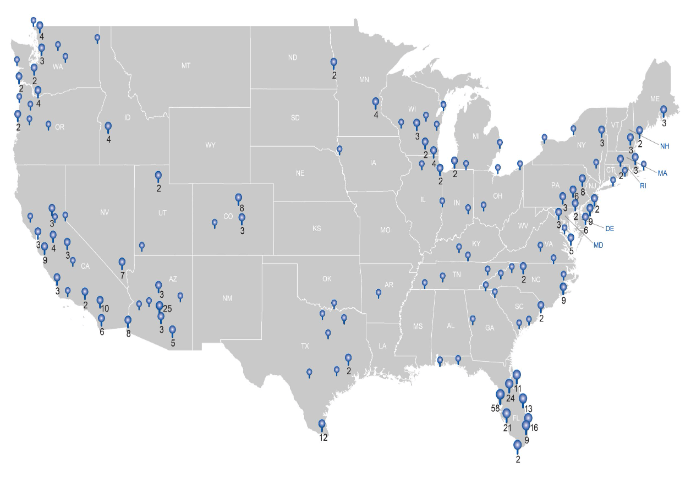
The REIT’s portfolio consists of 451 properties that aggregate 17,2465 sites and are spread across 35 states.
10-K
Equity Lifestyle differs from single-family and multifamily REITs in that it leases the land to which tenants move their manufactured homes, RVs, or boats. The REIT provides value to an underserved segment since it’s generally cheaper to build MHs or buy RVs and lease the land you move them to instead of buying single-family homes. For this reason, it can be seen as competing with the housing market and single-family rental market, as it’s a cheaper alternative to both. However, the portfolio is mostly located in vacation destinations, so it mostly attracts retirees and vacationing families. The elderly population and longer-staying traveller focus is also indicated by the inclusion of clubhouses in many of the properties that offer various recreation and social activity amenities.
As far as permanent residents are concerned, the high cost of moving the property elsewhere provides Equity Lifestyle with a mostly stable revenue source. It would also be a mistake to think that because it also attracts residents who are on vacation for longer than usual, it’s close to lodging REITs as 90% of the company’s revenue comes from annual leases.
Performance
Using the price performance as an indicator of operating in markets with adequate expansion opportunities and successful capital deployment to take advantage of such opportunities, it’s safe to say that Equity Lifestyle is the best REIT in its sub-sector. It has been outperforming its peers for the past two decades by a great margin:
However, using its total returns as a measure of value delivery, its performance is as good as Sun Communities’ (SUI), while still outperforming UMH Properties’ (UMH) by a large margin:
Regardless, its long-term performance is still exceptionally good, and it has also been beating the real estate equity market and broader U.S. market for a long time:
Although its pace of revenue growth doesn’t provide a likely explanation for its peer-relative outperformance, its FFO growth does as its FFO per share hasn’t only tripled in the long run, but the growth was relatively less volatile:
More recent results support the bullish case for this REIT as in 2023 ELS’ monthly base rental income per site in its core portfolio increased by 7% YoY and its occupancy rate only decreased by 20 bps to 94.9%. Although its last quarterly results indicate a deceleration in the rent growth as the rental rate’s YoY change was 5.96%, that’s still persistently high. Also, the average occupancy for the core portfolio was 94.9% in the last quarter, 10 bps higher than the same period a year ago and unchanged since the 2023 year-end.
Cash NOI for the year 2023 after excluding gains/losses from the sale of properties and other income was 5.31% higher than it was the year before, and normalized FFO per share increased by 4.7% YoY. Predictably, NOI in 2Q24 was 4.85% higher YoY and normalized FFO increased by 2.9%; the slower pace being consistent with decelerating rent growth.
That being said, during the last earnings call, management guided higher by raising its projections for normalized FFO to $2.91 at the midpoint. For comparison, normalized FFO per share was $2.75 in 2023.
Leverage & Liquidity
Equity Lifestyle is financing 61.49% of its assets with debt consisting of mortgage notes, term loans, and an unsecured line of credit. Its Debt to EBITDAre ratio is 5.37x and interest coverage is 4.49x (the weighted average interest rate is 3.7%), indicating more than adequate liquidity.
Its strong solvency profile is also reflected in the fact that its available liquidity is about 15% of total debt. Moreover, there are no maturities in 2024 and the following years up to 2033 don’t involve amounts coming due that are more than 10% of total debt. For these reasons, I believe that shareholders are not exposed to a lot of solvency risk here.
Dividend & Valuation
ELS currently pays a quarterly dividend of $0.48 per share, suggesting a yield of 2.67%. With a payout ratio of 65.97% and a dividend growth rate of 12.40% in the last 10 years, I see the dividend profile here as appropriate for conservative income portfolios.
Regardless, the dividend yield is way too low for a REIT and growth prospects shouldn’t outweigh this fact. For the risk you take as far as common shares are concerned, you should demand something better than 2.67%. At the same time, it’s reflective of how overvalued the REIT is; for comparison, the sector median yield is 4.33%. The normalized FFO yield of ELS is also 4.05%, indicating no justified potential outperformance in the near term.
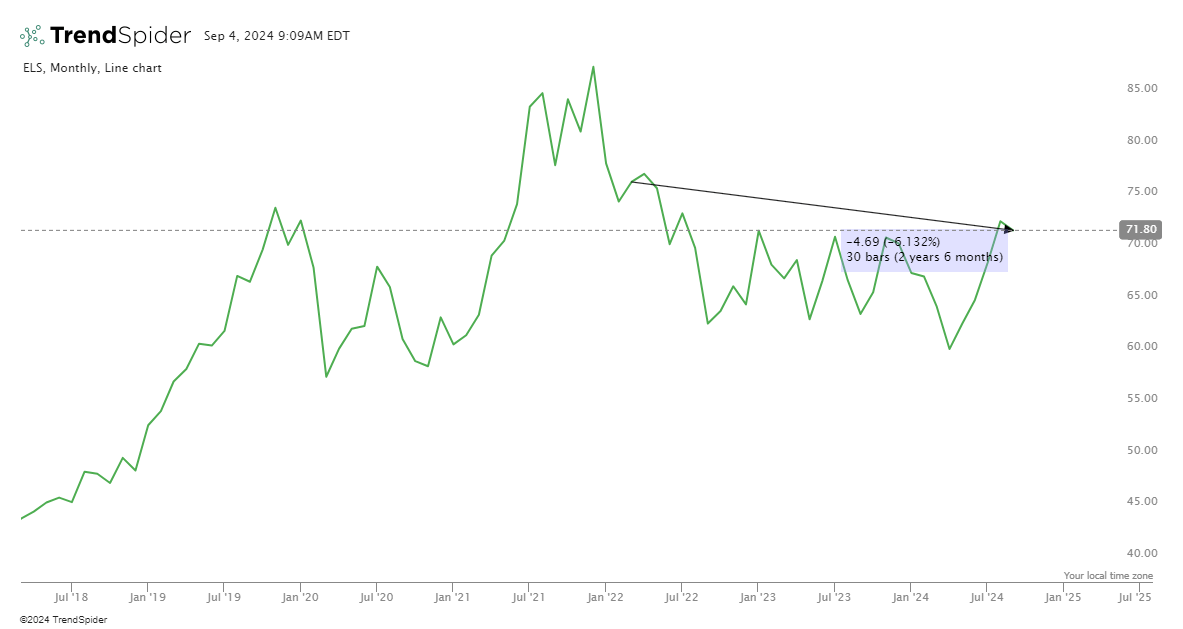
Unsurprisingly, ELS wasn’t punished as much by the market after interest rates started climbing in 2022 as other REITs were, and that explains the current valuation:
TrendSpider
Among its peers, the share price is also quite high on an FFO per-share basis, having the highest FFO multiple.
Stock
P/FFO
ELS
24.71
SUI
19.03
UMH
20.75
Average
19.89
Risks
So, the most significant risk comes from overvaluation and decelerating rent growth. If interest rates are decreased, the demand for renting could soften and the growth that the market probably expects may not continue. A lower price is possible, but just the scenario that it stays more or less flat for a prolonged period is enough to make ELS unattractive, as shareholders would incur an opportunity cost.
It certainly doesn’t help that the dividend yield is so low, which will likely not be enough to offset such a cost.
There is also the risk that interest rates are going to remain that high for longer than the market anticipates, in which case, the price could face more pressure in the short term.
Verdict
As I see it, there is no strong bullish case for ELS right now, so I am rating it a hold. But because it has a solid track record of growth, strong liquidity, and an attractive portfolio in a niche market, I would rethink my position if it ever drops to a more attractive level as compared to its peers, potentially resulting in a more attractive dividend yield (4-5%).
What do you think? Do you own this stock or do you favor some other residential REIT? I’d love to know! Also, please leave a comment if you found this post useful; it means a lot. Thanks for reading.