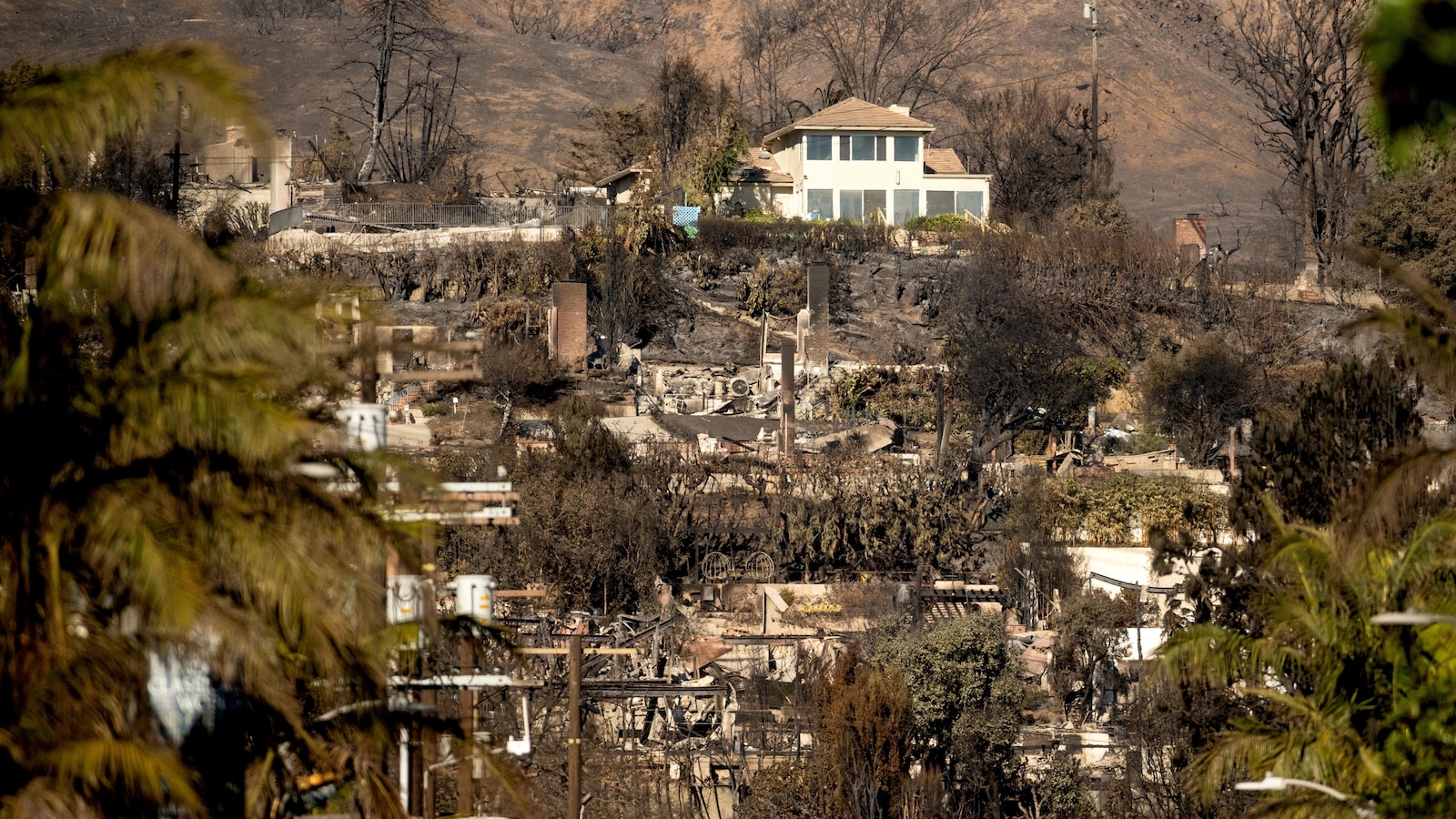
Emails and videos of burned buildings in Los Angeles next to those left standing have been flying back and forth among architects, builders and fire safety specialists around the world.
For many homeowners, like Enrique Balcazar, the sometimes scattershot nature of the carnage can seem like random chance. Balcazar, a real estate agent, posted video that showed little more than chimneys remaining of most homes on his block after fire leapt through his Altadena neighborhood. Balcazar stood on his neighbor’s destroyed classic Mustang to douse his smoldering roof, but his home was otherwise fine.
“It’s an older house and it still has the old wood sidings,” Balcazar said. “To me there’s nothing explainable in logical or scientific reason of why my house would not have burned.”
Many experts say luck does play a part. After all, wind can shift 180 degrees in a split second, pushing fire away from your house and towards a neighbor’s. But they also say there are many ways that homes can be made less vulnerable to fire.
“Because there are, say, 50 ways a fire can burn your house,” said Greg Faulkner of Faulkner Architects in California, who has focused on less combustible home exteriors for more than a decade. “If you eliminate half of those, or three-quarters of them, that’s not luck, that’s increasing your odds.”
People in fire country generally know that trees, landscaping and wood fences near homes can be a fire risk. Architects and contractors are going beyond that, using newer materials and techniques in roofing, walls and windows to keep buildings standing. The measures do add cost to the homes — around 3% to 6%, Faulkner said, or as much as 10% for the most robust protection.
Many of these experts no longer use wood siding. Where it is used, or still allowed, it needs to have a fire-resistant barrier underneath, often made of gypsum, the same material used to make drywall. That way if the wood catches fire, it takes longer for the heat to reach inside the home
But even with that, you’re still putting a combustible material on the building, said Richard Schuh, with Nielsen : Schuh Architects. “So that would be something we would avoid. Use of fire-resistant materials is critical.”
Stucco, a cement material, is a common exterior for Southern California houses and it’s fire-resistant. Reviewing AP photographs showing buildings still standing, Arnold Tarling, who has four decades experience in fire protection and building inspection in Britain, said houses with stucco walls appeared to survive the Los Angeles fires better. Yet if more of them had had a layer of gypsum beneath the stucco, it would have given more protection from the heat, he said.
Windows are a huge factor in whether a home burns down, because so much heat is transmitted through them. Double-pane windows significantly slow heat coming from the burning building next door.
“The outside layer protects the inside layer until it fails,” said Schuh. Codes in many places require one of the two panes to be tempered, which is much more resistant to heat than conventional glass, he said.
Tarling noted one intact Malibu beachfront home, surrounded by gutted buildings. He speculated that the fact that no windows faced a neighbor helped protect it because radiated heat couldn’t penetrate as easily.
In his buildings, Faulkner builds in fire shutters that can slide closed and cover the windows.
Then there’s the roof — a convenient landing pad for fire embers.
Simpler roof lines can allow red-hot embers to slide off. Spanish Mission, for example, is an iconic Los Angeles style — part of what says “Hollywood” in movies about the city, for example, as well as a reminder of its Mexican and Spanish history. That style doesn’t always have simple roof lines — the knee walls that are common on Mission-style roofs create corners.
“The embers could, just like snow, gather in that corner,” Faulkner said.
Many roofs in the U.S. are covered in asphalt. Areas that are designated as wildfire-prone in California – an ever-growing area – are required to use roofing that delays the transfer of heat to the inside of the building, called one-hour or Class A.
Still, asphalt is a petroleum product. Some building professionals prefer metal, which doesn’t burn. Metal has its own downside, though: It conducts heat. Putting a layer of gypsum under a metal roof is becoming a common practice in some areas.
Maybe as important as which material is used on a roof is whether the roof offers fire a way to get in. Here, as in so many tradeoffs, one effort to do good conflicts with another: Contractors have been more careful over the years to make sure moisture doesn’t build up in attics by making sure air circulates, using those vents that are visible on many roofs or under eaves.
But in a powerful fire, Schuh says, “if you’re on the side where the wind is putting pressure against the house, it’s also blowing the flames into the house like a blow torch,” and fire gets in through the vents.
On the other side of the house, it can create a vacuum, several experts said, sucking fire in.
But you can’t easily just eliminate roof ventilation because it will cause moisture problems, said Cesar Martin Gomez, an architect at the University of Navarra, Spain, who’s worked for 25 years in building services.
Faulkner said in some buildings he’s eliminating the need for ventilation in the roof structure by sealing the spaces. Schuh is using a cover on roof vents that can actually respond to fire with a mesh that closes.
Martin Gomez noted that in some parts of Australia, new homes are required to have water tanks. “If each home has the ability to protect itself, fire won’t be able to spread as much,” he said.
And some homes in the U.S. are now built with sprinkler systems for the outside of the house, not just the inside. It sprays water with a soapy solution to make it flow over the surface of the building, Schuh said.
“You’re adding one more layer of protection to your building, and that’s more of a priority now than ever because your insurance company may or not be around for you,” he said.
___
The Associated Press’ climate and environmental coverage receives financial support from multiple private foundations. AP is solely responsible for all content. Find AP’s standards for working with philanthropies, a list of supporters and funded coverage areas at AP.org.
