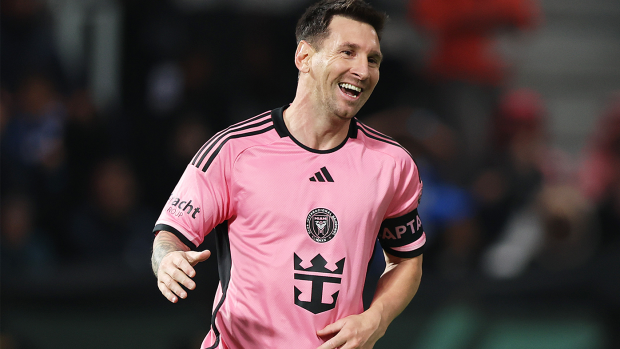
Inter Miami forward Lionel Messi against Orlando City in the MLS on March 2, in Fort Lauderdale, Fla.Rebecca Blackwell/The Associated Press
When Lionel Messi first arrived in the United States, he didn’t bother to introduce himself. Instead, he just started playing.
This was July, 2023. The Major League Soccer season was already half over. The team Messi joined – Inter Miami – was the worst in the league.
This is sports. You’d figure some encouraging words were required. No need for promises, but lie to people a little. Tell them there’s hope. Nope. None of that.
Messi finally got around to making public remarks in the middle of August. He said little on the topic of the MLS, and a lot about how much fun it was to be a retiree.
“I’m enjoying this new stage of my career,” Messi said. “I’m enjoying the experience of living in this country.”
It has continued in this way for all the time Messi has been in North America. He plays when and where he likes. Some of Messi’s dislikes – artificial surfaces, cold and long flights. He has become sports’ first remote worker.
They built the whole team to his preference, from the manager to the roster. Inter Miami is Messi’s personal startup, but it hasn’t worked out.
On Saturday, the L.A. Galaxy won the MLS Cup. Messi and Miami had already been home for a month after losing in the first round of the playoffs.
To recap – you hired a guy at massive expense. You renovated the team for him. That team hasn’t won anything that matters. Now you have to remake the team again (it has already selected another old pal of Messi’s as the new coach), but people are still worried that the headliner might jump ship.
By the ancient standards of sports, this is a bust.
Except, in this case, it isn’t. Messi has taken the old order of the sports business – win first; headlines after – and inverted it.
He is a story everywhere he goes, as well as everywhere he doesn’t. More so in the latter case, as Vancouver proved earlier this year. He’s not an athlete. He’s a pop star who can’t sing.
As a result, MLS attendance is through the roof. The league is still second-rate in most people’s minds, but Messi isn’t. You can’t go anywhere without spotting a kid in one of those hot-pink Miami No. 10 jerseys. The right guy plus the right look equals a marketing miracle.
Wherever Messi goes, the result is immaterial. The purpose of Messi’s presence is to create a happening, something that people will pay enormous amounts of money to say they were at.
Attention no longer follows success. It follows hype.
You still need success to create hype, but the system is adapting. We now know what the best players are doing in high school. Grade school, even.
The American sports industrial complex got smart and conned colleges into paying their players. Now that they are a de facto minor league, they do the dirty work of letting people know who’s a winner and who isn’t. ‘Winning’ in this case is not a matter of victories versus losses, but monies earned from marketing and image rights. The market now tells us what a champion looks like (championships optional).
By the time the student-athlete arrives at the pros, their legend can be fully formed. Caitlin Clark is the most shining recent example. Her teams haven’t won anything, but you know who she is.
Twelve women did win a WNBA championship this year. Can you name two of them? Okay, one? Or maybe just the team?
If you’re the WNBA, what’s the lesson here? Do you want winners, or do you want stars? Because the latter no longer need be the former and – this is the important part – being the former is no longer a guarantee of the latter.
This is the result of so much sports. Too many winners, making it impossible to convince people they should all matter. What people react to now is a hard-to-predict mix of talent, memeability, back story, personality and aesthetics.
By 2026, Toronto will have seven major-league clubs. That’s too many teams for most people with actual lives to keep track of, never mind follow closely.
This doesn’t begin to take into account all the foreign teams that occupy the average sports fan’s mental real estate, plus a bunch of annual tournaments, plus an Olympics every two years.
In that blizzard of elite performers – and we are beginning to stretch the meaning of ‘elite’ – many winners will not penetrate the public consciousness. But a star – a needs-a-police-escort-to-get-to-the-airport level star – has a shot.
Messi is that sort. His boss, Inter Miami part owner David Beckham, is another. Beckham hasn’t hoofed a ball in anger in more than a decade and people still want to know what he’s up to. They watch his shows and buy the junk he’s shilling. Unlike most pro athletes, he earns back the money people pay him. And this is a guy who was more famous for losing than winning.
The average role player on an average sports team could be replaced by an inflatable doll and most people wouldn’t notice. His job is to deflect interest and make five-million bucks a year.
Beckham is worth infinity glue guys. Messi is worth a hundred Beckhams. The two of them together are changing the rules.
The goal of any aspirational sports league is no longer to put a superior product on the field and to ensure that its best performers succeed. It’s to either create a Messi or steal him from someone else. Whether he then goes on to win anything is beside the point.