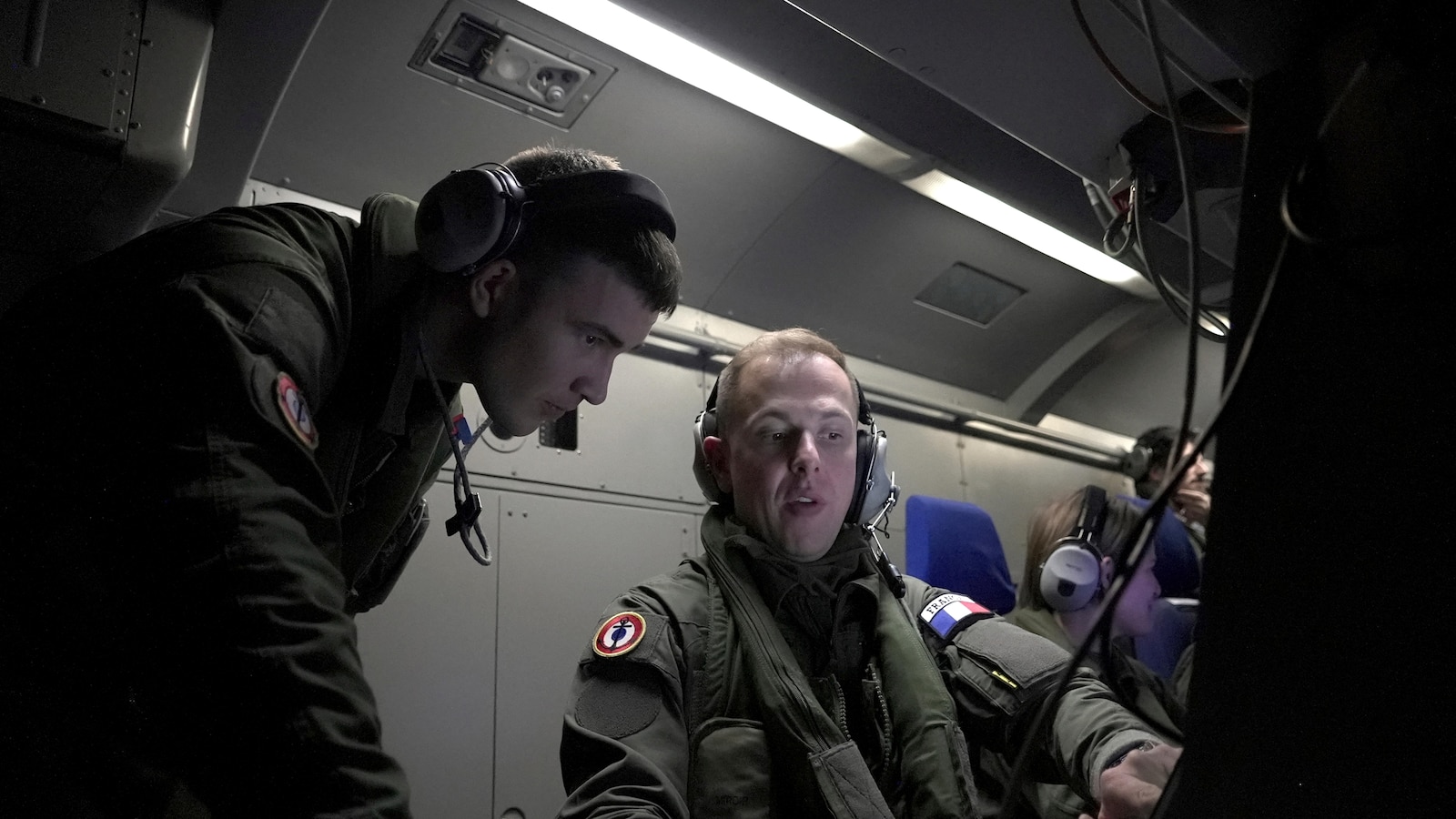
ABOARD A FRENCH NAVY FLIGHT OVER THE BALTIC SEA — With its powerful camera, the French Navy surveillance plane scouring the Baltic Sea zoomed in on a cargo ship plowing the waters below — closer, closer and closer still until the camera operator could make out details on the vessel’s front deck and smoke pouring from its chimney.
The long-range Atlantique 2 aircraft on a new mission for NATO then shifted its high-tech gaze onto another target, and another after that until, after more than five hours on patrol, the plane’s array of sensors had scoped out the bulk of the Baltic — from Germany in the west to Estonia in the northeast, bordering Russia.
The flight’s mere presence in the skies above the strategic sea last week, combined with military ships patrolling on the waters, also sent an unmistakable message: The NATO alliance is ratcheting up its guard against suspected attempts to sabotage underwater energy and data cables and pipelines that crisscross the Baltic, prompted by a growing catalogue of incidents that have damaged them.
“We will do everything in our power to make sure that we fight back, that we are able to see what is happening and then take the next steps to make sure that it doesn’t happen again. And our adversaries should know this,” NATO Secretary-General Mark Rutte said this month in announcing a new alliance mission, dubbed “Baltic Sentry,” to protect the underwater infrastructure vital to the economic well-being of Baltic-region nations.
Power and communications cables and gas pipelines stitch together the nine countries with shores on the Baltic, a relatively shallow and nearly landlocked sea. A few examples are the 152-kilometer (94-mile) Balticconnector pipeline that carries gas between Finland and Estonia, the high-voltage Baltic Cable connecting the power grids of Sweden and Germany, and the 1,173-kilometer (729-mile) C-Lion1 telecommunications cable between Finland and Germany.
Undersea pipes and cables help power economies, keep houses warm and connect billions of people. More than 1.3 million kilometers (807,800 miles) of fiber optic cables — more than enough to stretch to the moon and back — span the world’s oceans and seas, according to TeleGeography, which tracks and maps the vital communication networks. The cables are typically the width of a garden hose. But 97% of the world’s communications, including trillions of dollars of financial transactions, pass through them each day.
“In the last two months alone, we have seen damage to a cable connecting Lithuania and Sweden, another connecting Germany and Finland, and most recently, a number of cables linking Estonia and Finland. Investigations of all of these cases are still ongoing. But there is reason for grave concern,” Rutte said on Jan. 14.
At least 11 Baltic cables have been damaged since October 2023 — the most recent being a fiber optic cable connecting Latvia and the Swedish island of Gotland, reported to have ruptured on Sunday. Although cable operators note that subsea cable damage is commonplace, the frequency and concentration of incidents in the Baltic heightened suspicions that damage might have been deliberate.
There also are fears that Russia could target cables as part of a wider campaign of so-called “hybrid warfare” to destabilize European nations helping Ukraine defend itself against the full-scale invasion that Moscow has been pursuing since 2022.
Without specifically blaming Russia, Rutte said: “Hybrid means sabotage. Hybrid means cyber-attacks. Hybrid means sometimes even assassination attacks, attempts, and in this case, it means hitting on our critical undersea infrastructure.”
Finnish police suspect that the Eagle S, an oil tanker that damaged the Estlink 2 power cable and two other communications cables linking Finland and Estonia on Dec. 25th, is part of Moscow’s “shadow fleet” used to avoid war-related sanctions on Russian oil exports.
Finnish authorities seized the tanker shortly after it left a Russian port and apparently cut the cables by dragging its anchor. Finnish investigators allege the ship left an almost 100-kilometer (62-mile) long anchor trail on the seabed.
Several Western intelligence officials, speaking on condition of anonymity because of the sensitive nature of their work, told The Associated Press that recent damage was most likely accidental, seemingly caused by anchors being dragged by ships that were poorly maintained and poorly crewed.
One senior intelligence official told AP that ships’ logs and mechanical failures with ships’ anchors were among “multiple indications” pointing away from Russian sabotage. The official said Russian cables were also severed. Another Western official, also speaking anonymously to discuss intelligence matters, said Russia sent an intelligence-gathering vessel to the site of one cable rupture to investigate the damage.
The Washington Post first reported on the emerging consensus among U.S. and European security services that maritime accidents likely caused recent damage.
The European Subsea Cables Association, representing cable owners and operators, noted in November after faults were reported on two Baltic links that, on average, a subsea cable is damaged somewhere in the world every three days. In northern European waters, the main causes of damage are commercial fishing or ship anchors, it said.
In the fiber-optic cable rupture on Sunday connecting Latvia and Sweden, Swedish authorities detained a Maltese-flagged ship bound for South America with a cargo of fertilizer.
Navibulgar, a Bulgarian company that owns the Vezhen, said any damage was unintentional and that the ship’s crew discovered while navigating in extremely bad weather that its left anchor appeared to have dragged on the seabed.
The alliance is deploying warships, maritime patrol aircraft and naval drones for the mission to provide “enhanced surveillance and deterrence.”
Aboard the French Navy surveillance flight, the 14-member crew cross-checked ships they spotted from the air against lists of vessels they had been ordered to watch for.
“If we witness some suspicious activities from ships as sea – for example, ships at very low speed or at anchorage in a position that they shouldn’t be at this time – so this is something we can see,” said the flight commander, Lt. Alban, whose surname was withheld by the French military for security reasons.
“We can have a very close look with our sensors to see what is happening.”
___
Burrows reported from London. AP journalists Jill Lawless in London, David Klepper in Washington and Veselin Toshkov in Sofia, Bulgaria, contributed to this report.
