hacklink hack forum hacklink film izle hacklink marsbahisizmir escortsahabetpornJojobetcasibom girişgalabetBakırköy Escortcasibom9018betgit casinomarsbahismatbet girişcasibomlink 5k depositjojobetonwinmatbetalobet

Tag: origin

  • Jeff Bezos’ Blue Origin launches massive New Glenn rocket on first test flight

    Jeff Bezos’ Blue Origin launches massive New Glenn rocket on first test flight

    CAPE CANAVERAL, Fla. — CAPE CANAVERAL, Fla. (AP) — Blue Origin launched its massive new rocket on its first test flight Thursday, sending up a prototype satellite to orbit thousands of miles above Earth.

    Named after the first American to orbit Earth, the New Glenn rocket blasted off from Florida, soaring from the same pad used to launch NASA’s Mariner and Pioneer spacecraft a half-century ago.

    Years in the making with heavy funding by Amazon founder Jeff Bezos, the 320-foot (98-meter) rocket carried an an experimental platform designed to host satellites or release them into their proper orbits.

    For this test, the satellite was expected to remain inside the second stage while circling Earth. The mission was expected to last six hours, with the second stage then placed in a safe condition to stay in a high, out-of-the-way orbit in accordance with NASA’s practices for minimizing space junk.

    The first-stage booster aimed to land on a barge in the Atlantic minutes after liftoff so it could be recycled.

    New Glenn was supposed to fly before dawn Monday, but ice buildup in critical plumbing caused a delay. The rocket is built to haul spacecraft and eventually astronauts to orbit and also the moon.

    Founded 25 years ago by Bezos, Blue Origin has been launching paying passengers to the edge of space since 2021, including himself. The short hops from Texas use smaller rockets named after the first American in space, Alan Shepard. New Glenn, which honors John Glenn, is five times taller.

    Blue Origin poured more than $1 billion into New Glenn’s launch site, rebuilding historic Complex 36 at Cape Canaveral Space Force Station. The pad is 9 miles (14 kilometers) from the company’s control centers and rocket factory, outside the gates of NASA’s Kennedy Space Center.

    Bezos — taking part in the launch from Mission Control — declined to disclose his personal investment in the program. He said he does not see Blue Origin in a competition with Elon Musk’s SpaceX, long the rocket-launching dominator.

    Blue Origin envisions six to eight New Glenn flights this year, if everything goes well, with the next one coming up this spring.

    “There’s room for lots of winners” Bezos said from the rocket factory over the weekend, adding that this was the “very, very beginning of this new phase of the space age, where we’re all going to work together as an industry … to lower the cost of access to space.”

    New Glenn is the latest in a series of big, new rockets to launch in recent years, including United Launch Alliance’s Vulcan, Europe’s upgraded Ariane 6 and NASA’s Space Launch System or SLS, the space agency’s successor to the Saturn V for sending astronauts to the moon.

    The biggest rocket of all, at approximately 400 feet (123 meters), is SpaceX’s Starship. Elon Musk said the seventh test flight of the full rocket could occur later Thursday from Texas. He hopes to repeat what he pulled off in October, catching the returning booster at the launch pad with giant mechanical arms.

    Starship is what NASA plans to use to land astronauts on the moon later this decade. The first two moon landings under the space agency’s Artemis program, which follows the Apollo missions of the 1960s and 1970s, will see crews descending from lunar orbit to the surface in Starships.

    Blue Origin’s lander, dubbed Blue Moon, will make its debut on the third lunar touchdown by astronauts.

    NASA Administrator Bill Nelson pushed for competing moon landers similar to the strategy to hire two companies to ferry astronauts to and from the International Space Station. Nelson will step down when President-elect Donald Trump takes office on Monday.

    Trump has tapped tech billionaire Jared Isaacman to run NASA. Isaacman, who has twice rocketed into orbit on his own privately financed SpaceX flights, must be approved by the Senate.

    New Glenn’s debut was supposed to send twin spacecraft to Mars for NASA. But the space agency pulled them from last October’s planned flight when it became clear the rocket wouldn’t be ready in time. They will still fly on a New Glenn rocket, but not until spring at the earliest. The two small spacecraft, named Escapade, are meant to study the Martian atmosphere and magnetic environment while orbiting the red planet.

    ___

    The Associated Press Health and Science Department receives support from the Howard Hughes Medical Institute’s Science and Educational Media Group and the Robert Wood Johnson Foundation. The AP is solely responsible for all content.
    Source link

  • Genetic analysis of animals in Wuhan market in 2019 may help find COVID-19’s origin

    Genetic analysis of animals in Wuhan market in 2019 may help find COVID-19’s origin

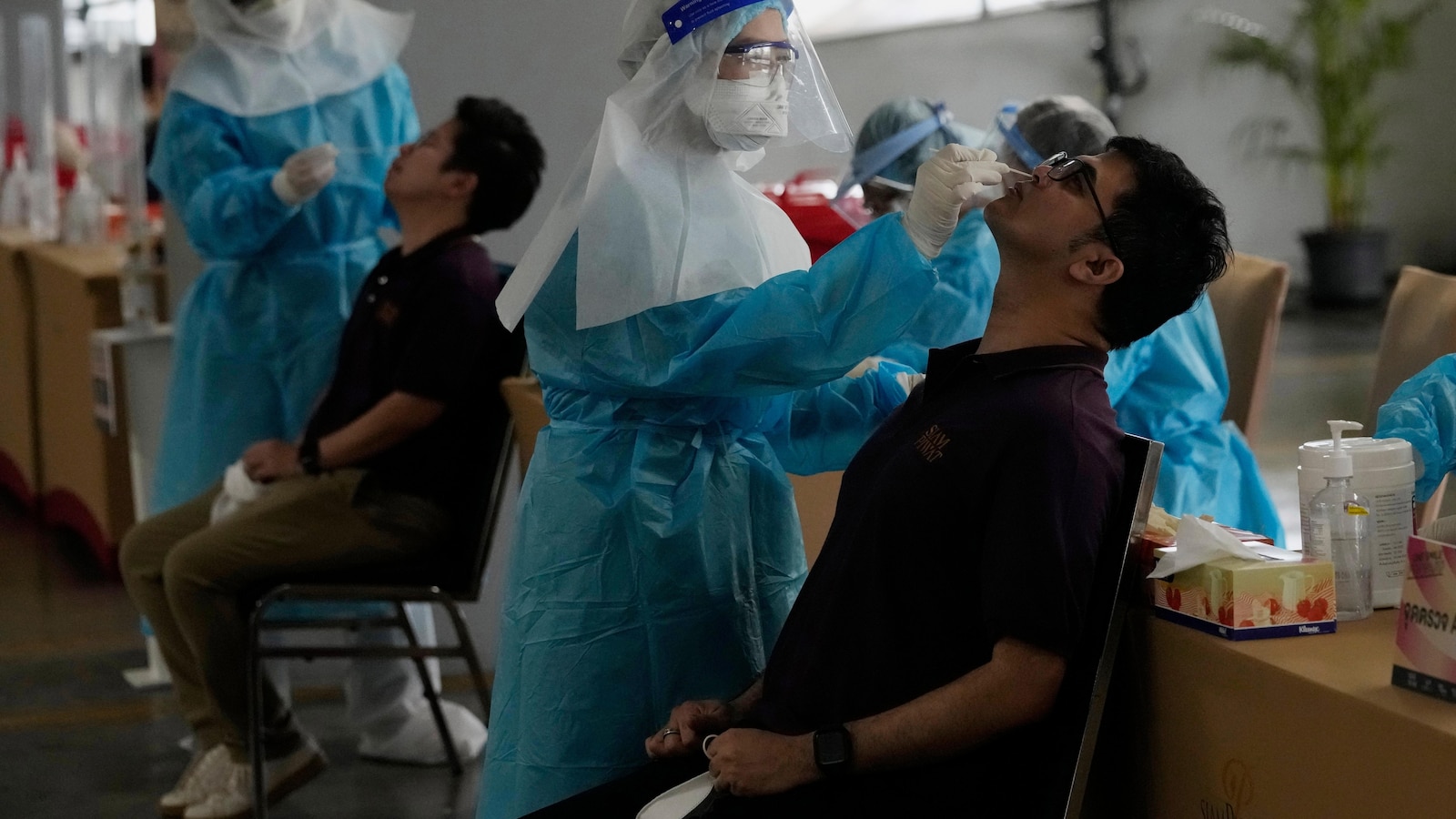
    LONDON — Scientists searching for the origins of COVID-19 have zeroed in on a short list of animals that possibly helped spread it to people, an effort they hope could allow them to trace the outbreak back to its source.

    Researchers analyzed genetic material gathered from the Chinese market where the first outbreak was detected and found that the most likely animals were racoon dogs, civet cats and bamboo rats. The scientists suspect infected animals were first brought to the Wuhan market in late November 2019, which then triggered the pandemic.

    Michael Worobey, one of the new study’s authors, said they found which sub-populations of animals might have spread the coronavirus, which may help researchers identify COVID-19’s natural reservoir.

    “For example, with the racoon dogs, we can show that the racoon dogs that were (at the market) … were from a sub-species that circulates more in southern parts of China,” said Worobey, an evolutionary biologist at the University of Arizona. Knowing that might help researchers understand where those animals came from and where they were sold. Scientists might then start sampling bats in the area, which are known to be the natural reservoirs of related coronaviruses like SARS.

    While the research bolsters the case that COVID-19 emerged from animals, it does not resolve the polarized and political debate over whether the virus instead emerged from a research lab in China.

    Mark Woolhouse, a professor of infectious diseases at the University of Edinburgh, said the new genetic analysis suggested that the pandemic “had its evolutionary roots in the market” and that it was very unlikely COVID-19 was infecting people before it was identified at the Huanan market.

    “It’s a significant finding and this does shift the dial more in favor of an animal origin,” Woolhouse, who was not connected to the research, said. “But it is not conclusive.”

    An expert group led by the World Health Organization concluded in 2021 that the virus probably spread to humans from animals and that a lab leak was “extremely unlikely.” WHO chief Tedros Adhanom Ghebreyesus later said it was “premature” to rule out a lab leak.

    An AP investigation in April found the search for the COVID origins in China has gone dark after political infighting and missed opportunities by local and global health officials to narrow the possibilities.

    Scientists say they may never know for sure where exactly the virus came from.

    In the new study, published Thursday in the journal Cell, scientists from Europe, the U.S. and Australia analyzed data previously released by experts at the Chinese Center for Disease Control and Prevention. It included 800 samples of genetic material Chinese workers collected on Jan. 1, 2020 from the Huanan seafood market, the day after Wuhan municipal authorities first raised the alarm about an unknown respiratory virus.

    Chinese scientists published the genetic sequences they found last year, but did not identify any of the animals possibly infected with the coronavirus. In the new analysis, researchers used a technique that can identify specific organisms from any mixture of genetic material collected in the environment.

    Worobey said the information provides “a snapshot of what was (at the market) before the pandemic began” and that genetic analyses like theirs “helps to fill in the blanks of how the virus might have first started spreading.”

    Woolhouse said the new study, while significant, left some critical issues unanswered.

    “There is no question COVID was circulating at that market, which was full of animals,” he said. “The question that still remains is how it got there in the first place.”

    ___

    The Associated Press Health and Science Department receives support from the Howard Hughes Medical Institute’s Science and Educational Media Group. The AP is solely responsible for all content.

    Source link