WASHINGTON — For the millions of Americans on the radar of the Kamala Harris and Donald Trump campaigns and those of their allies, the apocalypse is only a text message away.
The very future of the republic is at stake, some of the texts say and many others imply. But you — yes, YOU, Sally, Jose or insert-your-first-name here — can save it. For as little as $7.
Texting is a cheap and easy way to reach potential voters and donors, without all the rules meant to keep traditional paid broadcast advertising a bit honest. Both sides are working the texting pipeline aggressively. In the last days of the campaign, the pinging of phones can be relentless.
“All day, every day,” Robyn Beyah said of the torrent as she stood in line to get into a Kamala Harris rally outside Atlanta last week. “They have my number. We’re practically besties.”
Beyah is cool with that. She considers the text bombing “harmless” because it’s for a candidate she believes in. She even invites the Harris campaign to “harass me with text messages.” Not all voters are so charitable.
“To be honest with you, at this point, I’ve tuned it out of my brain,” said Ebenezer Eyasu of Stone Mountain, Georgia, standing in the same Harris rally line. He said the dozen or so texts he gets each day have become “background noise.”
Sarah Wiggins, a 26-year-old graphic designer from Kennesaw, Georgia, who supports Harris, prefers face to face persuasion. “I feel like it’s all about people around you,” she said. “Word of mouth is underrated.” As for the texts, “I just delete, to be honest. I don’t want to read it.”
Many Trump supporters also get pestered. Several at his rally in Tempe, Arizona, last week professed low-grade aggravation about that.
“They’re more of an annoyance than anything else,” said Morse Lawrence, 57, a physician assistant from Mesa, Arizona. “I get bombarded by text messages outside of political things as well. People wanting to buy my house, people wanting to sell me insurance, it’s all of it.”
He figures it’s an effective marketing strategy for campaigns even if the great majority of recipients don’t bite. “You go fishing and you catch two fish, you’ve got a meal for the day.”
Jennifer Warnke, 57, of St. John’s, Arizona, also at the Trump rally, expressed mixed feelings about what’s happening on her phone.
“They’re at least reaching out, because for years nobody ever called me,” she said. “I’ve been a registered Republican all my life and nobody ever called.”
She added: “It’s annoying, but it’s almost over.”
Trump’s campaign, although uniquely fixated on selling hats via text, shares certain traits with the Democrats.
Both sides traffic in dire warnings should the other side win. Both cook up phony deadlines to get you to hurry up with your money. Both play on the fantasy that luminaries — whether Harris, Trump, George Clooney, Nancy Pelosi or Donald Trump Jr. — are texting you personally, instead of the machinery that really is.
Texts under the name of Trump Jr. come with a twist, if a transparent one: “Please don’t give $5 to help dad before his critical deadline. I’m serious. Don’t. … Let me explain.”
The explanation is a link to a page asking for lots more than $5. You can choose $20.24 if you are a basic Trump supporter in 2024 or $47 if you think the 45th president was the greatest ever and want to make him the 47th.
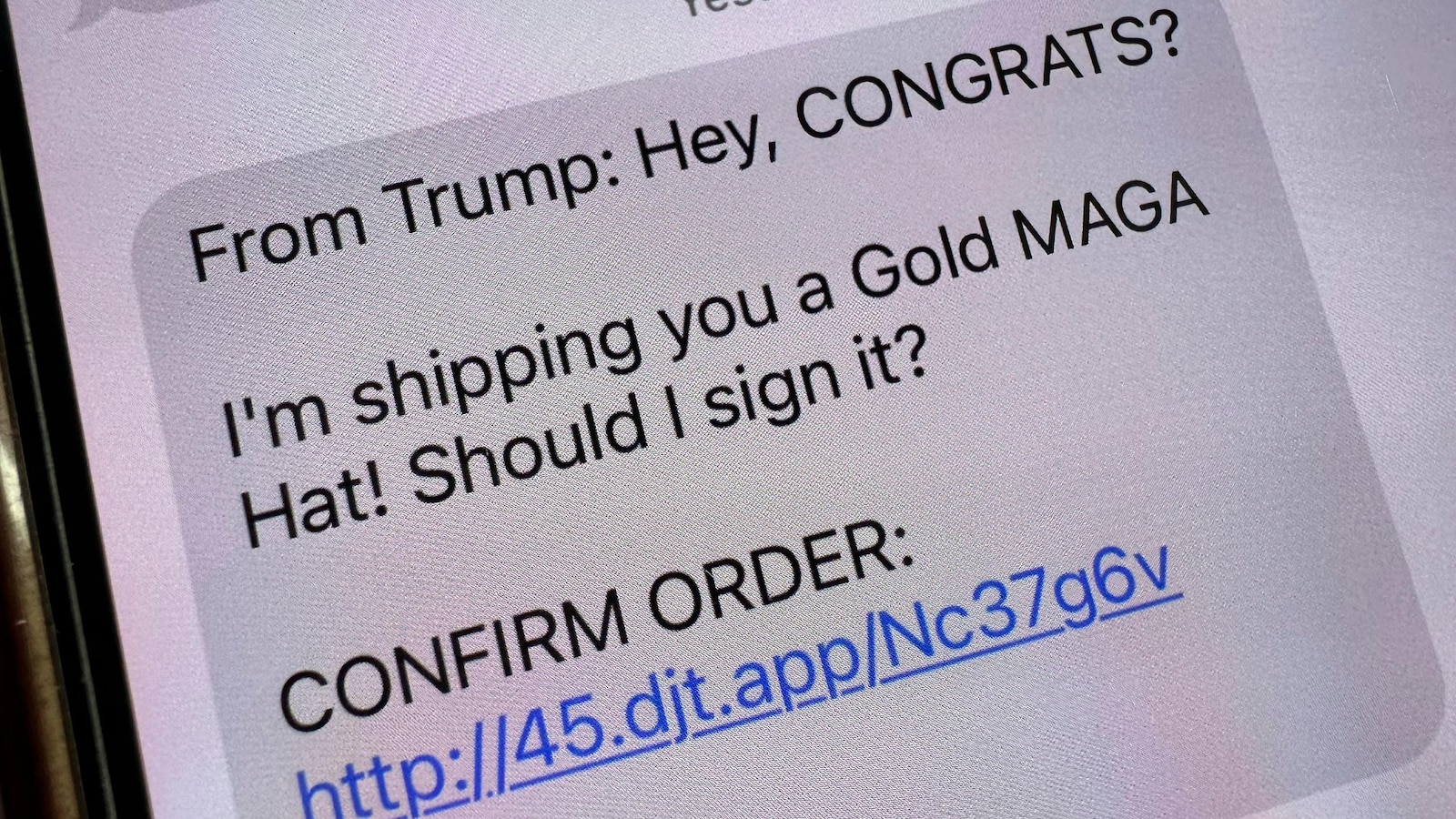
Trump himself seems to be heavily into merch. “I’m shipping you a Gold MAGA Hat!” say texts in his name. “Should I sign it?”
Tap through and you see the MAGA hat with gold lettering will cost you $50. But there’s more.
“Here’s my offer to you,” the digital Trump says. “If you place your order before the midnight deadline, I may add my signature and a quick personal note right on the brim!” May — or may not.
Thirteen days from Election Day, as she prepared to take the stage for a CNN town hall, Harris took a moment to confide in a Virginian she doesn’t know at all. At least that’s the scene sketched by a text in her name.
“Hi Chris, it’s Kamala Harris,” says the message. “It would mean the world to me if you added another donation to our campaign before my town hall on CNN tonight. Donald Trump and his allies are currently outspending us across the battleground states.”
A donation of $40 is suggested. No hat is offered. Despite the message’s angst over cash, Harris’ campaign and affiliated Democratic groups have raised over $1 billion in mere months and kept a large financial advantage over Trump in the campaign’s last leg.
Ping: “It’s Elizabeth Warren. ”
Ping: “From Trump: I JUST LEFT MCDONALD’S.”
Ping: “We’ve asked NINE TIMES if you support Kamala Harris … but you never completed the poll.”
Ping: “I just got off the debate stage.” — signed by Harris running mate, Minnesota Gov. Tim Walz.
Ping: “This is a BIG F#@%ING DEAL.” — in the name of Democratic strategist James Carville.
Ping: “It’s Nancy Pelosi. I need you to see this.”
Ping: “But you haven’t stepped up to defend our Senate majority!?! Rush $7 now.”
Ping: “I have a McGift for you! It’s President Trump. Want to take a look?”
Despite the sucker-born-every-minute undertone of some of the presidential campaign texts, experts say you can be reasonably confident that donations to the official candidate campaigns or the main party organizations will be used for your intended purpose.
But many more groups are pitching for your election-season cash, not all of them are legit and sorting that out takes work. Some voter-mobilization groups that claim to be funded by the left, for example, may be mischief-makers from the right, or just out to collect personal information on you.
This month, the League of Women Voters of Wisconsin wrote to the U.S. and state attorneys general to report that thousands of fraudulent text messages from an anonymous source were sent to young people threatening $10,000 fines or prison time if they vote in a state where they are not eligible to cast ballots.
The scam was meant to intimidate students from out of state who are legally entitled to vote in Wisconsin if they are attending college there, or to vote back at home instead, the letter said.
Last weekend, thousands of Pennsylvania voters received a text message that falsely claimed they had already voted in the election, The Philadelphia Inquirer reported Monday. It was from AllVote, which election officials have repeatedly flagged as a scam, the paper said. The group said the false claim was the result of a typo.
Experts say to read the fine print at the bottom of any fundraising link you open. It must outline the name of the group and where the money will go.
From there, people can go to sites such as OpenSecrets or the Federal Election Commission to see breakdowns of revenue and spending by groups that are registered political action committees. High overhead and low or no spending on ads or canvassing are red flags.
For all those traps, Beverly Payne of Cumming, Georgia, who has already voted for Harris and volunteers for her, welcomes the pings.
“I get texts every 30 minutes and I answer every single one of them,” Payne said. One favorite was about an ice cream flavor rolled out for Harris by Ben & Jerry’s, Kamala’s Coconut Jubilee layered with caramel and topped with red, white and blue star sprinkles. “I had to donate to that,” she said.
“It’s our culture now, we’re all addicted,” Payne said of texts and Harris’ use of them. “Maybe that’s why she has a billion dollars.”
___
Amy reported from Atlanta, Cooper from Tempe, Arizona. Associated Press writer Brian Slodysko contributed to this report.
