Vinesh Phogat was pictured with IOA president and former athlete PT Usha in what was the first photo of the wrestler after being disqualified at the Paris Olympics read more
In the aftermath, Phogat was pictured with IOA president and former athlete PT Usha in what was the first photo of the wrestler from the French capital.
“I don’t know what support I got from there. There was politics happening there. That is why I was left heartbroken. People are telling me to reverse decision on retirement but who should I do it for? Everywhere there’s politics. You are on the bed where you don’t know what is going on, going through the worst phase of your life and then there is someone who is there to take photos without permission, to post on social media and say we’re together, that’s not united,” she said in an interview.
BIG EXPOSE BY VINESH PHOGAT
When Vinesh Phogat was in the hospital after disqualification, PT Usha gone there just to click a picture with her.
PT Usha clicked a picture of Vinesh without her permission to post it on Social Media and left from there without saying anything. pic.twitter.com/53xQVwDMvu
In another part of the interview, Phogat said IOA’s support in her appeal to overturn the disqualification came later and as a third party. Instead, she had to personally file an appeal for a silver medal with the Court of Arbitration for Sport (CAS).
“Harish Salve Sir joined the case a day later. The case was filed by India or Vinesh? Vinesh. Obviously. The lawyers in Paris filed the case on my behalf. It wasn’t done by the Indian government, they were the third party. We represent our country and then the government oversees us. Why do associations and governments send athletes? So we can represent every resident at every tournament, at every location. They were looking to make media bytes,” stated the wrestler in the interview.
🚨BIG EXPOSE
I filed my case on my name. It should have been filed as a nation but the Indian government had already given up on that medal. I got zero support from the govt.
“You cannot expect positive results from Sanjay Singh,” continued Phogat on the Wrestling Federation of India (WFI) president and their claims of being in talks with United World Wrestling (UWW). “There is no doubt (about his intentions). We cannot trust him. He is a dummy candidate of Brij Bhushan Sharan Singh. WFI still runs at Brij Bhushan’s home. Anyone with the power can go check,” she added.
In a shocking turn of events, former India wrestler Vinesh Phogat has accused Indian Olympic Association (IOA) chief PT Usha of playing politics during the Paris Olympics with her situation. During her hospital stay, Usha visited her and took a photo, which was widely shared on social media. Vinesh feels this was more about show than genuine support.
Speaking to a local media channel she said, ” I am standing here, you are taking photos without telling me, you are then posting them on social media and saying that we are standing together, it doesn’t happen like this
Vinesh Phogat returned heartbroken from the Paris Olympics after being denied a medal following a failed weigh-in ahead of her gold-medal match. Vinesh weighed 100gm over her freestyle category of 50kg and was thus eliminated from the Paris Games after reaching the final. She announced her retirement post the drama
Her appeal to the Court of Arbitration for Sport for a joint silver medal was also dismissed.The drastic efforts to cut down weight ahead of her final led to dehydration, for which she had to be hospitalized. Vinesh described her experience in Paris as a politically charged situation that added to her disillusionment with the sport.
IOA support for CAS appeal was slow: Vinesh phogat
In the interview, Vinesh Phogat also revealed that the Indian Olympic Association’s (IOA) support for her appeal to reverse the disqualification was slow and came only as an afterthought. She had to take the initiative herself and personally file an appeal with the Court of Arbitration for Sport (CAS) in hopes of securing a silver medal. The IOA’s involvement, she noted, appeared to be more of a third-party gesture rather than proactive support during her critical moment.
She stated “Harish Salve Sir joined the case a day later. The case was filed by India or Vinesh? Vinesh. Obviously. The lawyers in Paris filed the case on my behalf. It wasn’t done by the Indian government, they were the third party. We represent our country and then the government oversees us. Why do associations and governments send athletes? So we can represent every resident at every tournament, at every location. They were looking to make media bytes,”
She further added, “You cannot expect positive results from Sanjay Singh,” continued Phogat on the Wrestling Federation of India (WFI) president and their claims of being in talks with United World Wrestling (UWW). “There is no doubt (about his intentions). We cannot trust him. He is a dummy candidate of Brij Bhushan Sharan Singh. WFI still runs at Brij Bhushan’s home. Anyone with the power can go check,”
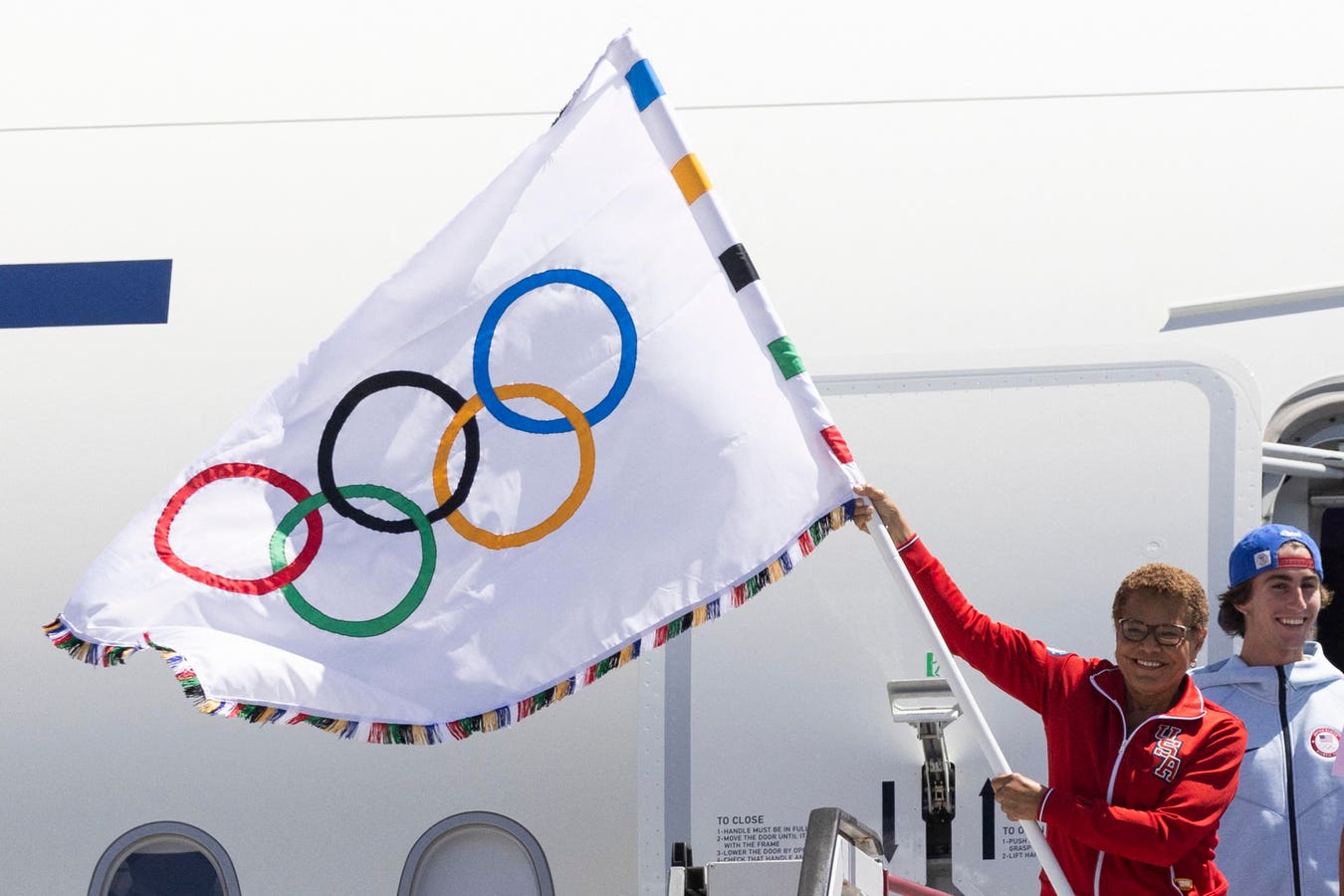
Los Angeles mayor Karen Bass (L) waves the Olympic flag next to US skateboarder Tate Carew (R) after … [+] their plane landed during an event celebrating the arrival of the Olympic flag at Los Angeles International Airport (LAX) in Los Angeles, on August 12, 2024. Los Angeles will host the 2028 Summer Olympic Games. (Photo by Etienne LAURENT / AFP) (Photo by ETIENNE LAURENT/AFP via Getty Images)
AFP via Getty Images
The Olympics, often celebrated as a forum for international cooperation and competition, have historically been a stage where the boundaries of sports and politics blur.
While many athletes focused on their performance, others used the global spotlight to make political statements, revealing the complex interplay between athletic competition and geopolitics. This dual nature of the Olympics—as both a sporting event and a political forum—has raised essential questions about the role of politics in international sports and the challenges of maintaining neutrality in a world fraught with political tension.
Historical Context and Political Undercurrents
The Olympics have long served as a platform for political expression, from Jesse Owens’ defiance of Nazi ideology in 1936 to the Black Power salute by Tommie Smith and John Carlos in 1968. These moments underscored the Olympics’ role in advocating for social justice and political change, making them more than just a showcase of athletic prowess. The recent Paris Games continued this tradition, with athletes and nations using the event to highlight political and social issues.
Taiwan’s participation at under the name “Chinese Taipei,” a designation meant to appease China, illustrated the political sensitivities involved in Olympic participation. This forced compromise required Taiwanese athletes to navigate a complex landscape where national identity and political recognition often conflicted. The New York Timesreported, “To be an Olympian from Taiwan is to not exist, at least not officially. To placate China, the island competes at the Games under the awkward designation of Chinese Taipei.” This statement reflected the broader political struggles faced by Taiwanese athletes, who had to balance their personal identities with the need to comply with the International Olympic Committee’s (IOC) regulations.
The IOC’s Challenge with Neutrality
The IOC’s attempt to enforce political neutrality was akin to navigating a highly volatile geopolitical environment, requiring a strategic leadership approach. Leaders in such contexts had to employ a delicate balancing act—managing competing interests while upholding core principles. The IOC’s mandate that athletes refrain from making political statements was an effort to preserve the Games as a moment of international harmony. Yet this approach became increasingly difficult to sustain, as evidenced by the controversy over allowing athletes from Russia and Belarus to compete as neutral individuals despite their countries’ involvement in geopolitical conflicts.
Himanshu Rai, director at Indian Institute of Management Indore, said, “Political neutrality in sports is a myth. The Olympics, by their very nature, are entangled in political dynamics. Decisions about participation, national flags, and even the order of the parade of nations are influenced by political considerations.”
Economic theory provides further insights into the motivations of nations participating in the Olympics. Countries invested heavily in their Olympic programs not only to win medals but also to boost national prestige and, by extension, political and economic influence. This investment is akin to strategic spending in business where the aim is to maximize returns—in this case, both tangible and intangible, such as global recognition, soft power, and domestic morale.
Moreover, smaller or politically unrecognized regions like Hong Kong or Chinese Taipei used the Olympics as a platform to assert their unique identities. As reported in the New York Times, “No Olympic truce held during the Paris Games,” highlighting the constant interplay of politics and sports even amidst a supposed ceasefire. The Games served as a low-cost but highly visible form of international diplomacy, where even a single victory could generate significant political and social capital.
The Olympics as a Platform for Political Statements
Recent events at the Paris Games showed how the Olympics continue to be a powerful platform for political expression. The refugee team’s first-ever medal, a bronze in boxing won by Cameroonian-born Cindy Ngamba who resettled in Britain, illustrated how the Olympics could spotlight global issues like displacement and migration. Similarly, the victories of Hong Kong’s fencers, whose affiliations with differing political ideologies quickly became the subject of public debate, showed how sports achievements could become politicized.
“Every victory and defeat at the Olympics was loaded with symbolic meaning,” Vijay Pereira said in an interview. The distinguished professor of international and strategic human capital management at NEOMA Business School added, “For athletes from politically contested regions, their performance could be seen as a statement, whether they intended it or not.”
The IOC’s leadership faced ongoing challenges in navigating these complex dynamics. The organization’s efforts to keep the Games free from overt political disputes achieved mixed results. On one hand, the IOC managed to sustain the event despite numerous geopolitical challenges. On the other, decisions like permitting athletes from controversial regions to compete under neutral flags were criticized for being inconsistent and potentially hypocritical.
“Every Olympiad presented a fresh set of political challenges,” Rai observed. “From apartheid to the contemporary disputes involving various nations, the Games have always mirrored the prevailing political landscape. The IOC’s efforts to remain neutral often forced it into paradoxical positions where every decision had far-reaching implications.”
Looking Ahead to Los Angeles 2028
As the world looks ahead to the 2028 Summer Olympics in Los Angeles, the lessons from the Paris Games remain fresh. The upcoming Games, officially known as the Games of the XXXIV Olympiad, will likely continue to reflect the intersection of sports and politics. The Los Angeles 2028 organizers will need to consider how to handle similar challenges, from managing geopolitical tensions to ensuring that the Games remain a space for fair competition.
Both Pereira and Rai suggested that the Los Angeles Olympics could be another testing ground for the IOC’s ability to navigate the fine line between political neutrality and the reality of global politics. The strategic decisions made by the IOC and the LA28 organizing committee will be closely watched, not just by athletes and fans, but also by political leaders around the world.
“We might expect the next Games to see even more overt expressions of national identity and political statements,” Pereira said. “As global tensions continue to evolve, the Olympics will inevitably reflect these dynamics.”
Rai added, “The 2028 Games will be a significant opportunity for the IOC to refine its approach to handling political issues in sports. How they manage these complexities will set the tone for future Olympics.”
As the countdown to Los Angeles 2028 begins, the world will be watching to see how the IOC and the host city navigate these challenges, balancing the ideals of the Olympic spirit with the realities of a politically charged global environment. The Games will continue to be a stage not just for athletic excellence but for the broader struggles and ambitions that shape our world.