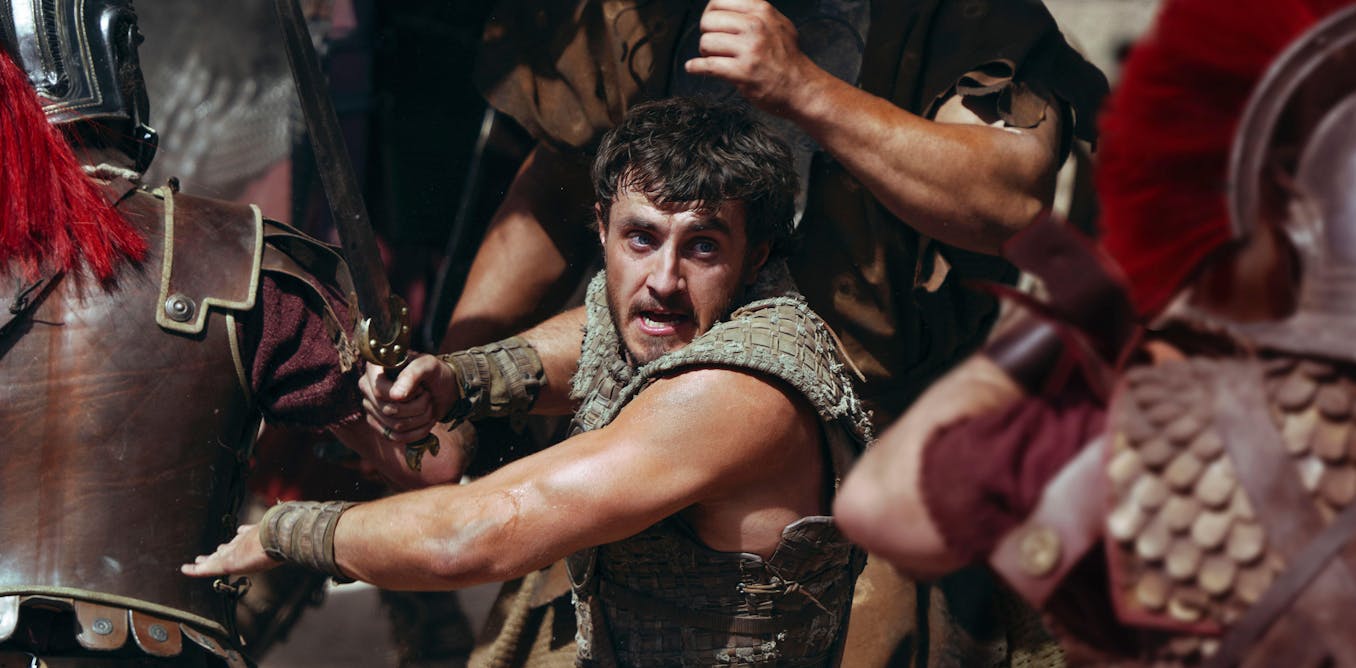
In the trailer for Ridley Scott’s hotly anticipated sequel to Gladiator (2000), a new gladiator (played by Paul Mescal) goes to battle in “the greatest temple Rome ever built – the Colosseum”.
He comes up against naval warfare, a cutthroat promoter (Denzel Washington) and a stampeding rhino. But how much of this really took place in Roman times? As always with films based in the past, pedantic historians will jump in to assess the degree of cinematic licence and historical misinterpretation. So it is with the forthcoming Gladiator II.
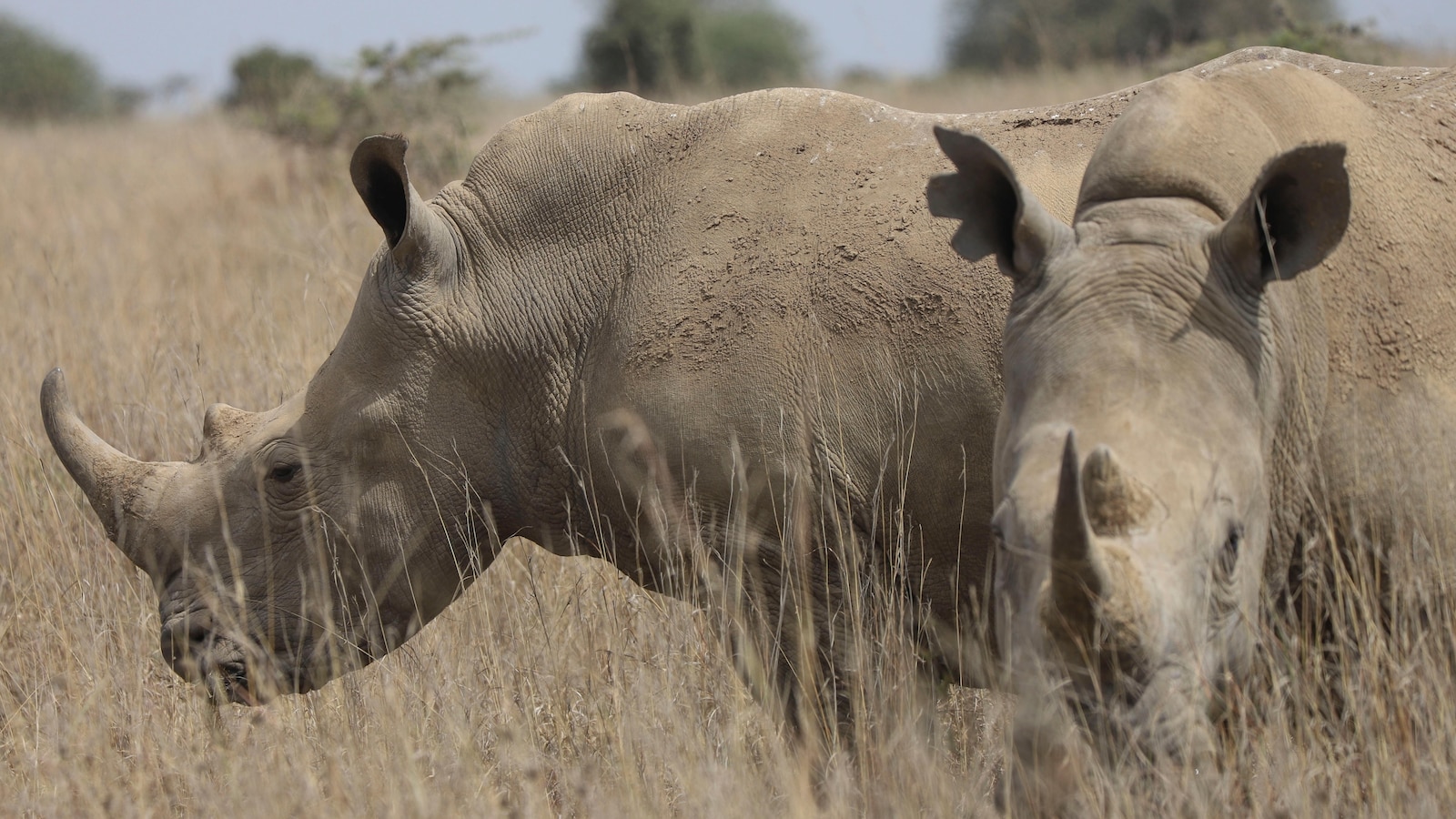
Did gladiators fight rhinos?
One thing that certainly did not happen was a warrior mounted on a rhinoceros (even a non-computer-generated one) charging at a group of gladiators. However, there is a record of a rhino at the inauguration of the Colosseum in 80BC. It didn’t fight men, but a bull, bear, buffalo, bison, lion and two steers. The other rare mentions of rhinos in Rome are of those in menageries, to be admired as exotic creatures.
This Roman interest in foreign, wild animals was the basis of the initial beast spectacles which began in 275BC with an exhibition of captured war elephants. Such non-violent displays of animals continued into the imperial era, but in 186BC the first staged animal hunt (venatio), featuring both lions and leopards, took place and by 169BC beast hunts had become an official part of republican state festivals.
Later, under the emperors, collecting and transporting beasts, especially unusual and foreign ones, to be displayed – but more often killed – demonstrated imperial power, territorial control and the vastness of the empire. Thousands of animals were brought from Africa and elsewhere to Roman arenas to be slaughtered for entertainment and the meat from the dead animals was given away to the spectators (it was easier than trying to dispose of the many carcasses).
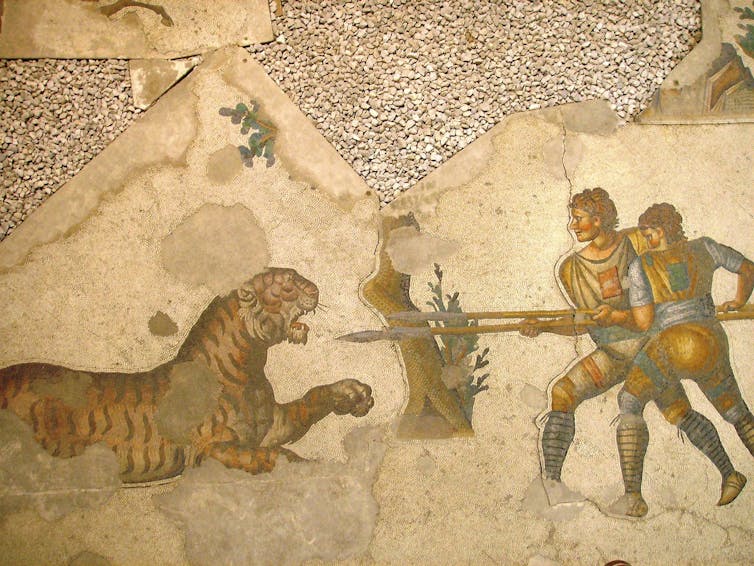
Great Palace of Constantinople, CC BY
Those who fought the beasts were not gladiators but specially trained hunters (venatores) armed with spears. The venatio could also feature fights between animals, as with the Colosseum rhinoceros, but most often the contest consisted of bulls against an elephant or bear. Animal hunts outlasted gladiatorial combats as a source of spectator entertainment, but as both the size of the empire and imperial funds diminished, greater reliance was placed on domestically reared “wild” animals.
Were there sea battles in the Colosseum?
More credence in historical terms can be given to the film’s staged sea battle (naumachia) in the flooded Colosseum. Such spectacles were expensive to stage and were reserved for special occasions.
The first one recorded was for Emperor Augustus in 2BC. Held on an artificial lake, it featured 30 large ships carrying some 3,000 marines plus an unspecified number of rowers. Participants in a naumachia, typically either convicted criminals or prisoners of war, were expected to kill each other or drown, though, the demonstration of fighting ability and courage could gain them a pardon.
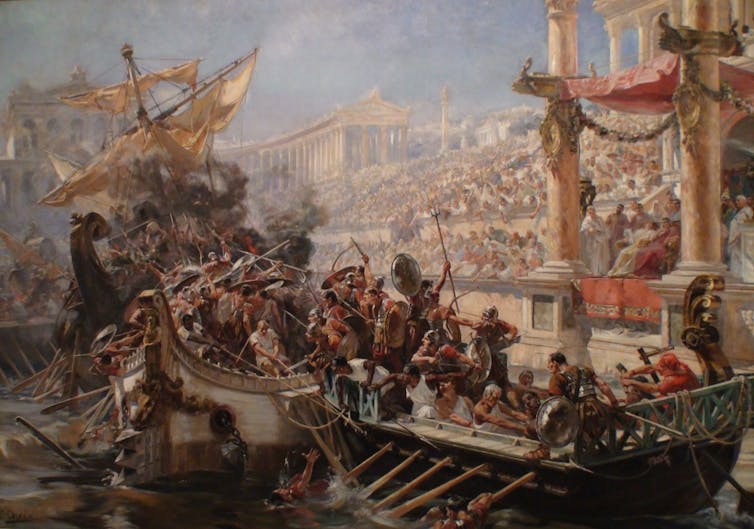
Museo Ulpiano Checa
The grandest sea battle was provided by Emperor Claudius on Lake Fucinus, a spectacle involving 100 ships and some 19,000 marines and oarsmen. It was at this event that the fighting men reportedly said “hail, emperor, we who are about to die salute you”, mistakenly assigned to gladiators in so many films, including the first Gladiator.
Literary sources (not always to be trusted in antiquity as they were often written well after alleged events) claim that the Colosseum was flooded for a sea battle at its inauguration. After some debate, historians now accept that the engineering mechanisms were in place so that, at least in its early days, the Colosseum could have accommodated a naumachia.
Did a thumbs down really mean death for a gladiator?
Gladiator II also showcases the misconstrued sporting legacy of the thumbs up signal to spare a defeated gladiator who requested mercy or the converse of a thumbs down from those who wished him to die.
The arena was a large, noisy place and hand signals were often used as a means of communication. Indeed, rather than verbally requesting mercy, the defeated warrior himself would raise the index finger of his right hand, or even the hand itself, both of which were recognised pleas for clemency.
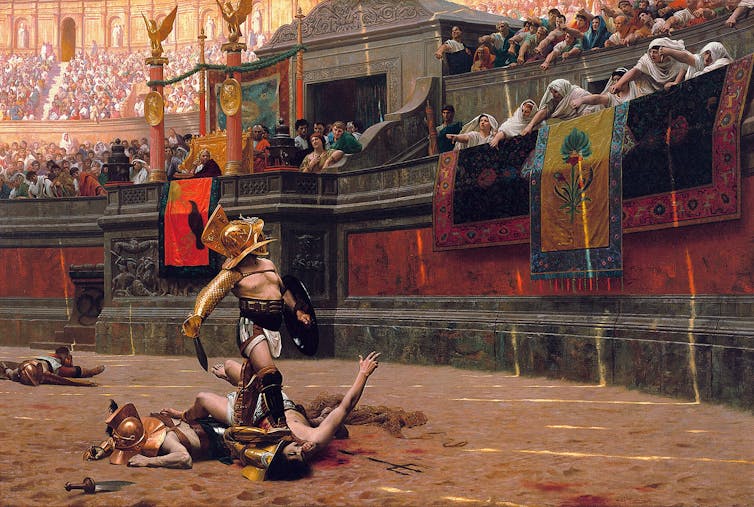
Phoenix Art Museum, CC BY
When the crowd opted for the death of a fighter they indicated this by means of pollice verso, literally a turned thumb, with no direction specified. When the hand was waved the sign indicated that the gladiator’s throat should be cut by his conqueror. Those who wished to save the vanquished, but courageous, fighter gave the sign pollice compresso, a compressed thumb but one often hidden from sight so as not to cause visual confusion.
Gladiators were valuable assets. Promoters, who had paid a hiring fee (typically 10-20% of their value) for them to fight, were reluctant to incur the full asset value demanded as compensation should they die. Especially when, at the crowd’s insistence, they could have a choice in the matter.
In many instances the event had been promoted to curry favour with the spectators so to go against their wishes would be counterproductive. However, whether the ultimate decision-maker gave a thumbs up or thumbs down is debatable. The idea that this occurred seems to have developed around 1872 with the popularity of a painting by French artist, Jean-Léon Gérôme. In it he depicts vestal virgins giving the dreaded sign. Although titled Pollice Verso, it became conventionally referred to as “the thumbs down painting”.

Looking for something good? Cut through the noise with a carefully curated selection of the latest releases, live events and exhibitions, straight to your inbox every fortnight, on Fridays. Sign up here.