hacklink hack forum hacklink film izle hacklink marsbahisizmir escortsahabetpornJojobet

Tag: Rise

  • The rise of album listening parties

    The rise of album listening parties

    I find the music industry one of the most rapidly changing fields in the country and the world. Possibly because artistes understand the need to keep their fans entertained but more so hooked on their creation, they do this by supplementing their recorded music with other fun activities. Because of this, trends are created as quickly as they are overtaken.

    In Kenya, the popularity of live music performances is leading to the rise of listening parties. Loosely defined as events where an artiste gathers their fans to sample an upcoming album or single, these parties are slowly becoming a must-do for musicians, both famous and upcoming.

    While there are no particular structures to an album listening party, most artistes seemingly favour two main approaches. One way is for the artiste to simply play the album over a sound system to the audience. The other approach is to have live performances of the tracks by the artiste. For instance, while at Bien’s listening party, a DJ was playing his songs as people interacted with the artiste and with themselves over drinks, the latter approach is what Blinky Bill went with.

    Blinky announced his newest solo Album, ‘We Cut Keys 2’ released officially in January this year, with an exceptional live performance and DJ set during his listening party in a show that wasn’t only sold out but was also attended by many artistes and celebrities. The Album, a successor of 2020’s ‘The Play House’ and coming seven years after the EP ‘We Cut Keys While You Wait’ assembled distinguished musicians from different genres in the 16-track album, such as Fuse ODG in ‘Konstant K’, Maji Maji (of Gidi Gidi Maji Maji) in ‘Boss’ and Shaunna Fung Yee and another in ‘Kiberit’.

    From the onset, Blinky’s new album was a favourite of many. In an online post, Blinky Bill narrates meeting a fan months after the listening party and the fan getting excited talking about their experience at the listening party.

    Like everything showbiz, listening parties aren’t obligated to be good; plenty of supposedly high-end musical events in this country have made that obvious by now. And yet, ‘We Cut Keys 2’ album listening party was a masterpiece.

    Blinky Bill brought out the funkiness that his music is known for by alternating between live DJ sets and his performance. At some point, he brought on stage traditional dancers to perform alongside.

    Overall, the album listening party was a high-concept show built around creating fun with already-great tracks, and pop aesthetics- funky dressing and the energy of Blinky’s very particular fan base.

    Entertainment purposes

    Listening parties are however not just hosted for entertainment purposes only. They can be crucial to the creation process for the artiste. So, at what stage do artistes have their listening parties and are they the final step before the album or song is released or can an artist make changes to the work after?

    “The individual pieces or even the entire album or EP may be adjusted- if the artist so wishes- after a listening party,” Brian Sigu tells me, “But often, you will find that changes at this stage are very minimal because most artistes have wrapped up production and are awaiting launching or releases.”

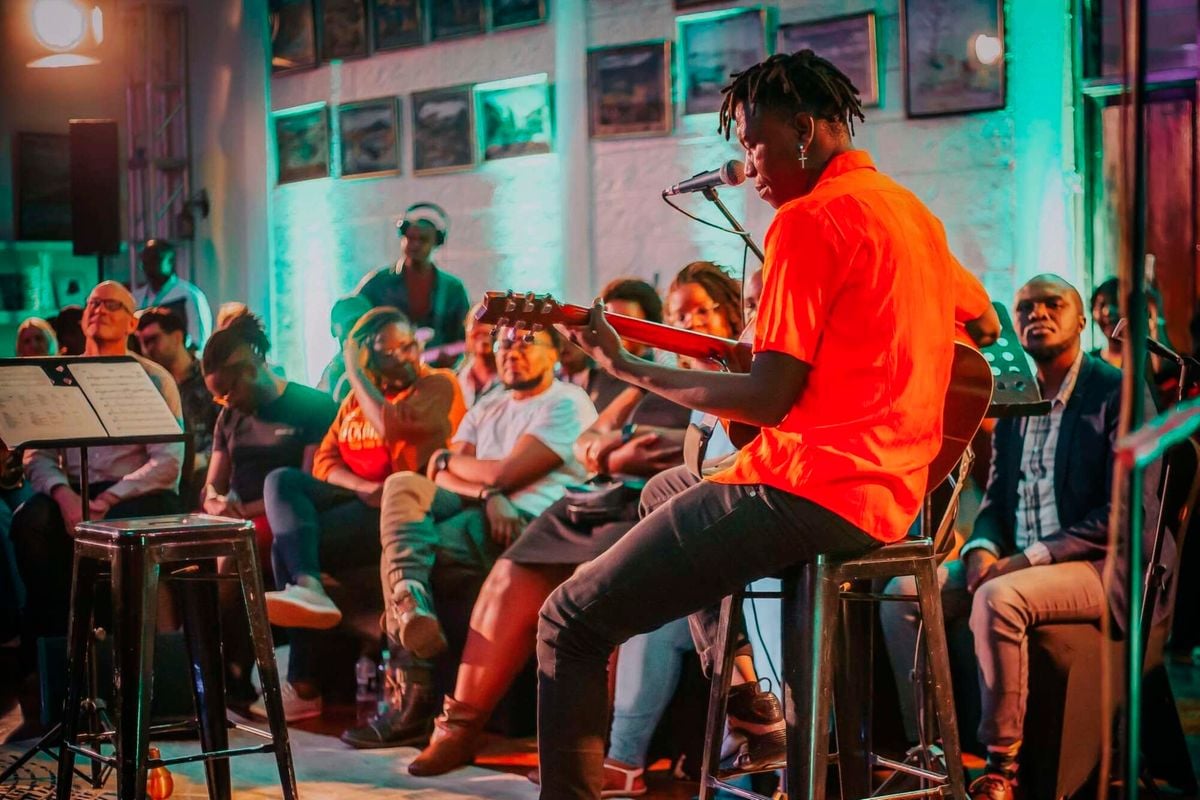
    I am at the WEAL House Hall on Ngong Road, and a man in a purple ‘Man of Nyadhi’ branded t-shirt leads me up the stairs into a warm orange and blue lit sitting area- that turns shadows into silhouettes- where Brian Sigu is hosting an album listening party on a chilly July evening.

    It’s only slightly over a year after the launch of his third album ‘Apaka’ and he is returning with his fourth, titled ‘A Man of Nyadhi’, which in some ways reaffirms his strengths in the previous three albums: great vocals blended with the longing ache always present in his songs and his trademark, charming banter.

    Brian Sigu

    Guitarist and lead vocalist Brain Sigu on stage during Showcase Wednesday at Alliance Francaise on January 22, 2020. 

    Photo credit: Francis Nderitu | Nation Media Group

    “I try to limit the tickets to my listening parties because I like them to be intimate events. While my album launch concerts are open to everyone, I try to have only my most dedicated fans at my listening parties. It’s all about intimacy with the fans. I want them to feel as if they were part of the album,” he says.

    At the event, Brian had opted to do a live performance of the about-to-be-released album, bringing on stage, at different points, the artists featured in the new album or whom he had collaborated with previously like Yaba (the Rhumbacane prince, not to be confused with Yebba, the great American vocalist) and Fadhili Itulya among others.

    In the album released three months later, here, Brian Sigu mixes some old ‘revisited’ pieces- as he prefers to call them- like ‘Apuoyo’ and ‘Kola’ that were previously featured on his second album ‘Jambaka’ alongside five new ones.

    The songs on the album all have different paces, hence creating different moods that are built gradually around the instruments and Brian’s powerful vocals, all sung in Luo. Notably, also, many of the tracks stretch beyond 5 minutes- the shortest, ‘Sulwe’ is 5:22 minutes long.

    Listening to the newly released album, I noticed stark differences between the performance at the listening party and the studio recordings released officially on his social media platforms this October.

    First, the artiste decided to smoothen some of his transitional notes- ironic because I have always thought his strength as a vocalist lies in high, rasp transitions. For instance, in his intro ‘Akal’ while he maintains the naughtiness in the opening line (translated: ‘my mother has always cautioned me against flirting with widows), he seemingly opts for a mellow following second line- and this has a rather interesting effect of making the verse sound regretful rather than melancholic (which is the impression I got listening to the song at the album party).

    However, ‘Apuoyo’ and ‘Isabella’ seem to be improved by the jazz sounds additions (post the listening party) making them my two overall best tracks of the album- ‘Kola’ comes second. ‘Akal’ and ‘Akinyi’ tie third position then ‘Sulwe’. At the listening party, I had ranked ‘Akal’ second.

    Also, unlike the performances at the listening party where featured musicians had played, the released album excludes all collabos, preferring to include only his solos. When I reached out to him to inquire about this decision, he had said, “I’m about to bring even hotter things, you’ll see. Watch this space.”

    Connection with the fans

    Evidently, listening parties are a great way for the artiste to create a community and foster an intimate connection with the fans. But there are many other purposes of a listening party, and some other reasons why an artiste would host one.

    “For me, the main reason I had my listening party was to get feedback from my fans,” says Coster Ojwang’. “As artistes, we are where we are because of our fans. So, we must make sure we are aware of how they feel about the art we put out there. After all, you don’t make art for yourself. So, I use listening parties to gauge what my fans think of my music and that also helps predict what the general public will respond to them. So, in short, it is like my testing ground.”

    Coster Ojwang’ also fondly known as ‘The Fisherman’ amongst his fans, hosted friends and fans in mid-September this year at Mageuzi Hub for the listening party of his new album titled ‘Imposter Syndrome No More’.

    I first came to Coster Ojwang’ rather late through one of his most popular releases ‘Manyo Pesa’ featuring Watendawili, because I was just coming back to the country after being away for quite a while, and it was the hit then. Slowly, I came to like many of his songs, especially ‘Kionge’ and ‘Kipenda roho’ both, part of his first album, ‘Fweny’ which was released about a year ago.

    In the new 17-track album, Coster opens with a powerful intro ‘Jowi’ (which was immediately a favourite of many people at the listening party). The rest of the album features familiar big names like Ambasa Mandela in ‘Dance’, Ayrosh in ‘Haaye’ and Savara in ‘Jathum’. There’s also Mordecai (of Hart the Band), Qwiss and Ywaya Tajiri (also featured in two big hits in Coster’s previous album).

    At the listening party, in between performances, Coster had an interactive Q&A session on stage- being interviewed on the album and answering questions from the audience.

    “Feedback is important for me as an artiste because then I get to know what worked and what didn’t- so I have that in mind as I think of the next project,” he says.

    Source link

  • The rise of album listening parties

    The rise of album listening parties

    I find the music industry one of the most rapidly changing fields in the country and the world. Possibly because artistes understand the need to keep their fans entertained but more so hooked on their creation, they do this by supplementing their recorded music with other fun activities. Because of this, trends are created as quickly as they are overtaken.

    In Kenya, the popularity of live music performances is leading to the rise of listening parties. Loosely defined as events where an artiste gathers their fans to sample an upcoming album or single, these parties are slowly becoming a must-do for musicians, both famous and upcoming.

    While there are no particular structures to an album listening party, most artistes seemingly favour two main approaches. One way is for the artiste to simply play the album over a sound system to the audience. The other approach is to have live performances of the tracks by the artiste. For instance, while at Bien’s listening party, a DJ was playing his songs as people interacted with the artiste and with themselves over drinks, the latter approach is what Blinky Bill went with.

    Blinky announced his newest solo Album, ‘We Cut Keys 2’ released officially in January this year, with an exceptional live performance and DJ set during his listening party in a show that wasn’t only sold out but was also attended by many artistes and celebrities. The Album, a successor of 2020’s ‘The Play House’ and coming seven years after the EP ‘We Cut Keys While You Wait’ assembled distinguished musicians from different genres in the 16-track album, such as Fuse ODG in ‘Konstant K’, Maji Maji (of Gidi Gidi Maji Maji) in ‘Boss’ and Shaunna Fung Yee and another in ‘Kiberit’.

    From the onset, Blinky’s new album was a favourite of many. In an online post, Blinky Bill narrates meeting a fan months after the listening party and the fan getting excited talking about their experience at the listening party.

    Like everything showbiz, listening parties aren’t obligated to be good; plenty of supposedly high-end musical events in this country have made that obvious by now. And yet, ‘We Cut Keys 2’ album listening party was a masterpiece.

    Blinky Bill brought out the funkiness that his music is known for by alternating between live DJ sets and his performance. At some point, he brought on stage traditional dancers to perform alongside.

    Overall, the album listening party was a high-concept show built around creating fun with already-great tracks, and pop aesthetics- funky dressing and the energy of Blinky’s very particular fan base.

    Entertainment purposes

    Listening parties are however not just hosted for entertainment purposes only. They can be crucial to the creation process for the artiste. So, at what stage do artistes have their listening parties and are they the final step before the album or song is released or can an artist make changes to the work after?

    “The individual pieces or even the entire album or EP may be adjusted- if the artist so wishes- after a listening party,” Brian Sigu tells me, “But often, you will find that changes at this stage are very minimal because most artistes have wrapped up production and are awaiting launching or releases.”

    I am at the WEAL House Hall on Ngong Road, and a man in a purple ‘Man of Nyadhi’ branded t-shirt leads me up the stairs into a warm orange and blue lit sitting area- that turns shadows into silhouettes- where Brian Sigu is hosting an album listening party on a chilly July evening.

    It’s only slightly over a year after the launch of his third album ‘Apaka’ and he is returning with his fourth, titled ‘A Man of Nyadhi’, which in some ways reaffirms his strengths in the previous three albums: great vocals blended with the longing ache always present in his songs and his trademark, charming banter.

    Brian Sigu

    Guitarist and lead vocalist Brain Sigu on stage during Showcase Wednesday at Alliance Francaise on January 22, 2020. 

    Photo credit: Francis Nderitu | Nation Media Group

    “I try to limit the tickets to my listening parties because I like them to be intimate events. While my album launch concerts are open to everyone, I try to have only my most dedicated fans at my listening parties. It’s all about intimacy with the fans. I want them to feel as if they were part of the album,” he says.

    At the event, Brian had opted to do a live performance of the about-to-be-released album, bringing on stage, at different points, the artists featured in the new album or whom he had collaborated with previously like Yaba (the Rhumbacane prince, not to be confused with Yebba, the great American vocalist) and Fadhili Itulya among others.

    In the album released three months later, here, Brian Sigu mixes some old ‘revisited’ pieces- as he prefers to call them- like ‘Apuoyo’ and ‘Kola’ that were previously featured on his second album ‘Jambaka’ alongside five new ones.

    The songs on the album all have different paces, hence creating different moods that are built gradually around the instruments and Brian’s powerful vocals, all sung in Luo. Notably, also, many of the tracks stretch beyond 5 minutes- the shortest, ‘Sulwe’ is 5:22 minutes long.

    Listening to the newly released album, I noticed stark differences between the performance at the listening party and the studio recordings released officially on his social media platforms this October.

    First, the artiste decided to smoothen some of his transitional notes- ironic because I have always thought his strength as a vocalist lies in high, rasp transitions. For instance, in his intro ‘Akal’ while he maintains the naughtiness in the opening line (translated: ‘my mother has always cautioned me against flirting with widows), he seemingly opts for a mellow following second line- and this has a rather interesting effect of making the verse sound regretful rather than melancholic (which is the impression I got listening to the song at the album party).

    However, ‘Apuoyo’ and ‘Isabella’ seem to be improved by the jazz sounds additions (post the listening party) making them my two overall best tracks of the album- ‘Kola’ comes second. ‘Akal’ and ‘Akinyi’ tie third position then ‘Sulwe’. At the listening party, I had ranked ‘Akal’ second.

    Also, unlike the performances at the listening party where featured musicians had played, the released album excludes all collabos, preferring to include only his solos. When I reached out to him to inquire about this decision, he had said, “I’m about to bring even hotter things, you’ll see. Watch this space.”

    Connection with the fans

    Evidently, listening parties are a great way for the artiste to create a community and foster an intimate connection with the fans. But there are many other purposes of a listening party, and some other reasons why an artiste would host one.

    “For me, the main reason I had my listening party was to get feedback from my fans,” says Coster Ojwang’. “As artistes, we are where we are because of our fans. So, we must make sure we are aware of how they feel about the art we put out there. After all, you don’t make art for yourself. So, I use listening parties to gauge what my fans think of my music and that also helps predict what the general public will respond to them. So, in short, it is like my testing ground.”

    Coster Ojwang’ also fondly known as ‘The Fisherman’ amongst his fans, hosted friends and fans in mid-September this year at Mageuzi Hub for the listening party of his new album titled ‘Imposter Syndrome No More’.

    I first came to Coster Ojwang’ rather late through one of his most popular releases ‘Manyo Pesa’ featuring Watendawili, because I was just coming back to the country after being away for quite a while, and it was the hit then. Slowly, I came to like many of his songs, especially ‘Kionge’ and ‘Kipenda roho’ both, part of his first album, ‘Fweny’ which was released about a year ago.

    In the new 17-track album, Coster opens with a powerful intro ‘Jowi’ (which was immediately a favourite of many people at the listening party). The rest of the album features familiar big names like Ambasa Mandela in ‘Dance’, Ayrosh in ‘Haaye’ and Savara in ‘Jathum’. There’s also Mordecai (of Hart the Band), Qwiss and Ywaya Tajiri (also featured in two big hits in Coster’s previous album).

    At the listening party, in between performances, Coster had an interactive Q&A session on stage- being interviewed on the album and answering questions from the audience.

    “Feedback is important for me as an artiste because then I get to know what worked and what didn’t- so I have that in mind as I think of the next project,” he says.
    Source link

  • The rise of album listening parties

    The rise of album listening parties

    I find the music industry one of the most rapidly changing fields in the country and the world. Possibly because artistes understand the need to keep their fans entertained but more so hooked on their creation, they do this by supplementing their recorded music with other fun activities. Because of this, trends are created as quickly as they are overtaken.

    In Kenya, the popularity of live music performances is leading to the rise of listening parties. Loosely defined as events where an artiste gathers their fans to sample an upcoming album or single, these parties are slowly becoming a must-do for musicians, both famous and upcoming.

    While there are no particular structures to an album listening party, most artistes seemingly favour two main approaches. One way is for the artiste to simply play the album over a sound system to the audience. The other approach is to have live performances of the tracks by the artiste. For instance, while at Bien’s listening party, a DJ was playing his songs as people interacted with the artiste and with themselves over drinks, the latter approach is what Blinky Bill went with.

    Blinky announced his newest solo Album, ‘We Cut Keys 2’ released officially in January this year, with an exceptional live performance and DJ set during his listening party in a show that wasn’t only sold out but was also attended by many artistes and celebrities. The Album, a successor of 2020’s ‘The Play House’ and coming seven years after the EP ‘We Cut Keys While You Wait’ assembled distinguished musicians from different genres in the 16-track album, such as Fuse ODG in ‘Konstant K’, Maji Maji (of Gidi Gidi Maji Maji) in ‘Boss’ and Shaunna Fung Yee and another in ‘Kiberit’.

    From the onset, Blinky’s new album was a favourite of many. In an online post, Blinky Bill narrates meeting a fan months after the listening party and the fan getting excited talking about their experience at the listening party.

    Like everything showbiz, listening parties aren’t obligated to be good; plenty of supposedly high-end musical events in this country have made that obvious by now. And yet, ‘We Cut Keys 2’ album listening party was a masterpiece.

    Blinky Bill brought out the funkiness that his music is known for by alternating between live DJ sets and his performance. At some point, he brought on stage traditional dancers to perform alongside.

    Overall, the album listening party was a high-concept show built around creating fun with already-great tracks, and pop aesthetics- funky dressing and the energy of Blinky’s very particular fan base.

    Entertainment purposes

    Listening parties are however not just hosted for entertainment purposes only. They can be crucial to the creation process for the artiste. So, at what stage do artistes have their listening parties and are they the final step before the album or song is released or can an artist make changes to the work after?

    “The individual pieces or even the entire album or EP may be adjusted- if the artist so wishes- after a listening party,” Brian Sigu tells me, “But often, you will find that changes at this stage are very minimal because most artistes have wrapped up production and are awaiting launching or releases.”

    I am at the WEAL House Hall on Ngong Road, and a man in a purple ‘Man of Nyadhi’ branded t-shirt leads me up the stairs into a warm orange and blue lit sitting area- that turns shadows into silhouettes- where Brian Sigu is hosting an album listening party on a chilly July evening.

    It’s only slightly over a year after the launch of his third album ‘Apaka’ and he is returning with his fourth, titled ‘A Man of Nyadhi’, which in some ways reaffirms his strengths in the previous three albums: great vocals blended with the longing ache always present in his songs and his trademark, charming banter.

    Brian Sigu

    Guitarist and lead vocalist Brain Sigu on stage during Showcase Wednesday at Alliance Francaise on January 22, 2020. 

    Photo credit: Francis Nderitu | Nation Media Group

    “I try to limit the tickets to my listening parties because I like them to be intimate events. While my album launch concerts are open to everyone, I try to have only my most dedicated fans at my listening parties. It’s all about intimacy with the fans. I want them to feel as if they were part of the album,” he says.

    At the event, Brian had opted to do a live performance of the about-to-be-released album, bringing on stage, at different points, the artists featured in the new album or whom he had collaborated with previously like Yaba (the Rhumbacane prince, not to be confused with Yebba, the great American vocalist) and Fadhili Itulya among others.

    In the album released three months later, here, Brian Sigu mixes some old ‘revisited’ pieces- as he prefers to call them- like ‘Apuoyo’ and ‘Kola’ that were previously featured on his second album ‘Jambaka’ alongside five new ones.

    The songs on the album all have different paces, hence creating different moods that are built gradually around the instruments and Brian’s powerful vocals, all sung in Luo. Notably, also, many of the tracks stretch beyond 5 minutes- the shortest, ‘Sulwe’ is 5:22 minutes long.

    Listening to the newly released album, I noticed stark differences between the performance at the listening party and the studio recordings released officially on his social media platforms this October.

    First, the artiste decided to smoothen some of his transitional notes- ironic because I have always thought his strength as a vocalist lies in high, rasp transitions. For instance, in his intro ‘Akal’ while he maintains the naughtiness in the opening line (translated: ‘my mother has always cautioned me against flirting with widows), he seemingly opts for a mellow following second line- and this has a rather interesting effect of making the verse sound regretful rather than melancholic (which is the impression I got listening to the song at the album party).

    However, ‘Apuoyo’ and ‘Isabella’ seem to be improved by the jazz sounds additions (post the listening party) making them my two overall best tracks of the album- ‘Kola’ comes second. ‘Akal’ and ‘Akinyi’ tie third position then ‘Sulwe’. At the listening party, I had ranked ‘Akal’ second.

    Also, unlike the performances at the listening party where featured musicians had played, the released album excludes all collabos, preferring to include only his solos. When I reached out to him to inquire about this decision, he had said, “I’m about to bring even hotter things, you’ll see. Watch this space.”

    Connection with the fans

    Evidently, listening parties are a great way for the artiste to create a community and foster an intimate connection with the fans. But there are many other purposes of a listening party, and some other reasons why an artiste would host one.

    “For me, the main reason I had my listening party was to get feedback from my fans,” says Coster Ojwang’. “As artistes, we are where we are because of our fans. So, we must make sure we are aware of how they feel about the art we put out there. After all, you don’t make art for yourself. So, I use listening parties to gauge what my fans think of my music and that also helps predict what the general public will respond to them. So, in short, it is like my testing ground.”

    Coster Ojwang’ also fondly known as ‘The Fisherman’ amongst his fans, hosted friends and fans in mid-September this year at Mageuzi Hub for the listening party of his new album titled ‘Imposter Syndrome No More’.

    I first came to Coster Ojwang’ rather late through one of his most popular releases ‘Manyo Pesa’ featuring Watendawili, because I was just coming back to the country after being away for quite a while, and it was the hit then. Slowly, I came to like many of his songs, especially ‘Kionge’ and ‘Kipenda roho’ both, part of his first album, ‘Fweny’ which was released about a year ago.

    In the new 17-track album, Coster opens with a powerful intro ‘Jowi’ (which was immediately a favourite of many people at the listening party). The rest of the album features familiar big names like Ambasa Mandela in ‘Dance’, Ayrosh in ‘Haaye’ and Savara in ‘Jathum’. There’s also Mordecai (of Hart the Band), Qwiss and Ywaya Tajiri (also featured in two big hits in Coster’s previous album).

    At the listening party, in between performances, Coster had an interactive Q&A session on stage- being interviewed on the album and answering questions from the audience.

    “Feedback is important for me as an artiste because then I get to know what worked and what didn’t- so I have that in mind as I think of the next project,” he says.

    Source link

  • The rise of album listening parties

    The rise of album listening parties

    I find the music industry one of the most rapidly changing fields in the country and the world. Possibly because artistes understand the need to keep their fans entertained but more so hooked on their creation, they do this by supplementing their recorded music with other fun activities. Because of this, trends are created as quickly as they are overtaken.

    In Kenya, the popularity of live music performances is leading to the rise of listening parties. Loosely defined as events where an artiste gathers their fans to sample an upcoming album or single, these parties are slowly becoming a must-do for musicians, both famous and upcoming.

    While there are no particular structures to an album listening party, most artistes seemingly favour two main approaches. One way is for the artiste to simply play the album over a sound system to the audience. The other approach is to have live performances of the tracks by the artiste. For instance, while at Bien’s listening party, a DJ was playing his songs as people interacted with the artiste and with themselves over drinks, the latter approach is what Blinky Bill went with.

    Blinky announced his newest solo Album, ‘We Cut Keys 2’ released officially in January this year, with an exceptional live performance and DJ set during his listening party in a show that wasn’t only sold out but was also attended by many artistes and celebrities. The Album, a successor of 2020’s ‘The Play House’ and coming seven years after the EP ‘We Cut Keys While You Wait’ assembled distinguished musicians from different genres in the 16-track album, such as Fuse ODG in ‘Konstant K’, Maji Maji (of Gidi Gidi Maji Maji) in ‘Boss’ and Shaunna Fung Yee and another in ‘Kiberit’.

    From the onset, Blinky’s new album was a favourite of many. In an online post, Blinky Bill narrates meeting a fan months after the listening party and the fan getting excited talking about their experience at the listening party.

    Like everything showbiz, listening parties aren’t obligated to be good; plenty of supposedly high-end musical events in this country have made that obvious by now. And yet, ‘We Cut Keys 2’ album listening party was a masterpiece.

    Blinky Bill brought out the funkiness that his music is known for by alternating between live DJ sets and his performance. At some point, he brought on stage traditional dancers to perform alongside.

    Overall, the album listening party was a high-concept show built around creating fun with already-great tracks, and pop aesthetics- funky dressing and the energy of Blinky’s very particular fan base.

    Entertainment purposes

    Listening parties are however not just hosted for entertainment purposes only. They can be crucial to the creation process for the artiste. So, at what stage do artistes have their listening parties and are they the final step before the album or song is released or can an artist make changes to the work after?

    “The individual pieces or even the entire album or EP may be adjusted- if the artist so wishes- after a listening party,” Brian Sigu tells me, “But often, you will find that changes at this stage are very minimal because most artistes have wrapped up production and are awaiting launching or releases.”

    I am at the WEAL House Hall on Ngong Road, and a man in a purple ‘Man of Nyadhi’ branded t-shirt leads me up the stairs into a warm orange and blue lit sitting area- that turns shadows into silhouettes- where Brian Sigu is hosting an album listening party on a chilly July evening.

    It’s only slightly over a year after the launch of his third album ‘Apaka’ and he is returning with his fourth, titled ‘A Man of Nyadhi’, which in some ways reaffirms his strengths in the previous three albums: great vocals blended with the longing ache always present in his songs and his trademark, charming banter.

    Brian Sigu

    Guitarist and lead vocalist Brain Sigu on stage during Showcase Wednesday at Alliance Francaise on January 22, 2020. 

    Photo credit: Francis Nderitu | Nation Media Group

    “I try to limit the tickets to my listening parties because I like them to be intimate events. While my album launch concerts are open to everyone, I try to have only my most dedicated fans at my listening parties. It’s all about intimacy with the fans. I want them to feel as if they were part of the album,” he says.

    At the event, Brian had opted to do a live performance of the about-to-be-released album, bringing on stage, at different points, the artists featured in the new album or whom he had collaborated with previously like Yaba (the Rhumbacane prince, not to be confused with Yebba, the great American vocalist) and Fadhili Itulya among others.

    In the album released three months later, here, Brian Sigu mixes some old ‘revisited’ pieces- as he prefers to call them- like ‘Apuoyo’ and ‘Kola’ that were previously featured on his second album ‘Jambaka’ alongside five new ones.

    The songs on the album all have different paces, hence creating different moods that are built gradually around the instruments and Brian’s powerful vocals, all sung in Luo. Notably, also, many of the tracks stretch beyond 5 minutes- the shortest, ‘Sulwe’ is 5:22 minutes long.

    Listening to the newly released album, I noticed stark differences between the performance at the listening party and the studio recordings released officially on his social media platforms this October.

    First, the artiste decided to smoothen some of his transitional notes- ironic because I have always thought his strength as a vocalist lies in high, rasp transitions. For instance, in his intro ‘Akal’ while he maintains the naughtiness in the opening line (translated: ‘my mother has always cautioned me against flirting with widows), he seemingly opts for a mellow following second line- and this has a rather interesting effect of making the verse sound regretful rather than melancholic (which is the impression I got listening to the song at the album party).

    However, ‘Apuoyo’ and ‘Isabella’ seem to be improved by the jazz sounds additions (post the listening party) making them my two overall best tracks of the album- ‘Kola’ comes second. ‘Akal’ and ‘Akinyi’ tie third position then ‘Sulwe’. At the listening party, I had ranked ‘Akal’ second.

    Also, unlike the performances at the listening party where featured musicians had played, the released album excludes all collabos, preferring to include only his solos. When I reached out to him to inquire about this decision, he had said, “I’m about to bring even hotter things, you’ll see. Watch this space.”

    Connection with the fans

    Evidently, listening parties are a great way for the artiste to create a community and foster an intimate connection with the fans. But there are many other purposes of a listening party, and some other reasons why an artiste would host one.

    “For me, the main reason I had my listening party was to get feedback from my fans,” says Coster Ojwang’. “As artistes, we are where we are because of our fans. So, we must make sure we are aware of how they feel about the art we put out there. After all, you don’t make art for yourself. So, I use listening parties to gauge what my fans think of my music and that also helps predict what the general public will respond to them. So, in short, it is like my testing ground.”

    Coster Ojwang’ also fondly known as ‘The Fisherman’ amongst his fans, hosted friends and fans in mid-September this year at Mageuzi Hub for the listening party of his new album titled ‘Imposter Syndrome No More’.

    I first came to Coster Ojwang’ rather late through one of his most popular releases ‘Manyo Pesa’ featuring Watendawili, because I was just coming back to the country after being away for quite a while, and it was the hit then. Slowly, I came to like many of his songs, especially ‘Kionge’ and ‘Kipenda roho’ both, part of his first album, ‘Fweny’ which was released about a year ago.

    In the new 17-track album, Coster opens with a powerful intro ‘Jowi’ (which was immediately a favourite of many people at the listening party). The rest of the album features familiar big names like Ambasa Mandela in ‘Dance’, Ayrosh in ‘Haaye’ and Savara in ‘Jathum’. There’s also Mordecai (of Hart the Band), Qwiss and Ywaya Tajiri (also featured in two big hits in Coster’s previous album).

    At the listening party, in between performances, Coster had an interactive Q&A session on stage- being interviewed on the album and answering questions from the audience.

    “Feedback is important for me as an artiste because then I get to know what worked and what didn’t- so I have that in mind as I think of the next project,” he says.
    Source link

  • The rise of album listening parties

    The rise of album listening parties

    I find the music industry one of the most rapidly changing fields in the country and the world. Possibly because artistes understand the need to keep their fans entertained but more so hooked on their creation, they do this by supplementing their recorded music with other fun activities. Because of this, trends are created as quickly as they are overtaken.

    In Kenya, the popularity of live music performances is leading to the rise of listening parties. Loosely defined as events where an artiste gathers their fans to sample an upcoming album or single, these parties are slowly becoming a must-do for musicians, both famous and upcoming.

    While there are no particular structures to an album listening party, most artistes seemingly favour two main approaches. One way is for the artiste to simply play the album over a sound system to the audience. The other approach is to have live performances of the tracks by the artiste. For instance, while at Bien’s listening party, a DJ was playing his songs as people interacted with the artiste and with themselves over drinks, the latter approach is what Blinky Bill went with.

    Blinky announced his newest solo Album, ‘We Cut Keys 2’ released officially in January this year, with an exceptional live performance and DJ set during his listening party in a show that wasn’t only sold out but was also attended by many artistes and celebrities. The Album, a successor of 2020’s ‘The Play House’ and coming seven years after the EP ‘We Cut Keys While You Wait’ assembled distinguished musicians from different genres in the 16-track album, such as Fuse ODG in ‘Konstant K’, Maji Maji (of Gidi Gidi Maji Maji) in ‘Boss’ and Shaunna Fung Yee and another in ‘Kiberit’.

    From the onset, Blinky’s new album was a favourite of many. In an online post, Blinky Bill narrates meeting a fan months after the listening party and the fan getting excited talking about their experience at the listening party.

    Like everything showbiz, listening parties aren’t obligated to be good; plenty of supposedly high-end musical events in this country have made that obvious by now. And yet, ‘We Cut Keys 2’ album listening party was a masterpiece.

    Blinky Bill brought out the funkiness that his music is known for by alternating between live DJ sets and his performance. At some point, he brought on stage traditional dancers to perform alongside.

    Overall, the album listening party was a high-concept show built around creating fun with already-great tracks, and pop aesthetics- funky dressing and the energy of Blinky’s very particular fan base.

    Entertainment purposes

    Listening parties are however not just hosted for entertainment purposes only. They can be crucial to the creation process for the artiste. So, at what stage do artistes have their listening parties and are they the final step before the album or song is released or can an artist make changes to the work after?

    “The individual pieces or even the entire album or EP may be adjusted- if the artist so wishes- after a listening party,” Brian Sigu tells me, “But often, you will find that changes at this stage are very minimal because most artistes have wrapped up production and are awaiting launching or releases.”

    I am at the WEAL House Hall on Ngong Road, and a man in a purple ‘Man of Nyadhi’ branded t-shirt leads me up the stairs into a warm orange and blue lit sitting area- that turns shadows into silhouettes- where Brian Sigu is hosting an album listening party on a chilly July evening.

    It’s only slightly over a year after the launch of his third album ‘Apaka’ and he is returning with his fourth, titled ‘A Man of Nyadhi’, which in some ways reaffirms his strengths in the previous three albums: great vocals blended with the longing ache always present in his songs and his trademark, charming banter.

    Brian Sigu

    Guitarist and lead vocalist Brain Sigu on stage during Showcase Wednesday at Alliance Francaise on January 22, 2020. 

    Photo credit: Francis Nderitu | Nation Media Group

    “I try to limit the tickets to my listening parties because I like them to be intimate events. While my album launch concerts are open to everyone, I try to have only my most dedicated fans at my listening parties. It’s all about intimacy with the fans. I want them to feel as if they were part of the album,” he says.

    At the event, Brian had opted to do a live performance of the about-to-be-released album, bringing on stage, at different points, the artists featured in the new album or whom he had collaborated with previously like Yaba (the Rhumbacane prince, not to be confused with Yebba, the great American vocalist) and Fadhili Itulya among others.

    In the album released three months later, here, Brian Sigu mixes some old ‘revisited’ pieces- as he prefers to call them- like ‘Apuoyo’ and ‘Kola’ that were previously featured on his second album ‘Jambaka’ alongside five new ones.

    The songs on the album all have different paces, hence creating different moods that are built gradually around the instruments and Brian’s powerful vocals, all sung in Luo. Notably, also, many of the tracks stretch beyond 5 minutes- the shortest, ‘Sulwe’ is 5:22 minutes long.

    Listening to the newly released album, I noticed stark differences between the performance at the listening party and the studio recordings released officially on his social media platforms this October.

    First, the artiste decided to smoothen some of his transitional notes- ironic because I have always thought his strength as a vocalist lies in high, rasp transitions. For instance, in his intro ‘Akal’ while he maintains the naughtiness in the opening line (translated: ‘my mother has always cautioned me against flirting with widows), he seemingly opts for a mellow following second line- and this has a rather interesting effect of making the verse sound regretful rather than melancholic (which is the impression I got listening to the song at the album party).

    However, ‘Apuoyo’ and ‘Isabella’ seem to be improved by the jazz sounds additions (post the listening party) making them my two overall best tracks of the album- ‘Kola’ comes second. ‘Akal’ and ‘Akinyi’ tie third position then ‘Sulwe’. At the listening party, I had ranked ‘Akal’ second.

    Also, unlike the performances at the listening party where featured musicians had played, the released album excludes all collabos, preferring to include only his solos. When I reached out to him to inquire about this decision, he had said, “I’m about to bring even hotter things, you’ll see. Watch this space.”

    Connection with the fans

    Evidently, listening parties are a great way for the artiste to create a community and foster an intimate connection with the fans. But there are many other purposes of a listening party, and some other reasons why an artiste would host one.

    “For me, the main reason I had my listening party was to get feedback from my fans,” says Coster Ojwang’. “As artistes, we are where we are because of our fans. So, we must make sure we are aware of how they feel about the art we put out there. After all, you don’t make art for yourself. So, I use listening parties to gauge what my fans think of my music and that also helps predict what the general public will respond to them. So, in short, it is like my testing ground.”

    Coster Ojwang’ also fondly known as ‘The Fisherman’ amongst his fans, hosted friends and fans in mid-September this year at Mageuzi Hub for the listening party of his new album titled ‘Imposter Syndrome No More’.

    I first came to Coster Ojwang’ rather late through one of his most popular releases ‘Manyo Pesa’ featuring Watendawili, because I was just coming back to the country after being away for quite a while, and it was the hit then. Slowly, I came to like many of his songs, especially ‘Kionge’ and ‘Kipenda roho’ both, part of his first album, ‘Fweny’ which was released about a year ago.

    In the new 17-track album, Coster opens with a powerful intro ‘Jowi’ (which was immediately a favourite of many people at the listening party). The rest of the album features familiar big names like Ambasa Mandela in ‘Dance’, Ayrosh in ‘Haaye’ and Savara in ‘Jathum’. There’s also Mordecai (of Hart the Band), Qwiss and Ywaya Tajiri (also featured in two big hits in Coster’s previous album).

    At the listening party, in between performances, Coster had an interactive Q&A session on stage- being interviewed on the album and answering questions from the audience.

    “Feedback is important for me as an artiste because then I get to know what worked and what didn’t- so I have that in mind as I think of the next project,” he says.

    Source link

  • How urbanisation, genetics and lifestyle fuel the global rise in obesity – Firstpost

    How urbanisation, genetics and lifestyle fuel the global rise in obesity – Firstpost

    In the last few decades,
    obesity has evolved from a localised public health issue to an international epidemic.  According to World Health Organisation (WHO), 1 in 8 people worldwide living with obesity. Adult obesity has more than doubled since 1990, and adolescent obesity has quadrupled over the same period. In total, 2.5 billion adults were classified as overweight last year, including 890 million living with obesity.

    Countries with the highest combined rates of underweight and obesity in 2022 were island nations in the Pacific and the Caribbean and those in the Middle East and North Africa.

    News18

    According to data, among adults aged 18 years and older, 43% were overweight, and 16% were living with obesity. The figures for children are equally concerning—37 million children under the age of 5 were reported as overweight in 2022. Additionally, over 390 million children and adolescents aged 5 to 19 years were overweight, of which 160 million were living with obesity.

    While the obesity rates in India have also witnessed an upward direction. According to National Family Health Survey (NFHS-5) 2019-2021, around 24% of women and 22.9% of men aged 15–49 are now considered overweight or obese, showing an increase from the previous survey in 2015-16, where 20.6% of women and 18.9% of men were affected.

    Watch Also: Obesity Has Become a Public Health Crisis with More Youngsters in Danger | Vantage with Palki Sharma

    Obesity is now recognised as a serious health condition that profoundly elevates the threat of heart disease, type 2 diabetes, stroke and even cancers.

    Dr Mohit Bhandari, Chief of Bariatric Surgeon at Pristyn Care  shared insights with Firstpost on various aspects surrounding the issues.

    Changes in dietary patterns

    Dr Bhandari: Probably, the most important cause of this rising tide of obesity is the dramatic change in global dietary patterns. With economic development and urbanisation, diets rich in fruits, vegetables, whole grains are replaced by these rather processed, high-calorie, and sugar-laden foods. Fast-food chains, sugary beverages, and ultra-processed snacks become more accessible and affordable in low- and middle-income countries. This is feeding into high-energy, nutrient-poor diets that fuel weight gain and obesity, particularly in the cities.

    Increasing trend of sedentary lifestyle

    Dr Bhandari: The other important factor is an increasing trend of sedentary lifestyle. The invention of modern technology has completely changed the way one lives, works, communicates, and entertains himself or herself. However, it greatly reduces the need for physical exercise. Such jobs in the office, buying on the internet, and streaming content encourage long sitting, but hard activities of the past years, which include walking and physical movements, have reduced. This low energy expenditure with high food consumption leads to gaining weight.

    Environmental and socioeconomic factors

    Dr Bhandari: The environment in which a person lives also contributes to obesity. Urbanisation has consequently created settings that discourage active physical activity the most. Without a conducive safe space for walking, biking, or exercising within many cities, the convenience stores and fast food tend to outweigh fresh food markets, thereby creating a food desert effect.

    Genetics and biological factors

    Dr Bhandari: Lifestyle and environmental factors have been important components of the story, but genetics also predispose individuals to be at higher risk for obesity. Perhaps some individuals have genetic factors that increase their likelihood of gaining weight or even have slower metabolisms. They may be more sensitized biologically and have a stronger urge to eat more. Hormonal problems, such as hypothyroidism or PCOS, also cause weight gain and make it a challenge for one to lose weight.

    Psychosocial and behavioural factors

    Dr Bhandari: Mental problems like stress, depression, and anxiety trigger conditions of over-eating or poorly eaten foods leading to more cases of obesity. Emotional eating is thus common as people over-eat comfort foods that contain so much fat and sugar, and so get conditioned to eat due to stress or bad feelings. Behavioural factors include poor eating habits or strategies, such as not eating at set times, consuming food at very late hours, and missing meals.

    Obesity is a complex issue influenced by many factors, including diet, lifestyle, environment, genetics, and mental health. To address this growing epidemic, both individuals and societies need to prioritize healthier eating habits, increased physical activity, and the creation of environments that support well-being. It is crucial to focus on these key factors to prevent and manage obesity on a global scale.

    Source link

  • Polling Place | Ducks rise to the occasion, take their place among college football’s elites | Newsletter

    Polling Place | Ducks rise to the occasion, take their place among college football’s elites | Newsletter

    The Associated Press Top 25

    The Top 25 teams in The Associated Press college football poll, with first-place votes in parentheses, records through Sept. 21, total points based on 25 points for a first-place vote through one point for a 25th-place vote, and previous ranking:

    Rk., Team Record Pts. Prv

    1. Texas (56) 6-0 1544 1

    2. Oregon (6) 6-0 1493 3

    3. Penn State 6-0 1380 4

    4. Ohio State 5-1 1357 2

    5. Georgia 5-1 1300 5

    6. Miami 6-0 1232 6

    7. Alabama 5-1 1127 7

    8. LSU 5-1 994 13

    9. Iowa State 6-0 982 11

    10. Clemson 5-1 980 10

    11. Tennessee 5-1 959 8

    12. Notre Dame 5-1 914 11

    13. BYU 6-0 889 14

    14. Texas A&M 5-1 744 15

    15. Boise State 5-1 597 17

    16. Indiana 6-0 580 18

    17. Kansas State 5-1 567 18

    18. Mississippi 5-2 511 9

    19. Missouri 5-1 409 21

    20. Pittsburgh 6-0 397 22

    21. SMU 5-1 260 25

    22. Illinois 5-1 249 23

    23. Army 6-0 137 NR

    24. Michigan 4-2 133 24

    25. Navy 5-0 84 NR

    Others receiving votes: Vanderbilt 68, Nebraska 62, Arizona State 39, Oklahoma 36, Washington State 32, Iowa 29, Texas Tech 18, Syracuse 13, Arkansas 13, Utah 7, Louisville 6, Southern Cal 5, Liberty 2, UNLV 1.

    THE NEWS-GAZETTE’S TOP 25

    Rankings from The News-Gazette’s college football and Illini beat writer Bob Asmussen, with his previous rankings listed:

    Rk., TEAM PREV.

    1. Texas 2

    2. Oregon 3

    3. Ohio State 1

    4. Penn State 4

    5. Miami 5

    6. Alabama 6

    7. Georgia 7

    8. Iowa State 8

    9. Notre Dame 9

    10. LSU 10

    11. Clemson 11

    12. Texas A&M 14

    13. Tennessee 13

    14. Missouri 15

    15. Boise State 17

    16. Illinois 16

    17. BYU 18

    18. Kansas State 20

    19. Indiana 21

    20. Pittsburgh 23

    21. SMU 24

    22. Vanderbilt 25

    23. Michigan NR

    24. Mississippi 12

    25. Army NR

    WHO’S UP

    Oregon. Dan Lanning’s team put itself in control of the Big Ten with a gutsy home win Saturday night against Ohio State. The Buckeyes had a chance to win late, but the clock ran out. Give them 10 more seconds and Ohio State would have scored the huge victory. The Ducks don’t play Penn State this season, so their toughest games remaining are at home against Illinois on Oct. 26 and at Michigan on Nov. 2. Then, the Big Ten title game, likely a rematch against Ohio State or a first-timer with Penn State. Dillon Gabriel has been everything Oregon hoped he would be when he transferred in. It is difficult to imagine the Ducks not earning one of the four College Football Playoff byes.

    WHO’S DOWN

    Utah. The Utes, considered a strong playoff contender going into the season, lost Friday night at Arizona State. That followed an earlier loss to Arizona at home. Utah also was tested at Oklahoma State, where Kyle Whittingham’s team won by three. Injuries have been a problem for the Utes. Quarterback Cam Rising, who came back for another season, is dealing with a hand injury that made it difficult for him to throw accurately in the 27-19 road loss to Arizona State. The fans and media figured it out, so you can bet opposing defenses will tee off on him and the Utes’ ground game. Utah might need to win out to have a shot at the Big 12 title and has challenging games remaining against BYU and Iowa State. Both teams come to Salt Lake City.

    WHO I’M WATCHING

    No. 5 Georgia at No. 1 Texas (6:30 p.m., Saturday, ABC). It’s the first real monster game for the Longhorns as members of the SEC. The Oklahoma game doesn’t count because the Sooners were clearly overmatched and, like Texas, are new to the league. Coach Steve Sarkisian has his team rolling both offensively and defensively. It scored an impressive win earlier against Michigan, though that outcome might be more the product of the Wolverines’ weaknesses. Georgia coach Kirby Smart has plenty of talent on hand, but the parts don’t seem to be working quite as well as usual.

    Bob Asmussen is a college football reporter and columnist for The News-Gazette. He can be reached at 217-393-8248 or asmussen@news-gazette.com.


    Source link

  • Meet Sam and Jasmine Phommachanh: The Football-Driven Parents Behind Taisun Phommachanh’s Rise to Fame

    Meet Sam and Jasmine Phommachanh: The Football-Driven Parents Behind Taisun Phommachanh’s Rise to Fame

    Taisun Phommachanh’s name might be tough to call, but trying to sack the 6’4 quarterback is even tougher. After committing with the Clemson Tigers for 2019 to 21, where he only served as a backup, he transferred to Georgia Tech for the 2022 season. He finally found his spot with the UMass Minutemen. As a redshirt junior in nine games in the 2023 season for the Minutemen, he completed 139 passes on 227 attempts and amassed 1,507 yards, including six touchdowns. At the minute, the Minutemen are 1-6 overall at the end of week 7 with a fresh 45-3 home beating to Missouri.

    Phommachanh’s dual-threat capabilities, combined with his ability to read defenses and make plays under pressure, have made the run-pass option a viable strategy. His football prowess has been a standout, reminding us why he’s so highly regarded. But no brownie points guessing why. It is no surprise as the ‘Phommachanh fam’ has been in the huddle for quite some time now.

    It’s in the blood of Taisum Phommachanh and his family

    ADVERTISEMENT

    Article continues below this ad

    Born into a family that breathes football, Taisun’s success comes as no shock to those who know the Phommachanh clan. At the helm of it was his father, Sam Phommachanh, a Lao American who was born in Vientiane and immigrated to the United States as a child. And mother Jasmine. They have raised four sons and a daughter. Each has taken to the gridiron like ducks to water. Unfortunately, Taisun’s dad couldn’t wrap his luck around playing professionally, but we can say that he passed down his ball knowledge to his children. He also went on to secure a Bachelor of Business from the University of Bridgeport and currently works in the real estate industry. Coupled with Jasmine’s support, they cultivated a household where sportsmanship is the foundation.

    ADVERTISEMENT

    Article continues below this ad

    The proof is with Taisun’s brothers, Jordan and Tyler. Who are all college-level football players—The eldest Jordan plays for Curry College and Tyler previously played for the UConn Huskies. But the athletic genes don’t stop there. The family’s youngest athlete, Kaylah, is a star in her own right, excelling in track and field at Bunnell High School. It’s safe to say that competition and athletic excellence are in the Phommachanh DNA.

    Taisum Phommachanh’s dad knows a thing or two about football

    Taisun’s father is the root cause of football. Sam was hooked on the sport from a young age. He got his start in the streets, playing football with his friends in the neighborhood, where his speed caught the eye of an older player. “He told me I should try out,” advised the veteran to Sam. His talents didn’t go unnoticed—he became a standout quarterback at Harding High School in Bridgeport, earning both All-State and All-League honors from 1988 to 1990. “I grew up in the Dan Marino era, and started practicing throwing,” he added to explain his passion for football. Although his football career didn’t extend to the professional level, Sam found a different way to make his mark on the sport: through his children. It’s no shame to say that Sam and Jasmine have built a football dynasty in their own home.

    ADVERTISEMENT

    Article continues below this ad

    The Phommachanh family’s football story isn’t just about talent. When Sam met Jasmine, it was clear they would form a dynamic team both in life and in raising their family. In fact, it was football that helped bring them together, as one of Sam’s go-to wide receivers also became his go-to matchmaker. His friend was dating a young Hattian-American woman and introduced Sam to her sister, Jasmine. You know the rest. Scoring both on and off the field! Taisun may be the current cynosure, but his siblings aren’t far behind. One thing is for certain, the Phommachanh name isn’t leaving the football scene anytime soon.


    Source link

  • The secrets behind the rise of Fox’s top college football booth

    The secrets behind the rise of Fox’s top college football booth

    MADISON, Wis. — It’s an idyllic Friday evening in Madison, and Gus Johnson is introducing Joel Klatt like he’s the reigning, defending undisputed champion.

    Fox’s top college football broadcast booth — comprised of Johnson, Klatt and sideline reporter Jenny Taft — is at its production meeting ahead of Wisconsin’s showdown with Alabama.

    The weekly meeting is akin to the walkthrough that football teams go through to prepare for their game.

    The announcing booth and the overall production, led by Fox lifer Chuck McDonald, who for years worked on the network’s top NFL crews with John Madden and Pat Summerall and later Joe Buck and Troy Aikman, has risen to the upper tier of big-time broadcast crews.

    Fox’s top college football announce crew of Gus Johnson, Jenny Taft and Joel Klatt. Courtesy of Fox Sports

    The production meeting illustrated why the booth is so upbeat and prepared come kickoff.

    Johnson, in his bombastic broadcasting voice, declares that Klatt is the “captain” of this meeting.

    The roles are reversed from what we see on TV — whereas Johnson is the quarterback of the broadcast and leads the rhythm with play-by-play, Klatt is guiding the meeting like a professor giving a lecture to a small class.

    He has a laminated sheet of notes on about 75 players but barely glances at it to go in-depth, unit by unit, of starters and reserves who are likely to see playing time, one by one, stating their histories, strengths, weaknesses and future professional prospects.

    Klatt has spoken to key players not just about their football but about their hobbies, noting at one point that Wisconsin quarterback Tyler Van Dyke was an avid golfer.

    The two had plans to play golf for money — “and he has it,” Klatt said.

    Throughout the meeting, Johnson would ask Klatt follow-up questions about everything from Xs and Os to narrative elements.

    Gus Johnson and Joel Klatt deserve to be considered as one of the top broadcast teams in all of sports. Joe Koshollek for Fox Sports

    Here, he wondered, as the rest of us do, about the general market in NIL — how much are these guys actually getting paid?

    Klatt said that a “run of the mill” quarterback is earning “mid six figures” while it can reach seven figures for an “impact guy.”

    The structure is likely to change again soon, he noted, as revenue sharing begins and programs are going to have to decide how to divvy up a proverbial salary cap.

    NIL will still be allowed, but the organized collectives might get legislated out.

    (Lamentably, the golf match will have to wait, as Van Dyke suffered a torn ACL in the first quarter on Saturday, and the future of the Badgers’ offense the rest of the season has a bleak forecast).

    Alabama’s Jalen Milroe runs past Wisconsin’s Hunter Wohler for a touchdown on Sept. 14, 2024. AP

    Taft, who at one time was the moderator between Skip Bayless and Shannon Sharpe on FS1’s “Undisputed,” approaches the sideline reporting role with rigor, and she has brought several elements to the meeting she hopes to include in the broadcast if there’s time.

    She spoke with Alabama quarterback Jalen Milroe, who told her matter-of-factly, “I’ve never been to Wisconsin. I want to get in, get the win and get the hell out.”

    Alabama wideout Ryan Williams, a 17-year-old phenom, comes up time and again in the production meeting, and Taft reports that all of his teammates have relayed that he has been relentless in the weight room because he feels a duty to live up to the hype.

    “I always try to anticipate which players will step up,” Taft said.

    Jenny Taft speaks with then-Michigan head coach Jim Harbaugh at the 2023 Big Ten championship. Getty Images

    “But then there’s an emotional story, which might not fit, but I want to have it if it works. Sometimes the conversations never make air, but sometimes we’ll have those teams again, so it’s creating those relationships.”

    Johnson and Klatt began working together on the top Fox college football team in 2015, and Taft joined the crew in 2017.

    In 2019, Fox introduced the “Big Noon Kickoff” strategy, putting the best game of their package at noon ET, a time slot which had previously been reserved for the dregs of all the networks, and bolstering it with a pregame show that currently features Rob Stone, Matt Leinart, Urban Meyer, Brady Quinn and Mark Ingram.

    For the last three years, the Michigan-Ohio State game in the “Big Noon” slot has been the most-watched regular season college football game each year on any network.

    Gus Johnson and Joel Klatt at Camp Randall at the University of Wisconsin in 2021. Joe Koshollek

    Beyond the individual talents of Johnson and Klatt, the secret sauce to the booth is that they are genuinely rooting for each other.

    “They play off each other really well,” McDonald, the producer, said.

    “But the other part about it is they like spending time together — at lunch, in the car, in coach’s meetings. The chemistry of that element — people probably think everybody’s putting on a show, but this is exactly what it’s like at all times.”

    As a viewer, it is remarkable how quickly Klatt can process what just happened in a football game with 22 moving parts on the field.

    “Nobody I’ve ever been with sees the game as quickly and can break it down like Joel,” McDonald said, noting that Klatt uses a different telestrator in real-time than anybody else.

    “When you look at his telestration, he is doing stuff that a lot of people would do after a commercial, but before the extra point is kicked. That’s a real tell on how well he sees the game. A lot of other guys have monitors that are on five-second delays [and ask the producer], ‘Was that 99 off the end?’ I have never had to confirm that for Joel in the 10 years we’ve worked together. He sees it now.”

    An example of this was last year when Michigan running back Donovan Edwards bursted for a 22-yard touchdown against Penn State, and Klatt immediately broke down the offense and defense with different colors on the telestrator.

    When other analysts break out the telestrator after a commercial break, it is often something that was put together for them in the production truck, according to McDonald.

    Gus Johnson is the lead play-by-play voice for Fox’s college football and basketball coverage. Getty Images

    McDonald said that, besides Klatt, the only color commentator that could always make him “right” in choosing from the production truck which camera angle, replay or graphic to display on the screen was Madden.

    Johnson also gushed about Klatt, saying he should be looked at as a football savant in accordance with great young offensive minds in coaching, like Ryan Day, Lincoln Riley, Sean McVay and, when they were young, Joe Gibbs and Norv Turner.

    “He’s a coach. He’s a young innovative mind that can decipher and present football at any level because he’s an incredible broadcaster,” Johnson said.

    Johnson built up to the punchline: “Why’s he an incredible broadcaster? Because I taught him!”

    Johnson left CBS for Fox in 2011 with an aura of getting up for big moments, in what Bill Simmons used to call the “Law of Gus Johnson” — where it felt like every game he called would come down to the final seconds and he’d have the perfect tone to match the moment.

    McDonald credited him, counterintuitively, for staying grounded unless moments actually call for him to reach another level.

    Joel Klatt starred at quarterback for Colorado in the early 2000s. MediaNews Group via Getty Images

    “He has more restraint than people think he does. He saves those big calls for big moments,” McDonald said.

    In a group conversation with The Post, Johnson, Klatt and Taft were all more interested in talking about what the other two do well than about promoting themselves.

    “We’re a team,” Johnson said. “We delight in the excellence of others. We delight in the excellence of the young men and women that we cover on the field and we delight in the excellence of the team. There is an unselfishness here that is unparalleled in my experience as a broadcaster.”

    “There’s such a trust,” Taft said. “We’re not a team that’s going to throw each other under the bus.”

    Klatt credited Johnson with establishing a “rhythm” that he believes viewers only notice subconsciously.

    “He explained to me that it’s kind of like a double-dutch — don’t trip the rope,” Klatt said.

    Klatt believed right away that it was a good crew but was affirmed in his belief during the Michigan-Ohio State game in 2021, when the Wolverines finally got over the hump to defeat the rival Buckeyes.

    “I knew that we had a really good sound, but you don’t really know until you do something where the stage requires you to be great,” Klatt said.

    “That game was when I was like, OK, what I know to be a really good crew just did an amazing job in a game that had to happen. It’s like great players have to be great when greatness is needed. That was the moment where I thought that we could get to that level when it was needed.”

    Johnson pointed out that all three of them were Division-1 athletes — he played baseball at Howard, Klatt was quarterback at Colorado and Taft played lacrosse at Boston University.

    Sports fans crave broadcasters who share their passion for the game, and communicate as though they are living out their dream jobs.

    Asked about bringing that energy to every game, Johnson gave a thoughtful answer.

    “My father was a janitor and a security guard, who died a double-amputee from Diabetes, who never went past the third grade in education. My job during the college football season is to watch marching bands, cheerleaders, mascots with young men from 18-25 who are trying their best to gain an education as well as maybe pursue some of their dreams — stardom in college or perhaps professional football,” he said.

    “I firmly feel that I have to walk in the light. I don’t want to walk in any kind of darkness. This a blessing. Words can’t express the amount of gratitude that I have just to be in this business and sustain a career for over 30 years. I have no excuse but to be happy. People who watch these games, this is their leisure time. This is not ’60 Minutes.’”

    Source link

  • Broccoli haircuts: Are perms for men on the rise in New Zealand?

    Broccoli haircuts: Are perms for men on the rise in New Zealand?

    “He’s about to say things like ‘no cap’ and ‘bussin’,” one Threads user said.

    For those who aren’t lucky enough to have naturally curly hair, many are turning to a tried-and-true treatment, the perm, which has found a new audience in young men influenced by the latest social media trends.

    The perm: Once in, then out, now back in again

    Invented in 1906, the perm is short for “permanent wave”.

    The distinctive look became popular in the late 70s and early 80s with the era’s long-haired rock and pop stars – Michael Jackson and Jon Bon Jovi were big fans of the style – and fans quickly followed suit, catalysing a trend of large, wavy hairstyles among men.

    The grown-out, shaggy look enabled the growth of other popular 80s hairstyles, such as mullets and shags, and widened the scope of what society deemed acceptable haircuts for men.

    Perms fell out of fashion in the 1990s as new Y2K trends surfaced and straightening iron technology improved, making it easier to curl your hair at home.

    “Sleek, poker-straight hair which defined much of this era edged perms out of the zeitgeist, and eventually perming treatments were dropped from compulsory hairdressing curriculum altogether,” says Viva beauty editor Ashleigh Cometti.

    “However, in the same way that we cycle through fashion trends, perms are back in a major way and its recent uptick in popularity has seen the chemical styling treatment praised for its ability to reshape and restore texture to a variety of hair lengths and hair types.”

    American rock band Bon Jovi, from left, David Bryan, Tico Torres, Jon Bon Jovi, Alec John Such and Richie Sambora. Photo / Getty Images
    American rock band Bon Jovi, from left, David Bryan, Tico Torres, Jon Bon Jovi, Alec John Such and Richie Sambora. Photo / Getty Images

    The perm is now finding its place within a niche new market. So, what’s behind its revival, and how are young men redefining the look for a new generation?

    South Korean culture can be credited with much of the work.

    While fading into the background in the West, perms became customary in South Korea and Japan. Musicians from K-pop boy group BTS and Squid Game actor Gong Yoo have all given their own takes on the style and helped cement the modern perm look, characterised by muted curls that appear wavier and more natural than other styles.

    K-pop’s rise and the general popularisation of Korean culture around the world have extended the cultural impact of Korean celebrities – including perms. This speaks volumes about the proliferation of K-beauty trends in Aotearoa New Zealand, Cometti says.

    “Few international beauty trends have been as influential locally as K-beauty, ranging from the widespread use of snail mucin in skincare to our growing desire for ‘glass skin’. Perms are just the latest to be added to the very long list of trends that have been inspired by and adapted from Korean pop culture,” she says.

    V (Kim Taehyung) of BTS is a fan of the perm, having shared photos and videos of him getting the treatment online. Photo / Getty Images
    V (Kim Taehyung) of BTS is a fan of the perm, having shared photos and videos of him getting the treatment online. Photo / Getty Images

    The New York Times aligned the fad to a more widespread challenging of outdated masculine conventions and stereotypes, highlighting how men were becoming more confident in taking charge of their own style and appearance.

    “We’re in a moment … where younger generations are very critical of something like toxic masculinity,” University of Hawaii assistant professor and Korean culture and beauty expert S. Heijin Lee told the outlet. “Something like a boy perm becomes an aesthetic way of wearing that and symbolising that.”

    How did the ‘Zoomer perm’ get so popular?

    Perms were picked up on TikTok in 2020 – Virginia-based Dillon Latham is cited as the first influencer to make a perm video when he was just 15 years old – and young men wanting to recreate what they’d seen influencers do online have driven demand for the style in salons.

    Latham, who has over 1.5 million TikTok followers, believes social media has a large impact on how young people look after and think about their hair. “All the guys coming up on TikTok, every guy who went viral and was considered highly attractive had this fluffy hair look. So it was kind of like, if you didn’t have that, you’re missing out,” Latham told GQ.

    Perm videos are huge on the platform, with countless young men filming before-and-after videos of their trips to the salon, in turn pulling millions of views and hundreds of thousands of likes.

    One California-based mother filmed her 13-year-old son getting a perm and posted it to TikTok, where it has received more than 28 million views, 3.5 million likes, and 142,000 saves.

    “Hair changes everything,” read one of the top comments, while another said: “She needs a raise!!!”

    One user wasn’t as impressed by the general trend, writing, “Only perm I’ve seen that looks good.” Their comment received over 72,000 likes.

    But what about in New Zealand? One’s bound to have noticed more finely tuned curls around town, so who’s been getting them?

    Salons around Aotearoa have been promoting the modern perm cut on TikTok and Instagram as they appeal to Gen Z men. Videos posted to social media show clients of all ages and hair types jumping on the trend.

    Twenty-two-year-old Wellington university student Aubrey Huang sports a mullet-perm hybrid and says “the intrigue of something new” was what prompted him to change his hair.

    “I’ve obviously got very straight hair, but that sort of limits your styling options – I used to have a dreadful side sweep and then I got a middle part last year, but I thought it would be fun to try a perm,” he told the Herald.

    After doing some research, Huang “bit the bullet”, and he’s been happy with the outcome. “It’s not that expensive nowadays for something that you redo every three months, and it doesn’t take that long either.”

    “Personally, I haven’t come across anyone in person with a Zoomer perm (but maybe that’s just my age). However, I have seen the trend flooding my TikTok algorithm. It’s only a matter of time before my generation tries this trend on for size, too,” Cometti says.

    What’s the process behind getting a perm?

    After analysing the trend’s online growth, the Herald spoke to an expert in New Zealand’s hairdressing industry to see if Kiwi salons really are seeing an uptick in men getting perms.

    Exile Hair Design in Epsom began marketing perms for men on its social media pages earlier this year after noticing a surge in the hair trend’s popularity.

    Exile’s owner, Jo Plant, says K-pop stars brought the perm back into fashion around 2018, this time on a shorter style of hair.

    Plant says while popular Korean celebrities “definitely revived this trend”, social media and influencers made the male perm a now-global phenomenon.

    Most men who head to Exile for perms are aged between 18-30, yet Plant notes the style’s explosion in popularity has meant their clients’ age range is “quite broad”.

    “At Exile, the majority of the men getting perms at our salon are only getting a top or half head perm,” so the perm treatment is priced from $106, although the general price of a perm would be salon-specific.

    When asked what advice she’d give to men thinking of getting a perm, Plant says to “do your research into what level of curl you desire and the maintenance afterwards, as there are extra steps in a hair routine you will have to follow to make sure you get the desired look you’re after.”

    Here are the steps Plant takes with a client during an appointment:

    • Firstly, she checks the client isn’t allergic to any chemicals used in the perm solution. A hair strand test might be conducted on previously dyed or chemically treated hair, as these “could compromise the end result”.
    • The client’s hair is then wrapped in rollers and perm solution is applied before allowing some time for the hair to process.
    • Once the hair is rinsed, neutralised, and trimmed, maintenance is key to keeping your hair healthy and retaining the curls. Plant says to avoid washing your hair within 48 hours after the treatment “as it’s in a fragile state and needs to settle”.
    • Finally, she recommends certain styling products alongside shampoo and conditioner to use for chemically treated hair. These vary depending on the client’s hair type.

    Tom Rose is an Auckland-based digital producer and editorial assistant for the Herald who covers lifestyle, entertainment, and travel.


    Source link