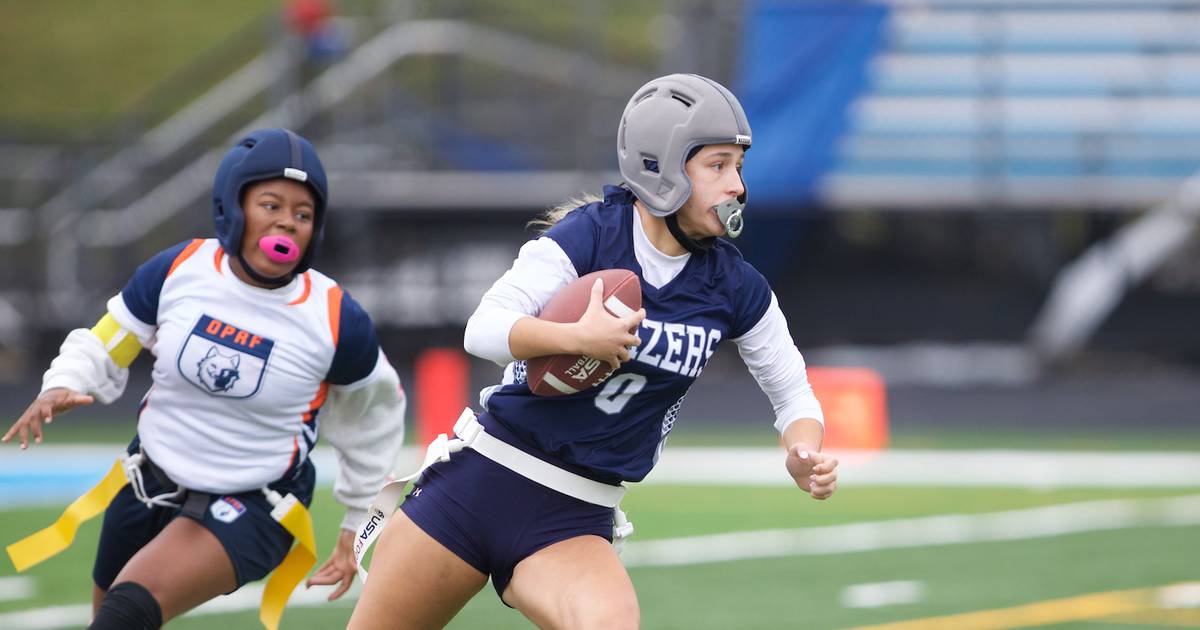
Willowbrook High School was the ideal place to watch high-level football Saturday.
On a cold, windy and gloomy late morning/afternoon, it was ideal football weather.
Without a hint of sunshine, along with a slight gust, the fans were all bundled up in fall clothes.
It was a typical fall football game atmosphere, with football players milling around outside the stadium and tents set up to enjoy the festivities.
But this was no ordinary football game.
In mid-February, the Illinois High School Association announced that girls flag football was the latest sport to debut an IHSA state series. The IHSA set in motion to conduct its inaugural postseason, concluding with an IHSA Girls Flag Football state champion in October 18-19.
The first practice was officially on Aug. 12, with games kicking off on Aug. 26. The first IHSA sanctioned season has been a big hit, as evidenced at Saturday’s Willowbrook Quad.
Willowbrook coach Rachel Karos lived up to the “this is football” mentality by delivering a motivation speech to her players sitting on the 50-yard line following Saturday’s final game – a victory over Addison Trail.
Karos, like her male counterparts, didn’t hold back in telling her players to work hard, eliminate mistakes and be focused.
Karos said the sport has grown tremendously over the last few years.
“The growth of girls flag football has been amazing over the last years,” Karos said. “Growing from 100 teams to now 170, which means more opportunities for female athletes in Illinois.”
Flag football is not tackle football, but you couldn’t tell that from Saturday’s quad. The players were aggressive and even tackled several runners in an attempt to grab a flag. Several players sported injuries from previous game, limped off the field and had visible scars on their bodies from the aggressive sport.
“The sport of flag football is not only physical but also highly skilled,” Karos said. “In many ways pulling a flag is harder than making a tackle, so our girls are not only training to handle the physicality of the game they are driven to Increase their hand eye coordination, and all necessary skills to be not just great athletes but great flag football players.”
Addison Trail coach Jenn Schulmeister said her team is playing with a lot of motivation due to the state series in October.
“We’ve had a very successful season so far,” she said. “We brought back a lot of girls. We’ve had great numbers, growing from 27 or 28 to 38 this year. That’s amazing. We also have new levels. This year has been different, just in solidifying the rules and not much grey area. It’s great that it’s been sanctioned because it gives our girls more to work for. There’s more excitement than before because there’s more of an end game for our girls.”
Addison Trails Vanessa Gonzalez runs the ball against Oak Park River Forest on Saturday, September 28,2024 in Villa Park. on Saturday, September 28,2024 in Villa Park. (Karen Naess for Shaw Local News Network)
Addison Trail quarterback Emma Caniglia took some big hits in Saturday’s game against host Willowbrook. She managed to whip passes all over the field and showcased her speed with several runs in and outside the pocket. Caniglia said this is her second year playing flag football and that she was drawn to the sport because of her brother.
“Last year was really interesting because it was our first year and we didn’t have much experience,” Caniglia said. “This year we have a lot of athletes on the team, so we connect really well. I love the sport so much more, so many more teams and competitions. It’s a physical game, but you have to do what you can do to get the flag. It’s a game, but really competitive on the field.”
Willowbrook junior Marli Smrz, who plays quarterback, wide receiver and safety, said this is her third full year playing football.
“My family has always been big in football,” Smrz said. “Coming into high school, it was a brand new sport and I figured I might as well try it and everybody is at the same level and scared too.”
A small but tough runner, Smrz can attest to the physicality of flag football. Three weeks ago, she suffered a torn labrum and dislocated her shoulder while trying to intercept a pass in a game. She returned to the field for Saturday’s games.
“I would definitely say it’s very physical,” Smrz said. “It’s really underrated.”
Willowbrook sophomore Liz Pettinger, who plays wide receiver and cornerback, is playing in her second season of flag football. Her older sister encouraged her to try the sport out.
”I would watch it and see how aggressive and fun it was and I liked the environment and you can make friends and loved watching the girls be united,” Pettinger said. “It’s more than I could imagine, just with the amount of opportunities and it’s been amazing to watch the team and sport grow in Illinois.”
Oak Park River Forests Niani Patton looks for the flag against Addison Trail on Saturday, September 28,2024 in Villa Park. (Karen Naess for Shaw Local News Network)
Even though the sport doesn’t have the traditional offensive linemen or feature kickoffs, Pettinger admitted the games can get aggressive.
“It says no contact but we get aggressive and you can tell the heart everyone puts into it,” Pettinger said.
Willowbrook junior Leigh Bernardo, who also does track and volleyball, said playing flag football is unique, especially given her 10-plus year background in gymnastics.
“Football is a whole different sport,” Bernardo said. “It’s very emotional. Team-wise, it’s like a family. I think it’s an amazing sport and a great way to bring more girls to the sport. It’s changing football and bringing everybody together.”
On the day that Jayvion Taylor collapsed during an afternoon football practice in Hopewell, Virginia, it wasnearly 90 degrees. By the heat index, it felt much hotter.
Taylor, 15, had just taken a water break after about 40 minutes of light drills that followed “standard safety protocols,” according to Hopewell City Public Schools. Coaches surrounded the wide receiver, who was sweating profusely and unresponsive, tried to revive him and doused him with cold water, a caller told 911.
“They’re still thinking he’s got a heat stroke,” the caller said.
Taylor died shortly after EMS personnel got him to a local hospital.
His official cause of death has not yet been released, but his mother, believes the heat had something to do with it. Alicia Trotter, a nurse, expressed concern that there was no athletic trainer present, a professional specially trained to follow the best practices in sports medicine and save lives when an emergency occurs.
Though Trotter said the team had been training since June, the athletic trainer’s contract was not set to begin until August 12, according to the school district, which called the death a tragic accident and said the staff who were there acted appropriately.
“You would think that if you’re not gonna have a trainer, that these coaches know what to do if something was to happen,” Trotter said. “But I really don’t know. I just know I sent him to school and he didn’t come back home.”
Taylor is one of at least eight young student athletes who died suddenly since Aug. 5 after training outdoors in blazing summer heat. Authorities have not determined official causes for all of them, but the deaths have renewed concerns about students practicing sports in sweltering conditions.
Heat stroke is one of the leading causes of death among high school athletes. Global temperatures are continuing to rise, and heat deaths in the United States already have reached record highs.
Experts say simple steps can be taken to save students’ lives, including modifying practices based on temperature and requiring sideline cooling equipment. They say state and school officials need to do more to enforce these best practices, particularly during the hottest part of the year.
It is “crushing” every time a student athlete dies of heatstroke because these life-saving policies are proven to be incredibly effective, said Rebecca Stearns, an athletic trainer and chief operating officer at the Korey Stringer Institute, a University of Connecticut nonprofit dedicated to preventing sudden death in sports.
“It is tough because you know the next one’s coming,” she said. “It’s really sad.”
‘Heatstroke is 100% preventable’ with simple policies
The week after Taylor’s death on Aug. 5, 14-year-old Semaj Wilkins collapsed while warming up during an afternoon football practice at New Brockton High School, in Coffee County, Alabama. Temperatures in the area hit 98 degrees that day.
Wilkins’ mother, Regena Johnson-Adams, rushed first to the field and then to the emergency room to see her son, who she remembers as a “people person” who loved learning, football and basketball. He had ice packs on his body and a medical device on his chest. He later died in the hospital.
“It’s a tragic loss,” an emotional Johnson-Adams told USA TODAY. “I hate that I lost my son, and I’m just waiting. I’m just ready for some answers.”
As she awaits word on his official cause of death, Johnson-Adams said she believes more can be done to protect student athletes.
“I would say [there] needs to be some more safety precautions,” she said. “And if any of it was heat related, maybe we need to try to see about practicing early, during the morning time when it’s cool.”
Research shows that implementing a number of low-cost, gold standard policies can dramatically reduce the number of high school athletes suffering heat illnesses, Stearns said.
She said teams should slowly ramp up the duration and intensity of initial practices to allow returning athletes to adjust to training in the heat and modify further based on the “wet bulb globe temperature,” a measurement which takes into account air temperature, humidity and radiant heat from the playing field.
If a player does overheat, schools should have cold water immersion tubs on site to start cooling them before paramedics transport them to the hospital, she said. Having an athletic trainer and a venue-specific emergency action plan are also crucial components to ensure athlete safety.
“Any kind of heat illness or heatstroke is 100% preventable,” said Jordan Clark, a climatologist and a senior policy associate for the Heat Policy Innovation Hub at Duke University. “These really robust policies and really having a lot of vigilance truly would prevent it.”
No state in the country requires all the best practices for student athlete safety identified by the Korey Stringer Institute, but Georgia, Louisiana, New Hampshire and New Jersey ranked highest for their heat safety policies, according to the institute’s 2023 analysis. California, Colorado, Maine and Vermont ranked lowest.
State high school sports associations are the primary governing body tasked with implementing these rules, but their power can be limited and enforcement mechanisms nonexistent.
In Virginia, where Taylor died, the Virginia High School League offers guidelines around heat safety including monitoring the wet bulb globe temperature and modifying practices early in the season, but following them is not required, according to Billy Haun, the league’s executive director.
Kelly Cobb, the superintendent of Coffee County Schools in Alabama, declined to answer specific questions about what happened to Wilkins and whether his high school followed policy that day. But she said the school district follows the Alabama High School Athletic Association’s exertional heat illness policy, which includes many of the gold standard practices.
“It’s really hard to make sure that all the participating schools in a given association and all sports are correctly measuring, like the wet bulb globe temperature for example, and they’re measuring it every time,” said Clark, of Duke University. “It’s very hard to enforce those rules.”
August ‘the deadliest month’ for high school athletes
Players who’ve been off for a few months and weather conditions in July and August, the two hottest months of the year, make for a dangerous combination, said Madeleine Orr, an associate professor in sport ecology at the University of Toronto in Ontario and author of “Warming Up: How Climate Change is Changing Sport.”
At least 77 heat-related deaths have been reported among athletes since 2000, with 65 of those among teenagers, according to data compiled by the Louisville Courier Journal, part of the USA TODAY Network.
The true toll is likely much higher, experts say, since officials signing a death certificate may not be aware of the circumstances that led to the hospitalization or death, and in order to attribute a death to exertional heat stroke, Orr said someone must take an internal body temperature right away.
“If coaches don’t know to check, by the time the athlete gets to the hospital the illness might be attributed to something else,” she said.
Three of the student deaths this summer have been attributed to sudden cardiac arrest, but studies have previously linked heat as a factor in some cardiac deaths. To prevent sudden cardiac death in athletes, the Korey Stringer Institute recommends avoiding practice in extreme heat or cold.
“August is the deadliest month for high school athletes,” Orr told USA TODAY. “Temperatures are higher and the athletes aren’t yet acclimatized to playing in tough conditions. It’s when the athletes are the least ready and it’s the hottest time.”
On top of the weather, the period before the school year begins is like “the wild wild west, meaning we don’t have a lot as much supervision, there are less rules,” said Douglas Casa, CEO of the Korey Stringer Institute.
In Kansas, following a heat acclimatization plan and having an emergency action plan are mandatory during the fall sports season, according to Jeremy Holaday, assistant executive director of the Kansas State High School Activities Association. But the rules don’t necessarily apply in the summer, a period when many teams hold preseason training sessions.
“We don’t govern the summer,” Holaday said.
Just days before the fall season began on Aug. 19, Ovet Gomez-Regalado, a 15-year-old football player at Shawnee Mission High School in Shawnee, Kansas died after collapsing following an afternoon training session, suffering a “medical emergency.” That morning, the weather service had issued a heat advisory for the area, warning heat index values could reach 106 and to stay indoors.
David Smith, a spokesperson for the Shawnee Mission School District, said the preseason conditioning workout was voluntary and Gomez-Regalado had lifted weights inside before heading outside to run.
“I think it’s premature to say that this was heat related,” Smith said, adding that Gomez-Regalado was outside for less than 10 minutes.
Gomez-Regalado’s family could not be reached for comment.
Smith said the school had a cold water immersion tub on site and the team was “well within” restrictions placed on activities based on wet bulb temperatures. He could not confirm what the wet bulb globe temperature was that day and declined to explain how Gomez-Regalado was treated or whether he was immersed in the cold-water tub.
Holaday, of the state’s high school activities association said such safeguards are recommended but not required, in part due to the cost.
Stearns, of the Korey Stringer Institute, said cost should not be an issue. A 150-gallon cold tub is about $200 and a wet bulb globe temperature monitor ranges from $100-$750.
“Everything that goes into having a sports program has a cost,” she said. “And so we look at the relative cost of these items that we talk about that can save a life, it is dwarfed in contrast to the cost of having an athletics program.”
Deaths spur states to change athlete heat policies
More than a dozen states have overhauled their heat policies in recent years, which Casa called “massive progress.” He said state legislatures are sometimes prompted to create stricter rules after high profile deaths.
In Maryland, a law went into effect in July requiring colleges and universities to develop venue-specific heat illness emergency action plans that include using cold-water immersion equipment and automatic external defibrillators. The bill is named after Jordan McNair, who died in 2018 after suffering heat stroke during a workout on the University of Maryland’s football field. A law implementing similar requirements for middle and high schools named after late high school football player Elijah Gorham was signed by then-Maryland Gov. Larry Hogan in 2022.
Despite increased protections, deaths can still occur. Just after 9 a.m. on Aug. 14, Leslie Noble experienced a medical emergency on the football field at Franklin High School in Reisertown, Maryland, where the temperature that day reached 82 degrees and conditions were hazy from Canadian wildfire smoke.
Police dispatchers said that the initial 911 call indicated Noble had suffered heat stroke, the Baltimore Sun reported. The Baltimore County 911 Center denied a records request from USA TODAY, citing an “open and ongoing law enforcement investigation.” Noble’s family did not respond to a request for comment from USA TODAY.
Charles Herndon, a spokesperson for Baltimore County Public Schools, declined to answer specific questions about what happened to Noble, but said the district has a heat acclimatization policy and guidelines restricting activities based on the heat index and wet bulb globe temperature.
“The only things we can add were that there was an athletic trainer present at the time and that all schools do have an emergency/safety plan,” Herndon said.
Casa said even more dramatic changes may need to be made to high school sports, particularly as global temperatures continue to rise.
Last year was the hottest year in recorded history, and the sweltering temperatures have stoked health and safety concerns for athletes, coaches and spectators across the athletic spectrum, from Olympians to high school and youth sports leagues.
“It’s not gonna ever get better in terms of the environmental conditions we need to consider,” Casa said. “So, I’m a big believer that in 20 years, high school football will be a spring sport and not a fall sport.”
Until such major changes occur, student athletes will keep dying in the heat, Stearns said.
“It’s really dark to say, but we know another death is going to happen because we know every high school athletes’ not going to have access to these lifesaving policies and equipment.”
Contributing: Ahjané Forbes, USA TODAY; Bill Atkinson, Petersburg Progress-Index; Stephanie Kuzydym, Louisville Courier Journal