hacklink hack forum hacklink film izle hacklink marsbahisizmir escortsahabetpornJojobetcasibompadişahbetGorabetcasibom9018betgit casinojojobetmarsbahismatbetmatbet giriş

Tag: site

  • Judge largely blocks Tennessee’s porn site age verification law as other states enforce theirs

    Judge largely blocks Tennessee’s porn site age verification law as other states enforce theirs

    NASHVILLE, Tenn. — A Tennessee law requiring pornographic websites to verify their visitors’ age was largely blocked in court before it was to take effect Jan. 1, even as similar laws kicked in for Florida and South Carolina and remained in effect for more than a dozen other states.

    On Dec. 30, U.S. District Judge Sheryl Lipman in Memphis ruled that Tennessee’s law would likely suppress the First Amendment free speech rights of adults without actually preventing children from accessing the harmful material in question. The state attorney general’s office is appealing the decision.

    The Free Speech Coalition, an adult entertainment trade group, is suing over Tennessee’s law and those in a half-dozen other states. The coalition lists some 19 states that have passed similar laws. One prominent adult website has cut off access in several states due to their laws.

    The issue will hit the U.S. Supreme Court for oral arguments regarding Texas’ law next week.

    No one voted against Tennessee’s law last year when it passed the Republican-supermajority legislature, and GOP Gov. Bill Lee signed off on it.

    The law would require porn websites to verify visitors are at least 18 years old, threatening felony penalties and civil liability possible for violators running the sites. They could match a photo to someone’s ID, or use certain “public or private transactional data” to prove someone’s age. Website leaders could not retain personally identifying information and would have to keep anonymized data.

    The Free Speech Coalition and other plaintiffs sued, winning a preliminary injunction that blocks the attorney general from enforcement while court proceedings continue. However, the coalition expressed concern that private lawsuits or actions by individual district attorneys could be possible.

    In her ruling, Judge Lipman wrote that parental controls on minors’ devices are more effective and less restrictive.

    She wrote that under Tennessee’s law, minors still could access adult sites using VPNs, or virtual private networks, that mask a user’s location. Or, they could view pornographic material on social media sites, which are unlikely to reach the law’s threshold of one-third of its content considered harmful to minors.

    The judge also said the impact could be overly broad, potentially affecting other plaintiffs such as an online educational platform focused on sexual wellness.

    She noted that Tennessee’s definition of “content harmful to minors” extends to include text. She specifically mentioned that the phrase “the human nipple,” or crude combinations of keyboard characters, would be considered harmful as long as they lack “serious literary, artistic, political, or scientific value for minors.”

    Tennessee Attorney General Jonathan Skrmetti’s office is asking the 6th U.S. Circuit Court of Appeals to let the law take effect as the lawsuit proceeds. His spokesperson, Chad Kubis, noted that other appeals courts, including the U.S. Supreme Court, allowed similar laws to take effect.

    “The Protect Tennessee Minors Act institutes common sense age verification to stop kids from accessing explicit obscene content while protecting the privacy of adults who choose to do so,” Kubis said.

    The Free Speech Coalition has argued the law would be ineffective, unconstitutional and force people to transfer sensitive information.

    “This is a deeply flawed law that put website operators at risk of criminal prosecution for something as trivial as a mention of the human nipple,” said Free Speech Coalition Executive Director Alison Boden.

    As verification laws took effect in Florida and South Carolina last week, website PornHub cut off access there and posted a message encouraging people to contact political decision-makers. They’ve acted similarly in other states that passed verification requirements.

    Judges had paused the laws in Indiana and Texas. But circuit appeals courts stepped in to allow enforcement.

    The Supreme Court declined to halt Texas’ law in April while the court action continues. The next step is Supreme Court oral arguments on Jan. 15.

    Another age verification law is set to begin in July in Georgia.

    Source link

  • New York semiconductor site picked for $825 million in funding

    New York semiconductor site picked for $825 million in funding

    ALBANY, N.Y. — A semiconductor research facility in upstate New York was selected as one of three national technology centers and will receive up to $825 million in funding as part of a broader federal effort to boost the United States’ competitiveness in the industry.

    U.S. Sen. Chuck Schumer made the announcement Thursday.

    The Albany NanoTech complex was selected by federal officials as the national headquarters for research into a cutting-edge semiconductor technology known as extreme ultraviolet, or EUV, lithography. The lab will have the most advanced chip-making machinery in the world and allow researchers from the semiconductor industry to collaborate with their university counterparts, according to Schumer, the Senate’s Democratic majority leader.

    “When you do the high-end research, which will be done here, and you can make the most advanced chips in the world, it makes sure that our military has the edge,” Schumer said in a telephone interview. “It makes sure our economy and our companies have the cutting edge, as well,”

    The National Semiconductor Technology Center Extreme Ultraviolet Accelerator is scheduled to begin operating next year. The contract for it stems from the 2022 CHIPS and Science Act, which was designed to create more high-tech jobs and help the United States compete with international rivals like China. The Biden administration has set a goal for the U.S. to make 20% of the world’s advanced chips.

    The Albany lab’s selection also advances longstanding efforts by Schumer and other government officials to make upstate New York a global center of semiconductor research and manufacturing.

    Gov. Kathy Hochul late last year announced a partnership with the semiconductor industry to fund construction of the EUV Center.

    The Biden administration announced in February that the government would provide $1.5 billion to the computer chip company GlobalFoundries to expand its domestic production north of Albany and in Vermont. And in April, the administration announced an agreement to provide $6.1 billion in government support for Micron Technology to produce advanced memory computer chips near Syracuse, New York; and in Boise, Idaho.

    “This is going to make upstate New York the center of semiconductor research, not just for America, but for the world,” Schumer said.

    The Department of Commerce has not yet announced where the other two national technology centers will be.

    Source link

  • PGA Tour back in Utah for the first time in six decades and European tour goes to site of Olympics

    PGA Tour back in Utah for the first time in six decades and European tour goes to site of Olympics

    PGA Tour

    BLACK DESERT CHAMPIONSHIP

    Site: Ivins, Utah.

    Course: Black Desert Resort GC. Yardage: 7,371. Par: 71.

    Prize money: $7.5 million. Winner’s share: $1,350,000.

    Television: Thursday-Sunday, 5-8 p.m. (Golf Channel).

    Defending champion: New tournament.

    FedEx Cup champion: Scottie Scheffler.

    Last week: Kevin Yu won the Sanderson Farms Championship.

    Notes: The PGA Tour returns to Utah for the first time since the Utah Open was part of the schedule in 1963. … Utah native Jay Don Blake has been given a sponsor exemption. Blake was born nearby in St. George, Utah. He won at Torrey Pines in 1991. This will be his 500th career start on the PGA Tour, and first since 2018 … Utah native Zac Blair also is in the field. Utah native Tony Finau is not playing because his son is in a national junior tournament. … The winner gets a spot in the Masters and PGA Championship. … Peter Kuest, a Utah Open winner, went to BYU and still lives in Utah. … The field features two players from the top 50 in the world ranking, Chris Kirk and Lucas Glover. … International captain Mike Weir is playing for the first time since the Presidents Cup. He played college golf at BYU. … Sanderson Farms Championship winner Kevin Yu is the 12th first-time winner on the PGA Tour this season.

    Next week: Shriners Children’s Open.

    Online: https://www.pgatour.com/

    ___

    European Tour

    FEDEX FRENCH OPEN

    Site: Saint-Quentin-en-Yvelines, France.

    Course: Le Golf National. Yardage: 7,247. Par: 72.

    Prize money: $3.25 million. Winner’s share: $541,667.

    Television: Thursday-Friday, 7:30 a.m. to 12:30 p.m. (Golf Channel); Saturday, 7-11:30 a.m. (Golf Channel); Sunday, 6:30-11:30 a.m. (Golf Channel).

    Defending champion: Ryo Hisatsune.

    Race to Dubai leader: Rory McIlroy.

    Last week: Tyrrell Hatton won the Dunhill Links Championship.

    Notes: Billy Horschel is playing for the third time in four weeks on the European tour, starting with his victory in the BMW PGA Championship at Wentworth. Horschel is the only player from the top 10 at the French Open. … Victor Perez and Matthieu Pavon are among nine players in the field who competed at Le Golf National in the Olympics. … Perez missed a chance at the bronze medal by one shot. … Le Golf National has hosted the Ryder Cup and the Olympics over the last six years. … Justin Rose is in the field. This is only his third regular European tour event this year. … Dunhill Links runner-up Nicolas Colsaerts received a sponsor invitation. The French Open in 2019 was his last victory. … Nicolai Hojgaard shot a 62 in the third round at the Olympics. He finished sixth. … From 1980 through 1986, the only French Open winners were Nick Faldo, Seven Ballesteros, Bernhard Langer, Greg Norman and Sandy Lyle.

    Next week: Andalucía Masters

    Online: https://www.europeantour.com/dpworld-tour/

    ___

    LPGA Tour

    BUICK LPGA SHANGHAI

    Site: Shanghai.

    Course: Qizhong Garden GC. Yardage: 6,672. Par: 72.

    Prize money: $2.1 million. Winner’s share: $315,000.

    Television: Wednesday-Saturday, 11 p.m. to 4 a.m. (Golf Channel).

    Previous winner: Angel Yin.

    Race to CME Globe leader: Nelly Korda.

    Last tournament: Jasmine Suwannapura won the Walmart NW Arkansas Championship.

    Notes: The LPGA begins the fall version of its Asia Swing, four tournaments in China, South Korea, Malaysia and Japan …. The tournament dates to 2018 but went three years without being played because of the COVID-19 pandemic before returning to the schedule last year. … Danielle Kang received a sponsor exemption. She won the first two editions of the Buick LPGA Shanghai. … Hannah Green, Ruoning Yin and Jeeno Thitikul give the field three players from the top 10 in the women’s world ranking. … Rose Zhang is playing. She is No. 11 in the world. … Zhang is one of only 12 Americans in the field. … Angel Yin moved to a career-high No. 25 in the women’s world ranking when she won in Shanghai last year. Yin reached as high as No. 19 this year and now is No. 33. … Lauren Coughlin, Bailey Tardy and Linnea Strom are the only first-time winners on the LPGA Tour this year.

    Next week: BMW Ladies Championship.

    Online: https://www.lpga.com/

    ___

    PGA Tour Champions

    SAS CHAMPIONSHIP

    Site: Cary, North Carolina.

    Course: Prestonwood CC. Yardage: 7,237. Par: 72.

    Prize money: $2.1 million. Winner’s share: $315,000.

    Television: Friday-Sunday, 2-5 p.m. (Golf Channel).

    Defending champion: Rod Pampling.

    Charles Schwab Cup leader: Ernie Els.

    Last week: Rocco Mediate won the Constellation Furyk & Friends.

    Notes: This is the last tournament before the Charles Schwab Cup playoffs begin. … The top 72 players in the Schwab Cup qualify for the postseason. The field will be trimmed to 54 players for the second event, and the top 36 reach the season-ending Charles Schwab Cup Championship. … Woody Austin is at No. 73 in the Schwab Cup by about $5,000. … Steve Stricker and K.J. Choi are the only players from the top 10 in the Schwab Cup not playing. Stricker is unlikely to play the rest of the season. … Bernhard Langer is in the field. He needs to win over the next three weeks to extend his streak of 17 consecutive years with a PGA Tour Champions victory. … Schwab Cup leader Ernie Els is playing. His lead over Steven Alker is just under $200,000. … Thomas Bjorn and North Carolina native Neal Lancaster received the two sponsor exemptions. Bjorn is at 27th in the Schwab Cup.

    Next week: Dominion Energy Charity Classic.

    Online: https://www.pgatour.com/pgatour-champions

    ___

    Korn Ferry Tour

    Last week: Braden Thornberry won the Korn Ferry Tour Championship.

    Next week: End of season.

    Points champion: Matt McCarty.

    Online: https://www.pgatour.com/korn-ferry-tour

    ___

    Other tours

    Japan Golf Tour: Japan Open, Tokyo GC, Saitama, Japan. Defending champion: Aguri Iwasaki. Online: https://www.jgto.org/en/

    Asian Tour: SJM Macao Open, Macau Golf and CC, Macao, China. Defending champion: Min Woo Lee. Online: https://asiantour.com/

    Ladies European Tour: Wistron Ladies Open-Taiwan, Sunrise Golf and CC, Taoyuan, Taiwan. Defending champion: New tournament. Online: https://ladieseuropeantour.com/

    Challenge Tour: Hainan Open, Sanya Luhuitou GC, Hainan Island, China. Defending champion: Ricardo Gouveia. Online: https://www.europeantour.com/challenge-tour/

    PGA Tour of Australasia: CKB WA PGA Championship, Kalgoorlie GC, Karlkurla, Australia. Defending champion: Ben Eccles. Online: https://pga.org.au/

    Sunshine Tour: Vodacom Origins of Golf-Wild Coast, Wild Coast Sun CC, Port Edward, South Africa. Defending champion: Pieter Moolman. Online: https://sunshinetour.com/

    Japan LPGA: Fujitsu Ladies, Tokyu Seven Hundred Club, Chiba, Japan. Defending champion: Kokona Sakurai. Online: https://www.lpga.or.jp/en/

    Korea LPGA: Dongbu Construction-Koreit Championship, Iksan CC, Jeonbuk, South Korea. Defending champion: Shinsil Bang. Online: https://klpga.co.kr/

    ___

    AP golf: https://apnews.com/hub/golf


    Source link

  • Details from New Mexico’s lawsuit against Snap show site failed to act on reports of sextortion

    Details from New Mexico’s lawsuit against Snap show site failed to act on reports of sextortion

    Snapchat failed to act on “rampant” reports of child grooming, sextortion and other dangers to minors on its platform, according to a newly unredacted complaint against the company filed by New Mexico’s attorney general.

    Attorney General Raúl Torrez filed the original complaint on Sept. 4, but internal messages and other details were heavily redacted. Tuesday’s filing unveils internal messages among Snap Inc. employees and executives that provide “further confirmation that Snapchat’s harmful design features create an environment that fosters sextortion, sexual abuse and unwanted contact from adults to minors,” Torrez said in a news release.

    For instance, former trust and safety employees complained there was “pushback” from management when they tried to add safety mechanisms, according to the lawsuit. Employees also noted that user reports on grooming and sextortion — persuading a person to send explicit photos online and then threatening to make the images public unless the victim pays money or engages in sexual favors — were falling through the cracks. At one point, an account remained active despite 75 reports against it over mentions of “nudes, minors and extortion.”

    Snap said in a statement that its platform was designed “with built-in safety guardrails” and that the company made “deliberate design choices to make it difficult for strangers to discover minors on our service.”

    “We continue to evolve our safety mechanisms and policies, from leveraging advanced technology to detect and block certain activity, to prohibiting friending from suspicious accounts, to working alongside law enforcement and government agencies, among so much more,” the company said.

    According to the lawsuit, Snap was well aware, but failed to warn parents, young users and the public that “sextortion was a rampant, ‘massive,’ and ‘incredibly concerning issue’ on Snapchat.”

    A November 2022 internal email from a trust and safety employee says Snapchat was getting “around 10,000” user reports of sextortion each month.

    “If this is correct, we have an incredibly concerning issue on our hands, in my humble opinion,” the email continues.

    Another employee replied that it’s worth noting that the number likely represents a “small fraction of this abuse,” since users may be embarrassed and because sextortion is “not easy to categorize” when trying to report it on the site.

    Torrez filed the lawsuit against Santa Monica, California-based Snap Inc. in state court in Santa Fe. In addition to sexual abuse, the lawsuit claims the company also openly promotes child trafficking and the sale of illicit drugs and guns.

    Source link

  • Arkansas sues YouTube over claims that the site is fueling a mental health crisis

    Arkansas sues YouTube over claims that the site is fueling a mental health crisis

    LITTLE ROCK, Ark. — Arkansas sued YouTube and parent company Alphabet on Monday, saying the video-sharing platform is made deliberately addictive and fueling a mental health crisis among youth in the state.

    Attorney General Tim Griffin’s office filed the lawsuit in state court, accusing them of violating the state’s deceptive trade practices and public nuisance laws. The lawsuit claims the site is addictive and has resulted in the state spending millions on expanded mental health and other services for young people.

    “YouTube amplifies harmful material, doses users with dopamine hits, and drives youth engagement and advertising revenue,” the lawsuit said. “As a result, youth mental health problems have advanced in lockstep with the growth of social media, and in particular, YouTube.”

    Alphabet’s Google, which owns the video service and is also named as a defendant in the case, denied the lawsuit’s claims.

    “Providing young people with a safer, healthier experience has always been core to our work. In collaboration with youth, mental health and parenting experts, we built services and policies to provide young people with age-appropriate experiences, and parents with robust controls,” Google spokesperson Jose Castaneda said in a statement. “The allegations in this complaint are simply not true.”

    YouTube requires users under 17 to get their parent’s permission before using the site, while accounts for users younger than 13 must be linked to a parental account. But it is possible to watch YouTube without an account, and kids can easily lie about their age.

    The lawsuit is the latest in an ongoing push by state and federal lawmakers to highlight the impact that social media sites have on younger users. U.S. Surgeon General Vivek Murthy in June called on Congress to require warning labels on social media platforms about their effects on young people’s lives, similar to those now mandatory on cigarette boxes.

    Arkansas last year filed similar lawsuits against TikTok and Facebook parent company Meta, claiming the social media companies were misleading consumers about the safety of children on their platforms and protections of users’ private data. Those lawsuits are still pending in state court.

    Arkansas also enacted a law requiring parental consent for minors to create new social media accounts, though that measure has been blocked by a federal judge.

    Along with TikTok, YouTube is one of the most popular sites for children and teens. Both sites have been questioned in the past for hosting, and in some cases promoting, videos that encourage gun violence, eating disorders and self-harm.

    YouTube in June changed its policies about firearm videos, prohibiting any videos demonstrating how to remove firearm safety devices. Under the new policies, videos showing homemade guns, automatic weapons and certain firearm accessories like silencers will be restricted to users 18 and older.

    Arkansas’ lawsuit claims that YouTube’s algorithms steer youth to harmful adult content, and that it facilitates the spread of child sexual abuse material.

    The lawsuit doesn’t seek specific damages, but asks that YouTube be ordered to fund prevention, education and treatment for “excessive and problematic use of social media.”

    Source link

  • Technology unlocks Han Dynasty lifestyle at Mawangdui site for the public in reality

    Technology unlocks Han Dynasty lifestyle at Mawangdui site for the public in reality

    Yang Jiyuan, a restorer of ancient silk textile, and her apprentices study the details of the drawings on a Western Han Dynasty robe. Photo: Courtesy of Nanjing Yunjin Research Institute

    Yang Jiyuan, a restorer of ancient silk textile, and her apprentices study the details of the drawings on a Western Han Dynasty robe. Photo: Courtesy of Nanjing Yunjin Research Institute

     
    Editor’s Note: 

    Fifty years ago, not only the archaeological community but also ordinary people were stunned by the excavation of the Mawangdui Han Tombs. Among the findings was a remarkable discovery known as China’s “Sleeping Beauty” (Lady Xin Zhui), an over 2,100-year-old lady who looks nearly as good as she did when she was buried after her death at the age of about 50, during China’s Western Han Dynasty (206BC-AD25). The world has marveled at the mystery behind her body, as well as the numerous precious treasures unearthed from the tombs, including textiles, bamboo and silk manuscripts. 

    In this Mawangdui trilogy, the Global Times Culture Desk explores how digital technologies have brought the public closer to the heritage and how the “Mawangdui IP” was revived by the creative industries. This is the third installment.


    Visitors explore <em>The Art of Life: Multimedia Exhibition of Mawangdui Han Culture</em> in Changsha, Central China's Hunan Province. Photo: IC

    Visitors explore The Art of Life: Multimedia Exhibition of Mawangdui Han Culture in Changsha, Central China’s Hunan Province. Photo: IC

    Although there are many sites in China that can embody the country’s Han Dynasty (206BC-AD220) history, Mawangdui is the most exceptional one mainly due to its mysterious finds like the 2,100-year-old mummified aristocrat that is known as Lady Xin Zhui. 

    Three excavations on the site were carried out from 1972 to 1974. At that time, such excavations brought a research craze to the academic field worldwide. Thanks to new means such as the digital technology, such a scholarly craze in the past 50 years has been extended to the public, especially among the young people.

    Decoding mystery    

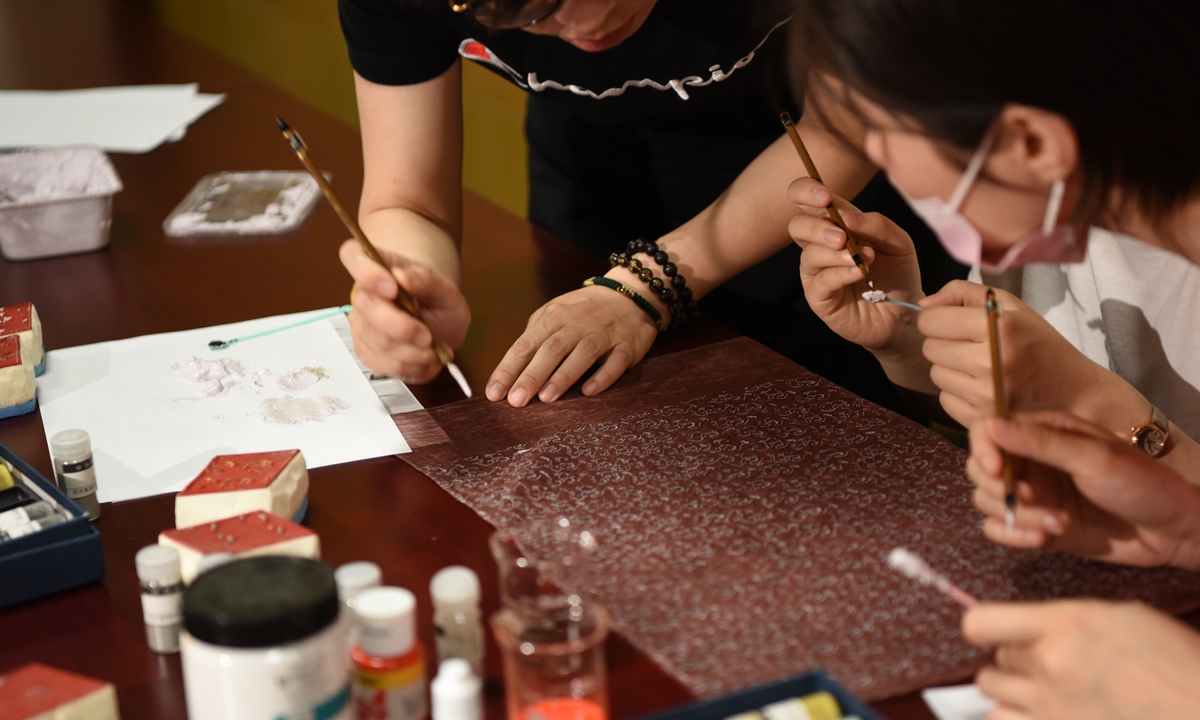
    Lady Xin Zhui’s silk garments are Mawangdui Han Tombs’ stellar artifacts. Due to their brittle and fragile nature, many original pieces are now only stored as archives at the Hunan Museum in Changsha, Central China’s Hunan Province. To connect the heritage with people, making replication for public display was a crucial task. The task engages both technological tools and the ingenuity of textile experts like Yang Jiyuan. 

    Yang, a restorer of ancient silk textile in Nanjing, East China’s Jiangsu Province, has replicated seven Lady Xin Zhui’s garments since 2016. She told the Global Times that the printed and painted floss silk-padded gauze robe was one of the most challenging tasks. 

    Through examination using a microscope and creating 3D modeling of the original “printed and painted gauze robe,” Yang revealed to the Global Times that the piece’s air-like fabric actually consists of seven sheerest silk layers, and the thickness of each one of them is like “one-third of the tissue’s thickness.”

    Matching such almost disappearing silk textiles together was not the most challenging task. Yang told the Global Times that the “painting” process was even harder since the colors should keep looking “not too vibrant and new.” 

    She said the gauze needs to be “1:1 the same to the original one” that has more than 2,000 years of history. Thanks to advanced technologies that can decode the ingredients and composition of ancient fabrics, Yang discovered that Lady Xin Zhui’s garment was painted in natural mineral dye and was covered with an extra “glue-like substance” to make it look understated while in a good shape. She said that she was only one of the heritage protectors in China, who has “felt the responsibility to show the public a legacy’s authentic aesthetics and story.” 

    “Technological tools are our assistants. They ensure the history we deliver to the public is correct,” Xiang Benshan, a restorer of underwater ceramic relics, told the Global Times. 

    Cross-field collaborations 

    Other than the research sector, technological innovations are now diversely applied on shows that relate to the Mawangdui Han Tombs. 

    Currently, a blockbuster show called The Art of Life: Multimedia Exhibition of Mawangdui Han Culture is ongoing at the Hunan Museum. The immersive digital project, a collaboration between the Hunan Museum, Digital Library of China, and the Harvard FAS CAMLab, presents a new model for showcasing the Mawangdui Han Tombs through multimedia installations. 

    The show includes three thematic sections such as “Time and Space.” They highlight the artistic grandeur and spiritual reflections of ancient Chinese, giving insight into their concepts of life, death and afterlife.

    Lü Chenchen, associate director of Harvard FAS CAMLab, told the Global Times that the future of Mawangdui-themed exhibitions lies in global academic collaboration and the integration of advanced technologies such as VR tools and interactive animations. 

    “By partnering internationally, institutions can leverage cultural IPs like the Mawangdui Han Tombs and digital tools to broaden access to historical knowledge from different perspectives and different disciplines,” Lü told the Global Times. 

    If the research lab and the museum are where the Mawangdui IP provides intellectual inspirations to people, then the site’s cross-field collaborations with the cultural and creative industries have made the heritage a joy of people’s everyday lives. 

    The Hunan Museum recently collaborated with a food brand to launch a “Mawangdui spicy strip,” one of the favorite snacks by young people that is also known as La Tiao. 

    At the museum’s “digital Han lifestyle experiencing center,” symbols of relics like the round lacquer plate and Lady Xin Zhui’s garments have been printed on products like scarves, fans and cakes.  

    Source link