hacklink hack forum hacklink film izle hacklink marsbahisizmir escortsahabetpornJojobetcasibompadişahbetBakırköy Escortcasibom9018betgit casinojojobet

Tag: System

  • Ukrainian front-line school system goes underground to protect against bombs and radiation

    Ukrainian front-line school system goes underground to protect against bombs and radiation

    ZAPORIZHZHIA, Ukraine — To be a parent in the Ukrainian front-line city of Zaporizhzhia means weighing your child’s life against the Russian weapons within striking distance.

    Most rain death in an instant: the drones, the ballistic missiles, the glide bombs, the artillery shells. But Russian soldiers control another weapon they have never deployed, with the potential to be just as deadly: The nearby Zaporizhzhia nuclear power plant.

    The NPP, as it’s known, once produced more electricity than any other nuclear power plant in Europe. It fell to Russian forces in the first weeks of the full-scale invasion, and Russia has held its six reactors ever since. The plant has come under repeated attacks that both sides blame on the other.

    These twin dangers — bombs and radiation — shadow families in Zaporizhzhia. Most of the youngest residents of the city have never seen the inside of a classroom. Schools that had suspended in-person classes during the COVID-19 pandemic more than four years ago continued online classes after the war started in February 2022.

    So with missiles and bombs still striking daily, Zaporizhzhia is going on a building binge for its future, creating an underground school system.

    Construction has begun on a dozen subterranean schools designed to be radiation- and bomb-proof and capable of educating 12,000 students. Then, officials say, they will start on the hospital system.

    The daily bombs are a more tangible fear than radiation, said Kateryna Ryzhko, a mother whose children are the third generation in her family to attend School No. 88. The main building, dating to the Soviet era of the children’s grandmother, is immaculate but the classrooms are empty. The underground version is nearly complete, and Ryzhko said she wouldn’t hesitate to send her kids to class there. Nearly four years of online learning have taken their toll on kids and parents alike.

    “Even classmates don’t recognize each other,” she said. “It’s the only safe way to have an education and not be on screens.”

    Within days of Russia’s full-scale invasion in February 2022, Zaporizhzhia’s 300,000 residents found themselves on the front lines. Unlike larger Ukrainian cities, like Kyiv or Kharkiv, there is no subway system that could do double-duty as a bomb shelter and few schools had basements where students could more safely attend classes.

    Many residents left — though some have returned. But the single-family homes and Soviet-style apartment blocks of Zaporizhzhia, the capital of the region that shares its name, filled nearly as quickly with Ukrainians fleeing areas seized by Russian forces, like the cities of Mariupol, Melitopol and Berdyansk.

    By the start of the school year in September 2022, which was supposed to mark the post-pandemic return to classrooms, schools were empty. Windows were boarded up to protect against bomb shockwaves, the lawns left unkempt. Fifty kilometers (31 miles) away, the nuclear reactor went into cold shutdown after intense negotiations between the International Atomic Energy Agency and the Russian government.

    The IAEA has rotated a handful of staff on site ever since. There are risks even in cold shutdown, when the reactor is operating but not generating power. The main danger is that its external electrical supply, which comes from Ukrainian-controlled territory under constant Russian bombardment, will be cut off for a longer period than generators can handle.

    The nuclear plant needs electricity to keep crucial backups functioning, including water pumps that prevent meltdowns, radiation monitors and other essential safety systems.

    During a recent Associated Press trip to the Ukrainian-controlled zone closest to the nuclear plant, two airborne bombs struck electrical infrastructure in a matter of minutes as night fell. Russia has repeatedly struck at Ukraine’s grid, attacks that have intensified this year. Highlighting the constant danger, electricity to the NPP was cut yet again for three days as emergency workers struggled to put out the fire. It was at least the seventh time this year that the plant was down to either a single electrical line or generator power, according to the global Nuclear Energy Agency.

    “Nuclear power plants are not meant to be disconnected from the grid. It’s not designed for that. It’s also not designed to be operating in cold shutdown for that long,” said Darya Dolzikova, a researcher on nuclear policy at the Royal United Services Institute in London.

    Ukrainian President Volodymyr Zelenskyy accuses Russia of targeting nuclear plants deliberately. The 1986 meltdown in Ukraine’s Chornobyl, on the northern border nearly 900 kilometers (550 miles) from Zaporizhzhia, increased the country’s rates of thyroid disease among Ukrainian children far from the accident site and radiation contaminated the immediate surroundings before drifting over much of the Northern Hemisphere. To this day, the area around the plant, known in Russian as Chernobyl, is an “exclusion zone” off-limits except to the technical staff needed to keep the decommissioned site safe.

    Russian forces seized control of Chornobyl in the first days of the invasion, only to be driven back by Ukrainian forces.

    The Zaporizhzhia plant has a safer, more modern design than Chornobyl and there’s not the same danger of a large-scale meltdown, experts say. But that doesn’t reduce the risk to zero, and Russia will remain a threatening neighbor even after the war ends.

    An investment that might seem extreme elsewhere is more understandable in Ukraine, said Sam Lair, a researcher at the Center for Nonproliferation Studies.

    “They are there under a conventional air and missile attack from the Russians, and they have experience with the fact that those attacks aren’t being targeted only at military targets,” Lair said. “If I were in their position, I would be building them too.”

    In addition, the Zaporizhzhia region received a European Union donation of 5.5 million iodine pills, which help block the thyroid’s absorption of some radiation.

    Since the start of the war, Russia has repeatedly alluded to its nuclear weapons stockpile without leveling direct threats. In September, Russian President Vladimir Putin said that Russia would consider any attack by a country supported by a nuclear-armed nation to be a joint attack and stressed that Russia could respond with nuclear weapons to any attack that posed a “critical threat to our sovereignty.”

    Ukrainian officials fear that the Russian attacks on Chornobyl and the Zaporizhzhia nuclear plants may be just a start. During his speech in late September to the U.N. General Assembly, Zelenskyy warned that Russia was preparing strikes on more nuclear plants, which generate a large portion of Ukraine’s electricity.

    “If, God forbid, Russia causes a nuclear disaster at one of our nuclear power plants, radiation won’t respect state borders,” Zelenskyy said.

    The cost to build a subterranean school system is enormous — the budget for the underground version of Gymnasium No. 71 alone stands at more than 112 million hryvnias ($2.7 million). International donors are covering most of it, and the national and local governments have made it a priority on par with funding the army.

    “Everybody understands that fortification and aid for the army, it’s priority No. 1,” said Ivan Fedorov, head of the Zaporizhzhia region. “But if we lose the new generation of our Ukrainians, for whom (do) we fight?”

    Daria Oncheva, a 15-year-old student at Gymnasium 71, looks forward to the underground classes, and not just because she’ll finally be in the same place as her schoolmates.

    “It’s safer than sitting at home remotely,” she said.

    School No. 88, across town, is further along, with rooms carved out and fully lined with concrete thick enough to block an initial onslaught of radiation. The contractor leading the project is also digging trenches for Ukraine’s military. When done, it will also be the primary bomb shelter for the neighborhood, whose single-family homes tend to have small orchards and trellised gardens — but no basements.

    An optimistic timeline has the school ready for children by December. It has three layers of rebar totaling 400 tons of metal, plus 3,100 cubic meters of reinforced concrete. The building will be topped by nearly a meter (yard) of earth, concealed by a soccer field and playground.

    The school will have an air filtration system, two distinct electrical lines and the ability to operate autonomously for three days, including with extra food and water supplies.

    Michael Dillon, a scientist at Lawrence Livermore National Laboratory who studies how people can survive nuclear fallout, said being underground improves survival by a factor of 10.

    But Alicia Sanders-Zakre at the International Campaign to Abolish Nuclear Weapons said ultimately people can do more — “which is eliminating these weapons instead of … building, really not even a Band-Aid, for the actual problem.”

    Lyudmila Zlatova, who has been the principal at School No. 88 for 30 years, hopes it will be a structure designed for the dangers Zaporizhzhia will face in the future. But she and the parents who gathered on a recent day were most concerned with the present, speaking at the edge of the construction pit as air raid sirens sounded.

    It takes 10 seconds for a bomb to reach the neighborhood from the front line, far too short a time to evacuate, and they land with unnerving frequency. The subterranean school’s sunless rooms and concrete corridors will only make children more comfortable, given what they’re already enduring, she said.

    “They will feel better studying without windows,” Zlatova said, peering across at the construction site.

    Zlatova believes it will bring back at least some of the families who’ve left Zaporizhzhia for other cities in Ukraine or elsewhere in Europe. The city remains fully functional, with public transit operating and grocery stores, markets and restaurants operating, and repairs ongoing for structures damaged by shelling — albeit in limited fashion. Around 150 of the school’s 650 prewar students have left the city, but she said she’s in touch with absent families and many promise to return home once there is a safe place to study.

    Gymnasium No. 6, which runs from first grade through high school, already has one. Its main building sits on the city’s easternmost edge, closer than any other school to the front 40 kilometers (25 miles) away.

    Little wonder that its principal, Kostyantyn Lypskyi, seems a little frayed at the beginning of the academic year. But at least his students can attend because parents chipped in money last year to renovate the basement shelter about 50 meters from the main school building into a series of classrooms.

    His underground school, whose concrete walls and relatively thin metal doors are not radiation proof but protect against explosions, hold around 500 people — the same number as the new designs. The school has double that number, so students will alternate weeks. The youngest children study full-time just upstairs from the shelter, and the older ones are in the main building.

    “Of course it will work,” he said. “We prepared everything for the start of the new school year.”

    In the earliest days of the school year, an air raid alarm meant he could test that confidence. It took five minutes from the moment the sirens sounded until the last children took their seats and spread out their books, awaiting instruction.

    It was morning, and they were ready for the day ahead.

    ___

    Associated Press reporter Martha Mendoza contributed from Santa Cruz, California. Alex Babenko contributed from Zaporizhzhia, Ukraine.

    ___

    The Associated Press receives support for nuclear security coverage from the Carnegie Corporation of New York and Outrider Foundation. The AP is solely responsible for all content.

    ___

    Additional AP coverage of the nuclear landscape: https://apnews.com/projects/the-new-nuclear-landscape/


    Source link

  • US to probe Tesla’s ‘Full Self-Driving’ system after pedestrian killed in low visibility conditions

    US to probe Tesla’s ‘Full Self-Driving’ system after pedestrian killed in low visibility conditions

    DETROIT — The U.S. government’s road safety agency is again investigating Tesla’s “Full Self-Driving” system, this time after getting reports of crashes in low-visibility conditions, including one that killed a pedestrian.

    The National Highway Safety Administration says in documents that it opened the probe on Thursday with the company reporting four crashes after Teslas entered areas of low visibility, including sun glare, fog and airborne dust.

    In addition to the pedestrian’s death, another crash involved an injury, the agency said.

    Investigators will look into the ability of “Full Self-Driving” to “detect and respond appropriately to reduced roadway visibility conditions, and if so, the contributing circumstances for these crashes.”

    The investigation covers roughly 2.4 million Teslas from the 2016 through 2024 model years.

    A message was left early Friday seeking comment from Tesla, which has repeatedly said the system cannot drive itself and human drivers must be ready to intervene at all times.

    Last week Tesla held an event at a Hollywood studio to unveil a fully autonomous robotaxi without a steering wheel or pedals. CEO Elon Musk said the company plans to have fully autonomous vehicles running without human drivers next year, and robotaxis available in 2026.

    The agency also said it would look into whether any other similar crashes involving “Full Self-Driving” have happened in low visibility conditions, and it will seek information from the company on whether any updates affected the system’s performance in those conditions.

    “In particular, his review will assess the timing, purpose and capabilities of any such updates, as well as Telsa’s assessment of their safety impact,” the documents said.

    Tesla has twice recalled “Full Self-Driving” under pressure from the agency, which in July sought information from law enforcement and the company after a Tesla using the system struck and killed a motorcyclist near Seattle.

    The recalls were issued because the system was programmed to run stop signs at slow speeds and because the system disobeyed other traffic laws.

    Critics have said that Tesla’s system, which uses only cameras to spot hazards, doesn’t have proper sensors to be fully self driving. Nearly all other companies working on autonomous vehicles use radar and laser sensors in addition to cameras to see better in the dark or poor visibility conditions.

    Source link

  • Combi vs system boiler: which one is right for your home?

    Combi vs system boiler: which one is right for your home?

    When it comes to heating your home, choosing the right boiler is a decision that can make all the difference – especially in the face of rising energy costs. Boilers play an integral role in heating our homes, so finding one that perfectly aligns with your household’s size, needs, and lifestyle is crucial.

    But with so many options available, deciding between the different types of boiler, can feel overwhelming. There’s no one-size-fits-all answer, as factors like available space, water pressure, and installation costs all come into play.

    Source link

  • Combi vs system boiler: which one is right for your home?

    Combi vs system boiler: which one is right for your home?

    When it comes to heating your home, choosing the right boiler is a decision that can make all the difference – especially in the face of rising energy costs. Boilers play an integral role in heating our homes, so finding one that perfectly aligns with your household’s size, needs, and lifestyle is crucial.

    But with so many options available, deciding between the different types of boiler, can feel overwhelming. There’s no one-size-fits-all answer, as factors like available space, water pressure, and installation costs all come into play.

    Source link

  • A capsule has been propelled through a hyperloop test tube in a step forward for the transit system

    A capsule has been propelled through a hyperloop test tube in a step forward for the transit system

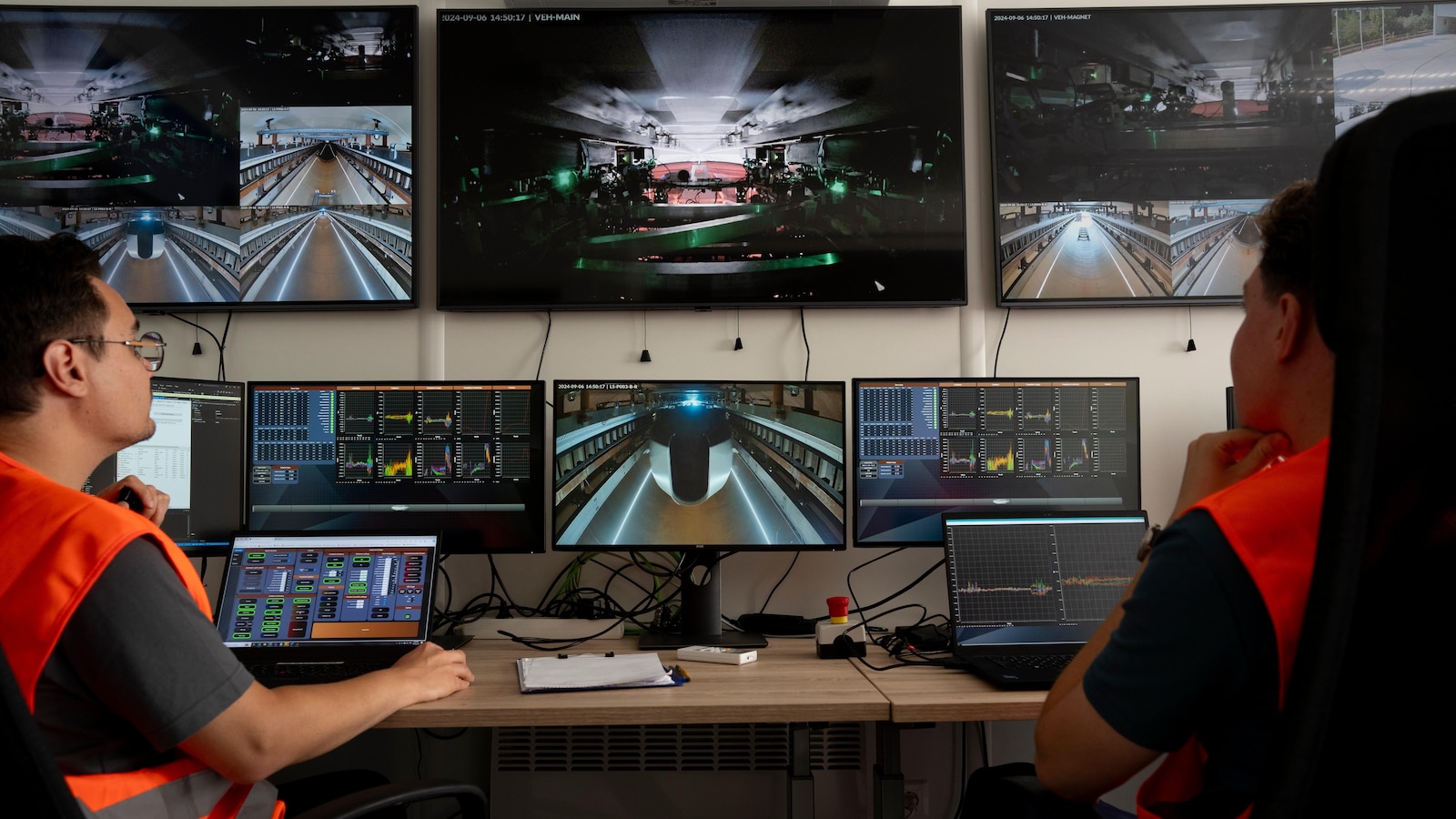
    VEENDAM, Netherlands — Hyperloop, a new form of mass transit involving capsules whizzing on magnetic fields through depressurized tubes, has achieved significant liftoff in the northern Netherlands, a company developing the technology said Monday.

    A test vehicle was levitated and zipped through a tube at a testing facility for the high-speed transit system once promoted by Elon Musk.

    “So today, with the first successful test, we were able to levitate the vehicle, also turn on the guidance system and the propulsion system,” Marinus van der Meijs, the technology and engineering director at hyperloop company Hardt, told The Associated Press late last week before Monday’s formal announcement.

    The European Hyperloop Center’s 420-meter (460-yard) tube is made up of 34 separate sections mostly 2½ meters (more than eight feet) in diameter. A vacuum pump sucks out the air to reduce the internal pressure. That reduces drag and allows capsules to travel at high speeds.

    Hyperloop developers aim to have capsules speeding through tubes at up to 700 kph (435 mph). Its backers say it’s far more efficient than short-haul flights, high-speed rail and freight trucks, but it will involve significant investment in infrastructure.

    So far, in the limited space offered by the test center, the speed has been modest.

    Once the capsule was in place in the tube, “we launched it with an acceleration similar to that of a metro, up to a top speed of about 30 kph (18 mph), about 100 meters (more than 300 feet) in the pipe,” Van der Meijs added.

    Even so, it’s a milestone that required some careful conducting.

    “The most difficult things that we are doing now is to test all of these functions together. Levitation, propulsion, guidance, all of those functions we are now capable of executing as an orchestra, making them work together,” said Roel van de Pas, commercial director of Hardt Hyperloop.

    Musk first proposed the idea more than a decade ago, suggesting it could shuttle passengers the nearly 400 miles (645 kilometers) between Los Angeles and San Francisco in 30 minutes. Since then, teams around the world have been working to bring the idea to fruition.

    “To deliver Hyperloop as a mobility system, we have a very complicated puzzle which requires technology, which requires policy, which requires public-private collaboration, and that is what is needed most,” Van de Pas said. “At Hardt, we are ready for passenger operations by 2030.”

    Some analysts are skeptical. When the hyperloop test facility opened in March, Robert Noland, distinguished professor at the Bloustein School of Planning and Public Policy at Rutgers University, told The Associated Press that building the necessary infrastructure is too costly, calling it “another example of policymakers chasing a shiny object.”

    In 2016, Dubai, in the United Arab Emirates, signed a deal with Los Angeles-based Hyperloop One to study the potential for building a hyperloop line between the city-state and Abu Dhabi, the Emirati capital.

    The announcement of the deal took place atop the Burj Khalifa, the world’s tallest building, with a panoramic view of the skyline of the futuristic city-state serving as both a backdrop and a sign of Dubai’s desire to be the first to rush toward the future.

    But like many flashy announcements in the city-state, the hyperloop idea faded in recent years with no track being built. Hyperloop One shut down in December.

    ___

    For more AP tech stories: https://apnews.com/technology

    Source link

  • Is Your Digestive System In Good Shape? Here Are 5 Signs That Say Yes

    Is Your Digestive System In Good Shape? Here Are 5 Signs That Say Yes

    We eat all kinds of healthy food to keep our digestive system smooth and happy, thinking that a well-balanced diet would do the trick for maintaining a healthy body. However, did you know that digestion is not just about eating light and healthy, but about how well your body processes and absorbs nutrients? A good digestive and gut system is important for overall wellness, which impacts everything, from our energy levels to our immune system. Now, if you eat healthy all the time and still experience digestive issues, chances are you have a poor gut system. However, is there a way to determine healthy digestion? The answer lies in our body itself. It gives out signs that could indicate the status of our digestive system. Are you wondering what those signs are? If yes, then you have landed on the right page! Here are 5 expert-suggested signs that indicate that you have a happy and healthy digestive system.

    Also Read: Have Digestion Issues? 5 Summer Beverages To Keep Digestive Issues At Bay

    Latest and Breaking News on NDTV

    Here Are 5 Signs To Know If Your Digestive System Is Healthy Or Not:

    Ayurvedic doctor Varalakshmi Yanamandra (@drvaraayurveda) shared a video on her Instagram pointing out 5 signs that indicate that you have good digestion.

    1. Clean Burp

    A clean, odourless burp after having a meal is an indicator of good digestion. As per the expert, a burp is known as “clean” if it doesn’t have any sour, bitter, or foul tastes, which means that the stomach acids are well balanced. When the digestive system is functioning properly, the food is broken down properly, preventing acid reflux and gas formation. However, if your burp is sour or bitter, it could mean you have poor digestion, which could lead to bloating and other digestive discomforts.

    2. Enthusiasm

    Do you feel enthusiastic about life? Every morning, when you wake up, do you look forward to the day? Then this could mean that you have good digestion. The expert states that when your body is properly nourished, it is filled with energy which means you will have a positive outlook about life. But, if your body is not nourished properly, it could lead to poor digestion caused by the storage of toxins inside which causes fatigue and lack of motivation.

    3. Clear Urges

    If you get clear and regular urges to poop and urinate, then this could be a sign of a healthy digestive system. Proper elimination of waste and toxins from our bodies is necessary to have a happy gut. As per the expert, when your digestive system is functioning adequately, it processes and digests food more efficiently without any discomfort. However, if you regularly experience constipation, it could mean that your system is sluggish and there is a waste build-up in your body.

    Latest and Breaking News on NDTV

    4. Feeling Lighter

    Feeling light and energized after a meal rather than heavy is another sign of good digestion. When the digestive system is functioning well, it digests food more efficiently and breaks down food quickly. According to the expert, if you feel sluggish after eating a meal, it means there are “AMA” or toxins built up in your body.

    5. Good Appetite And Thirst

    The expert states that having a healthy appetite and thirst is a clear indication that your digestive system is in good condition. A strong appetite shows that your digestive fire, or “Agni” is balanced and ready to break down food in your gut. In the same way, if you get adequately thirsty at regular intervals, then this shows proper hydration and a well-functioning metabolism. However, if you don’t get a desire to eat regularly, or get thirsty enough, then this could mean that your digestive system is sluggish.

    Watch the full video below:

    Also Read: 11 Best Probiotic Foods To Eat For Gut Health

    If you feel like your digestive system is sluggish, follow these 5 tips to improve it.


    Source link