hacklink hack forum hacklink film izle hacklink marsbahisizmir escortsahabetpornJojobetcasibompadişahbetjojobet

Tag: U.S

  • 2024 U.S. Open Slogan Calls Tennis ‘The World’s Healthiest Sport’

    2024 U.S. Open Slogan Calls Tennis ‘The World’s Healthiest Sport’

    Have you watched a healthy share of tennis action since the 2024 U.S. Open started on August 26? Well, if so, you may have noticed the slogan “The World’s Healthiest Sport” projected on the tennis courts. This, of course, refers to the sport of tennis as it wouldn’t make sense to place a reference to some other sport like basketball or cheese rolling there. This slogan is part of the big health and wellness vibe of the theme of this year’s fourth and final Grand Slam tennis tournament: “celebrating the power of tennis.” And that theme is an extension of the U.S. Tennis Association’s new give-em-health mission statement: “Growing tennis to inspire healthier people and communities everywhere.”

    So is it fair to call tennis the “world’s healthiest sport?” Well, while there isn’t an official overall ranking of the health benefits of all sports, it’s not as if that “healthiest” claim is a complete swing and a miss. For example, a study published in 2018 in the Mayo Clinic Proceedings did find that among 8,577 Copenhagen, Denmark, residents, those who had regularly played tennis lived on average 9.7 years longer than those who had remained sedentary. And that nearly “tennish” years of additional life was longer than the gains seen among people who regularly played other sports such as badminton (on average 6.2 years more of life), soccer (4.7 years), cycling (3.7 years), swimming (3.4 years), jogging (3.2 years), calisthenics, (3.1 years) and health club activities (1.5 years).

    These findings surely raised a racket among many sports enthusiasts. But there are a few caveats. The study did not include every sport out there. And tennis ain’t the only racket sport out there either. Plus, one study is never enough to draw a definitive conclusion. You always need multiple studies to show the same or similar result first. Additionally, the study showed a correlation or association between tennis and a longer life, which may or may not be a cause-and-effect relationship.

    That being said, other scientific studies have shown a range of different potential health benefits that can come from tennis. A review article in the British Journal of Sports Medicine from 2008 identified 24 studies that had evaluated the physical fitness of tennis players and summarized the findings of these studies. In general, those who played tennis tended to have “improved aerobic fitness, a lower body fat percentage, a more favourable lipid profile, reduced risk for developing cardiovascular disease, and improved bone health,” in the words of the authors.

    All of this shouldn’t be super-surprising because tennis does involve quite a lot of vigorous movement that incorporates much of your body. You can’t really say that you’ll play a tennis match and keep a part of your body like your butt completely still all the time. Not with all the running movements with your legs and swinging motions with your arms.

    And these bursts of movement can continue over sustained periods of time. A given point in tennis can last from a few seconds to much, much longer. The longest point in professional tennis history clocked in at a whopping 29 minutes. That’s as long as some episodes of Ted Lasso. This back-and-forth-back-and-forth-back-and-forth-and-so-forth occurred back in 1984 during a Virginia Slims of Richmond match between Vicki Nelson-Dunbar and Jean Hepner and consisted of 643 shots.

    That single point was significantly longer than the shortest ever professional tennis match in the Open era when Susan Tutt shellacked Marion Boundy in 20 minutes at the Surrey Championships in 1969. The longest professional tennis match ever was an 11 hour, 5 minute first-round men’s singles match between John Isner and Nicolas Mahut at the 2010 Wimbledon Championships. Most tennis matches fall within the hour to a few hours range.

    Another advantage of tennis is that it can be played across a very wide age range. You probably aren’t going to find too many seventy year olds playing tackle football. But it’s not that uncommon to find people playing tennis well into that age range and beyond. Therefore, in theory, you could garner the health benefits of tennis for a longer period of time than sports that tend to more restricted to younger folks.

    Moreover, the injury risks of tennis compare pretty darn favorably to many other sports. The Aspen Institute’s Sports and Society Program compiled the Healthy Sport Index that scored and ranked each of the 10 most popular high school boys and girls sports on their safety. This was based on a weighted composite of the overall injury rates, time loss due to injury, concussion rates, numbers of injuries requiring surgery, numbers of non-fatal catastrophic injuries and illnesses and expert opinion. Tennis came out on top for both boys and girls followed by swimming and cross-country running. The injury rate for tennis was lower than that of practically all other sports with the exception of swimming.

    Finally, the surge in tennis popularity in 2020 highlighted not only the fact that tennis could be played even when Covid-19 made it difficult or impossible to play many other sports but also the social benefits of tennis. You can talk and interact with your partners readily during a tennis match. That may not always be the case in other sports like boxing unless you are saying something like, “Thank you for punching me in the face.”

    So, while the “world’s healthiest sport” is certainly not official, the potential health benefits of tennis are undeniable. Sure, tennis may not be the healthiest and most ideal sport for everyone. The health benefits of tennis do indeed depend on how and how often you play the sport and who you are and what you body is like. And certainly, no single sport is going to offer everything to everyone over all other sports, which is why many elite athletes grow up playing multiple sports and health experts encourage everyone to cross-train and sample different sports rather than stick with only one.

    But the 2024 U.S. Open probably didn’t serve up “The World’s Healthiest Sport” label as a formal claim, an official competition against other sports or an attempt to tell everyone to just play tennis and not other sports. No, instead the intended net result was likely to extol the health benefits of tennis. And to tell everyone that even though the U.S. Open is filled with fierce competition, tennis isn’t just about the competition.
    Source link

  • Hope Solo still refuses to ‘bow down’ to U.S. Soccer Federation

    Hope Solo still refuses to ‘bow down’ to U.S. Soccer Federation

    Hope Solo’s story is still the same 10 years later.

    In the upcoming Netflix “Untold” sports series, “Hope Solo vs. U.S. Soccer” — which premieres Sept. 3 — the former goalkeeper is steadfast in her stance that the U.S. Soccer Federation had ulterior motives for terminating her contract in 2016 — and had her exiled from the team.

    At the time, U.S. Soccer disciplined Solo for what it called “conduct that is counter to the organization’s principles” after the star goalkeeper called Swedish players “a bunch of cowards” following a loss to them in the quarterfinals of the 2016 Olympics.

    In the documentary, Solo and Rich Nichols, her legal counsel in 2016, said she was being punished for her fight for equal pay.

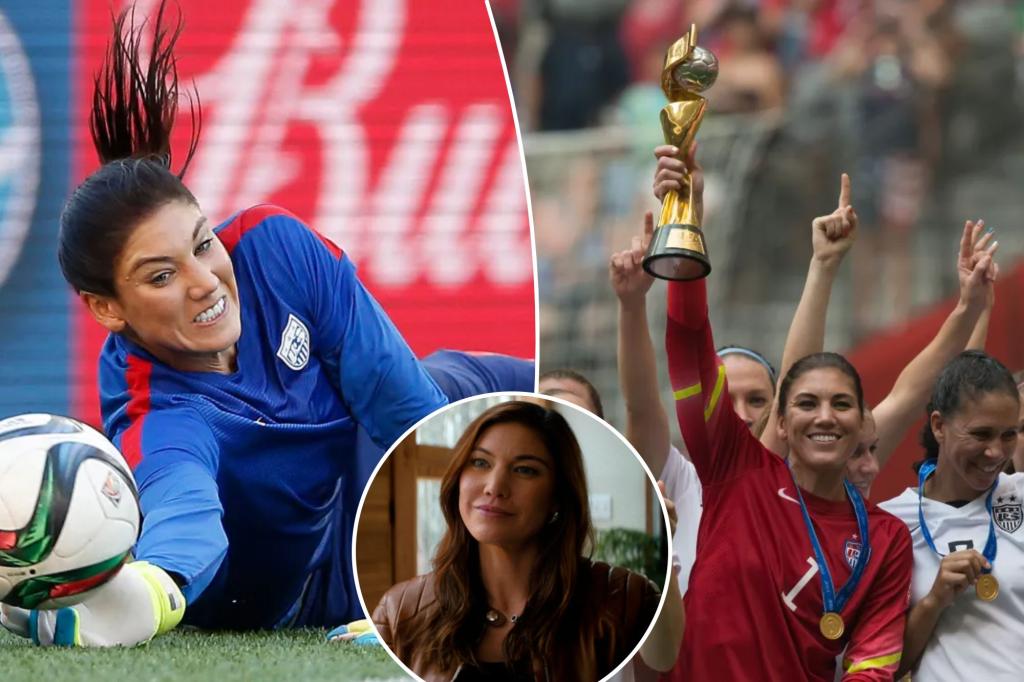
    Hope Solo discusses her career on and off the pitch in the Netflix “Untold” sports series, “Hope Solo vs. U.S. Soccer,” which premieres Sept. 3, 2024. Netflix
    Hope Solo was a long-time goalkeeper for Team USA, playing for the Senior National Team from 2000 to 2016. AP

    In March 2016, Solo and four players — Megan Rapinoe, Alex Morgan, Carli Lloyd, and Rebecca Sauerbrunn — filed an equal employment opportunity complaint for workplace discrimination, citing sex-based wage discrimination, against the US Soccer Federation.

    Solo’s fight started after the U.S. women’s national team won the 2015 World Cup, and she was awarded the Golden Glove.

    “In 2015, I knew that I found something out that I shouldn’t have found out,” Solo said in the documentary. “But at that moment, I had no idea that perhaps I had made an enemy. A year later, I was fired.

    “They said ‘she was a poor sport,’ but really I think it was, I was getting into the money of U.S. Soccer.”

    Hope Solo hoists the trophy as she and her teammates celebrate defeating Japan to win the FIFA Women’s World Cup on July 5, 2015. AP

    Solo was trying to get a home loan when she discovered that she had no working contract.

    Her attempts to reach the players’ association went unanswered.

    “I was told, ‘You’re asking questions beyond your pay grade. Just shut up and play,’” she recalls.

    Hope Solo (top L), Rebecca Sauerbrunn (top R), Alex Morgan (bottom L), and Carli Lloyd (bottom R) discuss their equal employment opportunity complaint for workplace discrimination against the US Soccer Federation on the “Today” show. YouTube

    Solo claims the U.S. women’s soccer team was told they were not allowed to communicate with her — and they listened.

    “It was a way for the federation to make me feel completely removed,” she said, ” …So I think these women are cowardly and controlled by the federation.”

    The following declined to interview directly or through representation for Solo’s documentary: Mia Hamm, Abby Wambach, Megan Rapinoe, Morgan, Lloyd, Julie Foudy, Briana Scurry, Heather O’Reilly, Heather Mitts, Cat Whitehill, Meghan Klingenberg, Jill Ellis, Ashlyn Harris, Stephanie Cox, Kate Markgraf and Ali Krieger. 

    “I was hurt, I felt betrayed by a lot of people. I don’t think people knew how dark of a time it was for me,” Solo said. 

    She never got a farewell game, which is a tradition in U.S. soccer.

    Solo sued the federation separately in August 2018, alleging violations of the federal Equal Pay Act and sex status discrimination.

    That case has not progressed to trial.

    Megan Rapinoe holds up her championship medal alongside Hope Solo during a homecoming ceremony before a match between Seattle Reign and Western New York Flash at Memorial Stadium on July 11, 2015. AP

    Solo, who is considered arguably the greatest goalkeeper of all time, played for the U.S. team from 2000-16 and won a World Cup and two Olympic gold medals. 

    She was inducted into the National Soccer Hall of Fame in 2023.

    “Sitting here today, I refuse to bow down to the federation and these players. I am ready to tell the truth about what it was really like throughout my time on the U.S. team,” Solo said.

    To this day, she disapproves of the U.S. women’s soccer team’s $24 million pay discrimination settlement. 

    It seems clear that Solo doesn’t have a relationship with most, if not all, of her past teammates.

    “It’s been very difficult getting people to interview for this project,” director Nina Meredith said.

    Hope Solo last played professional soccer in 2016. Getty Images

    In the documentary, Solo looks back on her illustrious career and the highs and lows of her personal life — including a domestic violence arrest in June 2014, which was later dropped.

    It also covers Solo’s 2022 arrest on suspicion of DWI when police found her passed out behind the steering wheel of her car with the vehicle’s engine running and the two children in the backseat.

    She was ordered by a judge to attend an alcohol treatment program, pay a fine and serve a license suspension.

    Solo takes responsibility for her past in the documentary.

    “I made a bad decision, a bad mistake and it’s something that I’m going to have to answer to my kids later in life,” she said of her 2022 arrest.

    “It’s something I will never live down.” 

    Source link

  • Hope Solo still refuses to ‘bow down’ to U.S. Soccer Federation

    Hope Solo still refuses to ‘bow down’ to U.S. Soccer Federation

    Hope Solo’s story is still the same 10 years later.

    In the upcoming Netflix “Untold” sports series, “Hope Solo vs. U.S. Soccer” — which premieres Sept. 3 — the former goalkeeper is steadfast in her stance that the U.S. Soccer Federation had ulterior motives for terminating her contract in 2016 — and had her exiled from the team.

    At the time, U.S. Soccer disciplined Solo for what it called “conduct that is counter to the organization’s principles” after the star goalkeeper called Swedish players “a bunch of cowards” following a loss to them in the quarterfinals of the 2016 Olympics.

    In the documentary, Solo and Rich Nichols, her legal counsel in 2016, said she was being punished for her fight for equal pay.

    Hope Solo discusses her career on and off the pitch in the Netflix “Untold” sports series, “Hope Solo vs. U.S. Soccer,” which premieres Sept. 3, 2024. Netflix
    Hope Solo was a long-time goalkeeper for Team USA, playing for the Senior National Team from 2000 to 2016. AP

    In March 2016, Solo and four players — Megan Rapinoe, Alex Morgan, Carli Lloyd, and Rebecca Sauerbrunn — filed an equal employment opportunity complaint for workplace discrimination, citing sex-based wage discrimination, against the US Soccer Federation.

    Solo’s fight started after the U.S. women’s national team won the 2015 World Cup, and she was awarded the Golden Glove.

    “In 2015, I knew that I found something out that I shouldn’t have found out,” Solo said in the documentary. “But at that moment, I had no idea that perhaps I had made an enemy. A year later, I was fired.

    “They said ‘she was a poor sport,’ but really I think it was, I was getting into the money of U.S. Soccer.”

    Hope Solo hoists the trophy as she and her teammates celebrate defeating Japan to win the FIFA Women’s World Cup on July 5, 2015. AP

    Solo was trying to get a home loan when she discovered that she had no working contract.

    Her attempts to reach the players’ association went unanswered.

    “I was told, ‘You’re asking questions beyond your pay grade. Just shut up and play,’” she recalls.

    Hope Solo (top L), Rebecca Sauerbrunn (top R), Alex Morgan (bottom L), and Carli Lloyd (bottom R) discuss their equal employment opportunity complaint for workplace discrimination against the US Soccer Federation on the “Today” show. YouTube

    Solo claims the U.S. women’s soccer team was told they were not allowed to communicate with her — and they listened.

    “It was a way for the federation to make me feel completely removed,” she said, ” …So I think these women are cowardly and controlled by the federation.”

    The following declined to interview directly or through representation for Solo’s documentary: Mia Hamm, Abby Wambach, Megan Rapinoe, Morgan, Lloyd, Julie Foudy, Briana Scurry, Heather O’Reilly, Heather Mitts, Cat Whitehill, Meghan Klingenberg, Jill Ellis, Ashlyn Harris, Stephanie Cox, Kate Markgraf and Ali Krieger. 

    “I was hurt, I felt betrayed by a lot of people. I don’t think people knew how dark of a time it was for me,” Solo said. 

    She never got a farewell game, which is a tradition in U.S. soccer.

    Solo sued the federation separately in August 2018, alleging violations of the federal Equal Pay Act and sex status discrimination.

    That case has not progressed to trial.

    Megan Rapinoe holds up her championship medal alongside Hope Solo during a homecoming ceremony before a match between Seattle Reign and Western New York Flash at Memorial Stadium on July 11, 2015. AP

    Solo, who is considered arguably the greatest goalkeeper of all time, played for the U.S. team from 2000-16 and won a World Cup and two Olympic gold medals. 

    She was inducted into the National Soccer Hall of Fame in 2023.

    “Sitting here today, I refuse to bow down to the federation and these players. I am ready to tell the truth about what it was really like throughout my time on the U.S. team,” Solo said.

    To this day, she disapproves of the U.S. women’s soccer team’s $24 million pay discrimination settlement. 

    It seems clear that Solo doesn’t have a relationship with most, if not all, of her past teammates.

    “It’s been very difficult getting people to interview for this project,” director Nina Meredith said.

    Hope Solo last played professional soccer in 2016. Getty Images

    In the documentary, Solo looks back on her illustrious career and the highs and lows of her personal life — including a domestic violence arrest in June 2014, which was later dropped.

    It also covers Solo’s 2022 arrest on suspicion of DWI when police found her passed out behind the steering wheel of her car with the vehicle’s engine running and the two children in the backseat.

    She was ordered by a judge to attend an alcohol treatment program, pay a fine and serve a license suspension.

    Solo takes responsibility for her past in the documentary.

    “I made a bad decision, a bad mistake and it’s something that I’m going to have to answer to my kids later in life,” she said of her 2022 arrest.

    “It’s something I will never live down.” 

    Source link

  • Fewer Electric Vehicles Will Qualify for U.S. Tax Credits in 2024

    Fewer Electric Vehicles Will Qualify for U.S. Tax Credits in 2024

    Efforts to fight global warming could suffer a setback next year when new rules reduce the number of electric cars that qualify for a federal tax credit.

    The credits, up to $7,500 a vehicle, have helped make electric cars more affordable, bringing the cost of some models below $30,000. Next year, for the first time, dealers will be able to give buyers the credit when they purchase a car, rather than telling them to claim it on their tax returns.

    But qualifying for the subsidy will become more difficult on Jan. 1 because of Biden administration rules intended to encourage automakers to manufacture vehicles and parts in North America, while bypassing China. Most automakers are still years away from breaking their dependence on China for batteries and essential materials like refined lithium.

    The stricter rules, which stem from the Inflation Reduction Act, throw up another impediment to electric vehicles. Sales of such cars and trucks are already growing less briskly than a year ago because of high interest rates and drivers’ anxiety about finding charging stations.

    Electric vehicles are still the fastest-growing segment of the auto industry, and Americans have already bought more than one million this year. Sales will rise another 32 percent in 2024, according to BloombergNEF, compared to 47 percent in 2023. But Ford Motor, General Motors and Tesla have slowed investment as the pace of growth has cooled.

    The list of fully electric vehicles that qualify for tax credits was already limited. Under rules that took effect this year, the credit was available only to cars manufactured in North America.

    To collect the full credit, carmakers also must meet quotas on how much of their battery components and certain raw materials come from the United States or trade allies. Tesla, General Motors, Ford, Volkswagen, Rivian and Nissan are the only companies offering electric cars that qualify for the at least a partial credit. Some plug-in hybrid cars from Audi, BMW, Chrysler, Jeep and Lincoln also qualify for tax breaks.

    New rules kicking in on Jan. 1 add another set of restrictions, disqualifying vehicles containing components made in China or made elsewhere by a firm under the control of the Chinese government.

    “If it was already confusing for consumers, it gets even more confusing,” said Kevin Roberts, director of industry insights and analytics at CarGurus, an online marketplace.

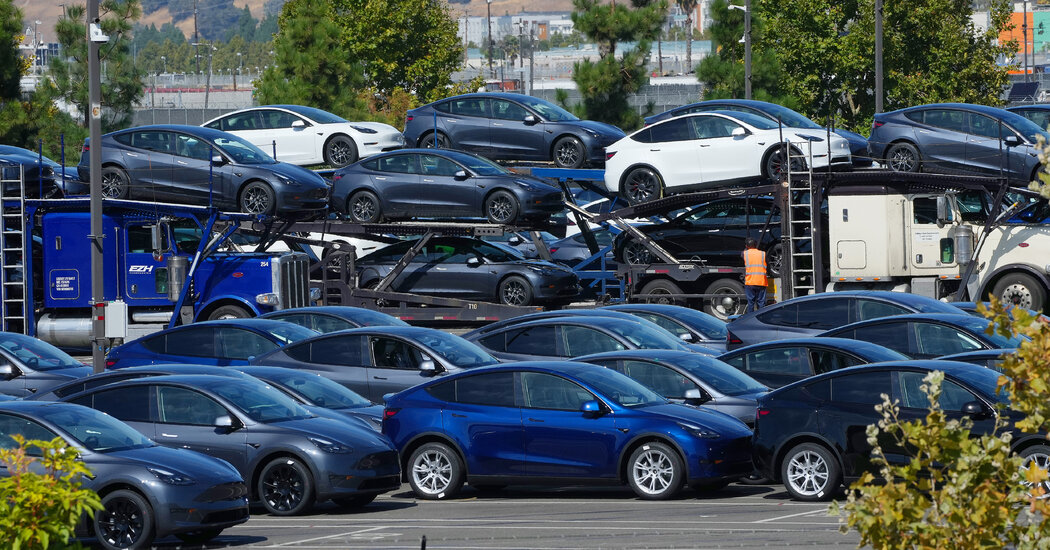
    Tesla, which accounts for half of all the electric vehicles sold in the United States, has warned on its website that the least expensive Model 3 sedan and a long-range version will no longer qualify after Dec. 31. The cars have a battery made in China. The existing credits lowered the price of the base Model 3 to around $30,000, on a par with similarly equipped gasoline cars like the Toyota Camry or Honda Accord.

    The stricter rules will also disqualify Ford’s Mustang Mach-E, which has been eligible for half the credit and was the fourth-most-popular U.S. electric vehicle this year. Ford is still figuring out whether the F-150 Lighting, an electric pickup, will be eligible, a spokesman said.

    The rules are complex and could still be modified by administration officials, leading to confusion among industry executives. In the worst case, only a handful of vehicles will qualify.

    Volkswagen said it is “cautiously optimistic” that its ID.4 electric sport utility vehicle, made in Chattanooga, Tenn., will continue to get the credit.

    General Motors said it is assessing whether its electric lineup, which includes the Chevrolet Bolt and an electric version of the Silverado pickup, will qualify. Nissan, whose electric Leaf is eligible for half of the $7,500 credit, did not respond to a request for comment. Rivian, whose electric pickups and S.U.V.s have qualified, also did not respond.

    There is another way drivers can benefit from the credit. Under an exception intended for businesses with vehicle fleets, the Inflation Reduction Act allows dealers to apply the subsidy to leased vehicles and pass it on to customers. That wrinkle has helped Hyundai and other foreign automakers remain competitive even though they do not produce electric vehicles and batteries in the United States.

    More than 40 percent of Hyundai’s electric vehicle sales are leases, a spokesman said, up from just 5 percent before new restrictions took effect this year. The same provision in the law has allowed people who lease cars made abroad by Mercedes-Benz, BMW, Volvo and Polestar to receive the credit indirectly.

    But leasing is not a panacea. Many people prefer to own their cars, and foreign automakers are sore that they have been excluded from the subsidy available to buyers. The electric vehicle credit “is overly complex and unfortunately creating customer and dealer confusion,” Volvo Cars said in a statement.

    But the lawmakers who drafted and passed the Inflation Reduction Act have said they wrote it to force carmakers to realign their supply chains. That is happening, but the changes will take some time to bear fruit.

    The list of eligible vehicles could grow over the course of 2024 as carmakers ramp up U.S. production to qualify for the credits and other subsidies.

    The Korean automaker Kia expects to begin producing the EV9, a seven-passenger electric sport utility vehicle, at a factory in Georgia next year. Those domestically assembled vehicles should be eligible for half the credit, or $3,750, a Kia spokesman said.

    Stellantis, which owns Chrysler, Dodge, Ram and Jeep, plans to introduce six mass-market electric vehicles in 2024, including versions of the Dodge Charger, Jeep Wagoneer and Ram pickup. The company has not said whether the vehicles will qualify for credits.

    Some hybrids, which have internal combustion engines and electric motors, will also qualify if they meet the sourcing requirements and have a battery with a capacity of at least seven kilowatt-hours.

    The Chrysler Pacifica Hybrid will most likely still be eligible for a $7,500 credit, a company spokesman said, while buyers of the Jeep Grand Cherokee 4xe and Jeep Wrangler 4xe hybrids are expected to be eligible for up to $3,750.

    Market forces are pushing down the prices of electric vehicles, a trend that is expected to continue as carmakers increase production. The average list price of an electric vehicle fell to $63,000 in November from $68,000 a year earlier, according to CarGurus. The average list price of a vehicle with an internal combustion engine was $48,000, the same as in the previous year.

    Federal subsidies and loans for battery factories and electric car plants are also helping to lower prices. At some point during the next several years, analysts expect electric vehicles to become less expensive than internal combustion models even without tax credits.

    “The long-term trend is going to be one of reducing prices,” Mr. Roberts of CarGurus said. “You are going to see more mainstream vehicles.”

    Source link