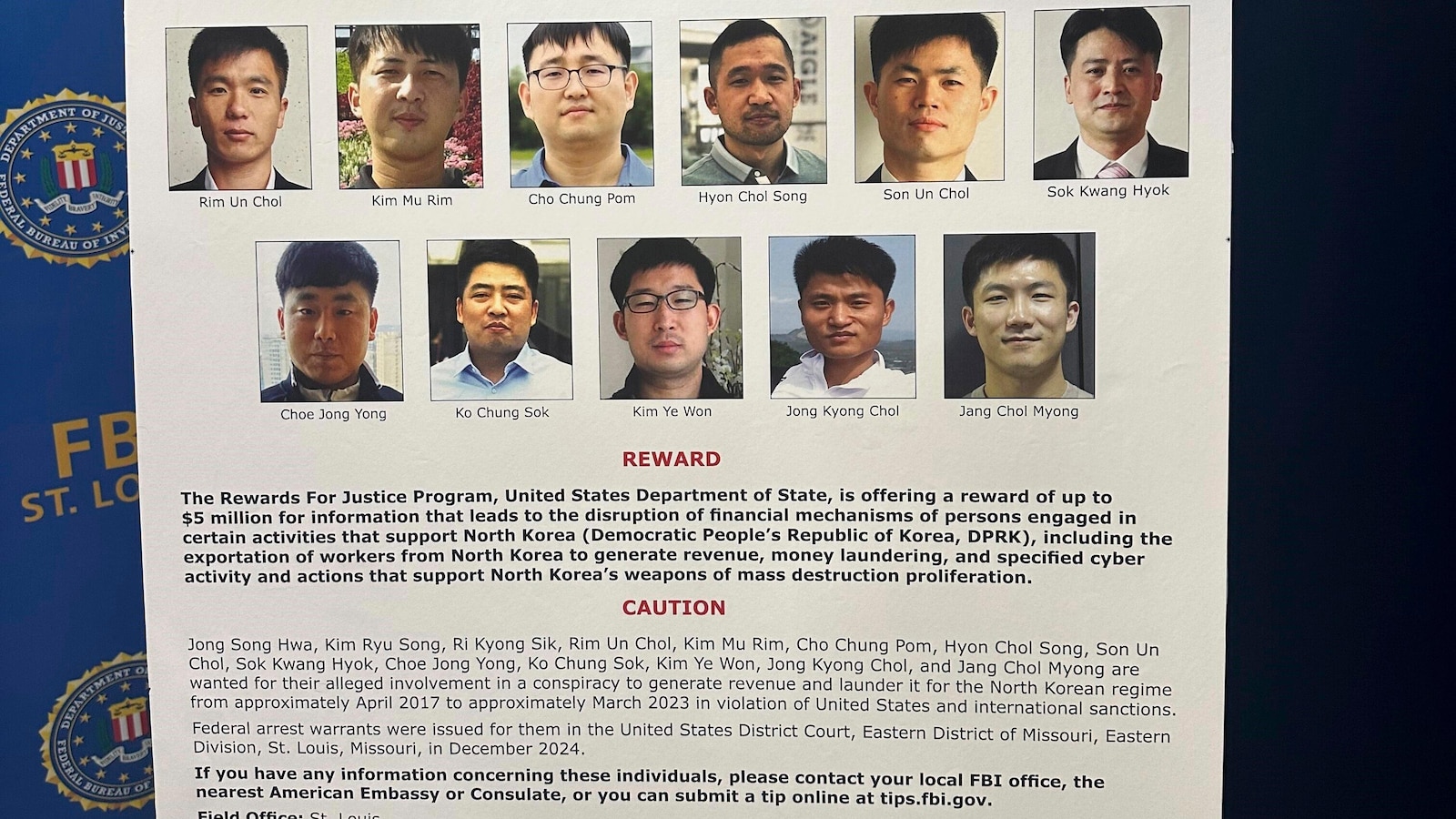
ST. LOUIS — Fourteen North Korean nationals have been indicted in a scheme using information technology workers with false identities to contract with U.S. companies — workers who then funneled their wages to North Korea for development of ballistic missiles and other weapons, the head of the FBI office in St. Louis said Thursday.
The scheme involving thousands of IT workers generated more than $88 million for the North Korean government, Ashley T. Johnson, special agent in charge of the St. Louis FBI office, said at a news conference. In addition to their wages, the workers stole sensitive information from companies or threatened to leak information in exchange for extortion payments, Johnson said.
Victims included defrauded companies and people whose identities were stolen from across the U.S., including Missouri, Johnson said. The indictments were filed Wednesday in U.S. District Court in St. Louis. All 14 people face wire fraud, money laundering, identity theft and other charges.
Most of those accused are believed to be in North Korea. Johnson acknowledged that bringing them to justice will be difficult. To help, the U.S. Department of State is offering a $5 million reward for information leading to any of the suspects.
Federal authorities said the scheme worked like this:
North Korea dispatched thousands of IT workers to get hired and work remotely or as freelancers for U.S. companies. The IT workers involved in the scheme sometimes used stolen identities. In other instances, they paid Americans to use their home Wi-Fi connections, or to pose in on-camera job interviews as the IT workers. Johnson said the FBI is going after those “domestic enablers,” too.
“This is just the tip of the iceberg,” Johnson said. “If your company has hired fully remote IT workers, more likely than not, you have hired or at least interviewed a North Korean national working on behalf of the North Korean government,” Johnson said.
The Justice Department in recent years has sought to expose and disrupt a broad variety of criminal schemes aimed at bolstering the North Korean regime, including its nuclear weapons program.
In 2021, the Justice Department charged three North Korean computer programmers and members of the government’s military intelligence agency in a broad range of global hacks that officials say were carried out at the behest of the regime. Law enforcement officials said at the time that the prosecution highlighted the profit-driven motive behind North Korea’s criminal hacking, a contrast from other adversarial nations like Russia, China and Iran that are generally more interested in espionage, intellectual property theft or even disrupting democracy.
In May 2022, the State Department, Department of the Treasury, and the FBI issued an advisory warning of attempts by North Koreans “to obtain employment while posing as non-North Korean nationals.” The advisory noted that in recent years, the regime of Kim Jong Un “has placed increased focus on education and training” in IT-related subjects.
In October 2023, the FBI in St. Louis announced the seizure of $1.5 million and 17 domain names as part of the investigation. The indictments announced Tuesday were the first stemming from the investigation.
Johnson urged companies to thoroughly vet IT workers hired to work remotely. “One of the ways to help minimize your risk is to insist current and future IT workers appear on camera as often as possible if they are fully remote,” she said.
Officials didn’t name the companies that unknowingly hired North Korean workers.
THE HAGUE, Netherlands — The global chemical weapons watchdog opened an emergency meeting on Thursday to discuss the situation in Syria over concerns about the country’s stockpile of toxic chemicals in the wake of the overthrow of President Bashar Assad.
The Organization for the Prohibition of Chemical Weapons on Monday told Syria that it is under obligations to comply with rules to safeguard and destroy dangerous substances, such as chlorine gas, after rebels entered the capital, Damascus, over the weekend.
“Chemical weapons have been used in Syria on multiple occasions and victims deserve that perpetrators that we identified be brought to justice and held accountable for what they did and that investigations continue,” Fernando Arias González, the OPCW secretary general, said in his opening remarks.
“Our reports over the past few years have reached very clear conclusions and we hope that the new circumstances in Syria will allow this chapter to be closed soon,” he added, referring to the lack of stockpile declarations and the use of the weapons themselves.
In a rare move, the OPCW’s executive council called the meeting, hoping that under a new government, some of its 80 inspectors may be allowed to pursue investigations into Syria’s chemical weapons program.
Members of the ousted Syrian government plan to gradually transfer power to a new transitional Cabinet headed by Mohammed al-Bashir, who reportedly headed the rebel alliance’s “salvation government” in its southwest Syrian stronghold.
Arias González also expressed concern about ongoing Israeli airstrikes in Syria.
“We do not know yet whether these strikes have affected chemical weapons related sites. Such airstrikes could create a risk of contamination. Another real risk would be the destruction of valuable evidence for investigations by different independent international bodies related to past use of chemical weapons,” the Spanish diplomat said.
The last time the OPCW called an extraordinary meeting was in 2018, in response to the chemical attack on Douma, a town close to Damascus, when some 40 people were killed by poison gas. Last year the watchdog found that the Syrian Armed Forces dropped canisters of chlorine gas during a major military operation.
Syria joined the OPCW in 2013 to ward off the threat of airstrikes in response to a chemical attack on the outskirts of Damascus.
The OPCW’s 193 member states are required to disclose their chemical weapons programs and dismantle them. The organization, created in 1997 by the Chemical Weapons Convention, seeks to eliminate all chemical weapons. In 2013, it was awarded the Nobel Peace Prize for its work.
SEOUL, South Korea — North Korea offered a rare glimpse into a secretive facility to produce weapons-grade uranium as state media reported Friday that leader Kim Jong Un visited the area and called for stronger efforts to “exponentially” increase the number of his nuclear weapons.
It’s unclear if the site is at the North’s main Yongbyon nuclear complex, but it’s the North’s first public disclosure of a uranium-enrichment facility since it showed one at Yongbyon to visiting American scholars in 2010. While the latest unveiling is likely an attempt to apply more pressure on the U.S. and its allies, the images North Korea’s media released of the area could provide outsiders with a valuable source of information for estimating the amount of nuclear ingredients that North Korea has produced.
During a visit to the Nuclear Weapons Institute and the production base of weapon-grade nuclear materials, Kim expressed “great satisfaction repeatedly over the wonderful technical force of the nuclear power field” held by North Korea, the official Korean Central News Agency reported.
KCNA said that Kim went around the control room of the uranium enrichment base and a construction site that would expand its capacity for producing nuclear weapons. North Korean state media photos showed Kim being briefed by scientists while walking along long lines of tall gray tubes, but KCNA didn’t say when Kim visited the facilities and where they are located.
KCNA said Kim stressed the need to further augment the number of centrifuges to “exponentially increase the nuclear weapons for self-defense,” a goal he has repeatedly stated in recent years. It said Kim ordered officials to push forward the introduction of a new-type centrifuge, which has reached its completion stage.
Kim said North Korea needs greater defense and preemptive attack capabilities because “anti-(North Korea) nuclear threats perpetrated by the U.S. imperialists-led vassal forces have become more undisguised and crossed the red-line,” KCNA said.
North Korea first showed a uranium enrichment site in Yongbyon to the outside world in November 2010, when it allowed a visiting delegation of Stanford University scholars led by nuclear physicist, Siegfried Hecker, to tour its centrifuges. North Korean officials then reportedly told Hecker that 2,000 centrifuges were already installed and running at Yongbyon.
Satellite images in recent years have indicated North Korea was expanding a uranium enrichment plant at its Yongbyon nuclear complex. Nuclear weapons can be built using either highly enriched uranium or plutonium, and North Korea has facilities to produce both at Yongbyon. It’s not clear exactly how much weapons-grade plutonium or highly enriched uranium has been produced at Yongbyon and where North Korea stores it.
“For analysts outside the country, the released images will provide a valuable source of information for rectifying our assumptions about how much material North Korea may have amassed to date,” said Ankit Panda, an expert with the Carnegie Endowment for International Peace.
“Overall, we should not assume that North Korea will be as constrained as it once was by fissile material limitations. This is especially true for highly enriched uranium, where North Korea is significantly less constrained in its ability to scale up than it is with plutonium,” Panda said.
In 2018, Hecker and Stanford University scholars estimated North Korea’s highly enriched uranium inventory was 250 to 500 kilograms (550 to 1,100 pounds), sufficient for 25 to 30 nuclear devices.
Some U.S. and South Korean experts speculate North Korea is covertly running at least one other uranium-enrichment plant. In 2018, a top South Korean official told parliament that North Korea was estimated to have already manufactured up to 60 nuclear weapons. Estimates on how many nuclear bombs North Korea can add every year vary, ranging from six to as much as 18.
Since 2022, North Korea has sharply ramped up weapons testing activities to expand and modernize its arsenal of nuclear missiles targeting the U.S. and South Korea. Analysts say North Korea could perform nuclear test explosions or long-range missile tests ahead of the U.S. presidential election in November with the intent to influence the outcome and increase its leverage in future dealings with the Americans.
North Korea had conducted test-launches of multiple short-range ballistic missiles on Thursday. In an apparent reference to those launches, KCNA said Kim had supervised test-firing of nuclear-capable 600mm multiple rockets to examine the performance of their new launch vehicles.
The Thracians, an ancient group of tribes inhabiting the Balkans, were infamous for their exceptional warrior culture and distinctive military strategies. With a fierce reputation that struck fear into their adversaries, Thracian warriors played a crucial role in shaping the military history of the region. Known for their brutal weaponry and tactical prowess, they were formidable opponents to their neighbors, including the Greeks and Romans. What made them so deadly? Taking a look at their famous tactics, the gear they carried, and the conflicts they fought in, as well as the evolution of their military, should give us a good idea.
The Thracian Military- Ancient Masters of Guerilla Warfare
Meet The Thracian Warriors. The Thracian people were a diverse group of tribes that occupied the region of Thrace, a vast area that once spanned parts of modern-day Bulgaria, Greece, and Türkiye. Their society was a tribal one, with each tribe maintaining its own identity and customs. These tribes didn’t always get along, but they shared common linguistic, cultural, and religious traits that bound them together.
Thrace held a strategic geographical location which made it a crucial crossroads for both trade and cultural exchange between Europe and Asia. Thanks to this, the Thracians were exposed to various cultural influences, which they readily adapted into their own culture. Despite their fierce reputation as warriors, most Thracians lived an agrarian lifestyle. References to their warlike lifestyle mostly come from ancient historians such as Herodotus and Thucydides, who noted their bravery and skill in battle.
As warriors, the Thracians were known for using guerilla warfare-style tactics, skilled in using the rugged terrain of their homeland to their advantage. They were known for their agility, speed, and ferocity, which made them formidable opponents. Thracian mercenaries were highly sought after by other civilizations, including the Greeks and Persians, who valued their combat skills and hired them for various military campaigns.
Outside of battle, the Thracians were known for their impressive metal work and for rearing some of the region’s most impressive horses. Under the leadership of the Odrysian Kingdom, one of the most powerful Thracian states, the Thracians held enormous influence over the region’s cultural and political landscape. Under the Odrysians,the Thracians enjoyed a centralized authority that unified its many tribes under one ruler. This unification allowed for greater stability and coordination in defense and trade, further enhancing the Thracians’ influence in the Balkans.
Reliable sources of information on the Thracians can be hard to find. Ancient historians often held heavy biases and the Thracians themselves left behind no written record. The first mentions of them come from Greek mythology and literature. Homer’sIliad tells how the Thracian king Rhesus brought his best warriors to aid the Trojans during their fight against the Greeks. Their arrival is marked by their distinctive white horses and impressive armor, underscoring their reputation as elite warriors. Their appearance in such tales emphasizes just how respected, and feared, these mighty tribes were, becoming the stuff of legend.
The Thracians as Tacticians
As warriors the Thracians and the tactics they employed were heavily shaped by the harsh terrain of their homeland. Consisting of mountains, forests, and valleys, this varied terrain meant the Thracians excelled in various forms of warfare. In particular, they were skilled in what we would describe as guerilla warfare today.
The Thracians liked to use hit-and-run attacks. Using the cover of dense forest and rough terrain they would launch surprise attacks on their unsuspecting enemies, striking swiftly and then retreating before the opponent could mount a counterattack. These tactics made them particularly dangerous against larger, more organized armies such as those of the Romans. These armies struggled to adapt to the unpredictable nature of guerilla warfare and couldn’t keep up with the fast-paced nature of Thracian combat.
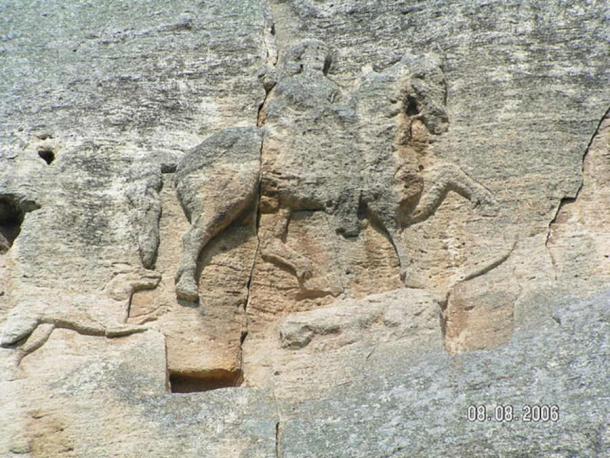
This quick and dirty style of Thracian warfare was reflected in their love of cavalry. The Thracians were known for their light cavalry units, often equipped with javelins and swords. These highly mobile units were great at harassing enemy formations and disrupting the enemy’s ranks. The Thracian infantry would then exploit the gaps made in the enemy’s defense, swarming their ranks.
Madara Rider, Bulgarian relief from the 7th century AD, resembling earlier depictions of the Thracian Horseman. (Public Domain)
Outside of these ragtag tactics, the Thracians also made use of more traditional infantry formations in battle. One notable example was the “crescent” or “V” formations. The Thracian infantry would form a curved line, which lured the enemy into the center. The enemy was then encircled and attacked from all sides, the tactic’s success relying on the Thracian’s superior mobility.
Finally, psychological warfare was a useful tool that the Thracians made ready use of. They would often decorate themselves with war paint, wear animal skins, and use loud war cries to create an aura of fear and unpredictability. This psychological edge, combined with their effective combat techniques, helps to explain why the Greeks placed such emphasis on them as terrifying warriors.
The Thracian Armory- Weapons and Armor
Of course, good tactics will only take an army so far. Thracian warriors were renowned for their distinctive and highly effective weaponry, which set them apart from other ancient military cultures.
Their most iconic weapon was arguably the rhomphaia, a long, single-edged blade that could be used as either a hacking weapon or as a polearm. It had a slightly curved blade mounted on a long handle. This gave the weapon both a reach advantage and increased striking power.
Shown on Tropaeum Traiani Metope. (CristianChirita/BY-SA 3.0)
This meant that the rhomphaia was useful in both close-quarters fighting and mid-range. It was particularly good at breaking through enemy armor and circumventing their shields. The rhomphaia’s design allowed Thracian warriors to engage their enemies with a combination of reach and agility, making it a versatile and deadly weapon on the battlefield.
The Thracians also made clever use of a curved sword known as the falx. It was similar in design to the rhomphaia but shorter, making it more maneuverable. It was a brutal short-range weapon; its curved blade was great at hooking and slashing opponents and bypassing armor and shields. These two weapons were so effective that after encountering them the Romans were forced to modify their armor to account for the powerful slashing attacks.
Besides these two unique weapons, the Thracians were also skilled in using javelins and spears. These ranged weapons allowed them to thin the enemy’s numbers before going in for melee combat. Their javelin throwers were known as peltasts and were known for both their accuracy and the power of their throws.
Peltasts tended to be lightly armored, which allowed for greater mobility in a fight. Their chief form of defense came from the small crescent-shaped shields they carried, called peltes. These were light enough to be carried easily but strong enough to deflect many incoming projectiles.
As for armor, it shouldn’t come as a surprise that the Thracians favored light and flexible protection that didn’t hamper mobility. This was usually leather or linen, sometimes reinforced with metal plates or scales. This style of armor offered a nice balance between protection and flexibility, making it a great fit for Thracian tactics. Thracian helmets were also distinctive, often adorned with animal motifs and plumes, which not only provided protection but also served to intimidate their enemies.
Much like the Peltasts, the Thracian infantry was often equipped with a shield. These ranged from small bucklers to larger, more protective versions depending on the situation and period. Their shields were typically made of wood, covered with leather, and reinforced with metal. The heavier shield could serve a dual role, not only great at blocking incoming attacks but also making good weapons.
Pottery Artwork of a Thracian Peltast fighting a Panther, 5th century BC. (Louvre Museum/CC BY 2.5)
The Evolution of Thracian Warfare
As we mentioned earlier, the Thracian homeland sat at a cultural crossroads. Much like their society in general, Thracian warriors were no strangers to adapting to and incorporating the influences of neighboring cultures. This adaptability was crucial to their sustained prominence in the Balkans.
In the early days of Thracian society, its warfare was characterized by small tribal conflicts and raids. Their tactics were predominantly guerrilla in nature, taking advantage of their intimate knowledge of the local terrain. Early Thracian weapons were simple yet effective, including spears, bows, and knives. As the Thracians began to unite and clash with larger neighboring powers like the Greeks and Persians, they refined their military techniques and equipment to combat these deadly threats.
A major period of change for the Thracian military came during the 5th and 4th centuries BC. The Thracians increasingly encountered the well-organized and equipped armies of the Greek city-states. The influence of Greek military practices led to the adoption of more structured formations and the integration of heavier infantry units.
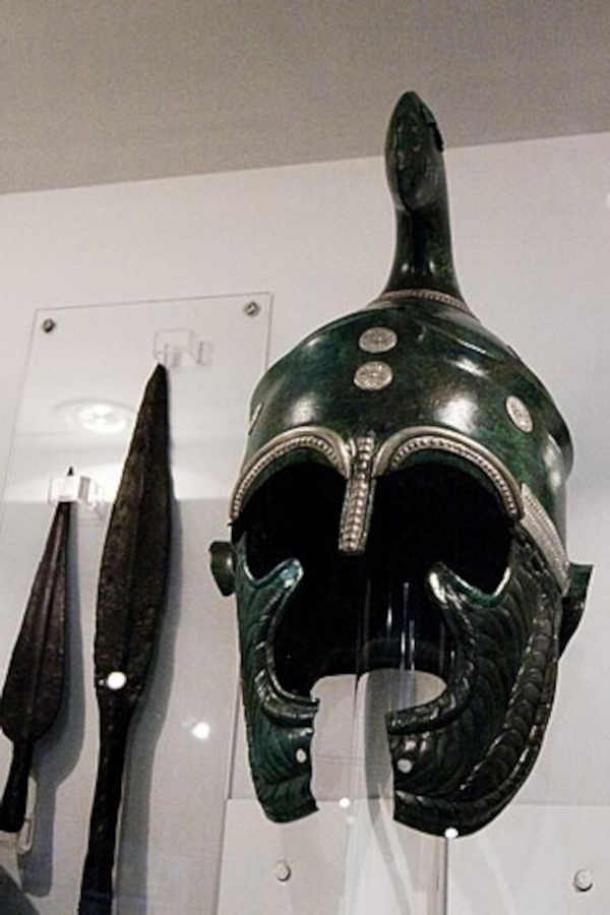
Thracian craftsmen were renowned for their metal work, and it only made sense at this point that their skills be incorporated into Thracian armor. The Thracians began to employ more sophisticated armor and helmets, incorporating metal reinforcements and designs inspired by Greek models.
Traditional Thracian helmet made of Bronze and Silver, 4th century BC. (Ann Wuyts/CC BY 2.0)
The rise of the Odrysians around this time also greatly affected the Thracian warriors. Under the Odrysian kings, the Thracians moved towards a more centralized and coordinated approach to warfare. This unification allowed for the creation of larger, more disciplined armies capable of both offensive campaigns and effective defense against external threats.
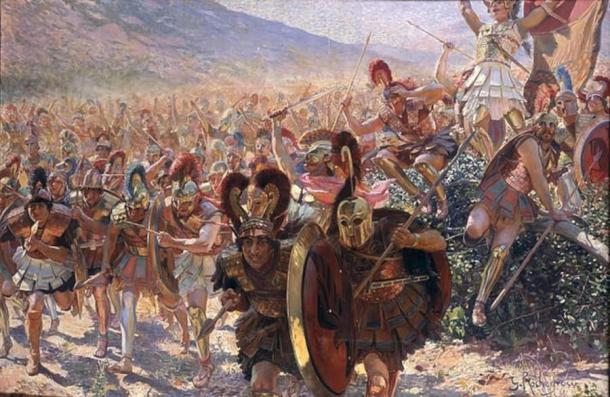
The encounter with the Macedonian army under Philip II and Alexander the Great in the 4th century BC further influenced Thracian military evolution. The Thracians observed and adapted elements of the Macedonian phalanx formation, which emphasized tightly knit infantry units with long spears. This period also saw an increase in the use of cavalry, as the Thracians recognized the strategic advantages of mobile, hard-hitting mounted units.
The Thracians’ Greatest Conflicts
Throughout their history, the Thracians were involved in numerous notable conflicts, both fighting for themselves and as prized mercenaries. Of particular note were their engagements with the Greeks and Romans, during which they showcased their abilities as both fierce warriors and strategic tacticians, as well as their knack for taking on much larger enemies.
Wars with the Greek City-States
Throughout the 5th and 4th centuries BC, the Thracians were frequently involved in conflicts with the Greek city-states. One notable series of engagements was during the Peloponnesian War, where Thracian mercenaries were employed by both the Athenians and the Spartans. Thracian warriors, known for their agility and ferocity, were highly valued as light infantry and cavalry.
In 429 BC, a significant event occurred when the Athenian general Cleon hired a large force of Thracian mercenaries to attack the city of Mycalessus in Boeotia. The Thracians, notorious for their brutality, sacked the city, killing many of its inhabitants. This event highlighted the Thracians’ effectiveness in warfare but also their reputation for ruthlessness.
The rise of the Odrysian Kingdom in the 5th century BC marked a period of consolidation and expansion for the Thracians. The Odrysian kings, such as Sitalces and Seuthes I, sought to unify the Thracian tribes and establish a powerful state capable of influencing regional politics. One particularly significant conflict during this period was the war between the Odrysian Kingdom and the Macedonians under King Philip II.
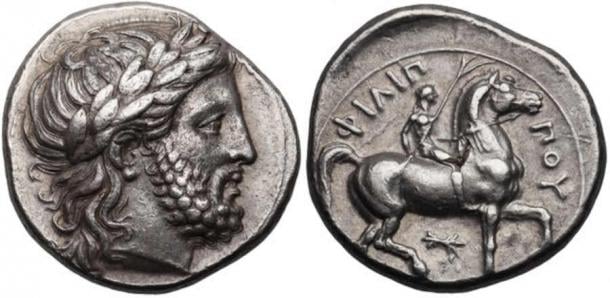
In 342 BC, Philip II of Macedon launched a campaign against the Odrysian Kingdom, aiming to secure his northern borders and gain control over Thrace. The Thracians, under King Cersobleptes, resisted fiercely but were ultimately defeated. This conflict demonstrated the resilience and tactical acumen of the Thracian warriors, even in the face of an overwhelming opponent like the Macedonians.
Silver tetradrachm dated to the reign of Philip II. The legend along the top reads ΦΙΛΙΠΠΟΥ (Philip). (Ancientcoincollector/CC BY-SA 4.0)
The Thracian Revolt Against Rome
One of the most significant and well-documented conflicts involving the Thracians was their series of revolts against the Roman Empire. The Thracians fiercely resisted Roman domination, leading to several notable uprisings.
The most famous of these revolts was the Great Thracian Revolt, which began in 4 AD. Led by the chieftain Vologaesus, the Thracians launched a large-scale rebellion against Roman rule, capitalizing on the empire’s internal strife and external threats. The revolt saw the Thracians employing their traditional guerrilla tactics, ambushing Roman forces and utilizing their knowledge of the rugged terrain to their advantage.
Thracian warriors. (Osama Shukir Muhammed Amin FRCP(Glasg)/CC BY-SA 4.0)
Although primarily involving the Roman conquest of Britain, the Battle of Mons Graupius in 83 AD saw the participation of Thracian auxiliary troops fighting for the Romans. This battle fought in Scotland against the Caledonians, showcased the versatility and combat effectiveness of Thracian warriors even when serving as part of a larger Roman force. The Thracians, known for their agility and expertise in skirmish warfare, played a crucial role in the Roman victory.
Conclusion
Even after Rome had conquered Thrace its warriors’ reputation as some of the region’s most fearsome warriors continued. Rather than discouraging this the Romans made sure to incorporate them into their military. It’s easy to see why.
From their early mythological depictions in the “Iliad” to their significant engagements with the Greeks, Macedonians, and Romans, the Thracians made a name for themselves as some of history’s greatest warriors. Their adaptability and unique combat strategies allowed them to stand out among their contemporaries, maintaining their relevance and influence over centuries. Their civilization may have ultimately been swallowed up and forgotten but Thrace’s warriors certainly left their mark on history.
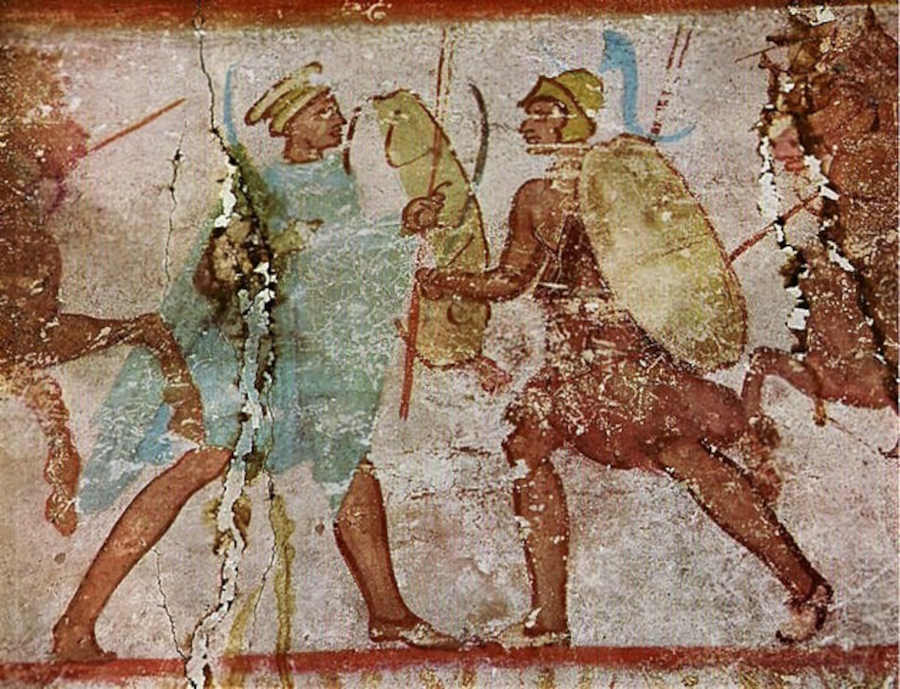
Top image: Thracian Warriors fresco, 4th century BC.Source: Public Domain