Once thought to be a problem of the elderly, stroke is affecting more and more young and healthy individuals. Hospitals report a surprisingly sharp increase in young stroke patients. This trend was virtually nonexistent just a few years ago. Doctors attribute this to a combination of lifestyle choices, increased stress and a rise in chronic health conditions, the Times of India reported.
Dr Raghuram G, additional director of neurosurgery at Fortis Hospital said:
“We are now seeing two cases of youngsters experiencing stroke every week. The rise in cases of people in their 30s experiencing stroke every week is alarming, probably influenced by modern lifestyles. Diets rich in junk food and unhealthy fats, accompanied by demanding work schedules and lack of sleep, are key factors. Since the Covid pandemic, we have seen an increase in the number of strokes due to the increased tendency for blood to clot, which can lead to clots forming in the brain vessels.”
Just five years ago, young stroke patients were rare and often associated with certain conditions such as lupus or genetic disorders.
Dr Santosh NS, consultant neurologist at Manipal Hospitals, noted that stroke in persons under 40, defined as stroke at an early age, now accounts for 10-15% of all stroke cases. “One common cause is arterial dissection, in which blood vessels in the neck rupture due to abnormal postures or movements, such as turning the head when visiting a hairdresser,” he explained.
These young stroke patients face a variety of risk factors that require different approaches to treatment and prevention. Risks that can be altered, such as smoking and exposure to cigarette smoke, can significantly increase the likelihood of stroke. “Avoiding exposure to second-hand cigarette smoke is key,” emphasized Dr. Santosh. Manipal hospitals have an average of 2-3 cases of young stroke patients per week.
Dr Amit Kulkarni, senior consultant and head of the neurology and stroke department at Sakra World Hospital, explains the alarming trends:
“We are now seeing strokes in patients in their late 20s and early 30s. Factors such as hypertension, diabetes and high cholesterol are prevalent, often due to sedentary lifestyles. Lifestyle choices and obesity contribute to conditions such as obstructive sleep apnea, which can exacerbate hypertension and lead to stroke.”
According to Sakra World, one in four stroke patients comes from younger age groups.
Achieving a healthy balance
29 October is World Stroke Day. Here are some precautions you can take to stay healthy:
Exercise regularly (30 minutes a day)
Eat a balanced diet rich in fruits, vegetables, whole grains and lean proteins.
Prioritize 7-8 hours of sleep per day
Stay hydrated
Limit time in front of screens
Practice stress reduction techniques
Schedule regular health checkups
Don’t skip meals, don’t eat too much sugar, salt and unhealthy fats, don’t neglect physical activity, don’t smoke, don’t consume excessive amounts of alcohol, don’t compromise on sleep and don’t ignore your mental health. | BGNES
Jean Longfield, who helped launch the Gift of Giving Back charity more than 20 years ago, poses for a photo in the Feed Halton food bank, in Burlington, Ont., on Oct. 23.Christopher Katsarov /The Globe and Mail
The organizer: Jean Longfield
The pitch: Creating the Gift of Giving Back
The reason: To teach children about philanthropy and support several charities
Jean Longfield wanted her son to experience more than sports when he joined the Burlington Eagles hockey team at the age of nine.
Ms. Longfield watched the boys pick out new hockey sticks, skates and other equipment and she thought about the less fortunate children in the community who didn’t have the same opportunities. So with the help of a couple of other parents, she got the team together and sent the boys out into the neighbourhood, having them go door-to-door asking for donations to the local food bank. They quickly filled up a couple of wagons and some hockey bags.
“The kids loved it. It was a highlight in their year,” Ms. Longfield, 74, recalled from her home in Burlington, Ont.
That outing led her to launch the Gift of Giving Back charity in 2005. Over the years, the food drive has expanded to several dozen hockey teams in Burlington and neighbouring Oakville. They all collect food and financial contributions for 10 organizations, including the Burlington Food Bank, Salvation Army, Kerr Street Mission and Halton Women’s Place.
Every spring as the teams are selected, each captain is tasked with organizing players for the food drive, which kicks off in the fall. The donations are stored in the gymnasium of a high school that also joins the drive. Last year, the players and students collected $1-million worth of food and money.
“Once we put the structure in place, the kids really, really embraced it,” Ms. Longfield said.
She added that the charity is about more than food drives. “Our whole goal in this was to make our kids kinder and more compassionate and to know about the vulnerable people in the community, and about kids growing up in families where they need help,” she said.
Ms. Longfield hopes hockey teams across the country will consider organizing a similar charity. “We’ve always known that kids can be extremely powerful change makers in a community, because we’ve always seen it. If you give them the guidance, the structure, the encouragement and the tools, they’ll take that and they’ll run with it.”
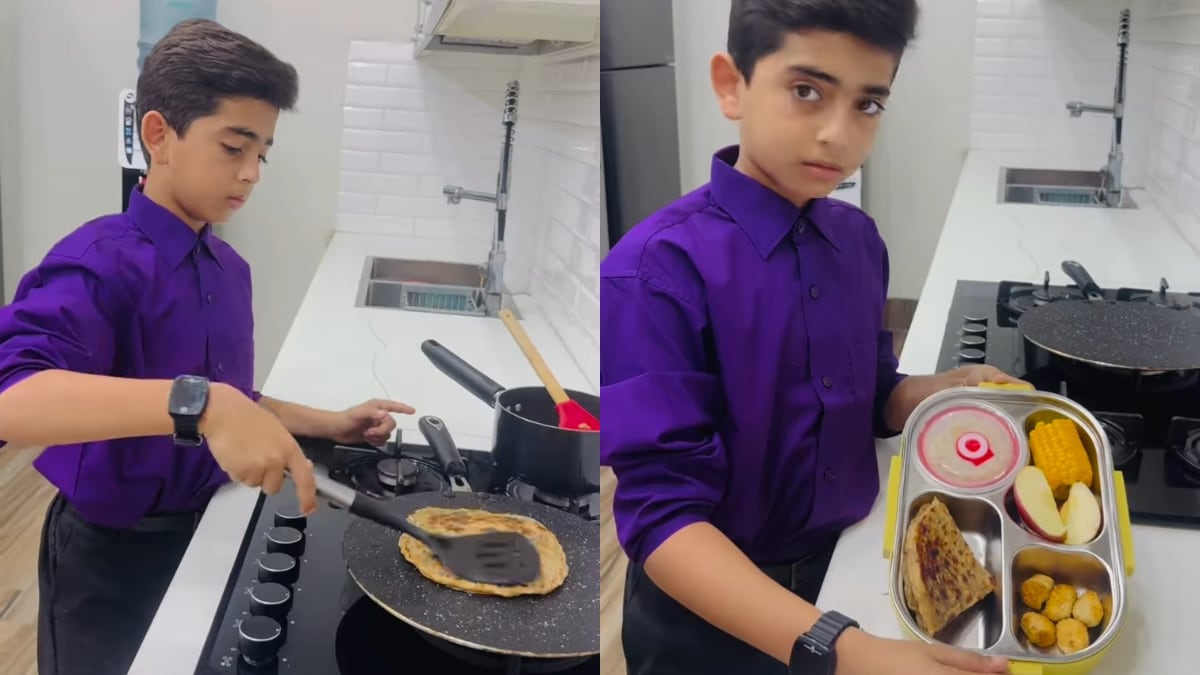
Recently, a video showing a young boy making his own tiffin meal, allegedly before dawn, has taken Instagram by storm. In the reel by @life_of_two_boys, we see the child, dressed formally in trousers and a shirt, put together various elements of his lunch box. He opens the refrigerator to take out atta (roti dough) that has already been kneaded and a packet of what seems to be chicken nuggets from the freezer. He places some of the latter in an air fryer. He also opens a packet of instant noodles and allows them to cook for a few minutes. Also Read:7 Evergreen Tiffin Options Every 90s Kid Will Instantly Recognise
In the meantime, he rolls out the dough to make a double-layered paratha. One of the layers contains a chocolate spread. He carefully seals the edges of the paratha and then cooks it on the tawa with a little oil. As it roasts, he uses a special slicer to cut through an apple in a single go from the top. He is then seen placing the apple pieces in a bowl of water. Next, he cuts up the paratha into 4 pieces and shows it off to the camera with a thumbs up.
He gets his lunch box out on the kitchen counter and starts filling up its different sections with his prepared food. One locked box contains the instant noodles, while the paratha and nuggets go into separate sections. In the last one, he places some apple slices and a halved piece of sweet corn on the cob. He is seen taking a bite of the paratha and enjoying it before he seals his tiffin box closed. The text on the video simply reads, “It’s 4 am. Let’s make my ‘lunch box’.” Take a look below:
Also Read:‘Cutest Chef’: Dadi’s Aloo Tikki Burger Recipe Leaves Internet Impressed – Watch Video The viral video has received 8 million views so far. In the comments, many people were impressed by the young boy’s skills. Some made jokes about how he was the adult in the house or how they could never match up to him. Check out how some Instagram users reacted below:
“Little bro drops his parents to work and then goes to school.”
“It’s becoming harder to raise parents these days.”
“Acha hai Meri mama Instagram use nahi karti.” [“It’s a good thing that my mom does not use Instagram.”]
“Thank God you do not live in my home.”
“He embarrassed me without saying anything.”
“When it’s dal roti every day and you need to take matters into your own hands.”
“Every parent’s dream child.”
“Super proud of you that you are teaching such important skills to your sons! Such a proud moment. Exceptional.”
Videos showing young cooks making elaborate dishes often go viral. Before this, a reel by Kian Hiatt, a young food content creator, grabbed the attention of many Indians. In it, he is seen making the beloved and delicious-looking combo of butter chicken and naan. Click here to read the full story. Also Read:Viral Video: Alpacas Roaming Inside A Taiwan Cafe Leaves Internet Surprised
Nigeria kicked off their FIFA U17 Women’s World Cup journey in style, securing a commanding 4-1 win against New Zealand’s Young Football Ferns.
The Flamingos displayed a strong start, finding the back of the net within just two minutes as Shakirat Moshood calmly converted a pass from Harmony Chidi.
In the 13th minute, Taiwo Adegoke extended Nigeria’s lead after capitalizing on a mistake by Brooke Neary, with an assist from Faridat Abdulwahab.
Abdulwahab then showcased her skills by scoring a spectacular goal in the 27th minute, receiving a pass from Shakirat Moshood.
The second half began with Nigeria taking the lead once again, as Taiwo Afolabi scored in the 56th minute with an assist from Taiwo Adegoke.
New Zealand responded in the 62nd minute with Hannah Saxon scoring their only goal, assisted by Ela Jerez.
With this win, Nigeria currently leads the group with three points and is set to face newcomer Ecuador in their next match.
Allnigeriasoccer,com presents five takeaways from the game.
Dominant First Half Performance
The Flamingos showcased an impressive performance, clearly evident by their three unanswered goals scored in the first half.
Nigeria controlled the match against New Zealand, excelling in all facets of the game and preventing their opponents from finding any rhythm.
Although Nigeria began the second half with strong momentum, New Zealand gradually found their footing as the game progressed.
High Line Defense
Nigeria implemented a high line defense against New Zealand, effectively hindering the host’s ability to build play from the back.
Throughout the match, the Flamingos’ defenders positioned themselves near the center circle, maintaining a high line that kept New Zealand’s forwards in an offside position.
Disappointing Night for Brook Neary
New Zealand’s goalkeeper, Brook Neary, faced a challenging and frustrating night, marked by two critical errors that contributed to Nigeria’s goals.
Her mistake directly led to Nigeria’s second goal, and she could have performed better on the third goal in the first half.
Choreography Celebration From Nigeria
The Flamingos showcased a distinctive choreography celebration following their goals against New Zealand.
After each goal, the Nigerian team would come together to perform a choreographed dance in front of their fans and coaching staff, concluding with a salute to both the technical crew and the audience.
This celebration was repeated after every goal scored by the Flamingoes.
Taiwo Adegoke and Faridat Abdulwahab Impress
Taiwo Adegoke and Faridat Abdulwahab stood out for Nigeria as they excelled in both defense and midfield during the match.
Both players not only scored during the game but also assisted the second and the fourth goal.
Adeyemi Adewale
Photo Credit: The Super Falcons show
Copyright ANS All rights reserved. This material, and other digital content on this website, may not be reproduced, published, rewritten or redistributed in whole or in part without prior express written permission from allnigeriasoccer.com
Former Nigerian striker, Jonathan Akpoborie, has warned young footballers to desist from living extravagant lifestyles.
In an interview with Elegbete TV Sports, the 55-year-old recounted how he used to travel from his former club side, Stuttgart in Germany, to Lagos, every fortnight.
He noted that while he grew up in the Ajegunle part of Lagos State, the distance between the community and Stuttgart in Germany, wasn’t much — asserting that it was easy for him to switch places within a little time without stress.
“I grew up in Ajegunle. I saw everywhere before I travelled from Nigeria. There is always a difference, you know, when you close your eyes. As I’m here now, in the evening, my friends might call me and I am in Ajegunle.
“Sometimes, I am coming back from America [sic], I drop my bag at home here, and I am in Ajegunle. That difference — you close your eyes and you are in Ajegunle. If you cannot learn from that, there is nothing that will be able to teach you.
“The problem when you have money, it pushes you to do a lot of things. If you don’t get control [over money], you will lose it, and when you lose it, it is a deep fall. That is why I am praying for these young ones that are playing now that they should be very wise,” he advised.
He recalled his playing days at Stuttgart where he and some colleagues would hire a private jet, say, “after a game,” and fly to different places outside Germany, like Spain.
Then, they would rent a villa and stay overnight while they enjoy themselves. The following day, they are back to their base in Stuttgart, and pretend as if nothing had happened.
Akpoborie said, “I remember while I was in Stuttgart, there were so many things that we did. There were things that, maybe after a game, seven or eight people would come together and we just take a private jet, because you can’t enjoy yourself in Stuttgart. There are reporters everywhere you go.
“So, you guys fly, you are in Spain, rent a villa. We stay overnight, do whatever you want to do, and the next morning, the private jet brings you back,” saying, “It is that power of money.”
He added, “I can tell you, when I was in Stuttgart, every two weeks, I was in Lagos, at the Sheraton. On Sunday or Monday, I am back in Germany, my family won’t know.”
When asked what particularly made him always return to Lagos, he said, “Lagos is Lagos, my friends are my friends, so you can’t stay away from home. But even then, there were so many things because you had that money; it pushed you every time. That is why I started by praying that those guys will identify and start doing things responsibly, because when money pushes you, you will do things [sic] you won’t believe you did.”
Akpoborie also spoke on how he found himself in an unexpected call-up to the Super Eagles during a game against Togo, following a hearty meal of pounded yam at the home of Honourable Nduka Irabor.
Former Nigerian striker, Jonathan Akpoborie, has warned young footballers to desist from living extravagant lifestyles.
In an interview with Elegbete TV Sports, the 55-year-old recounted how he used to travel from his former club side, Stuttgart in Germany, to Lagos, every fortnight.
He noted that while he grew up in the Ajegunle part of Lagos State, the distance between the community and Stuttgart in Germany, wasn’t much — asserting that it was easy for him to switch places within a little time without stress.
“I grew up in Ajegunle. I saw everywhere before I travelled from Nigeria. There is always a difference, you know, when you close your eyes. As I’m here now, in the evening, my friends might call me and I am in Ajegunle.
“Sometimes, I am coming back from America [sic], I drop my bag at home here, and I am in Ajegunle. That difference — you close your eyes and you are in Ajegunle. If you cannot learn from that, there is nothing that will be able to teach you.
“The problem when you have money, it pushes you to do a lot of things. If you don’t get control [over money], you will lose it, and when you lose it, it is a deep fall. That is why I am praying for these young ones that are playing now that they should be very wise,” he advised.
He recalled his playing days at Stuttgart where he and some colleagues would hire a private jet, say, “after a game,” and fly to different places outside Germany, like Spain.
Then, they would rent a villa and stay overnight while they enjoy themselves. The following day, they are back to their base in Stuttgart, and pretend as if nothing had happened.
Akpoborie said, “I remember while I was in Stuttgart, there were so many things that we did. There were things that, maybe after a game, seven or eight people would come together and we just take a private jet, because you can’t enjoy yourself in Stuttgart. There are reporters everywhere you go.
“So, you guys fly, you are in Spain, rent a villa. We stay overnight, do whatever you want to do, and the next morning, the private jet brings you back,” saying, “It is that power of money.”
He added, “I can tell you, when I was in Stuttgart, every two weeks, I was in Lagos, at the Sheraton. On Sunday or Monday, I am back in Germany, my family won’t know.”
When asked what particularly made him always return to Lagos, he said, “Lagos is Lagos, my friends are my friends, so you can’t stay away from home. But even then, there were so many things because you had that money; it pushed you every time. That is why I started by praying that those guys will identify and start doing things responsibly, because when money pushes you, you will do things [sic] you won’t believe you did.”
Akpoborie also spoke on how he found himself in an unexpected call-up to the Super Eagles during a game against Togo, following a hearty meal of pounded yam at the home of Honourable Nduka Irabor.
Former Nigerian striker, Jonathan Akpoborie, has warned young footballers to desist from living extravagant lifestyles.
In an interview with Elegbete TV Sports, the 55-year-old recounted how he used to travel from his former club side, Stuttgart in Germany, to Lagos, every fortnight.
He noted that while he grew up in the Ajegunle part of Lagos State, the distance between the community and Stuttgart in Germany, wasn’t much — asserting that it was easy for him to switch places within a little time without stress.
“I grew up in Ajegunle. I saw everywhere before I travelled from Nigeria. There is always a difference, you know, when you close your eyes. As I’m here now, in the evening, my friends might call me and I am in Ajegunle.
“Sometimes, I am coming back from America [sic], I drop my bag at home here, and I am in Ajegunle. That difference — you close your eyes and you are in Ajegunle. If you cannot learn from that, there is nothing that will be able to teach you.
“The problem when you have money, it pushes you to do a lot of things. If you don’t get control [over money], you will lose it, and when you lose it, it is a deep fall. That is why I am praying for these young ones that are playing now that they should be very wise,” he advised.
He recalled his playing days at Stuttgart where he and some colleagues would hire a private jet, say, “after a game,” and fly to different places outside Germany, like Spain.
Then, they would rent a villa and stay overnight while they enjoy themselves. The following day, they are back to their base in Stuttgart, and pretend as if nothing had happened.
Akpoborie said, “I remember while I was in Stuttgart, there were so many things that we did. There were things that, maybe after a game, seven or eight people would come together and we just take a private jet, because you can’t enjoy yourself in Stuttgart. There are reporters everywhere you go.
“So, you guys fly, you are in Spain, rent a villa. We stay overnight, do whatever you want to do, and the next morning, the private jet brings you back,” saying, “It is that power of money.”
He added, “I can tell you, when I was in Stuttgart, every two weeks, I was in Lagos, at the Sheraton. On Sunday or Monday, I am back in Germany, my family won’t know.”
When asked what particularly made him always return to Lagos, he said, “Lagos is Lagos, my friends are my friends, so you can’t stay away from home. But even then, there were so many things because you had that money; it pushed you every time. That is why I started by praying that those guys will identify and start doing things responsibly, because when money pushes you, you will do things [sic] you won’t believe you did.”
Akpoborie also spoke on how he found himself in an unexpected call-up to the Super Eagles during a game against Togo, following a hearty meal of pounded yam at the home of Honourable Nduka Irabor.
Former Nigerian striker, Jonathan Akpoborie, has warned young footballers to desist from living extravagant lifestyles.
In an interview with Elegbete TV Sports, the 55-year-old recounted how he used to travel from his former club side, Stuttgart in Germany, to Lagos, every fortnight.
He noted that while he grew up in the Ajegunle part of Lagos State, the distance between the community and Stuttgart in Germany, wasn’t much — asserting that it was easy for him to switch places within a little time without stress.
“I grew up in Ajegunle. I saw everywhere before I travelled from Nigeria. There is always a difference, you know, when you close your eyes. As I’m here now, in the evening, my friends might call me and I am in Ajegunle.
“Sometimes, I am coming back from America [sic], I drop my bag at home here, and I am in Ajegunle. That difference — you close your eyes and you are in Ajegunle. If you cannot learn from that, there is nothing that will be able to teach you.
“The problem when you have money, it pushes you to do a lot of things. If you don’t get control [over money], you will lose it, and when you lose it, it is a deep fall. That is why I am praying for these young ones that are playing now that they should be very wise,” he advised.
He recalled his playing days at Stuttgart where he and some colleagues would hire a private jet, say, “after a game,” and fly to different places outside Germany, like Spain.
Then, they would rent a villa and stay overnight while they enjoy themselves. The following day, they are back to their base in Stuttgart, and pretend as if nothing had happened.
Akpoborie said, “I remember while I was in Stuttgart, there were so many things that we did. There were things that, maybe after a game, seven or eight people would come together and we just take a private jet, because you can’t enjoy yourself in Stuttgart. There are reporters everywhere you go.
“So, you guys fly, you are in Spain, rent a villa. We stay overnight, do whatever you want to do, and the next morning, the private jet brings you back,” saying, “It is that power of money.”
He added, “I can tell you, when I was in Stuttgart, every two weeks, I was in Lagos, at the Sheraton. On Sunday or Monday, I am back in Germany, my family won’t know.”
When asked what particularly made him always return to Lagos, he said, “Lagos is Lagos, my friends are my friends, so you can’t stay away from home. But even then, there were so many things because you had that money; it pushed you every time. That is why I started by praying that those guys will identify and start doing things responsibly, because when money pushes you, you will do things [sic] you won’t believe you did.”
Akpoborie also spoke on how he found himself in an unexpected call-up to the Super Eagles during a game against Togo, following a hearty meal of pounded yam at the home of Honourable Nduka Irabor.
Mike Locksley knows the look by heart. It’s the one on an athlete’s face that tells you something is wrong.
It’s the one, he says, where you can see a person’s soul.
The three-decade college football coach has seen it on his players, and he saw it on his child.
“I didn’t understand it until it affected me,” says Locksley, Maryland’s head football coach. “I had no idea what they were going through.”
On Sept. 3, 2017, while Locksley was working as an Alabama assistant coach in a season-opening game in Atlanta, his son, Meiko was shot and killed outside a townhouse in Columbia, Maryland. The case remains mostly unsolved.
In the years leading up to his death, Meiko, a 25-year-old former Division I football player, had been diagnosed with schizoaffective disorder. He struggled, his parents say, with distinguishing myth from reality. Locksley and his wife, Kia, believe Meiko’s decline in mental health may have been a factor in his murder.
“The tragedy of losing my son, it opened my eyes,” Locksley says. “My son is struggling with these same looks I’ve seen before, and I didn’t recognize them. It hurts me a little bit because now, thinking back to the first 20 years of my profession, I had no idea what mental health meant, what it was about. We joke openly about, ‘Oh somebody’s crazy.’ I think you don’t get the same empathy.”
Locksley spoke with USA TODAY Sports at the Project Play Summit last spring in Baltimore, where he participated on a panel about health equity in youth sports. He talked openly about his transformation from a self-labeled “old school” football coach to one who understands players’ psychological struggles.
“You don’t have to be a tough guy if you went through some depression or you’re going through anxiety,” he says.
One in every four to five adolescents and adults can meet the criteria for a mental health concern every year in the United States, Timothy Neal, director of the athletic training program at Concordia University Ann Arbor in Michigan, said in a presentation this past summer. He was speaking at a National Athletic Trainers’ Association (NATA) media briefing that addressed mental health challenges Olympic athletes face.
“Many athletic trainers at the Olympic level, the collegiate level, the secondary school level will tell you many of those worst moments for athletes are psychological in nature,” he said.
As we enter the grind of the fall sports season, you might see that look, too. Here is how parents and coaches can notice and understand signs of emotional distress in young athletes and, as Locksley says, “create a safe environment where mental health is real.”
Mental health issues are normal at all ages and levels. The stigma associated with them prevents us from treating them.
Neal has chaired writing groups of two of the NATA’s consensus statements on secondary school and collegiate athletes and psychological concerns.
As a licensed social worker who has had psychotherapy sessions with athletes, he has found the higher your athletic identity, the less likely you are to seek psychological help. Think of Locksley’s old tough-guy approach.
“As a football coach, to be talking about mental health and not being in a good space, that wasn’t a typical conversation in a football locker room,” he says.
When the 54-year-old coach was growing up in Southeast Washington, D.C., he said nobody talked about mental health.
“It was your aunt had a mental breakdown or your aunt is not feeling well,” he said as part of the panel at Project Play. “Well, what does that mean? So we embrace it. We make it easy to come in and talk about it. We teach blocking, tackling, running, catching, throwing. Well, how can we teach the mental development of these young players?”
The topic has always seemed to have a stigma attached to it in all sports. Simone Biles’ case of “the twisties” that forced her to re-examine her mental health brought it attention. The NATA briefing revealed there are other Olympians dealing with similar issues.
“Inside I’m jumping for joy, because this is such an important topic for us,” said Clayton Young, an American Olympic marathoner who competed in Paris this summer. “There’s so much focus on our performance, but our mental health is just as important.”
Emma Coburn, a three-time American Olympian in steeplechase and a bronze medal winner in 2016 in Rio, talked about breaking her ankle this past spring and the strain of being unable to compete in this year’s trials.
“Coming off of an injury last year where I had finally kind of built my body back up, and not having a chance to show that was really kind of the emotionally more challenging part than missing Paris, in a way,” she said.
Olympians have performance anxiety just like young athletes. Locksley spoke of it with his players, as did Juliet Barnes, head athletic trainer for the U.S. women’s soccer team that won gold in Paris. Barnes supports them by referring them to a mental health provider or to apps such as Calm or Headspace that can take them through meditation or breathing exercises.
Sometimes, the strategy is simply an athlete visualizing herself performing well or making a certain movement that was previously inhibited by an injury.
“My wife’s a yogi,” Locksley says. “Meditation, sound baths, she’s into all of that. I used to be like, ‘That’s not for football.’ But no, it’s even more because it’s more mental than physical.”
Know the triggers for mental health issues and your association with them
As parents and coaches, we need to try and understand what our athletes are going through, but also the place from where they arrive.
Locksley, who played basketball and football at Towson State (now Towson University), was the first member of his family to graduate from college.
“These kids that come from the neighborhoods that I come from, the pressure they have on them to be successful in the sport that I’m coaching creates a tremendous amount of mental anxiety, pressure,” Locksley says. “A lot of them already have enough on their plate where they’re (from) single-parent homes, they’re breadwinners in their family. They have this enormous luggage that they’ve never unpacked of trauma, tragedy, things that have taken place that, when they come to college, for some of them like me, it was the first time in a setting with people of a different race.
“I grew up in a predominantly Black educational system and the first time I went and sat in a classroom with a white person was in college and so that in itself created anxiety.”
Locksley took the reins as Maryland’s full-time head coach in 2019. He inherited a group of players who had lost teammate Jordan McNair, who died of heatstroke in 2018, a harrowing episode in which McNair collapsed on the field during a workout. It was about a year after Locksley’s son died.
“It was almost like two worlds colliding to heal together,” he said.
At the time, Maryland had one mental health professional who worked with 120 players on the team. Locksley approached team physician Yvette Rooks about adding more. There are now five full-time mental health professionals players can consult, and the officials attend practice.
On Thursdays, Locksley says he brings everyone from campus life who associates with his team — coaches, teachers, mental health professionals, nutritionists, athletic trainers — for what he calls a State of the Union of each player in the program.
“That way,” he says, “if a kid’s struggling academically, our player development people may say, ‘Hey, you know, his cousin got shot two days ago, and he’s been struggling with it.’ We have everybody communicating about each individual player to make sure that as the village that’s raising him, we’re all on the same page.”
After Meiko Locksley’s death, The New York Times reported that he had CTE, or chronic traumatic encephalopathy, brought on by head trauma.
But while Mike Locksley has said the diagnosis has made him think twice about the amount of contact his team has in practice, he has been careful to differentiate between CTE and mental health. Concussions are a trigger that could raise psychological concerns for young athletes, but there are many others.
If you’re a parent of a young athlete, you know that silent intensity that can surround a youth sports event. Kids are compressed to smaller courts or fields, magnifying the pressure. Often, it’s the quiet of the parent waiting to explode with joy or anger that creates the pressure.
Imagine how a kid feels who’s going through all of this, especially if other things are bothering him or her.
They may not be playing well (and you have told them about it), or are having a conflict with a coach or teammate. Your son or daughter could be getting bullied or hazed. Some other triggering events, according to the NATA, are getting cut from a team, grades and overall concern about school, parent expectations and burnout on a sport.
It may be bottled up inside.
COACH STEVE: 70% of kids drop out of youth sports by 13. Why?
Watch your kids’ behavior closely for signs of a mental health disturbance.
“All of a sudden the kid’s standoffish that’s usually happy-go-lucky,” Locksley says. “We do room checks where I send my player development staff to check the dorms to go see them in their place. And all of a sudden, a kid’s room is a mess. A good player, now all of a sudden, he’s struggling.
“We’re teachers. And I think as teachers, kids are gonna to fail, they’re gonna make mistakes, and we’ve got to teach the lesson of the mistake or the lesson of the failure to be able to help them the next time around.”
Coming Sunday, Part II: How his son’s death taught Maryland’s football coach to change his approach
Steve Borelli, aka Coach Steve, has been an editor and writer with USA TODAY since 1999. He spent 10 years coaching his two sons’ baseball and basketball teams. He and his wife, Colleen, are now sports parents for two high schoolers. His column is posted weekly. For his past columns, click here.
LONDON — Worried about your teen’s Instagram use? Faced with growing pressure to do more to stop online harm, the social media platform has rolled out a major new update to protect young people and give parents more control.
With many teens spending almost all of their time online, parents are concerned that social media is exposing them to harmful content like cyberbullying, eating disorders and suicidal thoughts. Prominent profile figures including U.S. Surgeon General Vivek Murthy and Prince Harry have warned about the risks.
Critics say Instagram’s changes are a step in the right direction but they still put the onus on parents and children instead of the company to deal with the problem.
Here’s a guide to Instagram’s new teen accounts:
Instagram already prohibits anyone under 13 from signing up.
Now, teen accounts will automatically be set to private. That means they’ll have to accept or reject requests from new followers. Other users won’t be able to see a teen user’s posts and videos, or tag the account.
Teens will also face messaging restrictions. They can only receive direct messages from people they’re following or who follow them. But they can still send messages to other accounts.
And they’ll be subject to the strictest content settings, and won’t be shown content involving sensitive topics like fighting videos and posts about cosmetic procedures. Instagram’s anti-bullying feature will be set to the highest level to screen out offensive words and phrases in comments and direct message requests.
To cut down their screen time, teens will get a notification to stop using the app after it’s been open for more than an hour — which they can ignore.
Sleep mode will kick in from 10 p.m. to 7 a.m., which mutes notifications and sends auto-replies to direct messages at a time when they’re supposed to be sleeping. However, they can still scroll through Instagram and even respond to messages if they want to.
These limits will be turned on automatically for all teens, but 16 and 17-year-olds will have the authority to turn them off. Kids under 16 will need permission to do so and parents can make changes and approve or deny any requests in the family center.
Teens might lie about their age, but it’s getting harder to fool the platform. Instagram has previously started requiring users to verify their ages — by uploading an ID or doing a video selfie — if they try to change their birthdates to show they’re over 18.
Now, Instagram says it will start testing artificial intelligence technology early next year to detect if a user is a teen even if the account lists an adult birthday.
Of course, teens don’t have to agree to be supervised in the first place. Instagram says they and their parents both have to opt in. And either side can revoke supervision at any time.
What if the parent isn’t on Instagram? If you want to use the teen controls, you’ll need an account even if you don’t want it. A spokeswoman said it’s important for parents to be familiar with the platform so they can effectively supervise their teens.
If you don’t think the limits on your teen’s account are strict enough, you can add supervisory controls.
This feature allows parents to see who their teen has traded messages with within the past seven days, but not what’s in those messages.
Not happy that your teen can ignore reminders to stop using the app? There are controls to let parents limit the amount of time their teen spends on Instagram each day. Once the limit is hit, they are cut off. You can also block your teen from using Instagram during specific times of the day, and monitor the topics of content that they’re seeing.
First, you’ll need your teen to set up family supervision on his or her account. On the mobile app, go to settings and scroll down to the family center to activate this feature.
Next, the teen account will have to invite a parent. It will be in the form of a link the teen can send by text message to the parent.
After accepting the invite, the teen user has 48 hours to review and confirm the parent’s response.
Anyone under 18 who now signs up for Instagram in the U.S., U.K., Canada and Australia will be automatically enrolled into a restricted teen account. Existing accounts will be transferred by mid-November. Teens in the European Union’s 27 countries will be migrated later this year.
The rest of the world will get teen accounts in January and they will roll out to other Meta services like Facebook next year.
___
Is there a tech challenge you need help figuring out? Write to us at onetechtip@ap.org with your questions.